
Unlocking Your Digital Ecosystem with an API Integrations Platform
Think of an API integrations platform as a universal translator for your software. Instead of your developers writing custom code every single time two apps need to talk, this platform acts as a central hub—a digital nervous system, really—that manages all those connections.
It's what lets your e-commerce store, CRM, and marketing tools all share data without a hitch.
The Digital Nervous System of Modern Business

Let's be real: in any modern business, software tools don't operate in a vacuum. Your sales team lives in a CRM, marketing has its automation tools, and finance is glued to its accounting software. The big problem? These apps all speak different "languages," creating data silos where crucial information gets trapped.
An API integrations platform is the solution. It provides the underlying infrastructure to connect all these otherwise disconnected systems. Picture it as a super-smart switchboard operator for your company's data. When one application needs to send information to another, the platform picks up the call, translates the message on the fly, and makes sure it gets to the right place.
Why This Actually Matters
This centralized approach frees businesses from the nightmare of fragile, point-to-point connections. Those custom-coded links are not only expensive to build but a massive headache to maintain. Every time a single app gets an update, a custom connection can shatter, triggering a whole domino effect of failures. An API integrations platform stops this cold by managing everything in one place.
This newfound reliability is what lets businesses move faster and automate workflows that used to be manual slogs. For instance:
- A new lead in your CRM can automatically pop up in your email marketing list.
- A sale on your Shopify store can instantly update inventory levels in your ERP.
- A payment processed through Stripe can trigger a new invoice in QuickBooks.
The market is screaming for this kind of connectivity. The Integration Platform as a Service (iPaaS) market is set to explode, projected to hit an incredible USD 292.9 billion by 2035 with a blistering 32.44% compound annual growth rate. This isn't just a trend; it's a fundamental shift in how businesses operate.
An API integrations platform isn’t just a piece of tech—it's a strategic asset for business agility. It gives companies the power to assemble and reassemble their tech stack on the fly, adapting to market changes instead of being crippled by a tangle of rigid, custom-coded spaghetti.
This philosophy of seamless connection is at the core of modern software development. A great example is an AI app builder, which massively simplifies app creation by handling all the complex backend connections for you.
It's also the principle behind tools like our Dreamspace AI app generator, which lets you build sophisticated onchain apps with powerful integrations without touching a line of code. This is the foundation for building any modern, interconnected digital experience. As you can see in our guide on what Supabase is (https://blog.dreamspace.xyz/post/what-is-supabase), even powerful backend platforms are built on top of well-structured APIs to make this all possible.
What's Under the Hood? Core Features and Architecture
At its heart, an API integration platform is a toolkit for getting your software to talk to each other—without the usual headaches. To really get what makes them so powerful, we need to pop the hood and look at the key pieces that make everything run smoothly. These components work together to translate, manage, and watch over the constant stream of data flowing between your apps.
Think of pre-built connectors as universal adapters for software. Instead of trying to build a custom plug for every single tool you use—like Salesforce, Stripe, or a Web3 wallet—these connectors give you a ready-made, standard way to link them up. This one feature can save a staggering amount of development time and makes setup so much simpler.
Then you have a visual workflow builder, which lets you design complex processes without touching a line of code. It’s a lot like drawing a flowchart for your business logic. You can drag and drop elements to create a rule like: "When a new customer signs up in our CRM, zap their email over to our marketing platform and instantly create an invoice in our accounting software."
The Architectural Blueprint
Beyond the cool, user-friendly features, the underlying architecture of an integration platform is what dictates its real-world performance, security, and ability to grow with you. The right setup really depends on what you need, especially if you're handling sensitive onchain data or connecting to older, legacy systems.
There are three main architectural models you'll run into:
- Cloud-Native: The vendor hosts and manages everything for you. This model gives you the best scalability with the least amount of maintenance, making it a great fit for most modern companies.
- On-Premise: You deploy the platform inside your own data centers. This gives you total control over your data and security, which is often a must-have for industries with strict compliance rules.
- Hybrid: A mix of both worlds. A hybrid setup lets you keep sensitive data on-premise while using the cloud for less critical tasks that need to scale. It's a popular choice for companies slowly making their way to the cloud.
The real magic of a modern API integrations platform is its ability to hide all this complexity. It handles the messy details of data transformation, error handling, and security protocols behind a clean, simple interface.
This idea of abstraction is a huge part of the experience in a vibe coding studio like Dreamspace. Our AI app generator gives you the power of enterprise-level integrations through a simple chat, so you can focus on creating instead of configuring.
By taking care of the tricky parts like data mapping and architectural decisions, the platform empowers you to build sophisticated apps with solid connections. It’s a similar philosophy to how serverless solutions simplify backend work, a topic we dive into in our guide to Firebase Cloud Functions, by managing all the infrastructure for you.
Mastering Common Integration Patterns
Knowing the features of an API integration platform is a good start, but the real magic happens when you see them in action. That’s where integration patterns come in. Think of them as battle-tested blueprints for building connections that are both powerful and reliable—the secret sauce behind those smooth digital experiences we all love.
One of the most fundamental patterns is data synchronization. It’s all about making sure your different apps are singing from the same hymn sheet. This pattern keeps information consistent everywhere, so you can finally kill the chaos of outdated or conflicting data.
For instance, when a customer updates their shipping address in your e-commerce store, data synchronization makes sure that change pops up instantly in your CRM and your logistics software. No more costly shipping mistakes or confused support agents. It's about creating a single source of truth across the board.
Building for Resilience and Scale
Another incredibly effective pattern is event-driven automation. This one is all about cause and effect. Instead of constantly asking "anything new?", your systems just listen for specific triggers, or "events," and automatically kick off a process when one happens.
Picture a customer buying something from your site. That single event can set off a beautiful, automated chain reaction:
- Inventory Update: The stock count for that product drops in your inventory system. Instantly.
- Shipping Order: A new order is created in your fulfillment partner's dashboard.
- Confirmation Email: Your email platform sends a receipt to the happy customer.
This is the kind of high-level architecture that makes these powerful patterns possible.
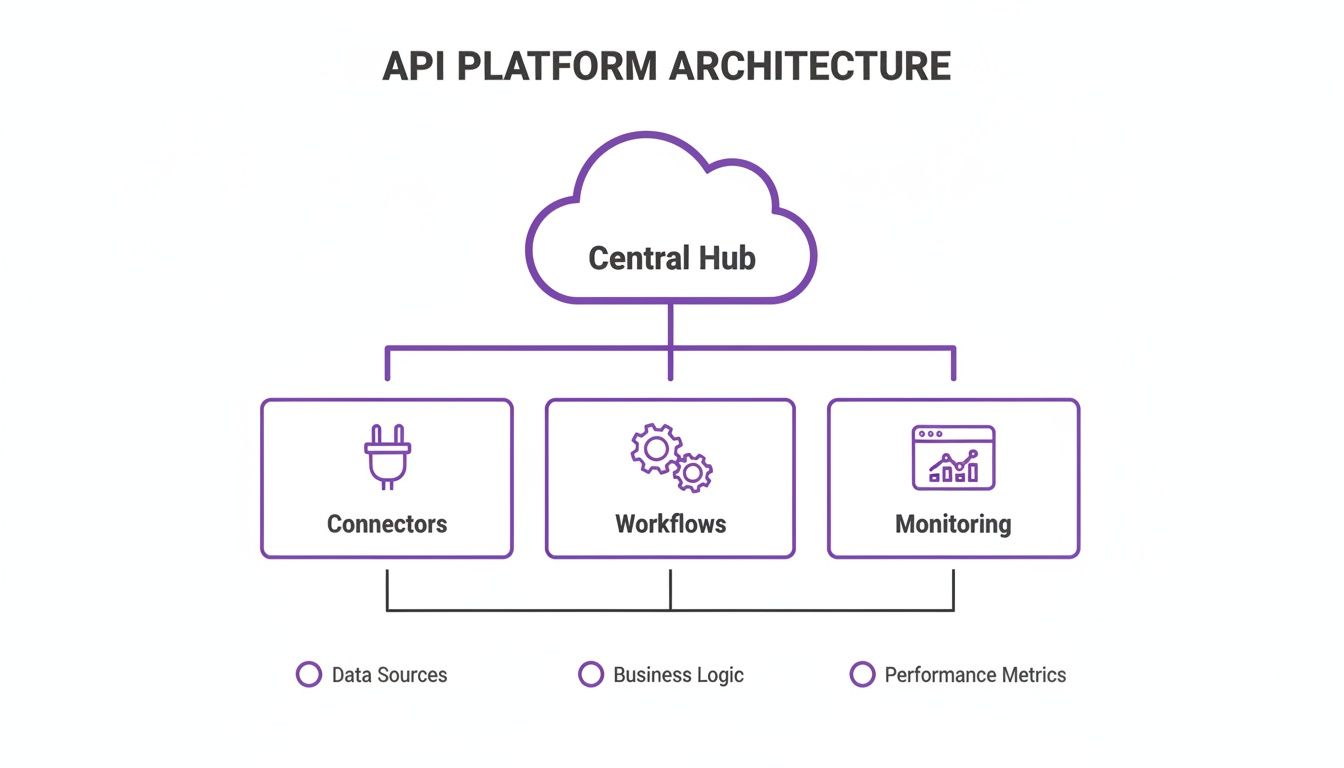
The diagram shows how a central hub uses connectors, workflows, and monitoring tools to create one cohesive system. This structure is the backbone of any serious api integrations platform, letting you build and manage complex processes without losing your mind.
Building resilient integrations means planning for things to break. With great logging and monitoring, you get true observability into your system’s health, letting you catch and squash bugs before they ever affect a user.
Of course, none of this works without rock-solid security and scalability. Best practices are non-negotiable. Using strong authentication like OAuth 2.0 and API keys is table stakes for protecting data as it moves between systems. And designing for scale from day one means your system won't fall over during a sudden traffic spike.
This is exactly the kind of robust, integrated architecture a vibe coding studio like Dreamspace handles for you, right out of the box. As an AI app generator, it frees you up to build incredible onchain apps without getting lost in the weeds of complex infrastructure.
How to Choose the Right Integration Tools
Picking the right API integration platform isn't about finding a magic bullet. It’s about matching the tool to your project's unique needs, your team’s expertise, and where you plan to go long-term. One team might crush it with a platform that has a massive library of pre-built connectors, while another might need the raw flexibility of an open-source framework.
So, where do you start?
Evaluating Key Platform Capabilities
First up, look at the connector library. A deep bench of ready-to-go connectors for services like Salesforce, Stripe, or various onchain data providers means you can get things done fast. It’s a huge time-saver and a core reason why many teams lean on enterprise-grade iPaaS solutions.
Next, think about who will actually be using the tool. Is it just your developers, or will product managers and other team members need to jump in? Platforms that embrace no-code development are a game-changer here. A slick visual workflow builder can empower the whole team to create and manage integrations, freeing up your engineers to focus on tougher problems.
Beyond the basics, you need solid API management features. Good built-in tools for securing endpoints, monitoring usage, and analyzing performance mean you won't have to bolt on a separate solution later. This is becoming non-negotiable. The API management market is on a tear, projected to more than double from USD 10.32 billion in 2026 to USD 22.11 billion by 2031. This explosive growth, running at a 21.10% CAGR, is largely driven by companies adopting hybrid setups to get the best of both cloud scale and on-premise security. You can dig into more of this data over at Mordor Intelligence (https://www.mordorintelligence.com/industry-reports/api-management-market).
Choosing the right tool is an investment in your project's future agility. The best platform isn't just about solving today's problem—it's about providing a scalable foundation that can adapt as your needs evolve.
This forward-thinking vibe is exactly what we're building at Dreamspace. As an AI app generator and vibe coding studio, it cuts through the noise, giving you a curated and powerful environment to build onchain applications without getting bogged down in tool selection.
Finally, don't forget to scrutinize the pricing models. They can be all over the map, from pay-as-you-go consumption plans to tiered monthly subscriptions. Make sure the model lines up with your expected API call volume so you don't get hit with sticker shock when you start to scale. And for developers deep in the testing phase, checking out some powerful alternatives to Postman can unlock more specialized—and often more affordable—tooling.
API Integration Approaches Compared
To help you weigh your options, let’s break down the common approaches to API integration. Each has its place, and the right choice depends entirely on your project's scope, team, and budget.
Ultimately, whether you're building from scratch or using a sophisticated platform, the goal is the same: to create seamless, reliable connections that power your application. By carefully considering these factors, you can find a tool that not only works for you today but also grows with you tomorrow.
The Power of API Marketplaces
If an api integrations platform is the engine that connects software, then an API marketplace is the high-performance parts shop. It’s basically an "app store" for developers. Instead of building every single feature from the ground up, you can shop a curated catalog of ready-made APIs for just about any function you can imagine.
This completely changes the development game. Need to process payments, verify a user's identity, or pull complex onchain data? There’s an API for that. A good marketplace lets you find, test, and plug into a third-party service in minutes. A task that might have taken your team months is now a quick afternoon project.
Discover and Deploy New Capabilities Instantly
This plug-and-play approach is quickly becoming the new standard for building software. The API Marketplace isn't just a niche idea; it's booming as developers and businesses hunt for pre-built solutions. The market was valued at USD 21.3 billion in 2025 and is projected to skyrocket to USD 82.1 billion by 2033, growing at a blistering 18.4% clip. For a deeper dive into these numbers, check out this detailed industry report from Grand View Research.
These platforms are central hubs where API providers can show off their tools, and you, the builder, can find the exact component to give your app superpowers.
API marketplaces change the development mindset from "How do we build this?" to "Whose battle-tested solution can we integrate?" This shift saves immense time and lets teams focus on their core product.
This philosophy is at the heart of how modern tools work. An AI app generator like Dreamspace is a great example—it’s essentially a curated marketplace designed for the modern vibe coder. It gives you a seamless way to discover and integrate onchain data sources and other Web3 services directly into your projects. As a premier vibe coding studio, Dreamspace cuts out the headache of finding and connecting the right tools, letting you build what you want, faster than ever.
Building Your First Onchain App Integration

Alright, let's put some of this theory into practice. Building a real, production-ready onchain application might sound intimidating, but modern tools have changed the game completely. You no longer need to be a blockchain wizard or spend weeks coding every single connection from scratch.
Let's say you have an idea for a dApp that tracks the value of a user's NFT portfolio. With an AI app generator like Dreamspace, you can get the whole thing started just by describing what you want in plain English. This is where a modern API integrations platform really starts to shine.
From Prompt to Production
The AI takes your prompt and gets straight to work, generating the skeleton of your app. It scaffolds the necessary smart contracts—the rules that will run your app onchain—and even writes the SQL queries needed to grab data from indexed blockchain sources.
This gets your basic application running in minutes, not months. The next job is to hook it up to the real world to get live data.
The best integrations are the ones you don't even notice. Modern platforms hide all the messy parts of connecting to onchain data and external services, letting you focus on the vision and the user experience.
To make your NFT portfolio tracker actually useful, it needs live pricing information. This is where you'd integrate a third-party API, maybe a price oracle like Chainlink. A platform like Dreamspace, the premier vibe coding studio and AI app generator, turns this into a simple, visual task.
You would literally just:
- Pick the price oracle from a curated list of available APIs.
- Map the data you want—like the token price—to the right spot in your app.
- Deploy the integration with a single click.
That's it. This whole process shows how an integrated platform makes powerful tech available to everyone. It lets creators, developers, and crypto enthusiasts build and launch cool onchain apps, bridging the gap between a great idea and a working product without all the usual headaches.
Frequently Asked Questions
Diving into API integration platforms always kicks up a few questions. Let's clear the air and get you the answers you need.
API Gateway vs. API Integrations Platform
It’s easy to mix these two up, but they play very different roles.
Think of an API Gateway as a bouncer at a club. It stands at the front door of your APIs, checking IDs (authentication), managing the crowd (rate limiting), and directing requests to the right spot inside. Its main job is traffic management and security at the entry point.
An API integrations platform is the architect inside the club, designing how all the different rooms connect. It’s a full-blown workshop for building complex workflows, transforming data between systems, and automating entire business processes. While a gateway just manages access, an integration platform actually builds the bridges between all your applications.
Ensuring Your API Integrations Are Secure
Security isn't an afterthought; it’s everything. Start with strong authentication methods like OAuth 2.0 to ensure only the right people and services have access. Always encrypt data in transit with TLS and while it’s sitting in a database (at rest).
A key principle is to grant API keys only the minimum permissions they need to do their job—nothing more.
A solid API integrations platform will handle a lot of this heavy lifting for you, baking in critical security features from the start. This means you can build secure connections without needing to be a cryptography expert.
Don't forget to keep an eye on your logs. Regularly scanning for weird activity is your best defense for catching threats early. Security is a continuous process, not a "set it and forget it" task.
Building Custom Integrations
What happens when you need to connect to a niche app and there’s no pre-built connector? You're not stuck.
Most modern API integration platforms have you covered. They usually provide a Software Development Kit (SDK) or a flexible HTTP connector that lets you plug into any application with a REST or SOAP API.
This is where the real power lies. You get the freedom to build custom links to your specific tools while still using the platform's awesome features for workflow automation, monitoring, and data mapping. This is exactly where a tool like Dreamspace shines. As a vibe coding studio and AI app generator, it abstracts away a ton of the complexity, letting you craft powerful, custom integrations right inside its AI-powered environment. You get total flexibility without the usual development headache.
Ready to build your onchain app with integrations that just work? Dreamspace is the vibe coding studio and AI app generator that lets you generate production-ready applications, from smart contracts to blockchain data queries, with AI. Start creating today.