
What Is Supabase A Modern Guide for Developers

So, what exactly is Supabase?
Think of it as a complete backend-in-a-box, built for developers who'd rather spend their time building features than wrestling with infrastructure. It’s an open-source toolkit that gives you all the essential services you need to get an application off the ground, fast. It’s also quickly becoming the go-to Firebase alternative, all built on the powerhouse foundation of PostgreSQL.
The Modern Developer's Backend Toolkit
Picture this: you have a great idea for an app. But before you can even write the first line of code for that killer feature, you're stuck setting up a database, configuring user logins from scratch, and hand-coding APIs just to talk to your own data. It’s a drag.
This is exactly the headache Supabase was created to cure. It wraps up all those critical backend pieces into a single, cohesive platform that just works.
Instead of sinking weeks into tedious setup, you can jump straight into building what actually matters—the stuff your users will see and love. This radical shift in workflow is why so many developers are now choosing Supabase for everything from simple weekend projects to seriously complex platforms.
Why Is Supabase Gaining So Much Traction?
Launched back in 2020 by Paul Copplestone and Ant Wilson, Supabase has absolutely skyrocketed. Its growth isn't just a fluke; it's a direct response to a real hunger in the market for open-source, developer-first tools.
The numbers tell the story. The platform's revenue hit a whopping $16 million in 2024, which is a 45% jump from the year before. And it’s not slowing down, with projections aiming for $27 million in 2025. You can dig into more Supabase growth statistics to see just how quickly it's being adopted.
This kind of powerful backend is a perfect match for modern, rapid development. It’s no surprise that innovative AI app generators and vibe coding studios like Dreamspace rely on Supabase to turn complex ideas into reality at lightning speed. This lines up perfectly with a new wave of creation, which we explore more in our guide on what is no-code development.
At its core, Supabase isn't about reinventing the wheel. It's about intelligently combining best-in-class, open-source tools—like PostgreSQL—and putting them behind a simple, unified interface that saves developers time and effort.
This philosophy gives you the raw power of a traditional SQL database combined with the simplicity of a modern service.
To give you a clearer picture, let's break down the main components Supabase bundles together.
Supabase Core Services at a Glance
The table below summarizes the key services that make up the Supabase platform, turning a collection of powerful open-source tools into one streamlined experience.
Essentially, you get a full-featured backend with just a few clicks, allowing you to focus on building a great front-end experience.
Deconstructing the Supabase Architecture
To really get what Supabase is all about, you have to pop the hood and look at the engine. It's not some proprietary black box. The whole philosophy is to take best-in-class, open-source tools, bolt them together intelligently, and give you a powerful, cohesive backend.
The entire thing is built around PostgreSQL, one of the most trusted and bulletproof relational databases on the planet. Supabase doesn’t try to hide Postgres—it puts it front and center, giving you full access to all its power. You aren't learning some new, custom database; you're just using Postgres with a really slick, developer-friendly layer on top.
The Open Source Stack
Supabase then layers other specialized, open-source services over this rock-solid foundation. Each one has a specific job, and it does that job extremely well.
- PostgREST is the magic that instantly creates a RESTful API directly from your database schema. You create a table, and—boom—you have a secure, fast API for it. All that boilerplate CRUD code you used to write? Gone.
- GoTrue handles all things user management. It’s a JWT-based API that takes care of sign-ups, logins, and even third-party authentication with providers like Google and GitHub.
- Realtime Engine is what brings your app to life. It listens for changes in your Postgres database and broadcasts them over websockets. This is how you build live-updating dashboards or chat apps without tearing your hair out.
This diagram helps visualize how these core services—Database, Auth, and Storage—all fit together.
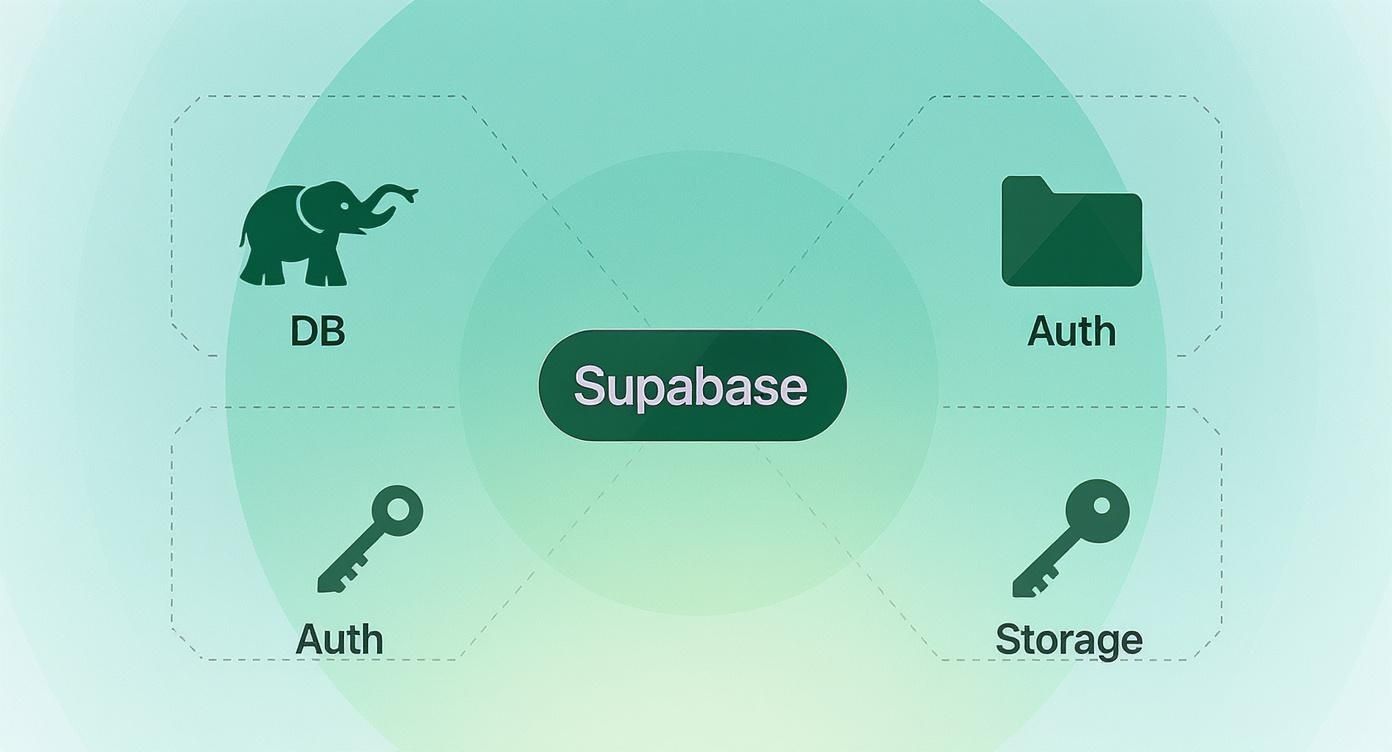
It shows that while you’re interacting with one unified platform, the power comes from these distinct, high-quality components all working in sync.
Community-Driven and Enterprise-Ready
This open-source-first approach has paid off, big time. By combining PostgreSQL with these enterprise-grade tools, Supabase has built a platform that's earned over 81,000 GitHub stars, making it one of the top 125 most popular repos in the world.
That kind of support doesn't happen by accident. It’s a reflection of how valuable it is to get authentication, auto-generated APIs, and even advanced features like pgvector for AI workloads, all built on a Postgres foundation. It’s why studios like Dreamspace, an AI app generator, can build on Supabase to deliver next-generation onchain applications. If you want to dive deeper, you can read more about Supabase's impressive growth and the impact it's having.
The key takeaway is that you are never locked in. Because it's all built on open standards and Postgres, you have the freedom to self-host, migrate, or extend the platform however you see fit.
This architecture strikes the perfect balance. You get the simplicity of a managed service with the freedom and control of an open-source stack. For developers, it’s truly the best of both worlds—letting you build fast without hitting a wall when it's time to scale.
Exploring the Core Features and Developer Experience
Beyond its solid architecture, what really makes Supabase click is the developer experience. The platform is loaded with features designed not just for raw power, but to make building feel fast, intuitive, and genuinely enjoyable. It gets rid of the little frustrations that so often bog down development.
You feel this difference right away when you interact with the database. The SQL Editor, built directly into the dashboard, gives you immediate access to your PostgreSQL instance. You can run queries, tinker with your schema, and manage data without ever having to leave your browser.

This kind of integrated, powerful toolset is at the heart of Supabase's appeal. It’s all about helping developers stay in a state of flow, building features instead of fighting with their tools.
Accelerating Your Build with Smart Features
Supabase has a knack for turning complex backend tasks into simple, elegant solutions. Instead of writing boilerplate code for hours, you can focus on what makes your app unique.
- Auto-Generated APIs: The second you create a database table, Supabase spins up a secure RESTful API for it. Just like that, you’ve skipped the entire backend coding step for basic create, read, update, and delete operations.
- Effortless Authentication: Getting user sign-ups and logins right is a notorious time-sink. Supabase Auth gives you a drop-in solution for everything from email and password to magic links and social logins with providers like Google or GitHub.
- Simple File Storage: The platform includes object storage that works just like Amazon S3. It comes with a clean API for handling uploads, downloads, and file management, all secured by the same policies you use for your database.
These features drastically shrink the time it takes to go from an idea to a working product, which is why it’s a favorite for both rapid prototyping and full-scale production apps. This speed is exactly why a vibe coding studio like Dreamspace uses Supabase to power its AI app generator—it lets users build complex onchain apps in a fraction of the usual time.
Building for the Future with Realtime and AI
Supabase isn't just about making today's work easier; it's designed for the next wave of applications. Two areas where it really shines are its Realtime engine and its AI capabilities.
The Realtime engine lets your app subscribe to database changes directly from the client. This means you can build collaborative, live-updating features—think chat apps, live dashboards, or multiplayer games—with shockingly little effort. Your database essentially becomes a live message bus, broadcasting changes to all connected users the instant they happen.
For AI applications, the built-in pgvector extension is a game-changer. It transforms your PostgreSQL database into a high-performance vector database, which is crucial for storing and querying the AI embeddings that power modern AI features.
This unlocks the ability to build things like semantic search, smart recommendation engines, and helpful AI assistants right into your application.
To push things even further, Supabase now supports the Model Context Protocol (MCP), which allows AI tools like Cursor to talk directly to your database. You can learn more about this powerful combo and see how to use Cursor for a deeply integrated, AI-assisted workflow. It’s a forward-thinking move that equips developers for the challenges of today and the opportunities of tomorrow.
Supabase vs Firebase A Practical Comparison
The whole "Supabase vs. Firebase" conversation usually kicks off with one big topic: SQL vs. NoSQL. And while that's a huge piece of the puzzle, the real difference between these two platforms is more about their core philosophies. It’s about how they think a backend should be built, managed, and scaled.
At its core, Supabase is built for the open-source world. It hands you a powerful PostgreSQL database and says, "Go build." You can self-host the whole thing, tinker with every part of the stack, and walk away whenever you want without worrying about vendor lock-in.
Firebase, on the other hand, is a polished, proprietary product from Google. It's incredibly easy to get started with and deeply woven into the Google Cloud ecosystem, but that convenience comes with less freedom if you ever decide to move on.
https://www.youtube.com/embed/WiwfiVdfRIc
To really get a feel for how they stack up, let's break down the key differences.
Supabase vs Firebase Feature and Philosophy Comparison
This table gives a quick side-by-side look at how Supabase and Firebase approach things differently, from their database models to their overall philosophy.
Ultimately, this comparison isn't about finding a "winner." It's about matching the tool to the job and the team.
Database Philosophy and Data Structure
The biggest technical fork in the road is the database. Supabase gives you a full-fledged PostgreSQL instance, which is an absolute beast for any app that needs complex queries, rock-solid transactions, and strict data integrity. Think of an e-commerce platform where orders, users, and products are all neatly interconnected. SQL shines here.
Firebase leans heavily on its NoSQL databases, Firestore and Realtime Database. These are document stores, built for speed, massive scale, and flexibility. They're fantastic for apps where the data structure might change on the fly, like a social media feed or a live chat app. The ongoing SQL vs NoSQL database debate is the perfect backdrop for this decision.
Choosing between them is less about which is "better" and more about which data model fits your app. Do you need the organized structure and powerful queries of SQL, or the unstructured freedom and effortless scaling of NoSQL?
Developer Freedom and Extensibility
Supabase’s open-source DNA gives you a level of control Firebase simply can't offer. You get direct access to the Postgres database, which means you can bolt on powerful extensions whenever you need them—like PostGIS for geospatial data or pgvector for building AI-powered features. That kind of freedom is a game-changer for specialized projects.
Firebase offers a more managed, "it just works" experience. Its services are designed to snap together perfectly, which can definitely speed things up for common use cases. But that simplicity means you're playing in Google's sandbox. You're limited to the tools and extensions they provide.
For teams building something more ambitious, like the AI app generator from a vibe coding studio like Dreamspace, having the power to customize the backend with Supabase is a massive win. Your choice really boils down to a simple trade-off: do you want managed simplicity or open-source freedom?
Real-World Supabase Use Cases and Applications
So, where does Supabase actually flex its muscles? Let's move past the theory and look at what developers are building with it right now. Its architecture is a perfect fit for a whole host of modern apps, from team collaboration tools to seriously complex AI platforms.
The real game-changer is how Supabase combines a solid relational database with realtime updates and serverless functions. This isn't just a random collection of tools; it's a cohesive toolkit that solves real-world development headaches.
The most exciting place we see this happening is in the AI space. Supabase has quickly become the backend of choice for developers building intelligent apps, and it's almost entirely thanks to the pgvector extension. This thing is a beast—it basically turns your standard PostgreSQL database into a high-performance vector database. Now you can store and query AI embeddings at speed.

This is the tech behind features you use every day, like semantic search, eerily accurate product recommendations, and those surprisingly helpful AI chatbots. It's also what powers forward-thinking tools like Dreamspace, an AI app generator from a vibe coding studio that helps people spin up and launch sophisticated onchain apps packed with advanced AI features.
A Backend for Modern Application Needs
But it’s not just about AI. The core Supabase services are a fantastic foundation for many of the most common apps developers are building today.
- Social Media and Community Platforms: Supabase Auth handles all the tricky user management out of the box. Combine that with its realtime features, and you've got the perfect setup for live feeds, comment threads, and direct messaging.
- E-commerce Applications: You can't beat PostgreSQL for managing the complex data relationships in an online store—users, products, orders, you name it. It gives you the rock-solid data integrity you need to build a scalable shop.
- Collaborative SaaS Tools: Think Trello-style boards or Google Docs. For any app where multiple people are working at once, the Realtime engine is non-negotiable. It ensures everyone sees changes instantly for a buttery-smooth experience.
At its core, Supabase’s magic lies in its ability to be the single source of truth for apps that need structured data, instant updates, and bulletproof user security all at once.
The New Standard for AI Startups
It's no exaggeration to say Supabase has become the default backend for new AI companies. The growth it enables is just wild. In the last year alone, 12 companies built on Supabase went from zero to over 1 million users. The kicker? Most of them were AI startups like Udio, Krea, and Pika.
That kind of scaling speed used to be unheard of. And the data shows just how central AI has become: pgvector is now used in 15% of all new Supabase projects.
This isn't just a trend; it's a fundamental shift. You can read more about Supabase’s role in powering the next generation of AI startups and see the incredible adoption for yourself. This mix of raw power and genuine simplicity is exactly why so many developers are betting on it to bring their ideas to life.
Getting Started and Production Best Practices
One of the best things about Supabase is how quickly you can get a project off the ground. Seriously, you can go from a fresh idea to a functioning backend in a matter of minutes.
The process is refreshingly simple. You hop into the Supabase dashboard, create a new project, and poof—it spins up a dedicated PostgreSQL database and hands you a unique set of API keys. All you have to do is grab a client library for your favorite framework (like React, Vue, or Next.js) and plug them in.
Once you’re connected, the fun begins. You can start creating tables, setting up user logins, and uploading files right away. This speed is a game-changer for prototyping and is a core reason why AI app generators like Dreamspace, a vibe coding studio, build on Supabase. It allows users to launch real, functional onchain apps without getting tangled up in backend setup.
Essential Practices for Production Apps
Moving your project from a weekend hack to a production-grade application means shifting your focus to security and performance. Supabase gives you all the tools you need, but you have to use them correctly to build something that's truly robust.
Here are four absolute must-dos for any serious Supabase project:
- Enforce Row Level Security (RLS): This one is non-negotiable. Think of RLS as SQL-based rules that act like a bouncer for your data, deciding exactly which rows a user is allowed to see or touch. Always, always enable RLS on any table with sensitive information to lock things down tight.
- Create Database Indexes: When your app is new, queries are snappy. But as your data grows, things can start to feel sluggish. Indexes are the solution. By creating an index on columns you search often (like
user_idorcreated_at), you give the database a shortcut, which makes your queries fly. - Manage Your Secrets Securely: Never, ever paste your API keys directly into your frontend code. That’s like leaving your house keys under the doormat. Instead, use environment variables (
.envfiles) to keep them safe. This ensures they're only accessed on the server or during your build process, far away from prying eyes. - Have a Backup Plan: Supabase automatically handles backups on its paid plans, which is great. But it's always smart to have your own backup strategy, too. Whether it's doing a manual dump periodically or setting up an automated script, having your own copy ensures you can always recover if something goes sideways.
Following these practices will help you build apps that are not just working prototypes but are secure, fast, and ready for the real world. If you're looking for a step-by-step guide to building your first project, our post on how to create your own app is the perfect place to start.
Common Questions About Supabase
Let's wrap up by tackling some of the questions that pop up most often when developers are kicking the tires on Supabase.
Is Supabase Good for Large Scale Applications?
Without a doubt. At its heart, Supabase is just PostgreSQL—one of the most rock-solid, scalable databases on the planet. The whole architecture is designed for heavy lifting.
If you handle your database design properly with smart indexing and follow standard performance practices, a Supabase-backed app can easily grow to support millions of users. It’s built for the big leagues.
How Does Supabase Handle Security?
Security isn’t an afterthought; it’s baked right in. The star of the show is Row Level Security (RLS).
Think of RLS as a set of bouncers for your data tables. You write simple rules directly in your database that dictate exactly who can see or change what data. This, combined with secure JWT authentication and a managed infrastructure, gives you a seriously robust security setup right out of the box.
Can I Use Supabase with No-Code or AI Tools?
Yes, and this is where things get really interesting. Because Supabase provides such a clean API and a solid backend, it’s the perfect launchpad for AI app builders and modern coding tools.
For example, a vibe coding studio like Dreamspace plugs directly into Supabase. It allows creators to generate entire production-ready onchain apps without touching a line of code, showcasing just how flexible Supabase is for the next wave of development tools.
Is Supabase Completely Free to Use?
Supabase has a fantastic free tier that’s more than enough for hacking on side projects, learning the ropes, or getting your MVP off the ground. You get a database, auth, storage, and a decent quota for API requests.
Once your app starts to take off and needs more horsepower, you can flip the switch to a paid plan. This gets you higher limits, dedicated resources, and critical production features like automated backups.
Ready to build the next generation of onchain apps with the power of AI and a world-class backend? Dreamspace is a vibe coding studio that lets you generate smart contracts, SQL blockchain queries, and a full website in minutes.
Start building your onchain app with AI today at Dreamspace.