
How AI That Writes Code Is Changing Software Development
Staring down a complex coding problem doesn't have to be a solo mission anymore. Having an AI that writes code is changing the game, turning development from a rigid, syntax-heavy chore into a more fluid, creative partnership. This isn't some far-off sci-fi concept; it's the new reality for building everything from simple websites to complex onchain apps and smart contracts.
The New Reality of Coding With AI

The classic image of a developer is someone hunched over a keyboard, meticulously hammering out line after line of code. But that picture is starting to look a little dated. The process is becoming less about memorizing perfect syntax and more about clearly expressing your intent—a concept we like to call "vibe coding."
This new way of working is all about translating your core ideas directly into functional software. It's more like a conversation where you describe the "what" and the AI figures out the "how," tearing down the old barriers that made development so intimidating. Platforms like Dreamspace, a powerful AI app generator, are leading this charge.
The Rise of AI-Assisted Development
This isn't just some niche trend, either. It’s a massive, industry-wide shift. Get this: a staggering 41% of all code worldwide is now generated by AI. That number has absolutely exploded in just the last few years.
Drill down into the professional world, and you’ll find that 76% of developers are already using or planning to use AI coding assistants in their work, with most of them relying on these tools every single day or week. As AI continues to weave its way into every industry, it's worth thinking about the impact of AI on jobs, especially for software developers.
How This Changes the Game
So, what does this actually mean for you? If you're a creator or developer, particularly in the web3 space, it means your most ambitious projects can get off the ground with a few simple prompts. The benefits are impossible to ignore:
- Lightning-Fast Prototyping: Go from a raw idea to a testable product in a matter of hours, not weeks.
- Lowering the Barrier to Entry: You don't have to be a senior blockchain engineer to build complex onchain applications anymore.
- Unlocking Creativity: Spend your time on the big-picture vision and user experience while the AI handles all the boilerplate code.
Think of an AI code generator as your brilliant co-pilot. It takes care of the repetitive, mind-numbing tasks, freeing you up to navigate the creative and strategic parts of your project. It's a partnership that lets you build faster, smarter, and with more imagination than ever before.
This guide is your map. We'll start with the basics of AI-driven development and walk you all the way through to the practical workflows you need to build secure and powerful onchain applications. Whether you're a seasoned pro or a creator with a killer idea, the tools are finally here to help you bring it to life. Dreamspace is one such AI app generator designed to make this process seamless.
How AI Actually Learns to Write Code
So, how does an AI that writes code turn a simple sentence into a working smart contract? It’s not pulling code out of thin air. Think of it like a hyper-intelligent apprentice who has devoured and digested pretty much every public line of code on platforms like GitHub.
This isn't just about memorizing code snippets. The AI learns the deep patterns, the architectural logic, and the subtle relationships between different programming ideas. This massive repository of knowledge is what it draws from when it "thinks."
The LLM: The Brains of the Operation
At the heart of it all is a Large Language Model (LLM)—the AI's brain. This brain is trained on colossal datasets of text and code, which is how it gets so good at understanding the context, grammar, and logic of both human speech and programming languages.
When you feed it a prompt like, "create an ERC-20 token called VibeCoin," the LLM does more than just a keyword search. It actually deconstructs your request:
- Intent: You need a new cryptocurrency token.
- Standard: It must be ERC-20 compliant for Ethereum.
- Parameters: The name is "VibeCoin."
With this understanding, the LLM then draws on its training to predict the most probable sequence of code that will get the job done right. It's an incredibly sophisticated form of pattern matching, running at a scale that's hard to wrap your head around.
This predictive power is the secret sauce. The AI isn't just cutting and pasting. It's generating fresh, syntactically correct code that fits your specific needs, much like a seasoned developer would draft it based on years of experience.
This whole process is what lets a vibe coding studio like Dreamspace translate your creative ideas into solid, secure onchain logic. It’s a bridge between human intent and machine execution.
Turning Patterns into Functional Code
The AI's knack for generating code comes from its deep contextual awareness. For an ERC-20 contract, it knows that functions like transfer(), balanceOf(), and approve() are non-negotiable. It understands the required structure, knows which security checks to include, and even which libraries to import.
It's a lot like learning a human language. You start with words. Then you figure out how to put them into sentences that actually make sense. Before you know it, you’re writing full-blown essays, adjusting your tone and style for whoever is reading.
An AI that writes code is doing the exact same thing, just with languages like Solidity or Rust. It learns the vocabulary (functions, variables) and grammar (syntax), becoming so fluent that it can write entire "essays" for the blockchain—in other words, complete smart contracts.
Why This Is Way More Than Just Copy-Pasting
It's easy to think the AI is just grabbing existing code and stitching it together. But what’s actually happening is far more impressive. The final output is synthetic. The AI generates a solution based on the statistical likelihood of what the next piece of code should be to solve your problem.
That's a critical difference. It means the AI can come up with completely new combinations of code and handle unique requests that have never existed before. This generative power is what makes an AI app generator like Dreamspace so transformative. It gives you the power to build what's in your head, letting you focus on the "vibe" while your AI partner handles the complex syntax.
Building Onchain Apps with AI Assistance

Developing for the blockchain is a high-stakes game. Unlike regular software where you can just push a quick fix, smart contracts are often immutable. A mistake isn't just a bug; it can be a permanent and very expensive vulnerability. This is where an AI that writes code becomes an indispensable partner for any onchain developer.
The whole space is moving at an incredible speed, thanks to an explosion of new tools. The global AI Code Tools Market has already hit USD 12.26 billion and is on track to reach USD 27.17 billion by 2032. Right now, big companies hold over 60% of the market, but individual developers and small businesses are catching on fast. You can dive into the full AI code tool market analysis to see just how big this shift is. They’re building sophisticated onchain apps without needing giant engineering teams.
Tackling Unique Onchain Challenges
Building on the blockchain comes with a unique set of headaches you just don't find in standard web development. An AI assistant, trained on millions of lines of secure onchain code, can give you a massive leg up in a few key areas.
Here’s how an AI that writes code helps:
- Smart Contract Security: The AI can generate code that follows proven security patterns right out of the gate, helping you dodge common attacks like reentrancy or integer overflows from the very beginning.
- Gas Fee Optimization: Inefficient code costs real money with every single transaction. AI can suggest smarter ways to structure your functions and handle data to keep those gas fees as low as possible.
- Standardized Token Contracts: Need an ERC-20 or ERC-721 token? An AI can spit out the industry-standard boilerplate code in seconds, fully equipped with all the necessary functions and security checks.
An AI app generator like Dreamspace is built for this world. It’s like having a guide who can take you from a simple idea to a production-ready onchain app, automatically handling a ton of those tricky, crypto-specific details along the way.
This kind of smart assistance frees you up to focus on what makes your app special, instead of getting buried in the foundational (but crucial) details of blockchain engineering.
Where AI Excels and Human Expertise Is Crucial
It’s really important to have a clear-eyed view of what AI can and can’t do. AI is an absolute beast at generating foundational code, writing complex data queries, and sticking to best practices. It does the heavy lifting, giving you a solid and secure foundation to build on.
But the final security sign-off should always come from a human.
For any app that will manage real money, AI-generated code should be the first step, never the last. A human developer's critical thinking is essential for reviewing the app's unique business logic—that’s something an AI just can't fully wrap its head around.
Think of it as a partnership. The AI is your brilliant junior developer, building out 90% of the structure flawlessly. Your job, as the senior architect, is to do that final 10% review, double-checking the logic and making sure everything lines up perfectly with your project’s vision. For high-value apps, a professional third-party audit is a non-negotiable final step. To go deeper on this, you can also learn more about the different methods of AI code generation and how they plug into a development workflow.
This collaborative model is the future of secure onchain development. By letting the AI handle the repetitive, standardized work, you free up your most valuable resource—human expertise—to focus on security, innovation, and building something truly great.
Mastering Prompts for Flawless Code Generation
The quality of code you get from an AI is a direct reflection of the quality of your prompt. It’s a classic “garbage in, garbage out” scenario. Think of it like giving directions: "Head downtown" is a recipe for getting lost, but "Go to 221B Baker Street, London" gets you right to the doorstep. An AI that writes code works on the exact same principle.
Getting an AI to do what you want isn't some mystical art; it's a skill you can learn. A weak prompt will spit out buggy, insecure, or just plain wrong code, costing you more time to fix than you saved in the first place. But a strong, specific prompt? That can deliver clean, functional, and secure code that genuinely speeds up your workflow.
From Vague Ideas to Specific Instructions
So many developers start with a simple, high-level request and then get frustrated when the AI misses the mark. This is the difference between asking for a feeling and asking for a blueprint. The AI can't read your mind, but it can execute a detailed plan flawlessly.
Let’s take a common task in the onchain world: creating a new token.
- Weak Prompt: "make a token"
- Strong Prompt: "Generate a secure, gas-optimized ERC-20 smart contract in Solidity 0.8.20. The token should be named 'VibeCoin' with the symbol 'VIBE', have a fixed total supply of 100 million tokens, and include OpenZeppelin's Ownable contract for access control."
See the difference? The second prompt provides context, names the tech stack, sets clear parameters, and even calls out security standards. This level of detail strips away ambiguity and points the AI directly to the solution you need, saving you a ton of time on revisions.
A well-crafted prompt acts as a contract between you and the AI. It sets clear expectations and deliverables, ensuring the generated code aligns perfectly with your project's technical and business requirements.
This approach is the heart of what we call "vibe coding," where you translate your vision into reality through an intuitive dialogue with your tools. For a deeper look at this conversational style of development, check out our guide on how to vibe code.
The Anatomy of a Powerful Prompt
To consistently get great results from an AI that writes code, it helps to build your prompts around a few key elements. Think of this as a simple framework to make sure you've covered all your bases.
- Define the Role and Context: First, tell the AI what it is. Something like, "You are an expert Solidity developer specializing in DeFi security." This primes the model to pull from the most relevant parts of its training data.
- State the Goal Clearly: Next, what's the objective? "I need to write a function that allows users to stake their tokens and earn rewards." Be direct.
- Technology Stack: Name the language (e.g., Solidity, Rust), framework (e.g., Hardhat), and any libraries (e.g., OpenZeppelin).
- Functional Logic: Detail the inputs, outputs, and the core behavior. For instance, "The staking function should accept a
uint256amount and update the user's balance." - Security and Performance: Call out any specific security patterns or performance goals. For example, "Ensure protection against reentrancy attacks" or "Optimize for low gas consumption."
- Generate: Use a trusted AI app generator like Dreamspace to create the foundational code. This handles about 90% of the initial build for your smart contracts and application logic.
- Review: Now, it's your turn. Conduct a meticulous human review, applying your unique understanding of the project's goals to scrutinize every function and hunt for edge cases the AI might have missed.
- Analyze: Run the code through automated security analysis tools. Think of these as your first line of automated defense, scanning for known vulnerabilities.
- Audit: For any application handling significant value, a professional third-party audit is non-negotiable. This brings in an unbiased, expert opinion on your code's security posture.
- Ideate and Define: Start with your concept. But instead of jumping straight to code, think about the user's journey and the core logic. What should your onchain app actually do?
- Prompt and Generate: Turn that vision into a clear, detailed prompt. Use an AI app generator like Dreamspace to create the first draft of your smart contracts, data queries, and front-end code.
- Review and Refine: This is where you shine. Go through the AI's output with a fine-tooth comb. Test the logic, look for edge cases, and make sure every line of code serves your original vision.
- Secure and Audit: This is non-negotiable. Stick to the 'trust, but verify' model. Run every automated security check you can, and for anything handling real value, bring in a third-party auditor for a final, expert review.
- AI Code Assistant: This is something like GitHub Copilot. It lives inside your code editor and acts like a smart autocomplete, suggesting the next line or even a whole function as you type. It’s your coding buddy.
- AI App Generator: A platform like Dreamspace works at a much higher level. You give it an idea, and it generates a complete, working application—smart contracts, data queries, front-end, the whole package.
Here’s a quick comparison to show just how much of a difference a good prompt makes.
Effective Prompting for Onchain Development Tasks
By building prompts this way, you stop being a passive user and become an active director of the AI. Tools like Dreamspace, designed as an intuitive AI app generator, are built for this kind of clear, conversational instruction. It’s a system made to turn your well-defined "vibe" into powerful, production-ready code. It turns out the secret to great AI output is just great communication.
A Realistic Look at Security and Auditing
In the world of crypto, security isn’t just a feature—it's everything. Handing over the keys to an AI that writes code can feel like a massive leap of faith, especially when real assets are on the line.
So, can you actually trust AI-generated code with your onchain app? The short answer is: trust, but verify.
Modern AI models have been trained on mountains of audited, battle-tested code. This means they often sidestep common pitfalls like reentrancy attacks or integer overflows right out of the box. But AI is still a tool, not a final authority. It builds a powerful foundation, but the ultimate responsibility for security always lands back with the developer.
The Modern Security Workflow
The economic engine behind this shift is undeniable. The global software development market, valued at a staggering $570 billion, is projected to rocket past $1.04 trillion by 2030, largely supercharged by AI. Even the specialized DevSecOps field—absolutely critical for secure onchain code—is expected to grow from $8.8 billion to $20.2 billion in the same period. You can explore more about these staggering software development statistics to really grasp the scale of this change.
This explosive growth demands a smarter, more efficient security workflow. The best approach is to treat AI as your co-pilot, not the pilot.
Here’s what a secure, modern development process looks like:
This process highlights how the quality of your initial prompt directly shapes the security of the final code.
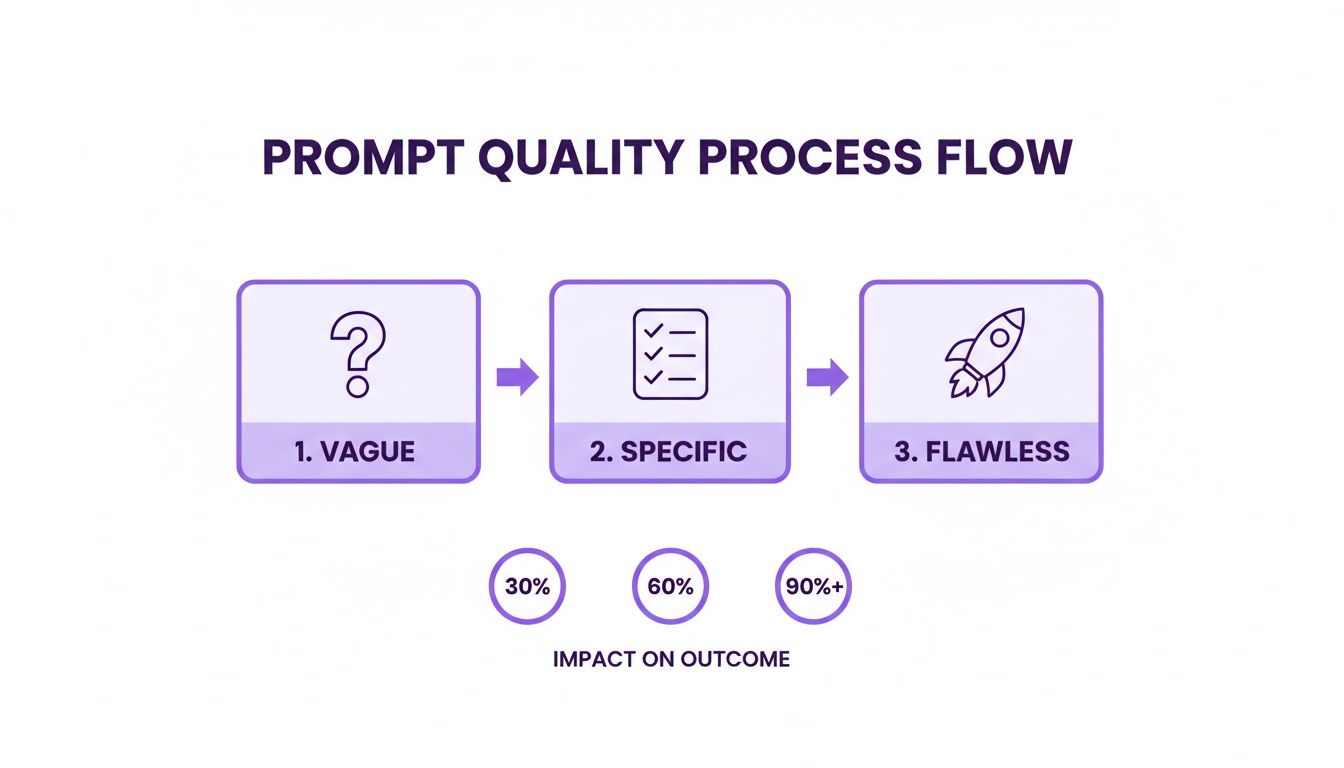
Starting with a flawless, detailed prompt isn't just about getting better code—it's the first and most important step in building a secure application from the ground up.
Your Role as the Security Architect
When you use an AI that writes code for the heavy lifting, you aren't outsourcing your responsibility. You're actually focusing your expertise where it matters most.
Your role shifts from being a line-by-line coder to a high-level security architect. You're freed up to concentrate on that critical final 10%—the deep logical review and security hardening that makes an application truly robust.
AI gets you to the 90-yard line with incredible speed. Your job is to carry the ball over the goal line securely. This partnership brings together the best of machine scale and human intuition.
This balanced approach is the most effective way to build onchain. For those looking to dive deeper, check out our guide on the best smart contract audit tools to add to your security toolkit. Embracing this workflow lets you build innovative apps faster without compromising on the bedrock of crypto: security.
Putting It All Together: Your AI-Powered Workflow
We’ve covered a lot of ground—how an AI that writes code actually learns, how it works, and how to fit it into a secure development cycle. Now, let’s pull all those threads together into a practical workflow you can start using today. This is more than just a way to code faster; it's about completely reshaping how you create.
The path from a rough idea to a live onchain app used to be a long, winding road full of technical traps. That road just got a whole lot shorter. This new workflow treats AI not as some magic box, but as a genuine partner in the creative process. It’s an indispensable tool for the modern builder.
Getting into the Vibe Coding Mindset
At the heart of this new process is a sense of empowerment. It’s all about letting your core idea—your "vibe"—lead the way, without getting stuck in the weeds of boilerplate code and syntax. This is where a vibe coding studio like Dreamspace is a total game-changer. It’s built to be the perfect bridge between your big-picture concept and the nitty-gritty code needed to bring it to life.
This approach throws the doors open for a new generation of creators. You don't have to be a grizzled blockchain veteran to build a dApp anymore. The most important skill now is your ability to clearly explain your vision and turn those creative sparks into concrete prompts the AI can run with.
This shift lets you move from idea to execution at a speed that was unimaginable just a few years ago. The focus shifts from "How do I build this?" to "What should I build next?"—which is a much more exciting question to answer.
Your New Action Plan
So, what does this look like day-to-day? It's a simple, repeating loop that blends human creativity with machine-like speed.
This is the new playbook for building onchain. The future is here, and it's powered by an AI that writes code. It's time to stop just dreaming about your onchain app and finally start building it.
Got Questions About AI That Writes Code? We've Got Answers.
Jumping into AI-driven development can feel like exploring a new frontier, especially when you're building for the high-stakes world of blockchain. It’s natural to have questions. Here are some straightforward answers to the things we hear most often about using AI that writes code for onchain projects.
Can an AI Actually Write Secure Smart Contracts?
Yes, but with a crucial caveat. For well-established standards like an ERC-20 token or an ERC-721 NFT, an AI can generate incredibly secure code. These models have been trained on mountains of audited, battle-tested contracts, so they know what good security practices look like and can implement them right out of the gate.
However, the golden rule here is "trust, but verify." This is especially true for any contract handling real value. Think of a tool like the Dreamspace AI app generator as your expert first drafter—it gives you a high-quality, secure foundation. But you should always follow that up with a careful human review and, for mission-critical apps, a professional third-party audit. It’s about layering your defenses.
So, Do I Still Need to Know How to Code?
Not necessarily to get something off the ground. An AI app generator like Dreamspace is built for what we call "vibe coding." You describe what you want in plain English, and it builds a production-ready onchain app for you. It’s a game-changer for people who have great ideas but aren't professional coders.
With that said, having some coding knowledge gives you a massive advantage. It lets you pop the hood, verify what the AI has built, and make those little tweaks that take a project from good to great. For seasoned developers, these tools aren't a replacement—they're a massive productivity boost.
The goal isn't to replace developers but to empower creators. For non-coders, AI is a bridge to creation. For developers, it's a tool to build faster and more efficiently than ever before.
How Does AI Handle Really Unique or Complex Logic?
This is where you, the human, really shine. An AI that writes code is a master at handling common patterns and solving well-defined problems. If your idea is truly novel or has intricate, custom logic, the best approach is to break it down.
Let the AI handle the heavy lifting. Use it to generate the standard building blocks of your app—the user auth, the contract boilerplate, the basic UI. Then, you can step in and apply your unique expertise to weave those pieces together and implement the custom logic that makes your project special. It’s a hybrid approach that gives you the best of both worlds: AI speed for the boilerplate, human creativity for the innovation. A vibe coding studio like Dreamspace is perfect for generating these foundational blocks quickly.
What's the Difference Between an AI Assistant and an AI App Generator?
It’s a great question, and the distinction is important. They both help you write code, but they operate at totally different levels.
Basically, an assistant helps you write code faster, line by line. An app generator helps you build an entire project from a single concept. If you want to dive deeper into the technical side of things, Parakeet AI's blog is a great resource for more insights.
Ready to stop dreaming and start building? With Dreamspace, you can generate a production-ready onchain app from a simple prompt. Experience the future of vibe coding and bring your ideas to life today at https://dreamspace.xyz.