
How to Create a Social Networking App
Thinking about creating your own social networking app? You can skip the long, expensive development cycles by using an AI app generator like Dreamspace. It helps you define your features, generates the code, and gets your platform launched in a fraction of the time. This is the perfect approach for targeting niche communities that the big players often ignore.
Why Launch a Social Networking App Now

It’s easy to look at the social media landscape and feel like it's a closed game, completely dominated by a few giants. But here’s the thing: that very dominance is what creates massive opportunities for new, focused social apps.
People are tired of the noise. They're actively searching for smaller, more authentic communities built around shared interests, hobbies, and values—something the monolithic platforms just can't deliver. This is where your idea can shine. The goal isn't to take on the giants head-on; it's to serve a dedicated audience better than anyone else.
The Untapped Potential in Niche Markets
The sheer scale of social media is mind-boggling. By 2025, the world will have roughly 5.42 billion social networking users. Sure, Meta owns four of the biggest platforms out there, but that concentration actually creates gaps in the market for specialized networks.
Just look at the success stories that prove this model works.
- Goodreads became the go-to for book lovers.
- Strava built a massive community for athletes.
- Letterboxd is the essential hub for film buffs.
These apps aren't trying to be everything to everyone. They thrive by fostering a true sense of belonging and offering tools perfectly suited to their audience's passions. This targeted approach is your single greatest advantage.
Modern Tools Make It All Possible
Not too long ago, the technical hurdles and astronomical costs of building an app were enough to kill most ideas before they even started. That's all changed. Powerful AI development tools have put the ability to create a full-fledged social networking app directly into your hands.
You don't need a huge team or a venture capital-sized budget anymore.
A vibe coding studio like Dreamspace uses its AI app generator to turn your ideas into functional code. This frees you up to focus on what really matters—your community and unique features—while the platform handles all the complex backend and infrastructure.
This new way of building makes it faster and cheaper than ever to get a Minimum Viable Product (MVP) into the hands of real users. You can test your concept, get feedback, and adapt quickly without the traditional risks. If you're wondering where to even begin, our guide on how to create your own app is a great starting point.
The opportunity to build the next great community platform has never been more within reach.
Finding Your Niche and Core App Concept
Every great social app started small. They didn't try to be for everyone; they zeroed in on a specific problem for a specific group of people. This is the single most important lesson to learn before you write a single line of code or generate your first screen.
Trying to build the next Facebook is a classic rookie mistake. The real gold is in the niches—the underserved communities crying out for a digital home. Your job is to find one.
Pinpointing Your Target Audience
So, where do you start? Forget "a social app for gamers." That's way too broad. Think deeper. Is it for competitive Valorant players who want to find scrim partners? Or maybe it's for D&D Dungeon Masters who need a better way to manage campaigns and player notes. Now we're talking.
Specificity is your superpower.
To get there, you need to do some old-fashioned digital anthropology. Go to the places your potential users already hang out: Reddit, niche Discord servers, maybe even specific Facebook Groups.
- Listen to what they complain about. What are the constant frustrations with the platforms they're currently using?
- Look for what's missing. Are they trying to organize events, trade digital items, or share highly specific content, but the tools are clumsy or non-existent?
- Spot the gaps in existing apps. Find the "almost-perfect" apps for your audience and figure out what they get wrong. Their weaknesses are your roadmap.
This whole process lets you build a clear picture of your ideal user. Give this person a name, a hobby, and a list of real-world problems. This persona becomes your North Star for every decision that follows.
Crafting a Unique Value Proposition
Okay, you know who you're building for. Now you need to figure out why they should care. This is your unique value proposition (UVP). It’s the one-sentence pitch that explains what your app does and why it's better than anything else out there.
A weak UVP sounds like this: "A new way for gamers to connect." A strong one is laser-focused: "The only platform where vintage comic book collectors can securely trade, catalog, and showcase their collections with verified peers." See the difference? One is generic, the other is a must-have for a specific community.
Your UVP isn't just marketing fluff. It’s the DNA of your app. It dictates every feature you build and keeps you honest about the problem you're solving.
This is a perfect spot to bring in a tool like the Dreamspace AI app generator. You can feed its AI your rough ideas about your audience and UVP. It will help you brainstorm different angles, sharpen your wording, and pressure-test the concept before you’re too far down the road. It’s like having a co-founder to bounce ideas off of.
Validating Your Core Concept
Here's a hard truth: an idea is worthless until it's validated. But you don't need a finished product to do that. You just need to talk to people.
Find individuals who match the persona you created and have real conversations with them. Pitch your concept. Is this a pain point they actually experience? Would your solution genuinely make their lives easier? Their raw, unfiltered feedback is the most valuable currency you have at this stage.
Don't forget the context you're building in. As of 2025, the average person is already spending 2 hours and 24 minutes on social media every single day, juggling about seven different platforms. They're connecting with family (48.7%), catching up on news (34.1%), and shopping (25.9%).
Your app needs an incredibly compelling reason to carve out a spot in that routine. By talking to real users early, you’ll discover if that reason actually exists, saving you from the all-too-common fate of building something nobody wants. If you want to dive deeper, you can read more about these social app market trends to get a better handle on the landscape.
Designing an Unforgettable User Experience

Let's be real: slick features might get someone to download your app, but the experience is what makes them stick around. For a social app, this is everything. A clunky interface or confusing navigation is a death sentence when users can jump ship to a competitor with a single tap.
This is exactly why you have to nail your User Experience (UX) and User Interface (UI) design. Think of UX as the overall vibe a user gets from your app—is it intuitive, frustrating, or actually fun to use? UI, on the other hand, is the visual stuff they see and touch: the buttons, icons, and layouts. The best apps get both right.
Mapping the Core User Journey
Before you even dream about color palettes or fonts, you need a blueprint. What are the critical paths a user will take inside your app? Every successful social network has absolutely perfected a few key journeys.
You have to start with that very first interaction.
- Effortless Onboarding: How does a new person sign up? The fewer steps, the better. There's a reason one-click sign-ins through existing social accounts are standard practice—they just work.
- The "Aha!" Moment: What's the one action that makes a user get your app's value? For a photo-sharing app, it's posting that first picture. For a community forum, it's getting that first reply. Your entire design needs to rocket them toward this moment.
- Seamless Content Creation: How easy is it for someone to post, comment, or share? This is your core loop, and it has to be frictionless. If it takes more than a couple of taps, you're going to lose people.
Nailing these journeys is what makes your app feel empowering. Users feel successful, which keeps them coming back.
From Wireframes to High-Fidelity Mockups
Once your user paths are mapped out, it's time to bring them to life visually. This usually happens in two stages: wireframing, then mockups.
A wireframe is a super basic, low-fidelity outline of your app's screens. It’s a schematic, focusing only on structure, layout, and flow. You're not worrying about aesthetics here, just pure function. This is where you ask, "Does this layout even make sense?" or "Is this button in the right spot?"
After you’ve hammered out the wireframes, you move on to mockups. These are the high-fidelity designs that look and feel like the final product, complete with your colors, typography, and branding. A good mockup gives you a real-world preview, letting you test the visual appeal before a single line of code gets generated.
Your goal is to create an interface that is clean, predictable, and visually engaging. Users shouldn't have to hunt for features; the design should guide them naturally.
This is where a modern toolset makes a world of difference. When you're ready to build your social network, you can describe the look and feel you want to an AI app generator like Dreamspace. It can spin up professional UI kits and design systems automatically, giving you a beautiful, consistent foundation to build on. This frees you from pushing pixels so you can focus on perfecting the user experience. If you want to dive deeper into how AI translates concepts into code, check out our guide on how to code an AI.
A killer design isn't just about looking good; it's about building trust and making your app a joy to use. By focusing on intuitive user journeys and using smart tools, you create an experience that keeps your community engaged and growing.
Bringing Your App to Life with Dreamspace
This is where the rubber meets the road. Your ideas, sketches, and user flows are about to become a real, working product. The theory is done—it's time to build.
Traditionally, this is the part of the journey that burns through the most time and money. But we're not doing this the traditional way. With an AI-powered platform, what used to take months of painstaking coding can now be knocked out in a matter of weeks.
Enter Dreamspace, a premier vibe coding studio that closes the gap between your vision and a live application. Instead of wrestling with boilerplate code or complex server setups, you get to stay focused on the fun stuff: defining the features that make your social network one-of-a-kind. The whole experience is designed to be intuitive, translating plain English into a secure, scalable backend.
Setting Up Your Project and Defining Core Features
Getting started is refreshingly simple. Your first move in Dreamspace, the vibe coding studio, is to create a new project and give the AI a high-level overview of your app. Think of it as your elevator pitch.
For our example, you might say: "A social networking app for urban gardeners to share plant photos, ask for advice, and trade seeds."
That one sentence sets the entire context. From there, you start building out the core features using simple, descriptive language. You don't need to be a developer; you just need to communicate clearly.
- User Profiles: You can tell the AI to create profiles with specific fields like a username, bio, profile picture, and a photo gallery for their plants.
- News Feed: Describe how you want the main feed to work. Something like, "Show a chronological feed of posts from people the user follows."
- Direct Messaging: Need a chat feature? A quick prompt like "Implement a direct messaging system for private conversations" gets it done.
- Content Sharing: Detail the main way users will interact. You could say, "Let users upload photos with captions and tag the type of plant."
Each prompt acts as a building block. The AI takes these commands, structures the database, generates the right APIs, and even scaffolds the front-end components for you.
The infographic below shows just how streamlined this workflow can be, breaking down the path from idea to functional app.
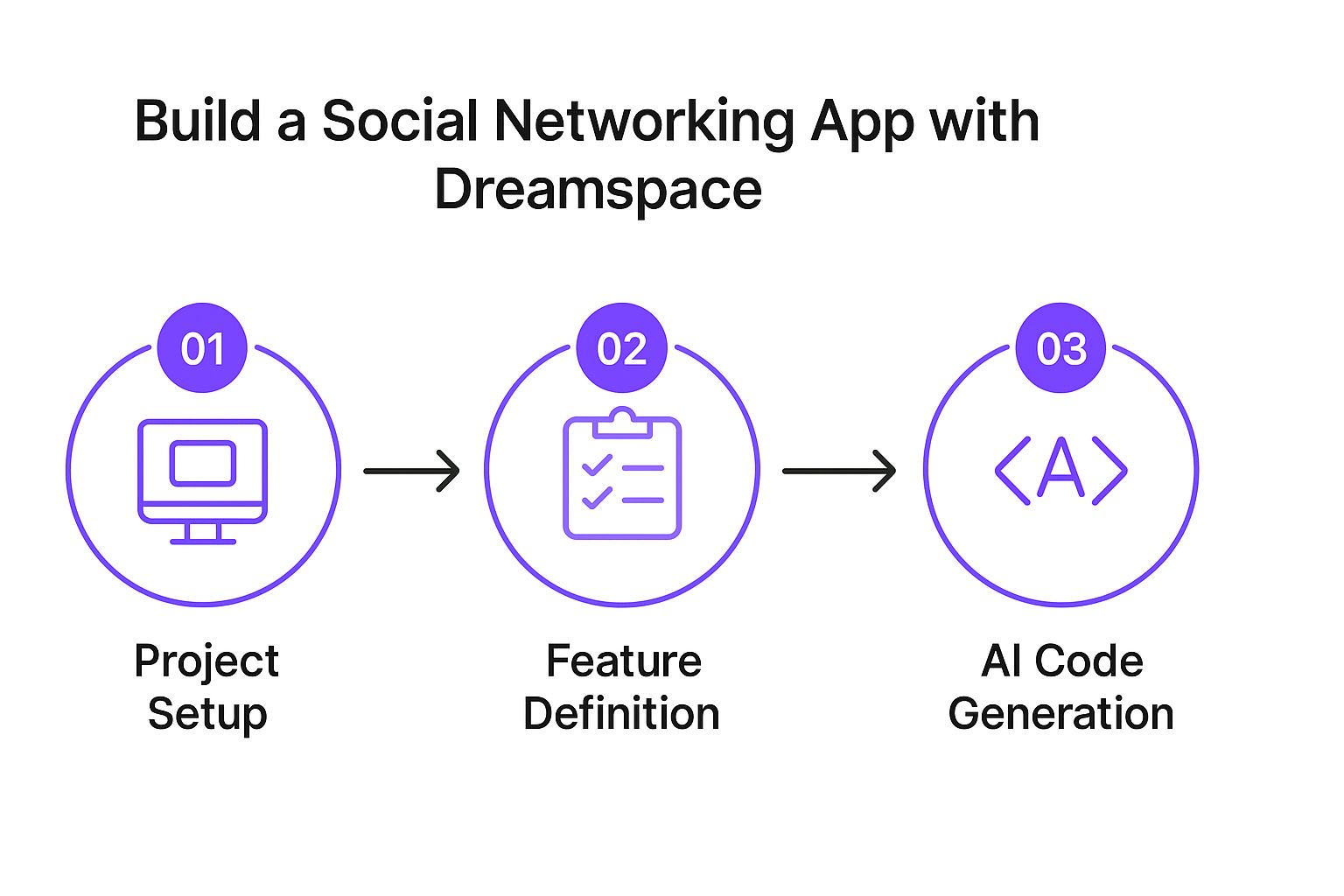
As you can see, the process flows naturally from project setup to AI-driven code generation, which is exactly why this approach slashes development time so dramatically.
Demystifying the Technical Heavy Lifting
Let's be honest: one of the biggest hurdles in creating a social app is the gnarly technical architecture behind it. A good app needs a solid database, secure APIs, and infrastructure that can actually scale. That usually requires a team of specialists.
This is where an AI app generator like Dreamspace really shines. It handles all that complexity for you, automatically building out the critical backend systems based on your feature descriptions.
Dreamspace doesn't just spit out lines of code; it architects a complete, production-ready system. As an AI app generator, it figures out the database schemas for profiles and posts, sets up all the API endpoints your app needs to function, and bakes in security protocols from the very beginning.
This means you get a solid foundation without having to become a database admin or cybersecurity guru overnight. The platform ensures the code follows industry best practices for performance and security, freeing you up to focus on what really matters: perfecting the user experience and planning your launch.
If you're curious to see how this technology stacks up against other tools, check out our guide on the best AI app builder platforms out there.
Building Your MVP the Smart Way
The initial goal isn't to build every single feature you've ever dreamed of. It’s to launch a Minimum Viable Product (MVP)—a lean version of your app with just enough functionality to solve a core problem for your first users. Their feedback is pure gold for future development.
The following table breaks down some core features for a social networking MVP and shows how an AI-first approach accelerates their creation.
Core Social App Features and AI Implementation
Building an MVP with a tool like the Dreamspace AI app generator is a game-changer. The development cycle is so rapid you can get a working version of your app into the hands of real users, gather feedback, and iterate in a fraction of the time.
Is the photo-sharing flow clunky? Is the feed engaging? Does the chat feature work reliably? Answering these questions early is the secret to building a product people actually want to use. The speed of AI lets you fail faster, learn quicker, and ultimately, build better.
Choosing Your Monetization and Growth Strategy
You’ve built a beautiful, functional app. That’s a huge win. But an app with a clear path to sustainability? That’s a real business. After bringing your vision to life with an AI app generator like Dreamspace, the next make-or-break step is figuring out how to grow your user base and, eventually, bring in revenue.
This isn’t about just slapping ads on every available pixel. It's about picking a model that feels right for your users and meshes perfectly with the community you’re trying to build. The wrong strategy can kill your app before it even gets going, while the right one can become the fuel for its long-term success.
Finding the Right Way to Fund Your Vision
There's no one-size-fits-all answer for monetization. What works for a massive, mainstream platform will likely feel clunky and out of place in a niche community. The real key is to select a strategy that actually adds to the user experience, rather than getting in the way.
For a great overview of the different ways apps make money, it's worth exploring these mobile app monetization strategies to get a feel for what might fit your project.
Here are a few of the most common models I've seen work well for social apps:
- Premium Subscriptions (Freemium): This is probably the most user-friendly approach out there. Everyone gets the core features for free, but your most engaged users can pay a small monthly fee for advanced tools, an ad-free experience, or exclusive content. Think of it as a VIP pass for your die-hard fans.
- In-App Purchases: This model is all about selling digital goods directly inside the app. For social platforms, this usually means things like virtual gifts, profile customizations (like unique badges or themes), or digital "coins" that let users boost their content's visibility.
- Advertising: It’s the classic model, but it needs a delicate touch. Ugly, irrelevant ads are the fastest way to annoy your users. A much smarter play is native advertising or sponsored posts that blend in with the rest of the content, offering value instead of just being an interruption.
- Sponsored Content Partnerships: Once your community starts to grow, you can partner with brands that want to connect with your specific audience. This could look like sponsored challenges, branded filters, or influencer collaborations that feel authentic and genuinely interesting.
A quick tip: Decide on your model early. It helps shape your app's entire feature set from the ground up. If you want to offer virtual gifts, for instance, that system needs to be baked into your core design, not tacked on as an afterthought.
The social networking market is absolutely massive and it's still growing fast. Projections show the market, which was worth around USD 95.8 billion in 2025, is on track to more than double to USD 221.4 billion by 2030. What's really interesting is that the fastest-growing piece of that pie isn't ads—it's virtual goods and gifting, which are exploding at a 27.2% compound annual growth rate. You can dig into more of these social networking market insights over at Mordor Intelligence.
Sparking Initial Growth and User Acquisition
Okay, you've got a monetization plan. Now for the next big challenge: getting people to actually use your app. An empty social network is a pretty lonely place, so getting that first wave of users in the door is absolutely critical. This is where a little strategic growth hacking comes in.
Your initial goal isn't to get a million users overnight. It's to attract a small, core group of super-enthusiastic early adopters who will go on to become your biggest champions.
Proven Techniques for Early Traction
Here’s how you can start building that initial momentum:
- Leverage Existing Platforms: Remember those niche communities where you first validated your idea—the subreddits, Discord servers, and Facebook Groups? Go back to them. Share your app directly with the people you built it for. They're your most likely first fans.
- Engage with Micro-Influencers: Forget the big-name celebrities. Find the smaller, respected creators in your niche who have a dedicated and trusting following. Give them early access and focus on building a real relationship. A single, authentic shoutout from the right person can be more powerful than a huge, expensive ad campaign.
- Design Viral Loops: This is the holy grail of organic growth. A viral loop is when you build shareability directly into your app’s core functions, so one user's action naturally encourages someone else to join. For example, a hiking app could generate a cool, shareable 3D map of a completed trail, which makes their friends ask, "Whoa, what app did you use for that?"
By pairing a smart monetization strategy with a focused growth plan, you're not just building an app. You're building a sustainable foundation for a thriving digital community with a very bright future.
Common Questions About Building a Social App
Jumping into social app development always sparks a few big questions. From the budget to the launch date, getting a handle on the basics can clear the fog and point you toward a solid plan. Let's dig into the queries that pop up most when people decide to build a new social network.
How Much Does a Social App Really Cost?
This is the million-dollar question—sometimes literally. If you go the traditional route with a development agency, you're looking at a bill anywhere from $50,000 to over $300,000 for a fairly basic app. That price tag covers a whole team: developers, designers, project managers, and quality assurance testers.
But that massive financial hurdle is starting to crumble.
Tools like Dreamspace, an AI app generator, completely flip the script on app creation costs. By getting AI to handle the heavy lifting of code generation, backend setup, and initial design, you can get a solid Minimum Viable Product (MVP) off the ground for a tiny fraction of that agency price. It's a game-changer for validating your idea without needing a huge round of funding first.
What Are the Must-Have MVP Features?
It’s so tempting to cram every cool feature you can think of into your first version. Don't do it. A great MVP is all about nailing one thing—that core interaction that makes your app special and valuable to your first users.
For pretty much any social app, that core loop breaks down into a few key pieces:
- Secure User Login: A dead-simple way for people to sign up and log in, ideally with social sign-on options.
- Customizable Profiles: A space for users to show who they are with a profile picture, bio, and other key details.
- A Dynamic Feed: This is the heart of your app, where users find new content. It could be a simple timeline or a smart discovery page.
- The Primary Engagement Method: This is your secret sauce. Is it posting photos? Writing reviews? Direct messaging? Whatever it is, make it shine.
Fight the urge to add more. Perfecting this core experience is what will bring people back. If you want to dive deeper into the whole process from market research to UX, this comprehensive guide on creating a social media app is a fantastic resource.
How Do I Keep My App and Users Secure?
For a social app, security isn't just a checkbox; it's the foundation of everything. One data breach can vaporize user trust and kill your app before it even gets going. You have to build on a secure base from day one.
Here's what should be on your non-negotiable security checklist:
- End-to-end encryption for any private communication, especially direct messages.
- Secure authentication protocols (like OAuth 2.0) to keep user accounts locked down.
- Proactive protection against common attacks like SQL injection and cross-site scripting (XSS).
- Transparent data privacy policies that clearly tell users how their information is handled.
Platforms like Dreamspace, the AI app generator, tackle this for you by baking security best practices right into the AI-generated code. This gives you a rock-solid foundation, so you can focus on growing your community instead of worrying about vulnerabilities.
How Long Does It Take to Build a Social App?
This is another area where modern tools have a massive edge. A traditional build-out for a social MVP can easily take six to twelve months. That long slog includes separate phases for planning, design, backend work, frontend work, and endless rounds of testing.
When you use a vibe coding studio like Dreamspace, you can compress that timeline from months into weeks. The AI handles the grunt work of generating code and setting up infrastructure, which means you can have a functional, testable app with all your core social features in record time. This speed is a huge strategic advantage—it lets you launch faster, get real feedback, and improve your app while your competitors are still drawing on a whiteboard.
Ready to stop planning and start building? With the Dreamspace AI app generator, you can generate your onchain social app with AI, no code needed. Transform your idea into a production-ready reality today.