
A Modern Guide to Create Web Applications with AI
If you want to create a web application today, forget everything you thought you knew about traditional coding. The game has changed. We're now in an era where AI-driven tools can spin up your ideas into reality almost instantly, turning simple prompts into everything from smart contracts to complete user interfaces.
The New Way To Create Web Applications With AI
Let's be real—the old way of building apps was a grind. You’d spend months buried in complex code, wrestling with bugs, and trying to master a dozen different programming languages and frameworks. It was a massive hurdle, and it kept a lot of great ideas from ever seeing the light of day.
But a new standard is taking over, and it’s all powered by AI. This isn’t just about making things a little faster; it's about a fundamental shift in how we create. Instead of coding from scratch, you can now use simple, descriptive prompts to generate production-ready applications, especially in the onchain world.
From Manual Coding To AI Generation
This change is a massive deal for anyone building in web3. The old process was brutal: painstakingly writing and auditing Solidity for smart contracts, cobbling together a complex backend, and then trying to build a frontend that actually worked with it all. It was slow, expensive, and just plain clunky.
That’s where platforms like Dreamspace come in. As a vibe coding studio and AI app generator, it's designed for creators, crypto devs, and "vibe coders" who want to launch their ideas without all the old-school friction. The entire workflow is brought into one seamless experience.
Here’s what that actually looks like in practice:
- Instant Creation: You can generate fully functional onchain apps—smart contracts and all—just by describing what you want in plain English.
- No-Code Power: It’s now possible to build some seriously sophisticated applications without writing a single line of code. This blows the doors wide open for non-technical founders.
- Unified Workflow: Your smart contracts, blockchain data queries (using SQL!), and frontend components all live in one spot. No more juggling a dozen different tools.
- Direct-to-Deployment: Go from a spark of an idea to a live, shareable web app in a tiny fraction of the time it used to take.
This isn’t just a niche trend; it’s part of a much bigger picture of AI in business automation that’s reshaping industries.
The Power Of Prompt-Driven Development
At the heart of this new method is prompt-driven development. You just articulate your app's logic in plain English, and the AI handles the heavy lifting, translating it into the technical guts.
Want a smart contract for a new NFT drop? Just describe the rules. Need to pull and display all transactions from a specific wallet? Ask for the SQL query. It’s that direct.
Thinking about the old way versus this new AI-powered approach really puts the difference into perspective.
Traditional Development vs Dreamspace AI Generation
The takeaway is clear: the barrier to entry has been smashed.
This shift is backed by some serious numbers. A whopping 77% of developers are already using AI coding tools to accelerate their work. Meanwhile, the low-code and no-code market is projected to explode from $28.75 billion to $264 billion by 2032. This is a massive tailwind for blockchain developers who need to generate smart contracts and SQL queries without getting bogged down.
The real breakthrough here is accessibility. By killing the coding requirement, AI app generators empower anyone with a solid idea to build and launch a real onchain product. You can learn more about this approach by checking out our guide on what no-code development is.
Nail Down the Vision for Your Onchain App
Every solid onchain app begins with a killer vision. Before you write a single line of code or even sketch out a UI, you have to get crystal clear on what you're building and, more importantly, why. This isn't just fluff—it's the foundation for everything else you'll do.
Forget about stuffy business plans. This is about capturing the core purpose and unique "vibe" of your project. Are you building a lightning-fast DeFi tool for hardcore degens? A tightly curated NFT gallery for digital artists? Or maybe a decentralized social hub for a niche community? Figuring this out first is your ticket to building something people actually want to use.
What's Your App's Vibe?
Your app's vibe is its soul. It's the personality that shapes the user experience, dictates which features get built, and defines how you talk to your community. It’s what makes your project memorable.
To lock it in, just ask yourself a few straight-up questions:
- What problem am I actually solving? Get specific. "Making DeFi easier" is way too vague. "One-click yield farming strategies for crypto newbies" is a much better starting point.
- Who is this for? Seriously, picture your ideal user. Is it a grizzled onchain veteran, a digital art collector, or someone just dipping their toes into web3?
- How should people feel when they use my app? Do you want them to feel smart, secure, creative, or like they're part of an exclusive club?
The answers here are gold. They'll guide your feature list and help you write prompts that an AI app generator like Dreamspace can turn into reality. A "simplicity for beginners" vibe will naturally lead to a totally different app than one built around "pro tools for power users."
Map Out the User Journey
Okay, you've got the vibe. Now, let's get practical. It's time to sketch out the key features and how someone will actually move through your app. No need for a super technical spec doc—a simple list or a rough flowchart is perfect for this stage.
Put yourself in your user's shoes from the second they land on your page. What’s the first thing they see? What can they do?
For a simple NFT marketplace, the flow might look something like this:
- User connects their wallet. That's table stakes.
- They browse a gallery of NFTs, maybe with filters for artists or collections.
- They click an NFT to see the juicy details—price, history, who made it.
- They smash the "Buy Now" button and confirm the transaction in their wallet.
- Boom. The onchain transaction clears, and the app shows a success message, updating who owns what.
Thinking through the user journey like this is non-negotiable. It forces you to consider every single interaction, making sure the experience is smooth and makes sense. It also gives you a clear shopping list for the smart contracts and data queries you'll need.
Pinpoint Your Onchain Needs
With a user flow in hand, you can easily spot the onchain tech you'll need. This is where your vision starts turning into a real technical blueprint. For every step in that journey, think about what has to happen on the blockchain.
Let's stick with our NFT marketplace example. The onchain must-haves would be:
- An NFT Minting Contract: A smart contract that lets creators mint new NFTs and give them unique traits.
- A Marketplace Contract: This is the big one. It'll handle all the logic for listing items, processing sales, and transferring ownership. You'll need functions like
listNFT(),buyNFT(), andcancelListing(). - Blockchain Data Queries: You need to pull data from the chain to make your app feel alive. Think SQL-style queries to grab all NFTs in a collection, check the transaction history for a specific token, or display all the assets a wallet holds.
This kind of structured thinking is exactly what a vibe coding studio like Dreamspace is built for. By breaking down your idea into these simple pieces—vibe, features, user flows, and onchain needs—you're basically creating a set of perfect instructions. These become the prompts the AI uses to generate everything from your backend and smart contracts to your frontend, making sure the final product is exactly what you envisioned.
Generating Your Backend and Smart Contracts with AI
This is where the magic happens. You’ve got a solid plan, and now it’s time to turn that vision into a real, functional backbone for your app. Forget staring at a blank editor, trying to recall Solidity boilerplate. We're going to speak your ideas into existence.
Using an AI app generator like Dreamspace completely changes the game. You're no longer just a coder hammering out lines; you're a creative director. Your main tool is the prompt—a clear, detailed instruction that tells the AI exactly what you need built. This approach sidesteps a massive amount of technical grunt work, especially with something as tricky as smart contracts.
The whole process flows from your core idea, gets refined into specific features, and then translates into a powerful prompt for the AI.
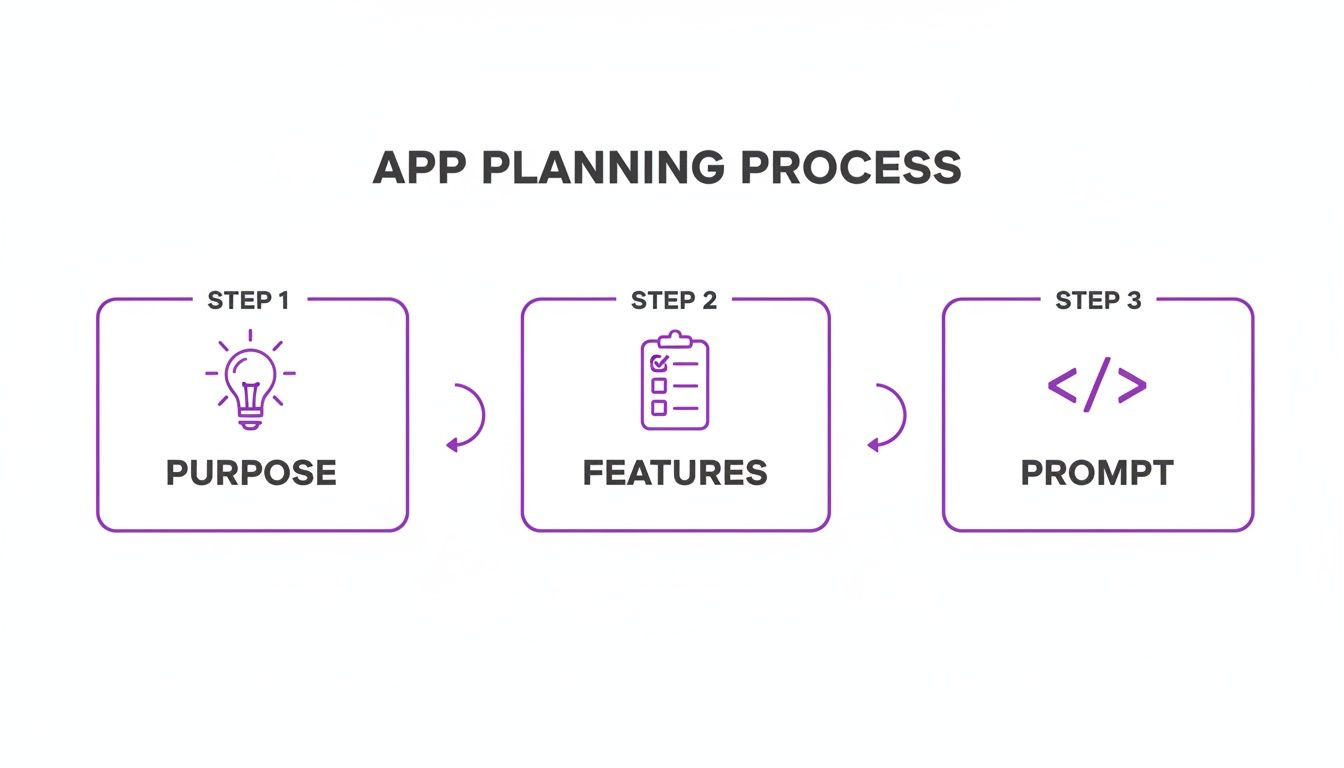
This visual shows that direct line from purpose to prompt—it’s the key to making the AI work for you, not the other way around.
Crafting Smart Contract Prompts That Actually Work
Nailing the prompt is an art. You need to be specific, but not buried in technical jargon. The goal is to describe the behavior and rules of your contract in plain English. Let the AI handle the gnarly syntax.
Let’s say you're building an NFT ticketing system for exclusive events. A weak, lazy prompt would be something like, "Make a smart contract for NFT tickets." That's way too vague and leaves everything up to chance.
A much stronger, actionable prompt would break it down like this:
- "Generate an ERC-721 smart contract named 'VibeEventTicket' with the symbol 'VIBE'." This immediately sets the token standard and its identity.
- "Include a minting function that only the contract owner can call. This function should take a wallet address and a tokenURI as arguments." Perfect. This defines who can mint and what info is needed.
- "Add a function to check if a specific wallet address holds a ticket for a given event ID." This builds in the core utility you'll need for event check-ins.
- "Make the tickets non-transferable after they have been used once to prevent resale after an event starts." This specifies a crucial business rule.
See the difference? This level of detail gives the AI clear guardrails and a specific goal. The result is a secure, production-ready smart contract that does exactly what you envisioned.
From Natural Language to SQL Queries
Here’s where things get really powerful. You can now talk to blockchain data using simple language. Blockchains are just massive databases, but pulling data from them has always been a pain. Now, you can generate complex SQL queries from straightforward prompts.
This is a complete game-changer for building dynamic frontends. Instead of wrestling with clunky APIs, you just ask for the data you want. The whole vibe coding studio experience is about this kind of directness.
Think of the AI as your personal data analyst. You tell it what insights you need from the blockchain, and it writes the exact code to fetch that information, ready to plug right into your app.
Here’s what this looks like in practice.
- Your Prompt: "Write a SQL query to show all tokens from the 'CryptoPunks' contract owned by wallet address '0x123...abc'."
- Your Prompt: "Generate a SQL query that ranks wallets by their total trading volume for the 'WETH' token in the last 24 hours."
- Your Prompt: "Give me a SQL query to list the 50 most recent transactions, both incoming and outgoing, for the address '0x456...def'."
The AI translates these plain-English requests into optimized queries that pull data from indexed blockchain sources. You get the info you need without ever having to write a line of SQL. If you want to dive deeper into the mechanics, you can learn more about how AI code generation works in our detailed guide.
By mastering the art of the prompt—for both smart contracts and data queries—you take full command of your app's entire backend. This frees you up to focus your energy on what really matters: building unique features and a killer user experience.
Building Your Frontend and Deploying to the World

Alright, your smart contracts are dialed in and the data queries are pulling exactly what you need. The heavy backend lifting is officially done. Now for the fun part: giving your onchain app a face and shipping it. This is where all those technical pieces finally become a real, interactive experience for users.
In the old days, this meant firing up your code editor and bracing for a long slog through React, state management, and API wrestling. But a modern vibe coding studio like Dreamspace sees the frontend differently—as a direct, logical extension of the backend you just generated. The best part? No frontend coding required from you.
From Backend Logic to a Live Interface
The magic of an integrated AI app generator is that it already gets what you're building. Your prompted smart contracts and SQL queries aren't just floating in the ether; they're the DNA of your app. Dreamspace takes these building blocks and automatically spins up a functional frontend that’s already wired up.
So, what does this actually look like? The platform generates all the crucial interface components for you:
- Wallet Connections: Users get a clean, simple way to connect their wallets and start interacting.
- Contract Interactions: Buttons and forms for your smart contract functions—like minting an NFT or staking tokens—are created automatically.
- Data Displays: The data from your SQL queries? It’s laid out in easy-to-read tables and cards.
You get to skip the tedious work of manually connecting every button or writing endless fetch requests. The system is smart enough to map your backend logic to the right frontend components, giving you a working web app from the get-go.
The core idea is simple: if the AI helped you create the logic, it should also help you create the interface for it. This approach dramatically speeds up the process to create web applications by removing an entire development phase.
One-Click Deployment Your App
Once you're happy with how the app looks and feels, it’s time to push it live. This used to be the part of the process that kept developers up at night—messing with server configs, domain management, and CI/CD pipelines. It was a massive technical hurdle that could stall a project for weeks.
Dreamspace boils all that complexity down to a single click. With your frontend and backend already connected, deploying your onchain app is literally as easy as hitting a button. The platform handles all the infrastructure headaches in the background, pushing your app to a public URL instantly.
This one-click approach means you can go from a fresh idea to a shareable product in an insanely short amount of time. No DevOps experience needed. It’s all provisioned for you, securely and reliably. Check out our guide on web app deployment to see just how streamlined this is.
Testing and Sharing Your Vision
Before you start hyping your project on mainnet, you absolutely have to test it. A small bug can become a very expensive mistake, not to mention a hit to your reputation. This is exactly what testnets were made for—they let you run through real-world scenarios without risking a single cent.
A Bitcoin testnet wallet is your best friend here. Use it to hammer your app, make sure every function behaves as expected, and ensure the user experience is smooth and bug-free before you even think about going live.
Once you’ve squashed the bugs, it’s time to get your creation in front of people.
- Crypto Communities: Drop your live app link on X (formerly Twitter), in niche Discord servers, and on relevant subreddits. Make sure you clearly explain what problem your app solves.
- Engage for Feedback: Don’t just post and run. Ask for honest feedback, listen to what your first users are saying, and be ready to iterate based on their input.
- Highlight the "Vibe": Lean into what makes your app special. Are you building for DeFi degens or NFT artists? Communicating that specific vibe is how you’ll attract your tribe.
By pairing AI-driven generation with dead-simple deployment, you can finally cut out the noise and focus on what really matters: building a killer product and a community around it.
Ensuring Your App Is Secure and Ready to Scale
Getting your onchain app deployed is a huge milestone, but it’s really just the beginning. In the crypto world, two things make or break a project long-term: security and scalability. These aren't just buzzwords; they're the foundation that keeps your users safe and ensures your app runs smoothly as your community balloons.
The good news is, when you create web applications with an AI tool like Dreamspace, you get a massive head start. The platform is designed to pump out secure, production-ready code right from the jump. Still, understanding the why behind the what is crucial for managing your app like a pro.
A Vibe Coder's Guide to Smart Contract Security
Let's be real: smart contract security can sound pretty heavy, especially if you're not a full-time Solidity wizard. But you don't need to be an auditor to give the AI-generated contracts a solid review. The trick is to focus on the logic and what the contract is supposed to do, not just the code itself.
Instead of getting bogged down in syntax, just ask yourself a few high-level questions.
- Did it do what I asked? Look at the functions in the contract and compare them to your original prompts. If you wanted a mint function that only the owner can call, double-check that the permissions are set up that way.
- Are the numbers correct? Scan for key values. Is the max supply for your NFT collection right? Are the fee percentages or staking rewards what you intended? These are usually easy to spot and absolutely vital.
- Where could this break? Walk through the user's journey in your head. What if someone tries to buy an NFT that’s already gone? A good contract will handle these edge cases without a hitch.
As a dedicated vibe coding studio, Dreamspace is built to automatically handle common crypto threats like reentrancy attacks and integer overflows. Your job is to be the final sanity check on the business logic, making sure the AI nailed your vision.
The best security review you can do is often the one focused on intent. You know your project's goals better than anyone. Just by confirming the contract aligns with those goals, you're performing a powerful, logic-based audit.
Building for Growth from Day One
Scalability is about making sure your app doesn't fall over the second it gets popular. A slow, janky app is a surefire way to kill momentum and lose users. Your app has to feel just as snappy with ten thousand users as it does with ten.
This is another spot where building with AI gives you a serious edge. Apps built with an AI app generator like Dreamspace are constructed on modern, scalable infrastructure that's ready to handle the chaos of a growing user base and high transaction volumes.
The global web application market is absolutely exploding—it's projected to hit $167.1 billion by 2030 with an insane 18.2% CAGR. This growth is all thanks to AI, blockchain, and smarter dev tools that empower creators. For context, companies using microservices see 40-60% faster deployments and recover from glitches 50-70% quicker, keeping their apps online during crucial market pumps. AI tools are also slashing delivery times by 30-40%, letting you generate production-ready code in minutes. You can read more about how these development trends are shaping the future and stay ahead of the game.
Key Scalability Considerations for Onchain Apps
So, how does this actually play out in your project? The architecture is already set up to handle the big performance hurdles for you.
- Efficient Data Queries: The AI-generated SQL queries are optimized to pull blockchain data fast. This means your frontend loads without those annoying delays that make users bounce.
- Optimized Gas Usage: The smart contracts are written to be as gas-efficient as possible. This doesn't just save your users money on transactions; it also helps reduce network congestion during busy periods.
- Load-Balanced Infrastructure: The underlying servers hosting your app are designed to spread out traffic. This prevents slowdowns during a hyped NFT mint or a big airdrop.
With these principles baked in from the start, your app is primed to scale right out of the gate. You can focus on growing your community and shipping cool new features, knowing your technical foundation is rock-solid.
Questions We Hear All The Time
Jumping into AI-powered development, especially for onchain projects, naturally comes with a few questions. We get it. Here are some of the most common things people ask when they're getting started with Dreamspace.
What Kind of Technical Skill Do I Actually Need?
Honestly, probably a lot less than you're thinking. The whole idea behind an AI app generator like Dreamspace is to kick the door down for creators who aren't hardcore coders. You definitely don’t need to be a Solidity guru to build something real.
The most important skill? A clear vision. If you can explain your app’s features, how users will move through it, and the core idea in plain English, you’re golden. The AI takes your words and turns them into code, so the better your prompts, the better the result.
Can I Get in and Tweak the AI-Generated Code?
Absolutely, and you should if you want to. As an AI app generator, Dreamspace spits out production-ready smart contracts and backend logic, but it’s not a locked black box. If you’re a developer who wants to get your hands dirty, you can access, review, and change anything the AI generates.
This is a huge deal. It means non-coders can build from zero, while seasoned devs get a massive head start they can then customize. It’s the perfect blend of speed and control.
Think of the AI like a super-fast junior dev. It does the grunt work—writing all the clean, boilerplate stuff—so you can focus your brainpower on the custom logic and unique features that make your app stand out.
How Does Dreamspace Work with Blockchain Data?
This is where things get really cool. Forget about wrestling with complicated APIs or spinning up your own nodes. You can just pull blockchain data using simple SQL prompts. Dreamspace, as an AI app generator, is hooked into indexed blockchain data, letting you grab what you need just like you're querying a normal database.
For instance, you can just ask for stuff like:
- "Show me all NFTs from the 'Bored Ape Yacht Club' collection."
- "List the last 20 transactions for a specific wallet address."
- "Calculate the total trading volume for a token in the past week."
The platform just translates that into a proper SQL query and fetches the data to power your frontend. Simple.
Is It Really Secure to Use AI for Smart Contracts?
Security is everything onchain, and it’s a massive focus for us. The AI has been trained on a huge dataset of audited, secure smart contracts, and it knows to follow best practices to dodge common pitfalls like reentrancy attacks or integer overflows.
But security is a team sport. The AI handles the technical side of writing secure code, but you're the expert on your app's logic. Always, always review the generated contract to make sure it does exactly what you intend for your business. The vibe coding studio provides the secure foundation, but you confirm the logic is sound.
What Blockchains Do You Support?
We built Dreamspace to be multi-chain from the ground up and we're always adding support for more ecosystems. The goal is to let you build where your users are, whether that's on Ethereum, a Layer 2, or another popular network.
Dreamspace handles all the annoying, chain-specific configurations behind the scenes. You just focus on your app, not the low-level details. This way, your project is ready for whatever comes next in the onchain world.
We've compiled some of the most frequent questions into a quick-reference table below to help you get started even faster.
FAQ on AI-Powered Web Application Creation
Hopefully, this clears things up! The best way to learn is by doing.
Ready to stop dreaming and start building? With Dreamspace, you can turn simple prompts into smart contracts, query onchain data with SQL, and get a live app running in minutes.