
Your Guide to Modern Blockchain App Development
It used to be that building a decentralized app was reserved for a small circle of hardcore coders. That's not the world we live in anymore. Today, building a real, production-ready on-chain app is more straightforward and powerful than you might think.
The New Era of On-Chain App Development
The jump from niche crypto experiments to essential business infrastructure happened fast. What was once a playground for hobbyists is now a serious toolkit for companies that need more transparency, security, and efficiency. It’s a fundamental shift in how we approach building and trusting the digital world.
This guide is your roadmap. We’ll go through the entire process of building a modern on-chain app, from sketching out the architecture to pushing your site live. We're keeping it practical, focusing on the steps that actually matter.
Why Now Is the Perfect Time to Build
A few things have clicked into place to make this the perfect moment to jump in. The whole ecosystem has grown up, with solid tools and frameworks that handle a lot of the heavy lifting. More importantly, we're seeing on-chain tech move beyond just finance and into supply chains, healthcare, and beyond.
This isn't just a trend; the numbers back it up. By 2025, global enterprise spending on blockchain integration shot past $54 billion. That growth is pulling in talent, too, with the Web3 developer community expanding by roughly 43% year-over-year. You can dig into more insights on enterprise blockchain adoption and check out the latest tech stack trends.
The barrier to entry for building on-chain is lower than it has ever been. Modern tools and platforms are abstracting away the most difficult parts of development, allowing creators to focus on their vision instead of complex infrastructure.
The Rise of AI in Blockchain Development
One of the biggest game-changers? Artificial intelligence. AI is tearing down the old walls, making it possible to write better, more secure code, and iterate way faster. This is exactly where tools like Dreamspace come into the picture.
Dreamspace is a vibe coding studio that lets you generate a production-ready on-chain app just by describing what you want. It turns your ideas into reality without you needing to be a Solidity wizard. This is a huge leap, opening up on-chain development to a much bigger crowd of creators and entrepreneurs.
With an AI app generator, you can pretty much just:
- Generate Secure Smart Contracts: Just explain your logic in plain English, and let the AI write the optimized, secure code for you.
- Simplify Data Queries: Automatically get the SQL-style queries you need to pull and show on-chain data on your site.
- Accelerate Prototyping: Go from a rough idea to a working app in a tiny fraction of the usual time.
We'll use these kinds of modern tools throughout this guide to show you how to build, test, and deploy your own dApp without all the usual headaches.
Crafting Your On-Chain Application Blueprint
Before you even think about generating a smart contract, the real work begins on the drawing board. A solid blueprint is what separates a project that gets traction from one that just fizzles out. This is where you lock in the foundational decisions that define your app's capabilities, how users interact with it, and whether it has a future.
Think of your architecture as the map for your decentralized application (dApp). You need to sketch out the smart contracts handling the on-chain logic, the frontend your users will see, and any off-chain bits and pieces needed to bridge the two.
Thankfully, new tools and workflows are making this whole process a lot less painful.
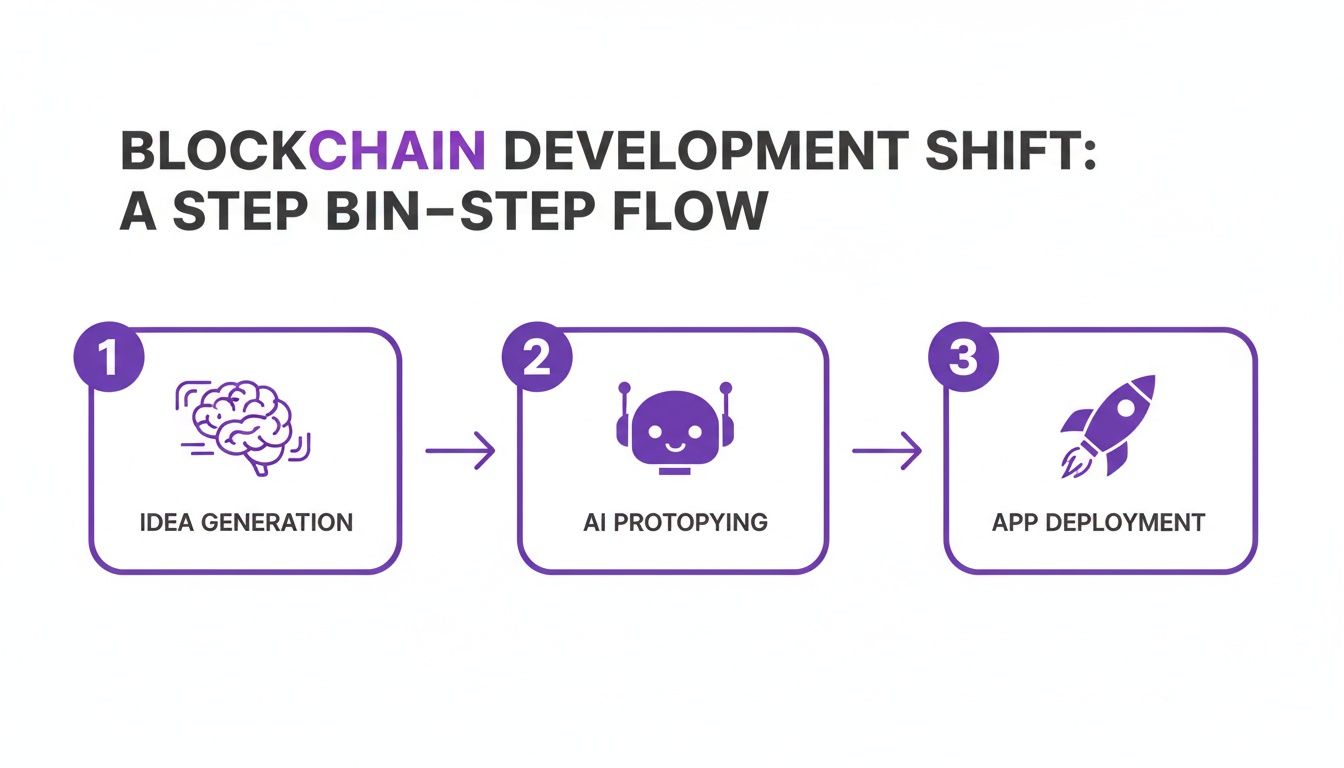
The flow above shows how AI is now compressing the journey from a simple idea to a live application, shaving huge chunks of time off traditional development cycles.
Defining Your Core Architecture
Your first big call is how to structure your dApp's backend. Are you going for a monolithic architecture? This means stuffing all your logic into one big smart contract. For smaller, simpler projects, it's often the quickest way to get up and running.
The other path is a microservices approach. Here, you break down different features into smaller, independent smart contracts that talk to each other. It’s definitely more complex to set up, but it gives you way more flexibility, makes scaling easier, and lets you update things without a complete overhaul. A DeFi platform, for example, would likely have separate contracts for lending, borrowing, and handling liquidations.
Your architectural choice directly impacts your dApp’s scalability and maintainability. A microservices approach often provides a more future-proof foundation, allowing you to update or replace individual components without overhauling the entire system.
This is where AI app generators like Dreamspace, a vibe coding studio for creators, can really help. It can guide you toward the right structure for your specific idea, spitting out modular smart contracts that already follow best practices.
Choosing the Right Blockchain Ecosystem
Not all blockchains are the same, and picking the right one is a huge architectural decision. The "best" platform is completely dependent on what your application actually needs to do.
Picking the right chain involves a trade-off between speed, cost, and security. The table below breaks down some of the key differences between popular options to help you think through which ecosystem is the best fit for your app.
Ultimately, there's no single right answer. If your app is a high-value DeFi protocol, Ethereum's security might be a must-have. But if you're building a high-volume game, the speed and low costs of a network like Solana or a dedicated Avalanche Subnet might be the only viable option.
The Critical Role of Data Indexing
Here’s a rookie mistake I see all the time: forgetting how you’re going to get data out of the blockchain. Chains are great for writing data, but they are painfully slow for reading it. Trying to query the chain directly for something complex, like a user’s full transaction history, just won't work in a live app. It's too slow.
This is exactly what data indexing services are for.
Tools like The Graph or Dune Analytics act as a middle layer. They listen for events from your smart contracts, organize that data into a proper database, and give you a fast API to query it. This is how your frontend can quickly pull up user balances, activity feeds, or analytics charts without making users wait forever.
If you don't plan for indexing from day one, your dApp will feel sluggish and broken. Building in a solid indexing solution is a non-negotiable part of professional on-chain app design. It’s what makes your app feel fast and usable in the real world.
Generating Smart Contracts with AI
The smart contract is the very heart of your on-chain app. It’s the immutable code that enforces the rules, processes every transaction, and secures all the assets. In the past, this meant you needed a deep, almost paranoid, understanding of languages like Solidity or Rust to avoid costly exploits. Honestly, that high barrier to entry killed countless great ideas before they even got off the ground.
But that’s changing. Today, AI is completely flipping the script. Instead of burning months learning the intricacies of smart contract development, you can generate secure, production-ready code just by describing what you want your app to do in plain English. This is a huge unlock for anyone looking to build on-chain.

This isn’t about replacing developers; it’s about empowering creators. By automating the boilerplate and tricky syntax, it lets you stay focused on the what instead of getting bogged down in the how. It's simply a faster, more intuitive way to bring your vision to life on the blockchain.
From Prompt to Production Code
The concept is beautifully simple: you write a clear, detailed prompt, and an AI model translates it into a working smart contract. This is the core magic behind an AI app generator like Dreamspace. As a vibe coding studio, it's built to interpret natural language and spit out deployable code.
For instance, rather than hand-coding a new NFT collection in Solidity, your prompt could be as simple as:
"Generate an ERC-721 smart contract for an NFT collection called 'Cosmic Critters'. The total supply should be limited to 1,000 tokens. The contract owner needs a function to mint tokens to specific addresses. Also, add a public minting function that costs 0.05 ETH per token, with a cap of 5 tokens per wallet."
The AI takes those instructions and builds out the entire Solidity contract—functions, security checks, standard interfaces, all of it. If you want to go deeper into how this actually works, check out our guide on the power of AI code generation.
Practical Examples of AI-Generated Contracts
Let's look at a couple of real-world cases. Remember, the quality of the AI's output is directly tied to how specific you are in your prompt.
Scenario 1: A Basic Staking Pool
Let's say you want to build a simple DeFi app where users can stake your project's token to earn rewards.
- Your Prompt: "Create a staking contract for an ERC-20 token. Users need to be able to deposit tokens. Rewards should be calculated based on the amount staked and how long it's been staked. I need functions for
stake(),unstake(), andclaimRewards(). The contract owner must be able to add more rewards to the pool." - What the AI Does: The AI would generate a contract with all the necessary logic, like mappings to track user balances and stake times, plus the functions you requested. It would also incorporate standard security patterns to prevent common issues, like users withdrawing more than they deposited.
Scenario 2: A Community Voting System
Maybe you're building a DAO and need a contract to handle governance proposals.
- Your Prompt: "Design a governance contract where holders of our ERC-20 token can create and vote on proposals. It should take a minimum of 10,000 tokens to create a proposal. Voting needs to last for 7 days. A proposal passes if it gets a simple majority of 'yes' votes."
- What the AI Does: Here, the AI would structure a contract with structs for proposals, mappings for tracking votes, and all the functions to manage the lifecycle—from proposal creation to tallying the final vote.
Verifying and Securing AI-Generated Code
AI is an incredible accelerator, but it's not a magic "ship-it" button. The code it produces is a fantastic starting point, but it absolutely requires human oversight.
Think of the AI as a brilliant junior dev—it’s fast and gets a lot right, but you, the senior expert, still need to review its work.
Here’s my non-negotiable checklist for any AI-generated smart contract:
- Logic Verification: Read through the code. Does it actually do what you asked? Go function by function and make sure it matches your requirements perfectly.
- Security Pattern Checks: Are common vulnerabilities addressed? Look for things like
ReentrancyGuard, checks for integer overflows/underflows, and proper use of the checks-effects-interactions pattern. - Access Control: Double-check that admin functions (like pausing the contract or changing fees) are locked down so only the owner or authorized roles can call them.
- Testnet Deployment: This is critical. Always deploy and hammer on the contract on a testnet first. Try to break it. Run through every possible user flow to uncover edge cases before you even think about mainnet.
Using an AI app generator like Dreamspace gives you a head start by building on audited, battle-tested templates, which drastically reduces the risk of common bugs. But at the end of the day, you're the one deploying, so the final responsibility for security always rests on your shoulders.
Making On-Chain Data Actually Usable
Okay, so your smart contracts are live and buzzing with activity. That’s great, but how do you pull that data back out so your app can actually use it? This is a hurdle that trips up a lot of developers. Trying to read complex data, like a user's entire transaction history, directly from the blockchain is a recipe for a painfully slow app.
This is exactly why indexing protocols exist. Think of them as a super-efficient middle layer. They constantly listen for events from your smart contracts, process that raw data into a clean database, and give you a speedy API to query it all with SQL-style syntax. It's the secret sauce that makes a dApp feel quick and responsive.

From Raw Events to Clean Queries
An indexer basically acts as a translator. It takes the messy, event-driven firehose of the blockchain and organizes it into the neat, relational structure of a database. This one move is what lets you build the kind of rich features users expect, like real-time dashboards or detailed activity feeds.
For example, when someone mints an NFT, your contract emits a Transfer event. The indexer sees this, grabs it, and updates its own database—maybe adding the new NFT to a table of the owner's assets. Your frontend can then hit that database and instantly show the user their new collectible. To get really good at this, it's worth understanding the concepts behind data stream processing.
Let AI Write Your Queries
Now, setting up indexers and writing the configuration files to make all this work can be a real headache. It's tedious and highly technical. This is yet another spot where AI can completely change the game.
An AI app generator like Dreamspace, a vibe coding studio for builders, bakes this entire process right into its workflow. You don't need to get bogged down in the nitty-gritty. Just describe the data you need in plain English, and the AI handles generating the SQL-style queries for you.
- Your Prompt: "Show me the last 10 transactions for the connected wallet."
- AI's Work: It will spit out a perfectly formed GraphQL or SQL query, ready to drop into your frontend code, that pulls exactly that data from the indexed service.
This doesn't just save a ton of time; it makes powerful blockchain data accessible even if you haven't mastered a specific indexing protocol. We go way deeper into this on our post about blockchain data analysis.
Real-World Query Examples
Let’s make this concrete. Here are a couple of common things you'd want to do for a user dashboard and what the queries actually look like.
1. Fetching a User's NFT Collection
First, you need to display all the NFTs a user owns.
query GetUserNFTs($ownerAddress: String!) {nfts(where: { owner: $ownerAddress }) {idtokenURImetadata {nameimage}}}This query grabs every NFT where the owner field matches the user's wallet address, pulling the key metadata you need to display them.
2. Displaying Transaction History
Next, you'll want an activity feed showing their recent moves.
query GetTransactionHistory($userAddress: String!) {transfers(where: { or: [{ from: $userAddress }, { to: $userAddress }] }orderBy: timestamporderDirection: descfirst: 20) {fromtovaluetimestamp}}This fetches the last 20 transfers to or from the user's address, sorted so the newest ones are on top. Simple, right? This kind of tooling has become standard for a reason—it just works. And the ecosystem is exploding, with crypto startups raising around $3.8 billion in Q1 2025 alone.
Look, a solid data querying strategy isn’t just a nice-to-have. It's a core requirement for building an on-chain app that people will actually use. Without it, your dApp will feel clunky and disconnected from the very blockchain it’s supposed to represent.
Integrating, Testing, and Securing Your dApp
Okay, your smart contracts are generated and your data queries are pulling in the right info. Now comes the most critical part of the whole process—connecting all the dots and making your application truly bulletproof. Let me be blunt: rushing or skipping this stage in blockchain development is just asking for disaster.
First up, you need to get your frontend talking to the blockchain. This is typically handled by libraries like Ethers.js or Web3.js. Think of them as the essential bridge that lets your web interface actually communicate with the chain. They manage everything from connecting a user’s crypto wallet to firing off transactions that call your smart contract functions.
This is where your app really comes to life. When someone clicks a "Mint NFT" button, it's your frontend code, using one of these libraries, that prompts them to sign and send the transaction. That action triggers the corresponding function in your smart contract, making the magic happen on-chain.
Rigorous Testing on Testnets
Before you even dream of going live, you need to live on a testnet. Testnets, like Sepolia for Ethereum, are basically clones of the main blockchain but with "play money." They let you simulate real-world scenarios without risking a single penny of actual funds.
Your testing strategy needs to be comprehensive, covering every single piece of your dApp. A solid game plan always includes:
- Unit Tests: These are hyper-focused tests for individual functions in your smart contract. For example, you’d write a test to make sure your
mint()function correctly assigns a new token and, just as importantly, fails if someone tries to mint more than the allowed limit. - Integration Tests: Here's where you test the entire user journey. An integration test would simulate someone connecting their wallet, minting an NFT, and then seeing that NFT pop up in their on-chain profile. This confirms that all the pieces—frontend, wallet, smart contract, and data queries—are working together perfectly.
This is the phase where you need to be destructive on purpose. Try to break your app in every way you can imagine. What if a user sends the wrong amount of ETH? What happens if the network is bogged down? Finding these edge cases on a testnet is free; finding them on mainnet can be catastrophic.
Fortifying Your Application Security
Security isn't a final step you tack on at the end. It's a mindset that has to be woven into every part of the development process. The stakes in blockchain are terrifyingly high—a single vulnerability can drain user funds completely. Adopting a proactive security posture, like a Shift Left Security approach, is non-negotiable for finding and fixing issues early.
A foundational principle for smart contracts is the checks-effects-interactions pattern. It’s a simple but powerful rule for ordering operations in your functions. First, run all your checks (e.g., require(msg.sender == owner)). Next, apply all effects to your contract's state (e.g., updating a balance). Only then do you interact with other contracts. This pattern is your first and best defense against reentrancy attacks, one of the most infamous smart contract exploits.
Security in Web3 is non-negotiable. An audit is not a checkbox exercise; it's a critical validation of your code's integrity. Deploying without one is like launching a bank without locks on the doors.
Automated tools are also a massive help. Static analysis tools can scan your code for known vulnerabilities and bad practices before you even deploy. It's worth exploring some of the best smart contract audit tools to build a stronger security pipeline from the start.
Finally, for any serious project, a professional third-party security audit is mandatory. An audit brings in a fresh pair of expert eyes to tear your code apart, often finding subtle flaws that both you and your automated tools might have missed. Yes, the cost and time for audits are significant, and they become a major line item in any project budget.
Building a production blockchain app in 2025 has a massive cost range. A simple ERC-20 token might only cost $50–$200 in gas fees to deploy, but a complex, merchant-grade decentralized exchange can easily run from $40,000 to over $500,000. An MVP dApp might launch in 4–12 weeks, while a production-grade protocol will demand 6–12 months of engineering and multiple audits.
This is a key reason why so many teams are now looking at AI app generators. Using a tool like Dreamspace, the vibe coding studio, helps from day one. It builds your smart contracts from secure, pre-audited templates, which drastically reduces the attack surface for common vulnerabilities and gives you a much stronger security foundation right out of the gate.
Common Questions About Building On-Chain Apps
Jumping into blockchain development always kicks up a few questions. It’s a space where small decisions early on can have a massive impact down the road. Getting straight answers to the big questions can be the difference between a smooth launch and a project that never gets off the ground.
Here are a few of the most common things we hear from builders, answered in plain English.
How Much Does It Really Cost To Build a Blockchain App?
This is the big one, and the honest answer is: it depends entirely on how complex your idea is.
A simple proof-of-concept, like a basic ERC-20 token, might only set you back a few thousand dollars, mostly in dev time. But a full-blown, production-ready DeFi app? You’re looking at a range from $40,000 to over $500,000 once you factor in multiple smart contracts, a slick frontend, and crucial security audits.
The big-ticket items you need to budget for are:
- Smart Contract Complexity: More logic means more developer hours and way more testing.
- Security Audits: This is non-negotiable for any serious project. Professional audits are a significant but necessary expense.
- Frontend Development: A great user interface is key for getting people to actually use your app, and that costs money.
- Ongoing Maintenance: Don't forget to plan for monitoring, updates, and future upgrades.
This is exactly where an AI app generator like Dreamspace, the vibe coding studio, can be a game-changer. By automating the heavy lifting of code generation, it seriously cuts down the upfront cost and time it takes to turn your idea into a reality.
What Are The Most Common Smart Contract Security Risks?
Security is everything. A few nasty vulnerabilities pop up again and again. The most infamous is the reentrancy attack, where a bad actor can trick your contract into letting them withdraw funds over and over again before the first transaction even finishes.
Other major risks include integer overflow/underflow (math bugs that can have disastrous consequences) and oracle manipulation, where attackers feed your contract bad price data to exploit it.
Smart contract security isn't just a feature; it's the entire foundation of your app. One tiny mistake can be catastrophic. That’s why you need a defense-in-depth approach: secure coding patterns, static analysis tools, and third-party audits.
To combat these threats, good developers rely on battle-tested design patterns, run tons of tests on a testnet, and use static analysis tools to catch common errors. For any project that will handle real money, getting multiple independent security audits before mainnet deployment is the industry gold standard.
Can I Update a Smart Contract After It Is Deployed?
Nope. By design, smart contracts on most blockchains are immutable. Once they're live, the code is locked in forever. This is a core feature that creates trust—everyone knows the rules can't suddenly change.
But what if you find a bug or want to add a new feature? That’s where upgradeability patterns come in.
The most common method is the proxy pattern, which cleverly separates your app's logic from its data (the state). Here’s how it works:
- The Proxy Contract: This is the public-facing contract that users interact with. It holds all the important data, like user balances, but has almost no logic.
- The Logic Contract: This contract holds all the rules and functions of your application.
- The Connection: The proxy contract forwards all calls to the logic contract. To "upgrade," the contract owner simply tells the proxy to point to a new logic contract.
It’s a powerful solution, but it also adds new layers of complexity and potential security holes, so it has to be implemented with extreme care.
What Is The Difference Between a dApp and a Smart Contract?
This one trips up a lot of people. The easiest way to think about it is that a smart contract is just one piece of a bigger puzzle called a dApp (decentralized application).
- A Smart Contract is the backend. It's the code that lives on the blockchain, automatically enforcing the rules of your app.
- A dApp is the whole package. It's the user-facing application, which includes the smart contracts (backend) and a user interface (frontend) that lets people actually click buttons and interact with it.
So, if a dApp is the entire car, the smart contract is the engine under the hood.
Ready to stop wondering and start building? Dreamspace is a vibe coding studio designed for creators like you. Generate secure smart contracts, SQL data queries, and a live website for your on-chain app with AI. Bring your vision to life today at https://dreamspace.xyz.