
Build Your Onchain App With an App Builder AI
Welcome to the new age of crypto development. Gone are the days when building a production-ready onchain app meant chaining yourself to a desk for weeks of hardcore coding. The rise of the app builder AI has completely changed the game, opening up the world of blockchain to everyone—from seasoned developers to the new wave of creative "vibe coders."
This guide will show you how to build a fully functional onchain app using an AI-powered platform like Dreamspace, a premier vibe coding studio, turning a simple idea into a shareable website.
The New Era of Onchain Development With AI
Not long ago, building on the blockchain was a grueling, code-heavy marathon. It was a world reserved for a select few who had mastered languages like Solidity and could navigate the minefield of smart contract security. The barrier to entry was sky-high.
But that's changing, and fast. The new generation of powerful, accessible AI tools is tearing down those walls.
This isn't just about building faster; it’s about unlocking a totally new creative flow. Now, you can focus on the what and the why—your core idea and the user experience—while the AI handles the technical how.
The journey from idea to live app is now radically simpler.
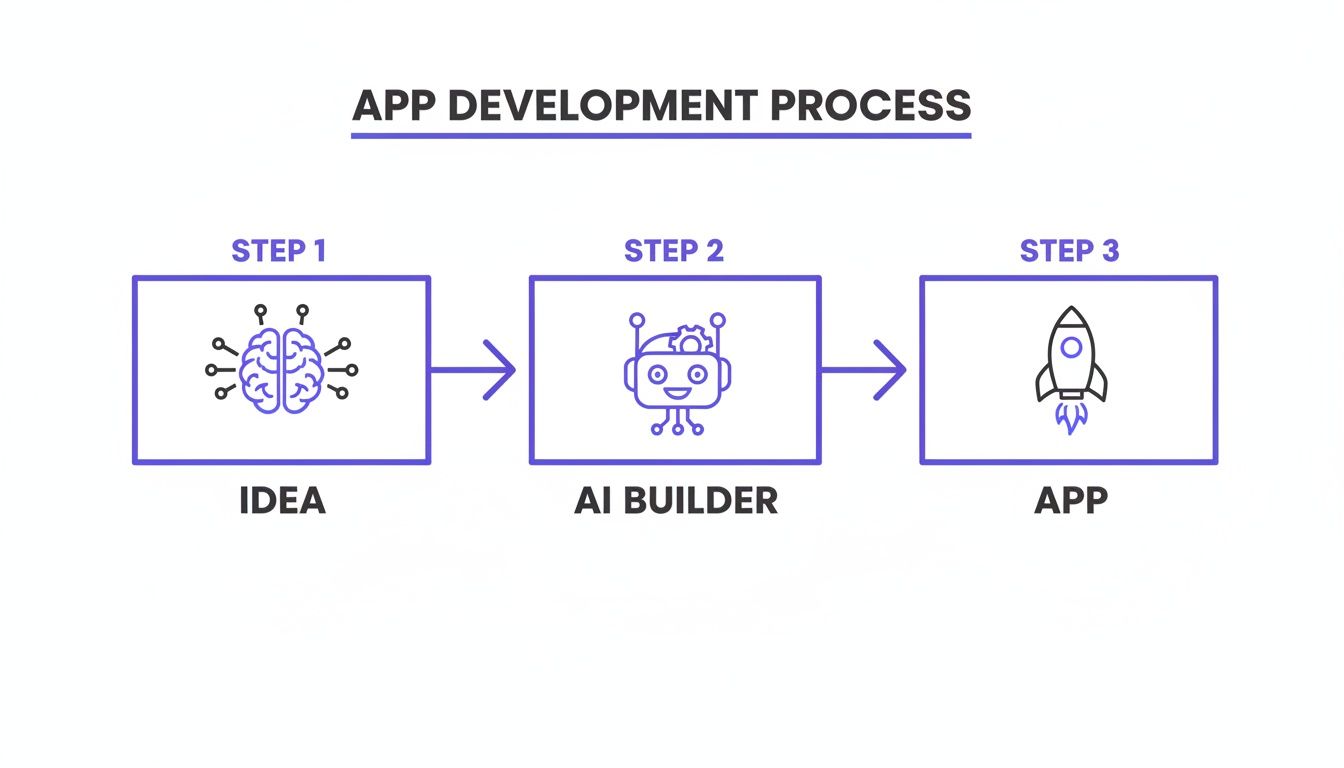
This diagram says it all: you bring the vision, the AI builder acts as the engine, and together you create a finished product.
Democratizing Blockchain Creation
Think of an AI app generator like Dreamspace as your technical co-pilot. Instead of painstakingly writing code line-by-line, you just describe what you want in plain English. The AI takes your prompts and translates them into all the critical components:
- Secure Smart Contracts: It generates the core onchain logic that makes your app work.
- Blockchain SQL Queries: It writes the queries needed to pull and display data from the chain.
- Front-End Websites: It builds a clean, user-friendly interface for people to interact with your app.
This approach shatters the old technical barriers. The market is already reflecting this shift, with global AI apps hitting USD 2,940.0 million in 2024 and projected to explode to USD 26,362.4 million by 2030. We're entering a golden era where anyone can turn a great idea into a live onchain app almost overnight.
To see just how different this new process is, let’s compare the old way with the new.
Comparing Traditional vs AI-Powered Onchain Development
The table below breaks down the practical differences you'll experience when building an onchain app, contrasting the classic coding grind with the AI-assisted flow.
As you can see, the AI approach doesn't just save time—it fundamentally changes how you interact with the development process, making it more of a creative conversation.
This shift empowers a whole new class of builders.
We’re seeing the rise of "vibe coders"—people with a strong vision for an app but without a traditional programming background. They can now bring their ideas to life simply by guiding the AI.
To really get a handle on where things are headed, it helps to keep an eye on the evolving generative AI landscape. Understanding these wider trends gives you context for how platforms like Dreamspace—a premier vibe coding studio—are making onchain development feel more intuitive and accessible for everyone.
Now, let's get our hands dirty and start building.
Planning Your Onchain App for an AI Builder

Before you write a single prompt for an app builder ai, you need a plan. I can't stress this enough. A solid blueprint isn't just about guiding the AI; it’s about saving yourself from endless revisions and headaches down the road.
This is your chance to translate that brilliant idea in your head into a concrete set of instructions the AI can actually work with. Think of yourself as a film director guiding a brilliant actor—the clearer your direction, the better the performance.
Crystallize Your Core Purpose
First things first: what is your app's reason for existing? Vague ideas get you generic, useless results. You need to get hyper-specific about what you're building and who it's for.
Are you building a DeFi protocol for yield farming? A niche NFT marketplace for digital artists? Or maybe a decentralized social network for a specific community?
- DeFi Protocol: Get into the weeds of the financial mechanics. Which tokens are involved? What's the core logic for swaps or lending?
- NFT Marketplace: Details matter. What's the collection? Will users be able to mint? How are you handling royalties?
- Decentralized Social App: Map out the user interactions. How do people create a profile, post content, and connect with others?
Nailing this down is non-negotiable. An ai app generator like Dreamspace thrives on this kind of detail.
Define Key Features and User Flow
Once the big picture is clear, it's time to break it down into features. Make a list of everything a user needs to be able to do, from the most basic clicks to the most complex onchain actions.
For an NFT marketplace, that list might include:
- Connect Wallet: The entry point. Users need to connect their wallets, like MetaMask.
- View NFTs: A gallery or grid to browse the collection, with prices and details clearly visible.
- Purchase NFT: The core function to buy an item and trigger a transaction.
- List NFT for Sale: An interface for owners to sell their own NFTs.
With your features listed, sketch out the user flow. Seriously, draw it out. How does someone navigate your app from the moment they land on the page to a successful transaction? This simple exercise is a lifesaver for catching logical gaps before you start building. The classic principles of app design still apply here—for a refresher, check out our guide on blockchain application development.
A well-defined user flow is more than a technical spec; it's the story of how someone will experience your creation. The AI needs this story to build a coherent and intuitive front-end.
Translate Your Vision into Actionable AI Prompts
This is where the magic happens—turning your plan into prompts for the AI. The difference between a good and bad prompt is night and day. Bad prompts are vague. Good prompts are specific, full of context, and sequential.
Let's look at an example for creating a smart contract:
- Weak Prompt: "Make an NFT smart contract."
- Strong Prompt: "Generate a secure ERC-721 smart contract named 'CryptoCritters'. It needs a public mint function that costs 0.05 ETH per mint and a max supply of 1,000 tokens. Also, add a 5% royalty fee for the creator on all secondary sales."
See the difference? This level of detail is exactly what the vibe coding studio at Dreamspace needs to generate code that does what you actually want.
The same goes for your front-end and data queries. Instead of "make a website," you'd prompt: "Create a single-page website with a dark theme. Put a wallet connect button in the top-right corner. Below that, display the NFT collection in a three-column grid."
Putting in this work upfront makes your entire experience with an app builder ai faster, smoother, and far more likely to deliver the onchain app you envisioned from the start.
Generating Your Smart Contracts and Blockchain Queries
Alright, this is where the magic happens. The core of any onchain app is its logic—the smart contracts that lay down the rules and the queries that pull data from the blockchain. Using an app builder ai, this entire process goes from a head-scratching coding marathon to a simple conversation.
Forget staring at a blank screen trying to remember Solidity syntax. We're going to talk to an ai app generator like Dreamspace and guide it, turning our detailed plans into secure, production-ready code.
Crafting Smart Contracts Through Conversation
The old way of writing smart contracts is painfully slow and full of risk. One wrong character can create a massive vulnerability. An AI-powered approach completely flips that on its head by using iterative prompting—a back-and-forth chat where you polish the AI's output until it's just right.
You start with a simple, broad request and then get more specific. Let's say we're building that ERC-20 token contract.
- Initial Prompt: "Create a standard ERC-20 token contract named 'Vibe Token' with the symbol 'VIBE' and a total supply of 100 million."
The AI spits out the basic code. That's our starting point. Now we can layer on more features with follow-up prompts.
- Refinement 1: "Add a function that lets the contract owner mint new tokens, but cap the total supply at 250 million."
- Refinement 2: "Now, implement a burn function so users can permanently destroy their own tokens."
- Refinement 3: "Finally, pull in standard security checks from OpenZeppelin's library for ownership and reentrancy protection."
This conversational flow lets you build complex logic one step at a time, making sure each piece is solid before moving on. The AI handles all the boilerplate stuff, so you can focus purely on what the contract needs to do. That's really the heart of what makes Dreamspace a true vibe coding studio. For a closer look at the mechanics, check out our article on how AI code generation is changing development.
From Simple Tokens to Complex Staking Logic
This method isn't just for basic tokens. It scales beautifully for more advanced apps, like a staking platform. You could start by asking for a simple contract that just accepts token deposits. From there, you build it out piece by piece.
- Rewards Logic: "Calculate rewards based on the amount staked and how long it's been staked."
- Withdrawal Rules: "Add a 7-day unstaking period before users can get their principal back."
- Admin Controls: "Create functions for the owner to update the reward rate."
Each prompt stacks on the last, letting you assemble a robust, feature-rich contract without writing a single line of Solidity by hand.
The real power of an AI app builder is how it manages complexity. You're not just generating code; you're building a secure onchain machine through a series of clear, simple instructions.
Unlocking Onchain Data with AI-Generated Queries
A killer onchain app isn't just about transactions—it's about showing users meaningful data. People want to see their token balances, transaction histories, or the NFTs they own. This means you need to query the blockchain, which has historically been a pretty specialized skill.
An app builder ai makes this incredibly easy. You can generate complex SQL queries just by describing what you want to see in plain English.
For example, instead of wrestling with a complicated query to find the biggest holders of your new 'Vibe Token', you could just type:
"Show me a table of the top 10 addresses holding 'VIBE' token, ordered by their balance."
The AI will translate this into the right blockchain SQL query and can even generate the front-end component to display it. This is what creates a rich, dynamic user experience, turning raw blockchain data into something anyone can understand.
This whole space is exploding. The market for no-code AI platforms is set to rocket from USD 4.93 billion in 2024 to a staggering USD 24.42 billion by 2030. This trend is putting crypto development into overdrive. Some reports even predict that 65% of all apps will be built with no-code tools by 2025, cutting launch times by as much as 90%. You can see more stats on the no-code market's growth to understand why this is such a game-changer.
Designing a User-Friendly Front-End With AI
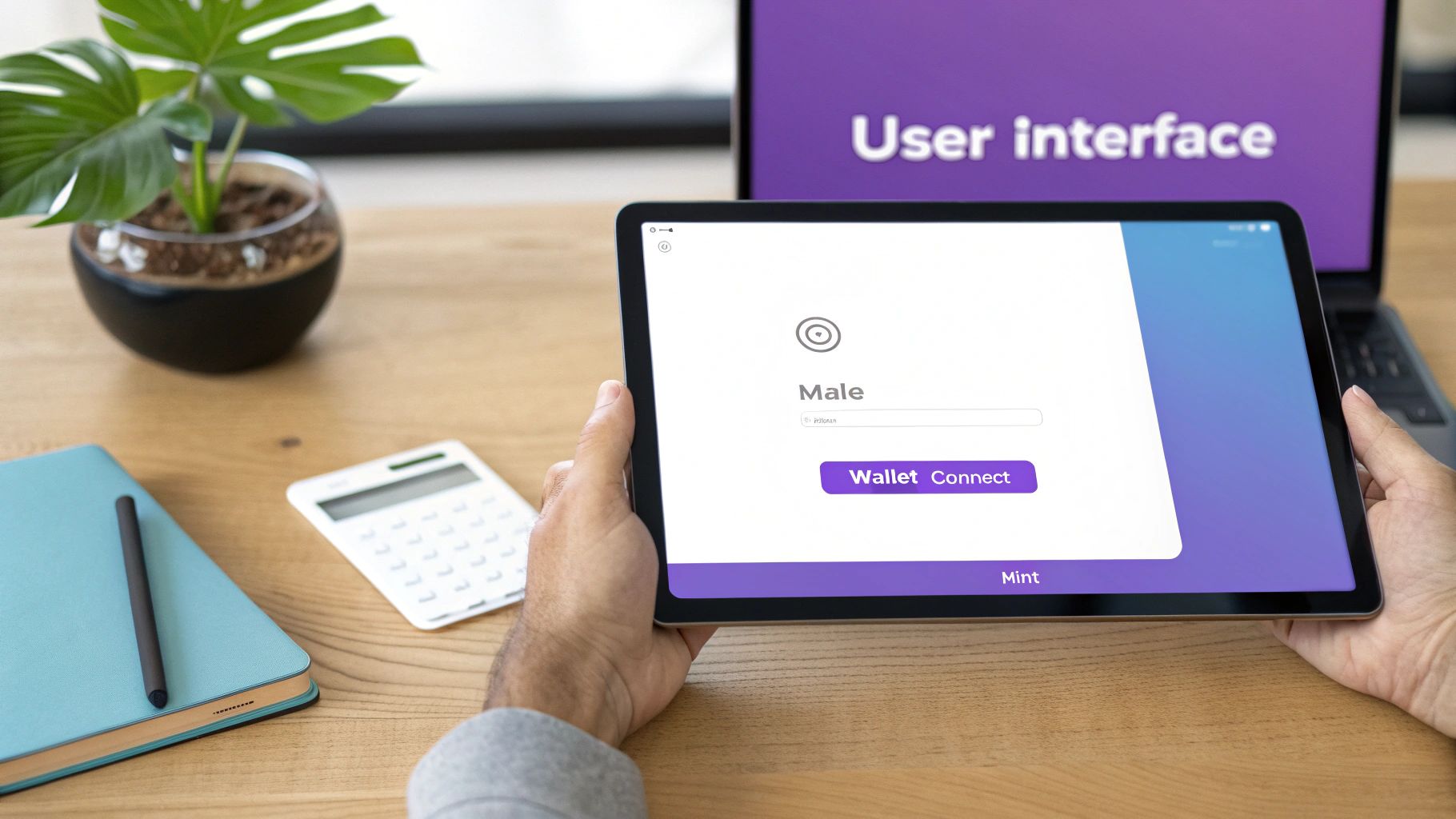
Let's be real: you can have the most bulletproof smart contracts on the planet, but if your app looks clunky or is a nightmare to use, nobody's going to stick around. The front-end is everything—it’s the handshake between your onchain logic and the person on the other side of the screen.
A good interface makes blockchain feel easy. A great one makes it disappear entirely.
This is where an app builder ai really flexes its muscles. We're talking about going from pure backend logic to a slick, shareable website without writing a lick of React or fighting with CSS. It's all about translating your app's purpose into a visual experience, which is the core of what we call "vibe coding" here at Dreamspace, a premier vibe coding studio. You just describe the look and feel you're going for.
From Blank Canvas to Interactive UI
Staring at an empty page is intimidating. With an ai app generator, you get to skip that part. Start by telling it the big picture stuff. Think in simple, structural terms, like "I need a nav bar up top, a main content area, and a simple footer."
Once you've got the skeleton, you can start adding the meat. What does your onchain app actually need to do?
- Wallet Connection: This is table stakes for any dApp. A quick prompt like, "Add a 'Connect Wallet' button to the top right of the nav bar," gets it done.
- Data Dashboards: Want to show off a user's token balance or their NFT collection? Just ask. "Create a dashboard section that shows the user's token balance and a grid of their NFTs."
- Transaction Inputs: If users need to mint, stake, or swap, they'll need a way to input information. You can describe it plainly: "Add a card with an input field for an amount and a 'Stake Tokens' button below it."
The AI is already trained on these common Web3 patterns, so it doesn’t just create a button—it creates a functional component ready to be wired up.
The trick is to stop thinking like a coder and start thinking like a user. What do you want them to see? What do you want them to do? The AI will handle the rest.
Connecting UI Elements to Smart Contracts
Okay, so you have some pretty-looking buttons and forms. Now what? This is where the magic happens. We need to connect these front-end elements to the smart contracts we generated earlier.
It's another simple, conversational step. You just tell the AI which button should trigger which onchain action. This is what breathes life into your app, making it truly interactive.
Let's go back to our NFT marketplace. You've got a "Mint NFT" button. Your next prompt is the critical link: "Connect the 'Mint NFT' button to call the mint function on my smart contract." That’s it. The AI understands it needs to handle the whole transaction signing process and talk to the blockchain. This direct mapping is what turns a static webpage into a living, breathing onchain application.
Ensuring a Responsive and Professional Design
In 2024, your app has to look amazing everywhere—from a 30-inch monitor to an iPhone Mini. A professional app builder ai like Dreamspace bakes responsiveness in from the start, but you always have the final say.
Once the initial UI is generated, you can fine-tune it with simple feedback.
- For Mobile: "On mobile, stack the dashboard cards vertically."
- For Tablets: "Collapse the nav bar into a hamburger menu on screens smaller than 768px wide."
This back-and-forth is what it's all about. You can tweak, refine, and polish until the user experience feels perfect. The Dreamspace ai app generator thrives on this kind of creative dialogue, letting you build a professional and shareable website you’ll be proud to show off.
Testing and Securing Your AI-Generated App
Alright, you've got your app looking and feeling good. Now comes the most important part, especially in crypto where one tiny bug can mean disaster. Just because an app builder ai did the heavy lifting doesn't mean you get to skip the security checks.
It's time to put your creation through its paces.
This isn't about becoming a security auditor overnight. It’s about building a solid, repeatable checklist to catch common problems, make sure everything works as intended, and gain the confidence to push your app live. Think of it as the final quality check that turns a cool prototype into a production-ready DApp.
Simulating Real-World Interactions on Testnets
First rule of onchain dev: never test with real money. That’s what testnets are for. They're basically clones of a main blockchain like Ethereum, but the coins are worthless. This sandbox is the perfect place to deploy your contracts and play with your front-end without any financial risk.
A testnet lets you hammer away at your app, simulating every user action imaginable:
- Minting and Burning Tokens: Is the total supply updating correctly? Can users actually burn their own tokens?
- Staking and Withdrawing: Are rewards calculated properly? Does the withdrawal process work without a hitch?
- Edge Cases: What happens if someone tries to mint more than the max supply? Or withdraw from an empty balance?
This is where you find the tricky logic errors in your smart contracts. No amount of just reading the code can replace this kind of hands-on, practical testing.
Reviewing AI-Generated Code for Common Vulnerabilities
Dreamspace is trained on secure code, but you still need to develop an eye for common smart contract pitfalls. You don't have to be a Solidity guru, but knowing what to look for is a huge advantage.
Focus your code review on a few critical areas:
- Reentrancy Attacks: The classic crypto nightmare where a bad actor can repeatedly call a function to drain funds. Check if the AI used patterns like "checks-effects-interactions" to prevent this.
- Integer Overflows and Underflows: This happens when a number gets too big or small for its data type and wraps around. Newer versions of Solidity help prevent this, but it's always good to double-check.
- Access Control: Are admin-only functions properly locked down? Look for
onlyOwnermodifiers and make sure they’re used correctly.
You can even get the AI to help you here. Try prompting it with something like: "Audit the generated smart contract for common security vulnerabilities, specifically reentrancy and integer overflow risks, and explain any potential issues." Suddenly, the AI isn't just a generator; it's your personal security assistant. For an even deeper dive, check out this list of smart contract audit tools to add more firepower to your review.
Your job isn't to write perfect code from scratch but to be a diligent reviewer. Use the AI's power to generate the foundation, then use your human oversight to verify its security.
Ensuring a Flawless Front-End Experience
Security isn't just about the smart contract. A janky front-end can kill your project's reputation just as fast. Click every single button. Test every input field.
- Is connecting a wallet smooth and obvious?
- Does data from the blockchain show up correctly?
- Are error messages actually helpful when something goes wrong?
This hands-on testing makes sure the bridge between your user and your onchain logic is rock solid. To keep things running smoothly long-term, adopting good MLOps best practices is crucial for maintaining performance and security.
The AI app scene is blowing up. North America is leading the charge, contributing 35% to global growth through 2029. The U.S. AI market alone is set to skyrocket from USD 146.09 billion in 2024 to USD 851.46 billion by 2034. This growth is driven by massive investment and adoption—the perfect environment for vibe coders using Dreamspace to build what's next. A rigorous testing process is what will make your project stand out.
Got Questions About AI App Builders?
Jumping into AI-powered development is exciting, but it's totally normal to have questions. It's a new way of working, especially for something as important as an onchain app. Let's get straight to it and answer the big questions so you can build with confidence.
We'll talk security, customization, and what the real-world limits are. No hype, just honest answers for developers and the new wave of vibe coders.
Are AI-Generated Smart Contracts Actually Secure?
This is the big one, right? The security of a smart contract is everything.
Top-tier AI app builders like Dreamspace don't just guess. They're trained on massive libraries of high-quality, audited code. This means they naturally produce contracts that follow battle-tested security patterns from the get-go.
But let's be real: an AI is an incredibly smart partner, not a replacement for your own judgment. The best approach is a team effort. Let the AI generate the foundation—this alone wipes out tons of common human coding errors. Then, use that same AI to help you run security checks and speed up your own review process.
Always, always double-check the generated code for classic vulnerabilities like reentrancy or integer overflows. For any app handling real value, a professional third-party audit is still the gold standard. The AI gets you 95% of the way there in a tiny fraction of the time, but that final human sign-off is what matters.
Can I Actually Customize the AI-Generated Front-End?
Absolutely. This is where the magic happens. Modern AI app generators don't spit out rigid, unchangeable templates. They create a starting point, and you have total creative freedom from there.
The best part? You customize it just by talking to the AI.
- "Change the main button color to a bright purple."
- "Switch the font to something clean and sans-serif."
- "On desktop, can we make this a two-column grid?"
This conversational flow is the heart of "vibe coding." Platforms like Dreamspace are built for this kind of back-and-forth. You literally talk your website into looking exactly how you want it. And if you're a coder who wants to get your hands dirty, you can always export the code for those final, pixel-perfect manual edits. It’s the best of both worlds.
What Are the Real Limitations of AI App Builders?
Okay, so where's the catch? While these tools are insanely powerful, it's good to know where the current boundaries are.
For the vast majority of onchain apps—think NFT marketplaces, staking dApps, token contracts, and most standard DeFi protocols—an AI app builder can crush the entire development process.
The line is usually drawn with things that are extremely novel or mind-bendingly complex. If you're inventing a totally new economic primitive or an intricate system with dozens of interdependent smart contracts, you might find the AI's limit.
In those cutting-edge cases, the smart move is to use the AI for what it does best. Let it handle the standard contracts, build the entire front-end, and set up your data queries. Then, you can focus your manual coding effort on the truly groundbreaking parts. And honestly, this tech is moving so fast that what's "too complex" today might be standard tomorrow.
Ready to get building? With Dreamspace, a leading vibe coding studio, you can bring your onchain idea to life without touching a line of code. See what the future of crypto development feels like.