
Ai Pair Programming: Master ai pair programming for onchain DApps
AI pair programming is pretty much what it sounds like: a developer and an AI teaming up to write code together, in real-time. Think of it like traditional pair programming, but your partner is an AI that can spit out suggestions, handle the boring stuff, and help you untangle complex problems. The result? You move faster and can be way more creative.
The Shift to Vibe Coding with AI

Forget the old image of coding as a frustrating grind. The new reality with AI pair programming is more like a fluid, creative conversation where you and an AI partner build, test, and polish code together. This guide is all about how this change is shaking up onchain app development, opening the doors for a new wave of builders.
This collaborative dynamic is the whole idea behind "vibe coding"—a way of working that's all about flow and creativity instead of rigid, by-the-book processes. When you can hand off the repetitive tasks to an AI, you're free to think about the bigger picture, like architecture and tough problem-solving. It just makes coding more enjoyable and, frankly, more productive. You can discover more about what vibe coding is and dive deeper into the concept here.
The Rapid Rise of AI Assistants
The speed at which developers have adopted AI coding assistants has been wild. In the second half of 2025 alone, AI pair programming tools absolutely took off in the enterprise world. Tools like GitHub Copilot quickly became the go-to AI developer tool globally.
The numbers don't lie. Studies found that developers using these tools reported a 55% jump in productivity and a massive 75% increase in job satisfaction. It’s easy to see why. These AIs automate the grunt work and offer smart suggestions, fundamentally changing a developer's day-to-day. You can read more about these findings on enterprise AI tools at Mixflow.ai.
This shift gives "vibe coders" the horsepower to bring ambitious crypto projects to life faster than ever. Need to generate boilerplate code or get a suggestion for a tricky algorithm? It’s right there, removing huge roadblocks from the development cycle.
By handling the routine aspects of coding, the AI partner frees up the human developer to focus on the creative and strategic elements of a project. It’s less about replacing developers and more about augmenting their abilities.
New platforms are now being built from the ground up to support this new way of working. Dreamspace, a premier vibe coding studio, is a great example. We use this approach to help you generate production-ready smart contracts and blockchain queries. As an AI app generator, it lets builders go from an idea to a full deployment, often without having to write a single line of code from scratch.
This sets the stage for what's next: building your own AI-powered workflow to launch your next onchain app with way more confidence.
Building Your AI-Powered Onchain Toolkit
Putting together your AI pair programming setup for onchain dev isn't about a shopping spree for new hardware. It’s about being smart and plugging powerful AI assistants right into the workflow you already have.
The whole point is to build a seamless connection between your local editor and the blockchain, transforming what used to be a clunky, disjointed process into a smooth, creative flow. Think of this setup as the launchpad for getting your dApps built faster and better.
Your IDE (Integrated Development Environment) is the heart of it all. For pretty much everyone in the blockchain space, that means Visual Studio Code (VS Code). Its massive library of extensions makes it a no-brainer, and it's where your AI collaboration really starts to take shape.
Integrating Your AI Assistant
First things first, you need to get an AI coding assistant installed directly into your IDE. This isn't just some glorified autocomplete. It's a true partner that gets the context of your project, suggests entire functions, and even helps you learn new frameworks as you go.
Here are the heavy hitters:
- GitHub Copilot: This is the one you see everywhere, powered by OpenAI’s models. It's fantastic at churning out boilerplate code and giving you sharp, context-aware suggestions in languages like Solidity and JavaScript.
- Tabnine: Another solid choice. Tabnine actually learns from your personal coding habits and can be run locally for better privacy—a huge plus if you're working on proprietary code.
Once you have one installed, the AI starts picking up on your patterns almost immediately. The real "aha!" moment is when you write a comment describing what a function should do, and your AI assistant just… writes it.
When you're really looking to level up your toolkit, exploring things like OpenAI integrations can open up a whole new world of possibilities.
Tailoring Your IDE for Blockchain Development
With your AI partner ready to roll, the next job is to outfit your IDE with the specialized tools for onchain work. If you’re writing smart contracts for Ethereum or other EVM-compatible chains, this means customizing your VS Code setup.
You’ll want to install a few key extensions to handle the specific quirks of the ecosystem.
- Solidity by Nomic Foundation: This is non-negotiable. It gives you syntax highlighting, proper code completion, and error checking for Solidity. It's the absolute foundation for any smart contract development.
- Solidity Visual Developer: A great tool for visualizing complex smart contract architecture. It shows you inheritance structures and function call graphs, which makes untangling a big project so much easier.
- ESLint with blockchain-specific plugins: For the frontend and backend scripts of your dApp, a well-configured linter keeps your JavaScript tidy and error-free.
Think of your local environment as a dedicated workshop for onchain creation. The AI assistant is your apprentice, while specialized extensions are your precision tools, each with a specific job.
The final piece of the puzzle is connecting this highly-tuned local environment to your command center. This is where a platform like Dreamspace fits in perfectly. As an AI app generator, it’s the bridge between the code you draft locally and a fully deployed application.
You can write and polish a smart contract with your AI in VS Code, then push it to Dreamspace to handle the deployment, generate the necessary SQL blockchain queries, and even spin up a user-facing website. That integration is what makes this new way of "vibe coding" so incredibly powerful.
Getting Smart Contract Prompts Right
When it comes to AI pair programming, your success hinges on one thing: how well you communicate. You have to think of your AI partner as an incredibly sharp junior developer who takes every single word you say literally. Give it a vague idea, and you'll get back a messy, insecure, or completely broken piece of code.
The trick is to craft prompts that leave zero room for interpretation. This isn't about just barking orders like "write a token contract." It's about giving the AI a full project brief, packed with context, clear rules, and non-negotiable security requirements. Nailing this is the difference between hitting a dead end and getting a production-ready smart contract in seconds.
The Anatomy of a Powerful Prompt
A truly effective prompt gives the AI the why and the how behind your request, not just the what. This helps it make smarter architectural choices right from the start.
Instead of a one-liner, you need to build up your request with layers of detail. I always break it down like this:
- The Context: What's this contract for? Who's using it? Be specific about the blockchain (like Ethereum or Polygon) and the token standard (ERC-721, ERC-1155, etc.).
- The Constraints: This is where you lay down the law. What’s the minting fee? Is there a supply cap? Can tokens be transferred? Every rule you add sharpens the AI's focus.
- The Security: This is absolutely critical for onchain code. I always explicitly tell the AI to build with security in mind. I’ll mention specific, battle-tested libraries like OpenZeppelin and demand checks against common attack vectors like reentrancy.
A well-crafted prompt basically guides the AI’s "thought process." You're steering it toward a solution that works correctly and is built to be secure from the ground up, which saves an insane amount of time during the audit phase.
Let’s make this real. A lazy prompt would be something like: "Make me an NFT contract." You can guess what you'll get back—something generic and probably useless.
Now, here's how a seasoned dev would ask for the same thing:
"Generate an ERC-721 smart contract using Solidity 0.8.20. It needs to inherit from OpenZeppelin's ERC721 and Ownable contracts. Include a public minting function that costs 0.05 ETH. Also, add an owner-only function to withdraw the contract's balance. Finally, make sure it has a 5% onchain royalty fee for all secondary sales, following the EIP-2981 standard."
See the difference? That level of detail guarantees the AI understands everything from the exact Solidity version to the specific royalty standard you need.
Effective AI Prompting Patterns for Onchain Tasks
To really drive this home, here’s a look at how you can level up your prompts for common onchain development tasks. The gap between a basic request and a context-rich one is huge.
As you can see, adding context isn't just a "nice-to-have"—it's what makes the AI a genuinely useful partner.
Beyond Just Smart Contracts
This approach isn't limited to writing Solidity. It's how you should think about your entire dApp development process, whether you're coding in your local IDE or using an AI app generator like Dreamspace.
Need to dig into some blockchain data? Formulate a precise question, and the AI can spit out a complex SQL query in seconds. Building out your UI? Guide the AI to create components that are already wired up to interact with your smart contract's functions correctly.
This whole feedback loop is what we mean when we talk about how to learn more about how to vibe code. The more specific you are, the more powerful your AI partner becomes, turning what used to be a solo grind into a real collaboration.
Full-Stack DApp Generation with Dreamspace
Alright, we've gone from generating small bits of code to building an entire application. This is where your AI pair programming setup really starts to pay off, especially when you bring in an orchestration layer like Dreamspace to stitch everything together into a working decentralized application (DApp).
I like to think of Dreamspace as a dedicated vibe coding studio. It takes all the pieces your local AI assistant helps you draft and assembles them into a cohesive whole. This creates a really fluid conversation between you, your AI, and the Dreamspace platform, which essentially becomes your AI app generator.
From Smart Contract to Live App
Let’s imagine a typical workflow. You start in VS Code, working with your AI pair programmer to hash out a secure smart contract. Once you’re happy with the Solidity, you can import it right into Dreamspace and deploy it to a testnet or mainnet with a single click.
That's a massive shortcut, but it's really just the first step. A smart contract floating on the blockchain isn't much use on its own; people need a way to interact with it and see what's happening.
This is where the magic happens:
- Generate Blockchain Queries: Your next move is to prompt Dreamspace to write the SQL queries needed to pull data from your contract. This could be anything from tracking NFT mints in real-time to monitoring token transfers for a dashboard.
- Create a Web Interface: With the data flowing, Dreamspace can then generate a shareable web app. This gives users a front-end to call your contract's functions—maybe to mint an NFT or just check their balance.
This whole integrated process massively lowers the barrier to entry. You're no longer juggling three or four different toolchains to get a full-stack DApp off the ground.
The New Normal in Development
Workflows like this are quickly becoming standard. By Q1 2025, a staggering 82% of developers were already using AI tools weekly, and 59% were running three or more at the same time. With analysts projecting that AI will generate nearly half of all new code in 2025, it’s clear where things are headed.
But this doesn’t mean developers are becoming obsolete. In fact, the demand for human guidance is stronger than ever. This trend is exactly what Dreamspace is built for—letting AI handle the heavy lifting on smart contracts and blockchain queries while you steer the creative vision. You can dive deeper into the explosive growth of AI in coding to see just how big this shift is.
The real power of modern AI pair programming isn't just about writing code faster. It's about integrating the entire development lifecycle—from contract creation and data analysis to frontend generation—into a single, cohesive flow.
The diagram below really breaks down how to craft the initial prompts that drive this entire process.
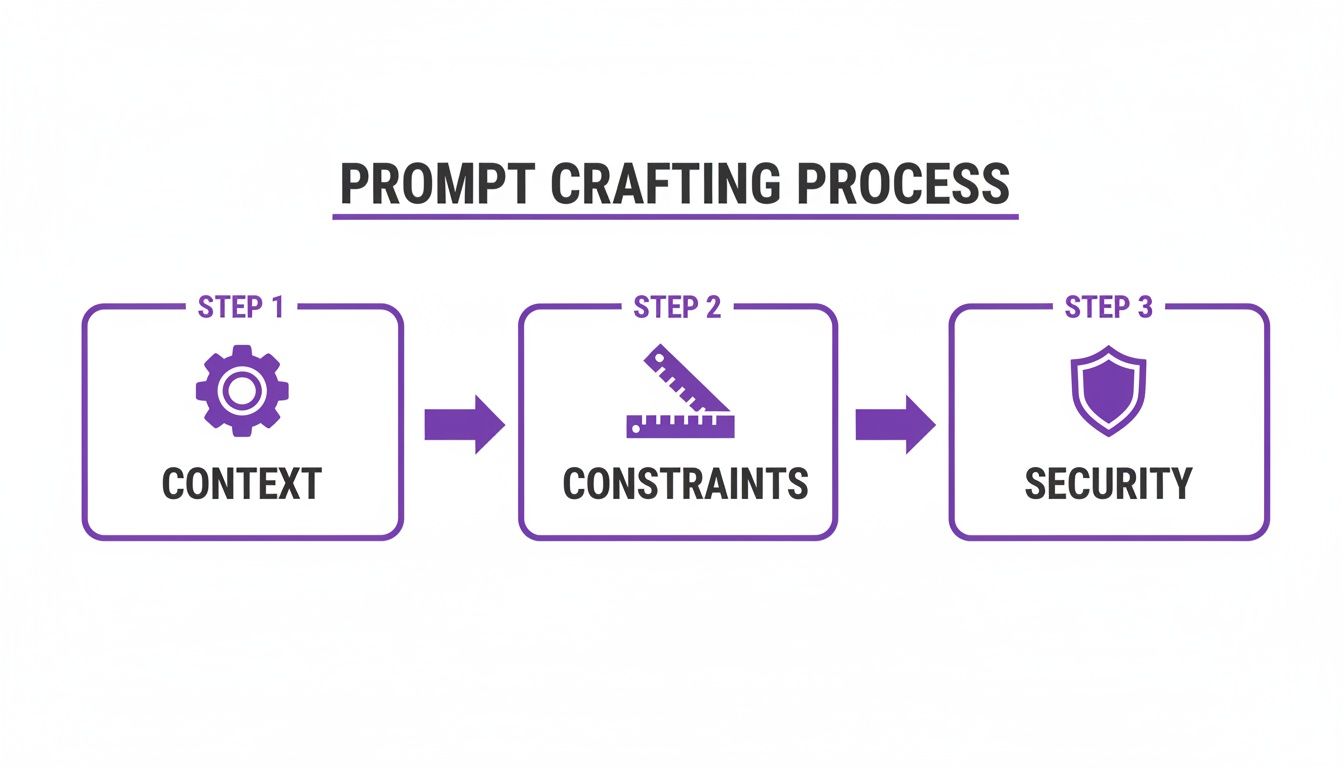
As you can see, a solid prompt is built on three pillars: providing clear context, setting firm constraints, and always emphasizing security. If you nail this first step, you're setting yourself up for a much smoother and faster development cycle, cutting out the old bottlenecks and shipping complete apps in a fraction of the time.
Auditing and Securing AI-Generated Code
In the high-stakes world of onchain development, security isn't just a feature; it's everything. While an AI pair programmer can feel like a superpower, you absolutely have to operate with a "trust, but verify" mindset. Think of AI as a brilliant assistant, not an infallible oracle. Every single line of code it produces must be scrutinized before it ever touches real assets.
This brings us to what some are calling the 'AI Productivity Paradox'. It's a fascinating problem. A recent Stack Overflow survey found that a whopping 84% of developers are using or planning to use AI tools. But here's the catch: trust is tanking. The same survey showed that 46% of developers are skeptical about AI's accuracy. This massive gap between adoption and trust means many teams aren't seeing the real-world gains they expected.
Adopting a Security-First Mindset
So, how do you bridge that gap? Simple. Treat every piece of AI-generated code like a first draft from a talented but very green junior dev. It's a fantastic starting point, but it needs a senior-level review before it's ready for primetime.
A great way to start is by flipping the script and asking your AI to put on its security auditor hat.
Try prompts like these:
- "Review this Solidity function for potential reentrancy vulnerabilities and suggest a fix."
- "Can you analyze this smart contract for integer overflow or underflow risks?"
- "Identify any potential gas optimization issues in this code."
This simple shift turns your AI from just a code factory into an active participant in your security process.
The goal isn't just to find bugs; it's to build a workflow where security is a constant, collaborative conversation between you and your AI. This proactive auditing is crucial for onchain applications.
Practical Auditing Techniques
Beyond just clever prompting, you need to bake real auditing tools into your workflow. Automated static analysis is your first line of defense, tirelessly scanning your code for known vulnerabilities.
For example, running a tool like Slither on your AI-generated smart contracts is non-negotiable. It’s brilliant at catching common pitfalls that are surprisingly easy for a human eye to miss. To really level up, you can explore a full suite of essential smart contract audit tools that cover everything from formal verification to fuzz testing.
Another powerful technique is to co-write your test suite with the AI. Prompt it to generate comprehensive unit tests that cover all the nasty edge cases, failure scenarios, and access control restrictions you can think of. This does more than just verify the code's logic—it forces you to think critically about its underlying security assumptions.
At the end of the day, using AI to code faster is really about augmenting your security process, not replacing it.
Common Questions About AI Pair Programming
As AI pair programming starts showing up in more dev workflows, a lot of good questions are popping up. This is especially true when we're talking about the high-stakes world of onchain development. It's smart to figure out where this new approach shines and where its limits are.
People often wonder if the code is actually production-ready. Another common point of confusion is how to juggle different AI tools—like what you've got in your local editor versus a cloud platform. Let's clear these up so you can use AI with confidence.
Is AI-Generated Code Secure for Smart Contracts?
The short answer? Not by itself. You should always treat AI-generated code as a first draft. It's an incredibly powerful draft, mind you, but still just a starting point. It's fantastic for scaffolding complex logic and getting you off the ground fast.
But—and this is a big but—it absolutely must go through a rigorous audit by a human before it ever touches mainnet. The best workflow is to let the AI handle the boilerplate and initial structure. Then, you step in with your expertise and tools like Slither to harden it.
Think of the AI as a brilliant junior dev. Their work is promising, but it always needs a final sign-off from someone senior.
How Dreamspace Fits into the Workflow
This is a great question because it gets at how these tools work together. You're probably already using an AI assistant like GitHub Copilot in your IDE for real-time suggestions. That's your local, line-by-line AI pair programming partner.
Dreamspace, on the other hand, is the orchestration layer. It's the vibe coding studio and AI app generator that takes the code you've drafted and turns it into a real, functioning application. You can deploy your smart contract, generate the SQL queries to read its data onchain, and even spin up a user-facing frontend—all from one place. It’s what connects your code file to a live DApp.
Can AI Help Debug Onchain Transactions?
Absolutely. This is honestly one of its most practical uses. Instead of squinting at a cryptic revert reason on Etherscan for an hour, you can just paste the error or the sketchy code snippet right into your AI assistant. For more on AI-powered development, the Copycat247's Blog is a great resource for ongoing discussions and updates.
Try asking it things like:
- "Explain this Solidity error like I'm five."
- "What are the most common reasons a transaction with this pattern would fail?"
The AI can often break it down in plain English and suggest potential fixes, which can slash your debugging time from hours to minutes.
Ready to turn your AI-assisted code into a live application? With Dreamspace, you can go from a smart contract to a fully deployed DApp with a shareable frontend. Generate, deploy, and share your onchain project today at https://dreamspace.xyz.