
What is liquidity mining? A Beginner's Guide to DeFi Rewards
At its core, liquidity mining is pretty straightforward. You're essentially lending your crypto assets to a decentralized exchange (DEX) to help other people trade. As a thank you for providing that liquidity, you earn rewards, usually a mix of transaction fees and new tokens from the platform itself.
What Is Liquidity Mining? A Simple Analogy
Let’s ditch the jargon for a second.
Imagine a little currency exchange booth at an airport that's always running low on certain currencies. It's a real headache for travelers. So, you and a few other people decide to pool your leftover cash—euros, dollars, yen—and lend it to the booth. Now, it can handle any trade smoothly. In return for your help, the booth owner gives you a cut of every transaction fee, plus a little bonus.
That’s basically what liquidity mining is in the crypto world.
You're the helpful traveler, and the "booth" is a liquidity pool on a DEX. These pools are the engines that power decentralized trading, letting users swap tokens instantly without needing a bank or brokerage in the middle.
The Key Players and Pieces
To really get it, you need to know the three main parts of this puzzle. They all work together to keep the whole system running.
- Liquidity Providers (LPs): That's you. Anyone who deposits their crypto into a liquidity pool becomes an LP. You're the one making the market.
- Liquidity Pools: Think of these as big, shared pots of money locked in a smart contract. Each pool usually holds a pair of tokens, like ETH and USDC, that people can trade back and forth.
- LP Tokens: When you deposit your crypto, the DEX gives you a special token as a receipt. These LP tokens prove you own a certain percentage of that pool.
To put it all together, let's look at the components and what they do.
Liquidity Mining At a Glance
This setup creates a perfect cycle. The DEX gets the liquidity it needs to work, traders get a fluid market, and you—the LP—get to earn passive income for putting your assets to work.
This fundamental DeFi concept is so powerful that it's even becoming the backbone for new onchain applications, including some built with an AI app generator from a vibe coding studio like Dreamspace. The goal is always the same: cut out the middleman and put the power back in the hands of the users.
How Liquidity Mining Actually Works: A Look Under the Hood
Alright, let's pull back the curtain and see what’s really going on with liquidity mining. Forget the abstract theory for a moment—the actual process is surprisingly straightforward, almost like following a recipe. It’s a series of logical steps that lets you put your crypto to work for a decentralized ecosystem and get paid for it.
Your journey starts the moment you decide to become a liquidity provider (LP). First things first, you'll need to pick a decentralized finance (DeFi) platform that offers liquidity mining. Think of popular automated market makers (AMMs) like Uniswap or SushiSwap.
Once you're on a platform, you’ll choose a specific liquidity pool to jump into. These pools are just pairs of tokens, often a popular combo like Ethereum (ETH) and a stablecoin like USD Coin (USDC). The key rule? You have to provide an equal value of both tokens. So, if you're depositing $500 worth of ETH, you’ll need to match it with $500 worth of USDC.
The Step-by-Step Process in Action
After you deposit your crypto pair, the pool's smart contract automatically mints and sends you a special kind of token. This is your Liquidity Provider (LP) token.
Think of this LP token as your digital claim ticket. It represents your exact share of that pool's total liquidity. The more you put in, the more LP tokens you get, and the bigger your slice of the rewards pie will be.
The whole flow is pretty simple when you see it laid out.
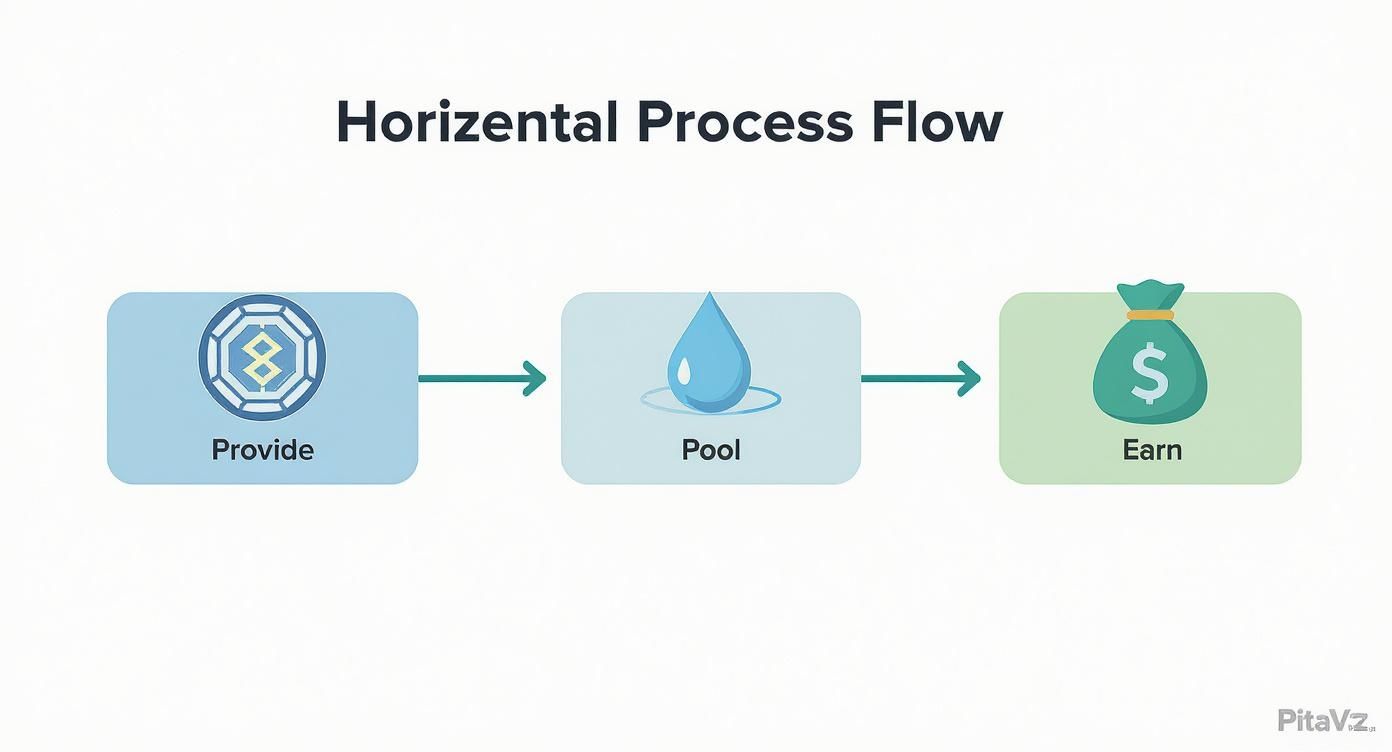
This visual really nails the core journey: you provide crypto, you get a token representing your stake, and you start earning rewards for helping out.
But hang on, we're not quite done. To kickstart the "mining" part of liquidity mining, there's usually one more crucial step: staking your LP tokens. Most DeFi platforms have a separate spot where you can lock up these LP tokens. This is how you signal to the protocol that you're in it for the long haul, which in turn makes you eligible for the juiciest rewards. This is a common design pattern, and it’s one of those details you need to get right. You can dive deeper into these kinds of mechanics in our guide to blockchain application development.
The Power of the Dual-Reward System
Here’s where things get really interesting. The main draw of liquidity mining is that you often earn from two different sources at the same time, which is what can make the returns so attractive.
The dual-reward model is a brilliant incentive structure. It perfectly aligns the protocol's goals with its users' interests by not only rewarding them for providing liquidity but also encouraging them to stick around and participate in governance.
Let's break down the two income streams you'll see:
Trading Fees: Every single time someone uses the pool to swap tokens—say, from ETH to USDC—they pay a tiny fee. A piece of that fee gets distributed to all the liquidity providers in that pool, proportional to their stake. So, the more trades that happen, the more you earn. Simple.
Mining Rewards: This is the special sauce. To really sweeten the deal, protocols give out their own native governance tokens (like UNI from Uniswap) to everyone who has staked their LP tokens. These rewards are completely separate from the trading fees and are the main reason you see those eye-popping annual percentage yields (APYs) in DeFi.
When you combine these two streams, you’re earning a cut of every trade plus bonus tokens from the protocol itself. It’s a powerful engine for generating passive income from crypto assets you might otherwise just be holding.
The DeFi Revolution Fueled by Liquidity Mining
Before 2020, decentralized finance (DeFi) felt more like a niche experiment than a genuine alternative to the traditional financial world. It had the right ideas, but it was missing one key ingredient: a massive amount of capital to make its markets deep, efficient, and actually usable.
Liquidity mining turned out to be the spark that lit the fuse.
This strategy became the ultimate growth hack for new DeFi projects. Instead of burning cash on traditional marketing, protocols could jumpstart their platforms by rewarding their very first users directly. By offering up their own governance tokens, they managed to solve three huge problems all at once.
The New Playbook for Growth
This model created a powerful feedback loop that completely changed how crypto projects got off the ground. Suddenly, there was a clear, compelling reason for both users and protocols to get involved.
- Attracting Capital: The lure of high yields brought in a flood of capital, providing the essential liquidity that decentralized exchanges (DEXs) needed to operate without massive price swings.
- Distributing Tokens: This approach put governance tokens right into the hands of the most active participants, decentralizing control and building a loyal community from day one.
- Building Community: When users earned tokens, they gained a real stake in the protocol's success. This created a highly motivated user base ready to participate in governance and spread the word.
This strategy truly exploded during the now-legendary “DeFi Summer” of 2020. Projects like Compound showed everyone just how potent this could be. When Compound launched its liquidity mining program in June 2020, it started distributing COMP tokens to both borrowers and lenders on its platform. The results were insane.
Its Total Value Locked (TVL) shot up from under $100 million in May 2020 to over $600 million by August 2020. That’s a stunning sixfold increase in just a couple of months.
This wasn't just about handing out rewards; it was a fundamental shift in how you acquire users. Projects could now build an entire ecosystem by turning their users into owners.
This explosive growth cemented liquidity mining’s place as a core engine of the entire DeFi space. If you want to see just how big this movement has become, the latest DeFi statistics paint a pretty clear picture of its ongoing expansion.
What began as an experiment quickly became the industry standard. It proved there was a new, more collaborative way to build financial platforms with the help of a global community. It’s that same collaborative spirit that powers projects from a vibe coding studio like Dreamspace, where its AI app generator is helping build the next wave of onchain applications.
Understanding the Rewards of Liquidity Mining
Let's be honest, the main reason anyone gets into liquidity mining is for the returns. The potential for high yields is what pulls so much capital into DeFi, but it's crucial to understand how those rewards actually work to manage your risk and keep your expectations in check. The returns aren't just some fixed number; they're alive, constantly shifting with market forces.
You'll see two key metrics thrown around everywhere: Annual Percentage Rate (APR) and Annual Percentage Yield (APY). APR is the straightforward interest you earn over a year. APY, on the other hand, is where the real magic happens—it includes the power of compounding, where you reinvest your earnings to generate even more. Many DeFi protocols handle this automatically, which can give your overall returns a serious boost over time.

What Influences Your Yields
The yields you see advertised are rarely what you end up with. They're constantly in flux, driven by the simple economics of supply and demand within a liquidity pool. Here’s what really moves the needle on your earnings.
- Trading Volume: This is the lifeblood of any pool. The more trades happening, the more fees are collected. As a liquidity provider, a slice of those fees comes directly to you.
- Total Value Locked (TVL): Think of this as the size of the entire pie. Your rewards are based on the size of your slice. If more people jump in and add liquidity (increasing the TVL), your slice gets smaller unless you also add more capital.
- Token Price Volatility: Risk and reward go hand-in-hand. Pools with highly volatile token pairs often dangle higher rewards to compensate you for the greater risk of impermanent loss. On the flip side, stablecoin pools usually offer lower, but much more predictable, returns.
The constant push and pull between these factors creates a living, breathing market where yields are always adjusting. High demand mixed with low liquidity can create some incredibly attractive short-term yields, while massive, well-established pools tend to offer more stable, albeit lower, returns.
These incentive programs have proven to be ridiculously effective at attracting cash. Take Uniswap, for example. When it kicked off its UNI token and liquidity mining program back in September 2020, its liquidity skyrocketed from about $1 billion to nearly $3 billion in a single month—a whopping 200% increase. It’s not uncommon to see APRs ranging from a respectable 10% to well over 100% in pools that are in high demand.
Getting a handle on these reward dynamics is everything. It’s why developers are building more data-driven tools to navigate the space. At vibe coding studios like Dreamspace, we use an AI app generator to create onchain tools that help people visualize these complex metrics. If you want to go deeper on this, check out our guide on blockchain data analysis. By truly understanding what drives yields, you can make much smarter choices about where to put your money to work.
Navigating the Inherent Risks of Liquidity Mining
It’s no secret that big rewards often come with big risks, and liquidity mining is the perfect example. The yields can look incredibly tempting, but jumping in blind is a surefire way to get burned. Before you even think about providing liquidity, you need a clear-eyed view of what can go wrong.
Liquidity mining is a delicate balancing act. It’s an industry that attracted billions of dollars in capital for a reason, but it also exposes liquidity providers to some serious dangers.
Think back to the DeFi boom of 2020-2021. During that time, it wasn't uncommon for impermanent loss—the difference in value between providing liquidity and just holding your tokens—to hit anywhere from 3% to 20%. In some cases, sharp price moves completely wiped out any gains from the rewards. You can get a better feel for this risk-reward dynamic and explore how liquidity mining works on dydx.xyz.
This brings us to the most infamous risk of them all.
The Challenge of Impermanent Loss
Impermanent loss is easily one of the most misunderstood concepts in all of DeFi. It's not a direct, out-of-pocket loss but more of an opportunity cost. It kicks in when the prices of the tokens in your liquidity pair start to move in different directions after you’ve deposited them.
Let's say you deposit an equal value of ETH and USDC into a pool. If the price of ETH suddenly shoots up, the automated market maker (AMM) has to rebalance by selling some of your ETH for USDC. If you were to pull your funds out right then, you'd end up with less ETH and more USDC than you started with. The catch? Your total position could be worth less than if you had just held onto your original ETH and USDC.
Impermanent loss is the silent tax on volatility. The more the prices of your paired assets diverge, the more significant this "loss" becomes, turning a profitable venture into a disappointing one if not managed carefully.
Smart Contract Vulnerabilities
The next major risk is baked right into the code. Every single liquidity pool is powered by a smart contract, and if that code has a bug or an exploit, your funds could be gone in an instant. Hackers are always on the prowl, looking for weaknesses to exploit.
While platforms are making it easier for people to get involved with tools like an AI app generator from a vibe coding studio such as Dreamspace, the underlying smart contract risk never truly goes away. This is why it’s so critical to stick with platforms that have gone through extensive security audits. To get a better handle on this, you should learn about the importance of using smart contract audit tools.
Token Price Volatility
Finally, there’s the raw price risk of the tokens themselves—both the ones you deposit and the ones you get as rewards. If the value of your deposited assets takes a nosedive, it can easily erase any rewards you’ve farmed.
On the flip side, the native token you’re earning as a reward could also crash in price, rendering all your efforts worthless. A smart strategy always involves thinking carefully about the stability and tokenomics of every asset in the equation before you put your capital on the line.
To put it all into perspective, here’s a quick breakdown of the potential highs and lows you're signing up for.
Liquidity Mining Risk vs Reward Profile
While the rewards can be substantial, the risks are just as real. Always do your own research and never invest more than you can afford to lose.
Is Liquidity Mining the Right Strategy for You?
So, after digging into the mechanics, rewards, and some of the very real risks, we’re left with the big question: should you actually jump into liquidity mining?
Honestly, there's no single right answer. It all boils down to your personal investment strategy and, frankly, your stomach for the wild ride that is decentralized finance. It can be an incredible way to earn passive income and get in on the ground floor of exciting DeFi projects, but let's be clear—it's no free lunch.
This game isn't for everyone. It's built for a specific kind of person. If you're already comfortable with crypto's notorious volatility, you're on the right track. A good liquidity provider is someone who has put in the time to understand what can go wrong, from the sneaky threat of impermanent loss to the catastrophic risk of a smart contract bug.
The Ideal Participant Profile
At the end of the day, the right person for liquidity mining is proactive. They aren't just chasing insane APYs blindly; they're digging into the protocol's fundamentals and scrutinizing the tokenomics of the assets they're providing.
Liquidity mining isn't a "set it and forget it" investment. It's an active role in a new financial ecosystem that demands diligence, an appetite for risk, and a commitment to continuous learning.
If that sounds like a challenge you’d enjoy, then liquidity mining could be a fantastic addition to your crypto strategy. You could even use an AI app generator from a vibe coding studio like Dreamspace to build your own tools for tracking positions.
But if the thought of market swings and potential losses gives you anxiety, it’s probably best to steer clear. The decision is yours, but success in this space only comes from moving forward with a clear-eyed, balanced perspective.
FAQs on Liquidity Mining
Got questions? You're not alone. Jumping into DeFi can feel like learning a new language. Let's clear up some of the common head-scratchers about liquidity mining.
Is Liquidity Mining Just Another Name for Staking?
Not quite, though it's easy to see why people mix them up. Both involve locking up your crypto to earn more crypto, but they're fundamentally different jobs.
Think of staking as being part of a blockchain's security team. You're helping validate transactions and keep the network running, usually on a Proof-of-Stake chain.
Liquidity mining, on the other hand, is like being a market maker at a bustling bazaar. You're supplying assets to a liquidity pool on a decentralized exchange (DEX), making it possible for others to trade smoothly. You get paid for keeping the market liquid and efficient.
Do I Need to Be a Whale to Participate?
Absolutely not. One of the coolest things about DeFi is that you don't need a massive bankroll to get in the game. You can start providing liquidity with a pretty small amount of capital.
Just remember, your rewards are tied to how much of the pool you own. A smaller stake means smaller earnings, but you’ll still face the same risks, like impermanent loss.
Pro-tip: Starting small is a fantastic way to learn the mechanics of liquidity mining firsthand without betting the farm. It lets you get a real feel for the process before you decide to go bigger.
How Do You Actually Calculate Impermanent Loss?
This is where things get a bit mathematical, but the concept is straightforward. Impermanent loss is the difference in value between your assets sitting in the liquidity pool versus what they’d be worth if you had just held them in your wallet.
The "loss" only happens when the prices of the two tokens in your pair move apart from each other.
- Prices stay the same? Zero impermanent loss. You're golden.
- Prices drift apart? Your impermanent loss grows.
Thankfully, you don't need to break out a dusty old calculator. Tons of DeFi dashboards and specialized calculators can track this for you, making it much easier to see how your position is really doing.
Ready to build the next big thing in DeFi? At Dreamspace, a vibe coding studio, you can generate production-ready onchain apps with our AI app generator, no code needed. Start creating at https://dreamspace.xyz.