
What Is Decentralized Finance A Beginner's Guide

Let's get one thing straight: Decentralized Finance (DeFi) isn't just a new buzzword. It's a complete reimagining of our financial system, built on the same secure, distributed ledger technology that powers cryptocurrencies.
The big idea? DeFi cuts out the middlemen. Think banks, brokerages, and other financial gatekeepers. It opens up the ability for anyone with an internet connection to lend, borrow, and trade assets directly with anyone else in the world.
Your First Look at Decentralized Finance
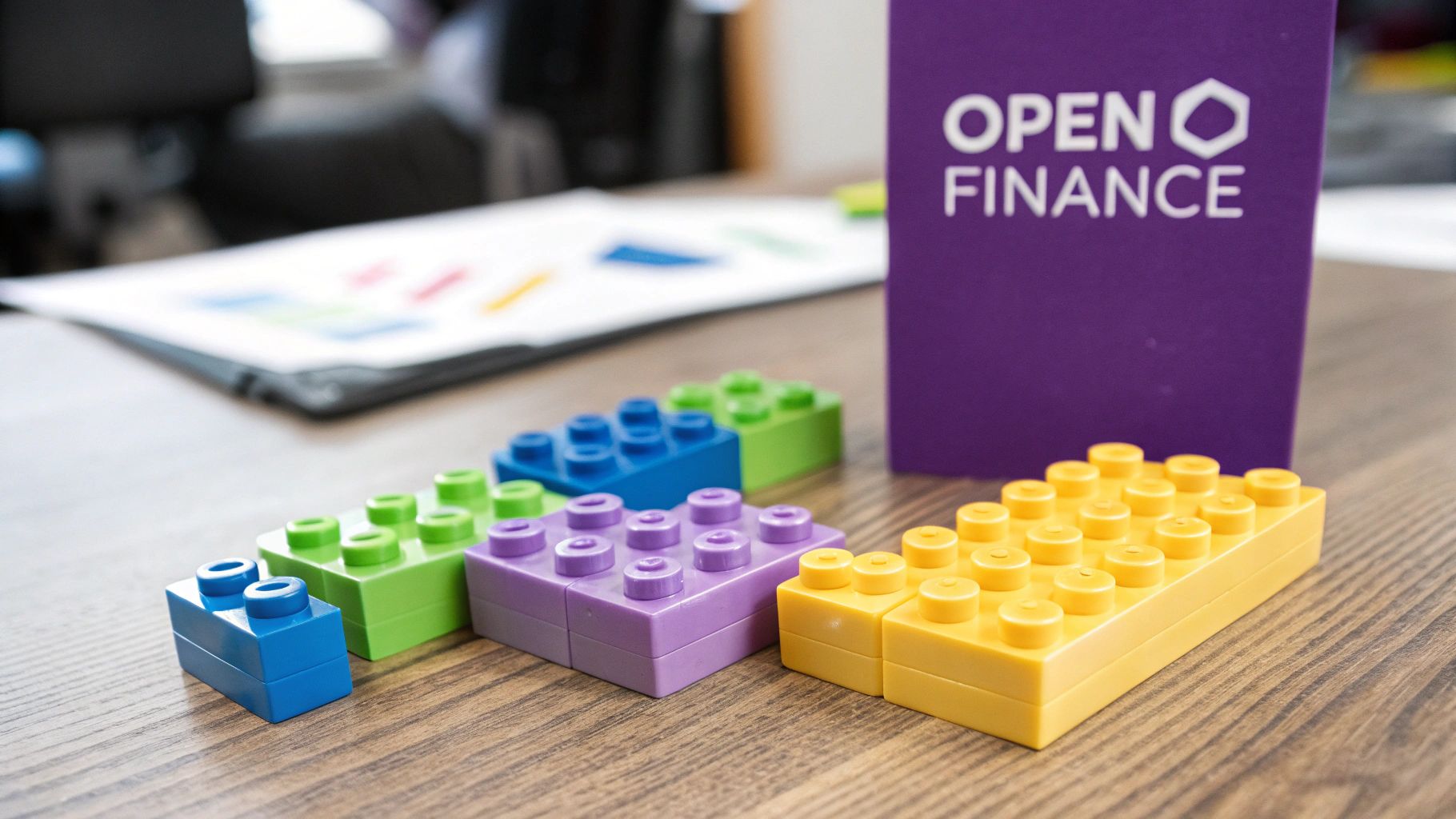
Think about the financial world you know as a giant box of LEGOs. In the traditional system, a big bank owns all the blocks. They dictate which pieces you can use, how you can connect them, and how much it'll cost you to play. That's traditional finance—centralized and controlled.
DeFi, on the other hand, just hands you the entire box of LEGOs.
Instead of relying on a central authority, DeFi uses blockchain and smart contracts to build a completely open and transparent financial ecosystem. It takes all the things we're used to—earning interest, borrowing, lending, trading—and rebuilds them on a global, peer-to-peer network.
A New Financial Playground
This shift creates a financial world that's far more accessible and fair. The whole point is that you have total control over your assets, held securely in your own digital wallet. You interact directly with financial protocols, no gatekeepers required.
At its heart, DeFi is about replacing an opaque, permissioned system with one that is transparent, open, and user-controlled. It empowers individuals by giving them direct ownership and agency over their financial lives.
This isn't some niche experiment, either. The DeFi market is exploding. Valued at over USD 32.42 billion recently, it's projected to skyrocket to an incredible USD 2.02 trillion by 2035. That's a compound annual growth rate of about 51.2%, signaling a massive change in how finance works.
For a side-by-side view, here's a quick breakdown of how these two worlds stack up.
Traditional Finance vs Decentralized Finance At a Glance
This table gives you a clear, at-a-glance comparison of the old guard versus the new kid on the block.
As you can see, the differences are fundamental, touching everything from who's in control to when you can actually access financial services.
From Concept to Creation
This new, open-source world is also a hotbed for creativity. Builders and developers are using these systems to create entirely new applications. It’s the perfect environment for tools like a modern vibe coding studio or an AI app generator to thrive, allowing creators to build onchain apps and jump into this new wave of technology.
In short, DeFi is flipping the script by focusing on:
- Accessibility: Anyone, anywhere can participate. No more geographical or institutional barriers.
- Transparency: Every transaction is recorded on a public blockchain for all to see.
- User Control: You, and only you, have custody of your assets.
Want to go a little deeper? This excellent article, What Is Decentralized Finance (DeFi) Explained, offers a fantastic breakdown of the core concepts and is a great place to start.
Understanding the Technology That Powers DeFi
To really get what DeFi is all about, you have to peek under the hood. It’s not some kind of financial magic—it’s a clever combination of three core technologies working in harmony to build a completely new kind of financial system.
It all starts with the blockchain. The easiest way to think about it is as a shared digital ledger, almost like a notebook that everyone can see but no one can change. Every transaction gets recorded as a "block" which is then added to the "chain," creating a permanent, transparent history of everything that’s ever happened.
Unlike a bank's private ledger, this notebook is copied and spread across thousands of computers worldwide. This distribution is what makes it so secure and nearly impossible to tamper with. It's no wonder blockchain adoption is soaring, accounting for over 42% of the market by component in recent years. The United States has been a huge driver, holding a massive 36.32% revenue share in North America alone.
The Role of Smart Contracts
The next piece of the puzzle is the smart contract. Picture a high-tech vending machine. You put in a specific amount of money (the input), and it's guaranteed to give you the snack you chose (the output). There's no cashier, no middleman—just a predictable, automated exchange.
That’s exactly what a smart contract is: a program that lives on the blockchain and automatically runs when certain conditions are met. These contracts are the workhorses of DeFi, handling everything from lending agreements to complex trades without a single human getting involved. This is what makes DeFi so incredibly efficient.
If you're curious about how these things are actually built, our guide on what is blockchain development is a great place to start.
This infographic breaks down how these three pillars—blockchain, smart contracts, and decentralization—come together to support the entire DeFi ecosystem.
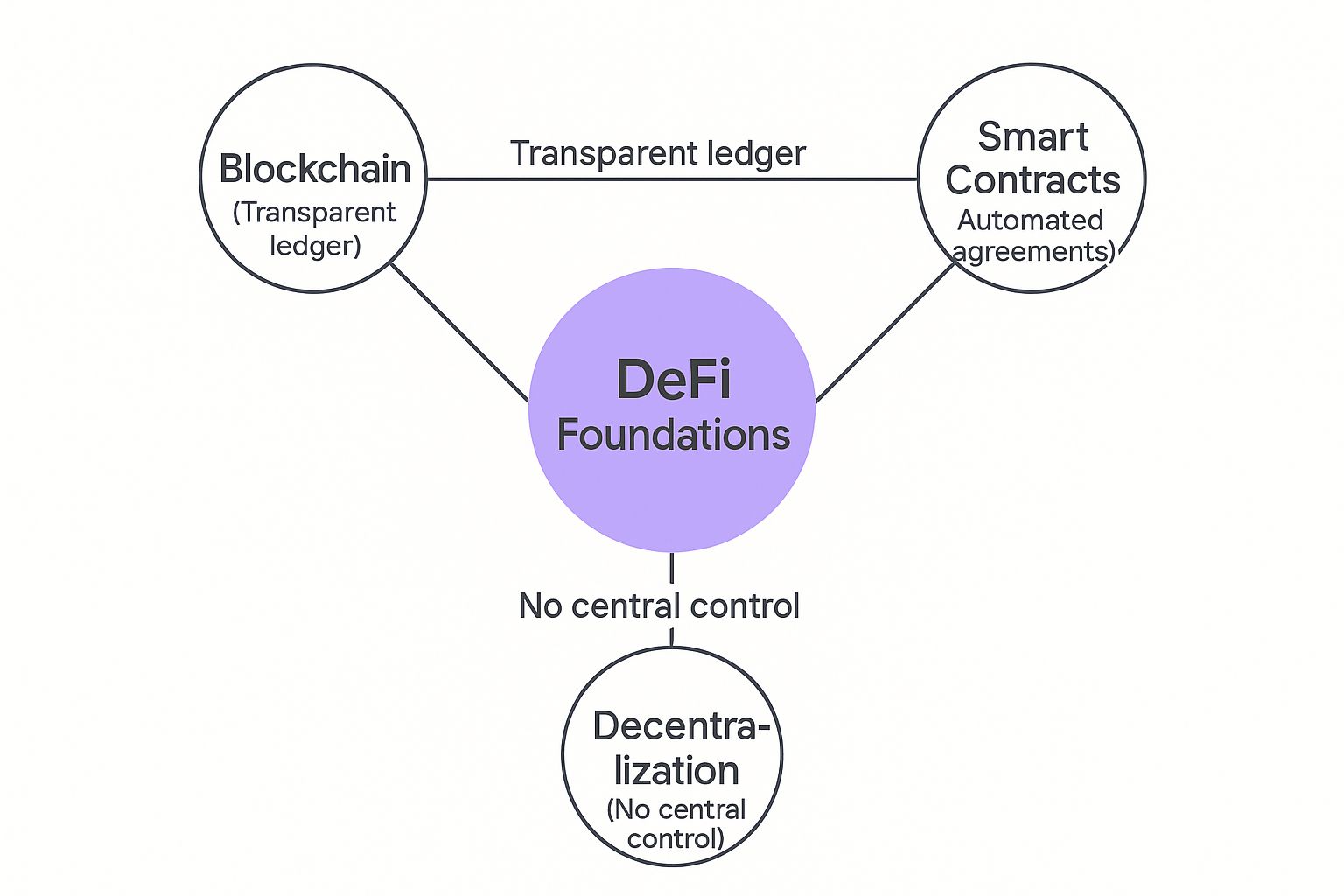
As you can see, each component is absolutely vital. Take one away, and the whole system just doesn't work.
The Power of Decentralization
Finally, decentralization is the glue that holds it all together. Traditional finance revolves around central authorities like banks and regulators. DeFi throws that model out the window.
By getting rid of a central point of control, the system becomes incredibly tough and resilient. There's no single server to hack, no headquarters to shut down, and no company that can manipulate the rules for its own benefit.
This structure ensures that users interact directly and securely with one another, fostering a system that is both censorship-resistant and globally accessible.
This is where the real paradigm shift happens. The whole system's integrity relies on this distributed ledger technology. Understanding how blockchain for payments works, for instance, gives you a practical look at these mechanics in action.
It’s this powerful trio—a transparent ledger, automated agreements, and a distributed network—that makes DeFi such a compelling alternative to the financial world we know today. It also creates a perfect environment for new tools like Dreamspace, an AI app generator and vibe coding studio designed to help people build the next wave of onchain applications.
Exploring What You Can Actually Do with DeFi
Alright, we’ve covered the tech behind the curtain. But what does DeFi actually let you do? Let's move past the theory and get into the real-world applications.
Think of DeFi as an entire financial system running on the blockchain—one that gives you the power to manage your money in ways that simply weren't possible before. We're talking about real, usable services you can access right now, without needing a bank’s approval.
Imagine swapping digital assets straight from your own wallet, earning interest that can blow traditional savings accounts out of the water, or even getting a loan without a credit check. It’s all happening in DeFi.
Trading on Decentralized Exchanges
One of the most common entry points into DeFi is the decentralized exchange (DEX). Picture a currency exchange booth at the airport, but instead of a person behind the counter, it’s all run by code. No middleman, no company custodying your funds.
Platforms like Uniswap let you swap one crypto for another directly. The entire process is just you and a smart contract. No sign-up forms, no KYC, and most importantly, your assets never leave your wallet until the swap is executed. You're always in control.
Lending and Borrowing without Banks
Another massive part of the DeFi world is peer-to-peer lending and borrowing. Protocols like Aave have basically built automated, global money markets that are open 24/7.
Here’s how it works:
- Lending: You can deposit your crypto into a lending pool and start earning interest almost immediately. Other users can then borrow from that pool, and you get a cut of the interest they pay. It’s all handled transparently by the code.
- Borrowing: Need some cash but don't want to sell your crypto? You can use your holdings as collateral to take out a loan instantly. Your eligibility is based purely on the value of your assets, not your credit score.
DeFi lending protocols turn your digital assets from static holdings into productive capital. They allow your crypto to work for you, generating yield in a transparent, automated, and globally accessible market.
This system creates a more efficient and open way for anyone to access capital or earn a return on their holdings.
Common Applications within the DeFi Ecosystem
The DeFi ecosystem is vast, but most activities fall into a few key categories. Here's a quick look at some of the most popular applications and the protocols that power them.
These are just a handful of the building blocks. The real magic happens when you start combining them to create more sophisticated financial strategies.
The Critical Role of Stablecoins
Of course, the crypto market is famously volatile. This is where stablecoins become absolutely essential. They are cryptocurrencies designed to hold a steady value, usually by being pegged 1-to-1 with a fiat currency like the U.S. dollar.
Stablecoins give you a safe harbor from the wild price swings of assets like Bitcoin or Ethereum. You can hold value on the blockchain without the risk of waking up to a 20% drop. Their importance is clear when you see the numbers: over $146 billion in stablecoins were circulating in DeFi as of June of a recent year. A major player, USDC, is now integrated into 92% of top DeFi lending and DEX protocols. You can dive into the data yourself and read the full research about DeFi market trends.
Advanced Strategies Like Yield Farming
Once you get the hang of the basics, DeFi opens up a world of more advanced strategies. Yield farming, for instance, is the art of chasing the highest returns by moving your assets between different lending protocols and liquidity pools.
It's kind of like an extreme version of switching between high-yield savings accounts at different banks, but it happens in real-time, 24/7, across a global, programmable financial system. These applications prove that DeFi isn’t just a concept—it’s a living, breathing financial ecosystem with real, tangible uses.
Why DeFi Is More Than Just a Crypto Trend
It's easy to dismiss decentralized finance as just another crypto buzzword, but its real significance goes much deeper than the technology itself. DeFi offers tangible, practical solutions to problems that have plagued traditional finance for decades. This isn’t just a niche for speculators; it's a fundamental reimagining of how money works, making the system more open, efficient, and centered around the user.
At its heart, DeFi is about financial inclusion. Billions of people around the world are shut out of the traditional banking system. For them, DeFi is a lifeline. All it takes is an internet connection to get access to a full suite of financial tools—from savings and loans to trading—no questions asked. It sidesteps the geographical and bureaucratic walls that keep so many people locked out.
Unlocking Transparency and Efficiency
Beyond just access, DeFi introduces a radical level of transparency. Every single transaction is recorded on a public blockchain, creating an immutable, auditable record that anyone can see. This completely does away with the hidden fees, confusing terms, and behind-the-scenes dealings that are all too common in traditional finance. In DeFi, the rules are embedded in code, and they apply equally to everyone.
This reliance on code also creates incredible efficiency. Smart contracts automate tasks that used to require a whole team of intermediaries, which slashes costs and speeds everything up. Right now, there are over 1,700 DeFi applications doing everything from stablecoin swaps to complex yield farming strategies. In fact, the top five DeFi protocols all use stablecoins as their primary collateral. You can discover more insights about DeFi applications from InsightSLICE.
DeFi’s true promise is in replacing a system built on trust in institutions with a system built on verifiable code. It gives control back to the individual, making finance more equitable and direct.
This blend of see-through operations and automation creates a financial backbone that's faster, cheaper, and more dependable. It's the perfect foundation for builders and creators to innovate, and an ideal environment for a vibe coding studio and AI app generator like Dreamspace to empower users in creating the next generation of onchain applications.
The Power of Self-Custody
Maybe the most powerful advantage of all is self-custody. Think about it: when you put your money in a bank, you’re legally handing over control of it. In DeFi, you hold the private keys to your digital wallet. That means you—and only you—are in charge of your assets.
This principle of true ownership is what the entire DeFi movement is built on. It’s your protection against a bank failing, a government freezing your account, or any other form of censorship. Your money is yours, full stop. When you combine that self-sovereignty with global access and transparency, you can see why DeFi is much more than a passing trend. It's the groundwork for a whole new financial world.
Navigating the Common Risks and Challenges
While DeFi opens up a world of financial possibilities, it's not a risk-free game. You have to go in with your eyes wide open. The very things that make this space so innovative—the autonomy, the automation—also create their own unique set of challenges.
Knowing what you’re up against is the first step to making smart decisions.
The single biggest risk in DeFi is smart contract risk. Think of a smart contract as a digital vending machine that runs on code. If that code has a bug or a loophole, hackers can and will find a way to exploit it. We're not talking about a theoretical problem here; hundreds of millions of dollars have been drained from protocols because of a single misplaced line of code.
What makes this even trickier is that smart contracts are often immutable—once they're live on the blockchain, you can't just go in and patch the bug. That’s why rigorous code audits are non-negotiable for serious projects. Getting familiar with the basics, like what reputable smart contract audit tools look for, can help you judge a platform's security.
Understanding Market and Platform Risks
Another major hurdle is market volatility. Crypto prices can swing wildly, sometimes in a matter of hours. This is a double-edged sword. While it’s the source of those incredible gains you hear about, it can also lead to massive losses, especially if you're using your assets as collateral for a loan.
Beyond the general market chaos, there's a specific risk for anyone providing liquidity to decentralized exchanges: impermanent loss. It's a tricky concept, but it basically means you could end up with less value than if you had just held onto your tokens instead of pooling them. If you’re thinking about getting into yield farming, this is something you absolutely need to understand.
DeFi's growth is undeniable, but it's happening within an evolving landscape. The key is to balance the immense potential with a healthy respect for the technical and market risks involved.
Despite these hurdles, the ecosystem is expanding at a breakneck pace. The Total Value Locked (TVL) in DeFi protocols, a key metric for the sector's health, recently hit $123.6 billion, a 41% jump from the previous year. You can learn more about these DeFi market findings to get the full scoop on the industry's growth.
The Challenge of Regulatory Uncertainty
Finally, we have to talk about regulatory uncertainty. Let's be honest: governments and financial watchdogs are still scratching their heads about DeFi. The rules are often unclear, vary wildly by country, and can change on a whim. This creates a pretty unpredictable environment for everyone involved.
This lack of clear rules means there's no safety net. If a protocol gets hacked or a project fails, there’s no FDIC-equivalent to bail you out. You are your own bank, which is incredibly empowering but also means you bear all the responsibility. Successfully navigating this world requires a ton of research and a healthy dose of caution.
How to Get Started with DeFi Safely

Ready to dive in and see what decentralized finance is all about? It’s an exciting frontier, but stepping in without a plan is a recipe for disaster. The golden rule is simple: start small, do your own research, and never, ever put in more money than you’re willing to lose.
Think of it like learning to swim. You wouldn't jump into the deep end right away. You’d start in the shallows, getting a feel for the water. That’s exactly the mindset you need here. While DeFi is constantly evolving with cheaper, more user-friendly solutions, a cautious first step is non-negotiable.
Your Three-Step Entry Plan
To get your feet wet safely, follow this simple three-step plan. It’s a tried-and-true path for beginners to gain hands-on experience without taking on massive risk.
Set Up a Secure Digital Wallet: First things first, you need a non-custodial wallet. This is your personal vault where you—and only you—control the keys. Options like MetaMask or Trust Wallet are solid starting points and widely supported by DeFi protocols.
Acquire Some Crypto: Next, you’ll need fuel for the engine. Head to a reputable crypto exchange and buy a small amount of a major asset like Ethereum (ETH). It’s the native currency for the Ethereum network, which is where most DeFi action happens, and you'll need it for transaction fees (gas).
Try a Well-Established Application: Now for the fun part. Dip a toe in by using a blue-chip DeFi protocol. Try swapping a tiny amount of crypto on a decentralized exchange like Uniswap or lending an equally small sum on a platform like Aave. This real-world experience is where the learning really happens.
The secret to a safe DeFi journey is all about incremental learning. Every small action—from setting up that first wallet to making a tiny swap—builds the confidence and practical knowledge you need to navigate the ecosystem.
Once you’re more comfortable, you might find yourself getting curious about what makes these platforms tick. For those who want to look under the hood, learning how to build smart contracts offers a much deeper understanding. It's also where new tools like Dreamspace, a vibe coding studio and AI app generator for building onchain apps, are making it easier for creators to build their own projects.
Got Questions About DeFi? We've Got Answers.
Diving into DeFi can feel a bit like learning a new language. Let's clear up some of the most common questions that pop up when you're just getting started.
Is DeFi Safe?
That's the million-dollar question, isn't it? The short answer is: it depends. The underlying blockchain technology is incredibly secure, but the apps (or smart contracts) built on top of it are only as safe as the code they're written in.
Think of it like this: the foundation of a building might be solid rock, but if the construction is shoddy, it's still risky. Hackers often look for bugs in a protocol's code to exploit. This is why it's so important to stick with well-known, battle-tested platforms that have undergone multiple security audits.
And always, always remember the first rule of crypto: never invest more than you are willing to lose. Get familiar with risks like impermanent loss and practice smart wallet security before you put any serious money on the line.
Do I Need a Ton of Cash to Get Started?
Not at all. In fact, starting small is the smartest way to go. You can dip your toes in with just a few dollars to get a feel for how everything works without taking a major financial hit.
One thing to keep an eye on, though, is transaction costs, often called "gas fees." On a busy network like Ethereum, these can sometimes be surprisingly high. Newer blockchains and Layer 2 solutions often have much lower fees, making them a more friendly starting point for beginners.
Is DeFi Actually Anonymous?
This is a common misconception. DeFi is pseudonymous, not anonymous. Your real name isn't attached to your crypto wallet, but every single transaction is recorded on a public ledger for anyone to see.
Your wallet address is like a username that can't be changed. Anyone can look up that address and see its entire history—every coin sent, every token swapped, every protocol interacted with.
While your real-world identity is shielded, your financial activity is completely out in the open. It's a trade-off between privacy and transparency.
Is DeFi Regulated?
Right now, we're in a bit of a "wild west" phase. The rulebook for DeFi is still being written, and it looks different in every country. Many protocols are operating in a legal gray area as governments scramble to figure out how to handle this new financial frontier.
This regulatory uncertainty is one of the biggest risks in the space today. If something goes wrong, you might find you have very little legal protection or recourse. It's a key factor to consider as the industry continues to mature.
Ready to move from learning to building? Dreamspace is an AI app generator and vibe coding studio that lets you create your own onchain apps with no code required. Explore the future of decentralized applications at https://dreamspace.xyz.