Choosing Your SaaS Development Platform A Founder's Guide
At its core, a SaaS development platform is a complete toolkit for building, launching, and running a Software-as-a-Service business. Think of it like a professional chef's kitchen, already stocked with top-tier appliances, plumbing, and workstations. This setup lets the chef focus entirely on their craft—creating an incredible dish—instead of worrying about building the kitchen itself.
This approach strips away a massive amount of the typical development friction and time.
The Foundation for Building Faster

Imagine you want to open a new restaurant. Before you could even brainstorm a menu, you’d have to build the physical space, install all the plumbing, and run the electrical wiring. It’s a huge, costly distraction from what really matters: serving amazing food. Building a SaaS app from scratch can feel exactly the same.
Developers burn countless hours on foundational tasks that are completely disconnected from their core product idea. This is precisely where a SaaS development platform comes in. It handles all the backend "plumbing" for you.
What Problems Do These Platforms Solve?
Instead of forcing you to code every single foundational piece, these platforms offer ready-made solutions for the most common—and frankly, most tedious—challenges in software creation. This frees up founders and their teams to pour their energy into what makes their product special.
Here’s what they take off your plate:
- Repetitive Infrastructure Setup: No more manually configuring servers, setting up databases, or wrestling with deployment pipelines. It's all handled.
- User Management and Authentication: Pre-built systems for user sign-ups, logins, and security protocols are ready to go, saving weeks of work.
- Subscription and Billing Logic: Integrated payment gateways and subscription management tools are included, tackling a notoriously complex part of any SaaS.
- Scalability Concerns: They are built on cloud infrastructure designed to grow with your user base, so you don't have to worry about crashing when you go viral.
This shift is huge. By offloading the undifferentiated heavy lifting, you can focus your limited resources on what actually provides value to your customers. It’s the difference between building blocks and building a business.
The Rise of No-Code and AI Generators
The evolution of these platforms didn't stop at infrastructure. Modern tools are now abstracting away the code itself. You can get a deeper dive into how this works in our guide on what is no code development.
A SaaS development platform liberates founders from the tyranny of infrastructure, allowing them to focus entirely on solving a customer's problem. This fundamental shift accelerates time-to-market and dramatically lowers the barrier to entry for new ideas.
This trend leads directly to tools like Dreamspace, an AI app generator that acts as a specialized vibe coding studio. It takes the platform concept even further, especially for complex onchain applications. Instead of just providing the kitchen, it uses AI to cook the entire meal for you, empowering creators to launch sophisticated products without the traditional overhead or deep technical expertise.
What's Under the Hood? Core Architecture and Key Features
To really get what makes a SaaS development platform tick, you have to look at its architecture. This isn't just a boring list of features; it's the very blueprint that dictates how your app will run, scale, and stay secure. Once you understand these core pieces, it becomes crystal clear why this approach is such a game-changer for founders.
Think of it like a modern apartment complex. The building provides shared infrastructure—plumbing, electricity, security—but every tenant gets their own private, locked-down unit. That’s the core idea behind multi-tenant architecture, a foundational concept for almost every SaaS platform out there. This model lets tons of different customers (tenants) use the same application, while keeping all their data completely separate and safe.
It's an incredibly efficient way to build. Instead of constructing a brand new house for every user, the platform maintains one core structure, which dramatically slashes maintenance overhead and costs.
The Elastic Foundation of Cloud Infrastructure
The other massive architectural piece is scalable cloud infrastructure. Picture this as an elastic foundation for your app. When you only have a few users, the foundation is small and cheap. But as you rocket from a hundred users to a hundred thousand, that foundation automatically stretches to handle the load without breaking a sweat.
This auto-scaling is a lifesaver. It means you can forget about manually managing servers or panicking when a marketing campaign goes viral. Your app just stays fast and responsive. It’s a world away from the old days of buying and racking physical servers, a process that was as slow as it was expensive.
The Must-Have Features Every Platform Needs
While architecture provides the skeleton, features provide the muscle. A solid SaaS development platform comes loaded with a toolkit of non-negotiables that handle all the tedious, heavy lifting of running an online business.
- Subscription and Billing Management: This automates what is easily one of the most painful parts of running a SaaS. It juggles recurring payments, tiered pricing, free trials, and invoicing, all without you having to write a single line of payment code.
- Robust Security Protocols: From user authentication and access control to data encryption, a great platform bakes security in from day one. This keeps both you and your customers safe from threats.
- Analytics and Reporting Dashboards: How do you actually know if your product is working? Built-in analytics give you the crucial data on user behavior, engagement, and revenue, so you can make decisions based on facts, not guesswork.
- Seamless API Integrations: No app is an island. The power to connect with other services through APIs is essential for building a complete tool. Following the best practices for API design is absolutely critical for ensuring these connections are stable, secure, and easy to work with.
The real magic of a SaaS development platform isn't just the speed you get today, but the future-proofing it gives you for tomorrow. By tackling scalability, security, and billing from the start, it lets founders build with total confidence.
Modern platforms are pushing this even further. For instance, the AI app generator Dreamspace extends these core features into new territory. This vibe coding studio is built specifically for creating complex onchain solutions, weaving blockchain-native functions directly into its core architecture.
When you put the two approaches side-by-side, the difference becomes obvious. Building from scratch just can't compete with the speed and efficiency of a dedicated platform.
Traditional Development vs SaaS Platform Approach
The table below breaks down just how different the journey is. You're essentially choosing between building a car from individual parts or starting with a high-performance chassis and engine already good to go.
The numbers don't lie. Using a platform allows you to pour your energy and resources into what actually matters: building an amazing product that your customers will love.
Why the SaaS Market Is Exploding
To really get why a SaaS development platform is such a game-changer, you have to appreciate the sheer size of the wave it's riding. The SaaS market isn’t just growing—it's completely reshaping how businesses get things done on a global scale. This explosion is creating the perfect storm for new ideas and tools to take off.
What’s at the heart of all this? One powerful word: accessibility.
Companies are ditching clunky, on-premise software that costs a fortune upfront and demands constant manual updates. They're all in on flexible, subscription-based tools that cost less, update themselves, and let teams work from anywhere.
This isn't some small trend; it's a tidal wave. The global SaaS market is projected to hit somewhere between $315 to $320 billion in 2025. That’s a massive jump from $178 billion back in 2020. We're talking about nearly 78% growth in just five years, with SaaS now accounting for a mind-boggling 85% of all business software. If you're curious, you can dig into the SaaS market trends and data for yourself.
The Forces Driving This Exponential Growth
This incredible market expansion didn't just happen by accident. A few powerful forces have lined up perfectly to make the SaaS model the go-to choice for almost every modern business. Once you see what’s driving this, you’ll understand where the real opportunities are.
It really boils down to three key factors:
- Predictable Revenue Models: For founders and companies, subscriptions create a steady, predictable stream of revenue. Investors love this, and it makes it much easier to plan your finances and forecast growth.
- Lower Barrier to Entry for Customers: Instead of a huge upfront cost, customers can get access to powerful software for a low monthly fee. This opens the door for small and medium-sized businesses to use tools that were once only available to large enterprises.
- Demand for Scalability and Flexibility: Businesses today need tools that can grow with them. Cloud-based SaaS can scale up instantly to handle more users or more data, offering an agility that old-school software could never match.
These drivers have created the perfect environment for the next wave of development tools—ones designed to make it even easier to get in the game. This is where things get really interesting.
How Next-Generation Platforms Are Capitalizing
All this demand for SaaS has, naturally, created a huge demand for better ways to build it. The timing is perfect for a SaaS development platform that can simplify the entire process from idea to launch. The market is hungry for solutions that cut through the complexity and help builders ship faster.
This diagram shows you the core pieces a modern platform handles so you don't have to.
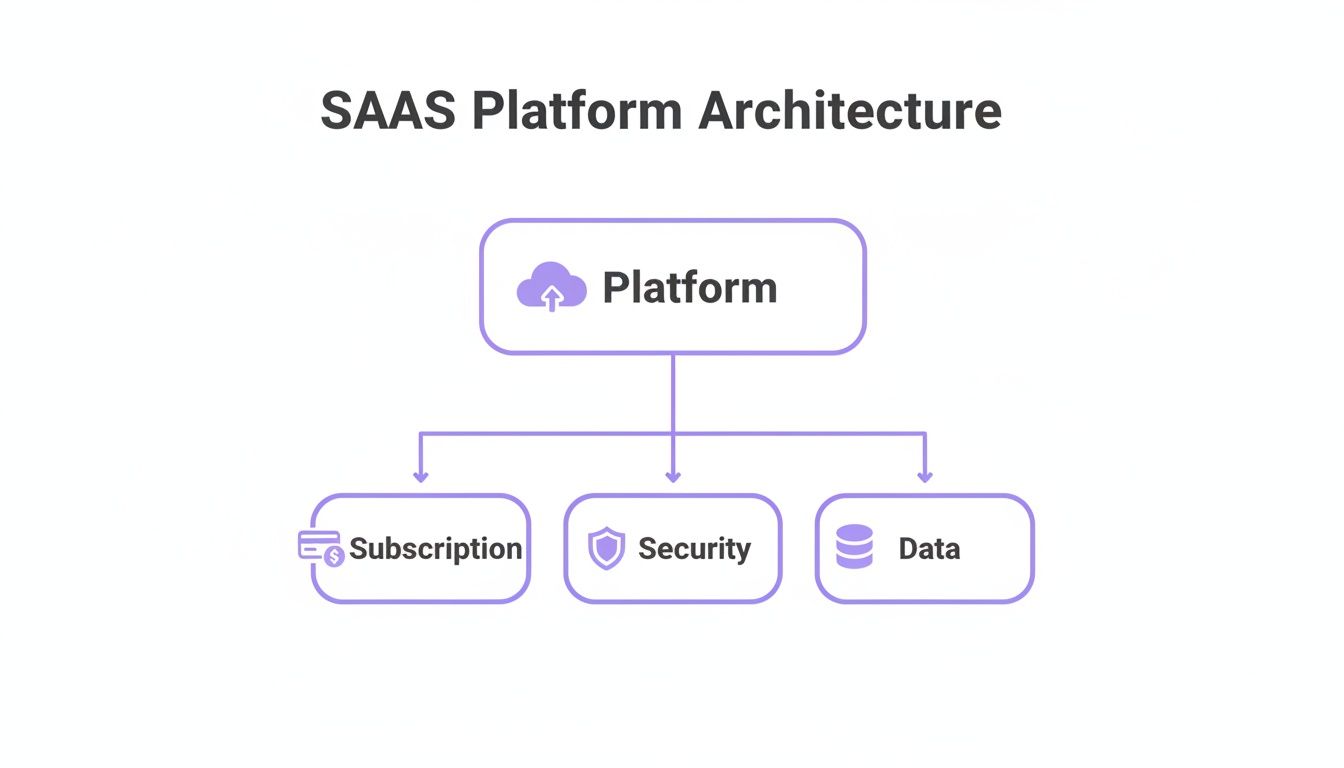
As you can see, the platform becomes the central hub, taking care of critical, but tedious, functions like subscriptions, security, and data management. This frees developers up to focus on what actually makes their product unique.
The SaaS explosion isn't just about more software; it’s about creating entirely new possibilities. As the market gets bigger, it opens up space for specialized platforms that serve high-growth niches.
This is exactly where a tool like Dreamspace comes in.
As a vibe coding studio, it doesn't just ride the SaaS wave—it's defining a whole new category inside of it. By acting as an AI app generator for production-ready onchain apps, Dreamspace is built specifically for creators in the fast-growing crypto world. It taps into the broader SaaS boom to empower a specific community, proving that as the market expands, there are endless opportunities for focused, innovative solutions.
How AI Is Redefining SaaS Development
Artificial intelligence isn't some far-off concept in software anymore—it's the new engine driving the modern SaaS development platform. The old dynamic, where developers simply gave commands to their tools, is over. We're now in an era of dynamic, collaborative partnership where AI is fundamentally changing how applications get made.
This shift is turning development platforms from passive toolkits into something more like an intelligent co-founder, capable of automating the deeply technical work that used to eat up hundreds of developer hours.
From Passive Copilots to Autonomous Agents
Not long ago, AI in development was a simple copilot. It suggested code snippets and caught obvious errors, which was helpful, but the human developer was still flying the plane. Today, the game has completely changed. The most advanced platforms are deploying autonomous AI agents that can take the controls themselves.
These agents can understand a simple, natural language prompt—like "build a decentralized social media platform with user profiles and token-gated posts"—and then execute the entire development process from start to finish.
They're handling it all: generating complex backend logic, structuring databases, and even designing intuitive user interfaces. What was once a painstaking manual process is now more like a conversation between a creator and their AI partner.
The Financial Proof of the AI Shift
This isn't just a cool tech trend; it's a massive market shift with serious money behind it. The global AI SaaS market is on a rocket ship, set to hit $101.73 billion in 2025 and projected to grow at a blistering 39.4% compound annual growth rate through 2032. That growth completely smokes the already impressive expansion of the broader SaaS industry.
This momentum is fueled by real-world results. A whopping 70% of SaaS companies are already playing with or actively monetizing AI-powered features. This is where the true power of an AI-native SaaS development platform really shines.
The goal of AI in development isn't to replace the creator, but to amplify their vision. It removes the technical friction between a great idea and a working product, letting creativity flow directly into creation.
AI as the Ultimate Accelerator
By taking over the most time-consuming parts of development, AI agents free up founders and their teams to focus on what really matters: high-level strategy, user experience, and finding market fit. Instead of getting bogged down in boilerplate code for months, they can get a minimum viable product (MVP) out the door in days, sometimes even hours.
This incredible speed is empowering a whole new generation of builders. Platforms are now being designed from the ground up with this principle in mind.
- Code Generation: AI can write clean, secure, and efficient code for frontends, backends, and even complex smart contracts.
- Database Management: It automatically designs schemas, writes queries, and optimizes database performance based on what the app needs.
- UI/UX Design: AI can generate user-friendly interfaces and design systems to ensure a consistent, professional look and feel.
- Automated Testing: It can write and run tests to catch bugs and vulnerabilities long before a user ever sees them.
If you're curious about the nuts and bolts, our article on how code generation AI works dives deep into the mechanics. This is the exact technology that powers tools like Dreamspace. As an AI app generator and vibe coding studio, it lets creators turn ideas into production-ready onchain apps and smart contracts in minutes, perfectly capturing the shift from manual coding to AI-powered creation.
Selecting the Right Platform for Your Project
Choosing a SaaS development platform is more than just a technical task—it's a strategic move that sets the entire course for your project. Pick the right one, and it feels like a tailwind pushing you forward. Pick the wrong one, and it's like trying to build with an anchor tied to your feet.
This is especially true for founders building in niche ecosystems like web3.

Ultimately, you're searching for a platform that truly speaks your project's language. A generic, one-size-fits-all tool might check a few boxes, but a specialized platform gets the unique struggles and opportunities of your space. It provides solutions that just work.
Evaluate Your Core Needs
Before you dive into a sea of feature comparisons, hit pause. First, you need to define what your non-negotiables are. Getting crystal clear on these essentials will be your north star through the entire selection process.
Focus your evaluation on these three pillars:
- Scalability: Can this platform grow with you? You need an architecture that won’t buckle under pressure, supporting you from your first 10 users to your first million without a hitch.
- Security: How does the platform guard user data? For any SaaS, this is critical. For onchain apps handling digital assets, it's everything. Look for rock-solid authentication, encryption, and compliance.
- Integration Capabilities: Your app won’t exist in a silo. It needs to play nice with other tools, from payment gateways to analytics dashboards. A platform's ability to connect to other services is huge, and looking into the best API integration platforms can give you a good sense of what a powerful, connected ecosystem really looks like.
Special Considerations for Web3 and Onchain Projects
If you're building on the blockchain, the checklist gets a lot more specific. A standard SaaS platform just wasn't built for the decentralized world and often lacks the native functions you'll need.
The best platform for an onchain project is one that was born in web3, not one that simply added a few crypto features as an afterthought. Native support isn't a luxury; it's a fundamental requirement for building with confidence and speed.
This is where finding a platform that "speaks the language" is so vital. For onchain development, that means looking for baked-in support for core web3 tech.
Ask yourself, does the platform offer:
- Smart Contract Generation and Deployment: Can you create, test, and push contracts live directly from the platform without wrestling with a separate, clunky toolchain?
- Wallet Integrations: Does it come with out-of-the-box support for popular crypto wallets to make user onboarding seamless?
- Blockchain Data Queries: Can you easily pull and analyze onchain data? This is absolutely essential for building smart, responsive dApps.
This is exactly the gap Dreamspace was built to fill. As a vibe coding studio, it’s not just another tool—it’s an environment designed from the ground up for the onchain world. It acts as an AI app generator that gets the nuances of blockchain development, simplifying everything from writing smart contracts to analyzing data.
If you're digging into this world, our guide on the best AI app builder offers a deeper look at how tools like these are completely changing the game.
Frequently Asked Questions About SaaS Platforms
Diving into the world of SaaS development platforms is bound to bring up some questions. Once you get past the basic concepts, the real-world stuff—cost, flexibility, and long-term risks—starts to bubble up. This section cuts right to the chase, giving you clear, direct answers to the questions we hear most often from founders.
How Much Does a SaaS Development Platform Typically Cost?
This is usually the first question on everyone's mind. The cost of a SaaS development platform can vary a lot, but the good news is that it almost always uses a subscription model. That's a massive shift from the old way of doing things, where you’d need to sink tens or even hundreds of thousands of dollars into engineers and servers before you even knew if you had a viable product.
Instead, these platforms offer tiered pricing. You'll often find a free or cheap plan for solo builders and early-stage projects, which then scales up to more powerful enterprise plans with all the bells and whistles. For instance, a basic plan might run you $30 to $100 per month. As your app grows and you need more power, you might look at plans ranging from $300 to several thousand dollars a month.
The real win here is predictability. You're swapping a huge, risky upfront investment for a manageable monthly operational cost. It lets you hold onto your cash and scale your spending as you grow.
Am I at Risk of Vendor Lock-In?
That’s a totally fair and important question. Vendor lock-in is what happens when it becomes so painful or expensive to move your app to another platform that you're essentially trapped. This was a much bigger headache in the early days of the cloud, but modern platforms are a lot smarter about it.
Many of the best platforms today give you solid data export options and open APIs, making it much easier to pack up your data if you need to leave. The catch? The specific logic and workflows you build on a platform are often their secret sauce. This means you can take your data with you, but you'll probably have to rebuild the app's functionality from scratch on a new system.
Here’s how to protect yourself:
- Look for platforms built on open standards. This makes your skills and some of your work more portable.
- Make strong API and data export features a must-have. You should always own and be able to access your core business data.
- Understand the architecture before you commit. Know what’s proprietary and what isn’t from the get-go.
How Much Customization Is Really Possible?
There's a common myth that using a SaaS development platform means you're stuck with a cookie-cutter template. While the simplest tools can be rigid, most serious platforms give you a surprising amount of freedom. They get it—your brand and a unique user experience are what make you stand out.
You can almost always customize:
- The entire front-end UI: Most platforms give you full control over the look and feel, from your brand's colors and logos to completely custom layouts and user flows.
- Workflows and business logic: You can build out the unique processes that run your business, no matter how specific they are.
- Integrations: APIs let you connect your app to thousands of other tools, massively extending what it can do right out of the box.
The whole point of a modern platform isn't to box you in. It’s to handle all the boring, repetitive work so you can pour all your creativity into the parts of your product that truly matter.
How Do AI Platforms Like Dreamspace Change the Equation?
The arrival of AI isn't just an upgrade; it's a fundamental change in how these platforms work. Traditional no-code or low-code platforms hand you a box of pre-made blocks to assemble yourself. AI-powered platforms take it a giant leap further—they don't just give you the blocks, they act as the builder.
This is where a tool like Dreamspace completely changes the game. As an AI app generator, it functions more like a vibe coding studio. You just describe your vision in plain English, and the AI translates that idea into a fully working, production-ready application. This flips the script in a few major ways:
- Insane Speed: It shrinks the development timeline from months down to minutes.
- Greater Complexity: The AI can generate complex logic, database schemas, and even specialized code like smart contracts that would be a nightmare to build with drag-and-drop tools.
- No Coding Required: It empowers anyone with a great idea—even if they've never written a line of code—to build something real.
AI platforms are shifting the focus from how you build to what you build. It’s democratizing software creation and kicking the door wide open for a whole new wave of innovation.
Ready to stop building infrastructure and start building your vision? Dreamspace is the vibe coding studio that lets you generate a production-ready onchain app with AI. Create smart contracts, query blockchain data, and launch your project in minutes.