
A Practical Guide to Reducing Technical Debt in Onchain Apps

Tackling technical debt isn't just about cleaning up your codebase. Think of it as a core business strategy—one that prevents a cascade of future costs, glaring security risks, and development that grinds to a halt. It's about proactively refactoring that convoluted logic, optimizing those clunky processes, and baking clean coding practices into your DNA from day one.
The Real Cost of 'Move Fast and Break Things' in Web3

In the brutal, high-stakes arena of Web3, the "move fast and break things" philosophy doesn't just sting—it can be fatal.
A bug in a normal app might mean some downtime or a frustrated user. In an onchain app, that same level of technical debt can trigger irreversible financial loss, torch your reputation for good, and lock up your entire operation. Every shortcut you take becomes a potential vulnerability, etched permanently into an immutable ledger.
This goes way beyond messy code. We're talking about the tangible, often devastating, consequences of cutting corners. Rushed smart contracts become black holes, draining user funds through insane gas fees. Poorly planned architecture creates bottlenecks that kill any hope of scaling.
When Shortcuts Lead to Catastrophe
Picture this: a DeFi protocol rushes its launch to beat a rival. They skip a few rigorous testing cycles. That one subtle flaw in their hastily written smart contract—a classic piece of technical debt—gets spotted by an attacker. The result? A multi-million dollar exploit. The treasury is drained, and user trust vanishes in an instant.
This isn't some far-fetched hypothetical. It's a headline we see over and over again in the crypto world. The fallout from onchain debt is severe and it hits from all sides:
- Direct Financial Loss: Exploitable flaws in smart contracts are an open invitation for thieves to steal funds from your treasury and your users.
- Reputational Damage: One major security breach can permanently poison your project's reputation. Good luck attracting new users or investors after that.
- Operational Inefficiency: Badly optimized contracts mean sky-high gas fees. This creates a terrible user experience and makes your app too expensive for anyone to actually use.
- Blocked Innovation: As debt piles up, adding new features becomes a slow, painful, bug-ridden process. Meanwhile, your more disciplined competitors are shipping clean code and leaving you in the dust.
Technical debt has ballooned into a staggering financial burden. A report from Accenture revealed that it costs the United States $2.41 trillion annually. On the flip side, companies typically see a 300% return on investment when they get serious about managing and reducing that debt.
Shifting from Reactive to Proactive
The only real way to win the war against technical debt is to prevent it from piling up in the first place.
Building cleanly from the start isn't a luxury; it’s a non-negotiable for survival in the blockchain space. This means putting secure, efficient, and well-documented code ahead of raw speed.
This is where a new generation of tooling is changing the game. For instance, using an AI app generator like Dreamspace can help you produce optimized and secure smart contracts right from the get-go. By generating clean code based on proven best practices, it helps teams sidestep common pitfalls and build on a solid foundation that won't crumble under the weight of future development. You can get up to speed on the fundamentals in our guide to what is blockchain development: https://blog.dreamspace.xyz/post/what-is-blockchain-development
Ultimately, moving past the "break things" mindset means getting serious about robust self-custodial security. It's the only way to manage the massive risks that come with building in Web3. Proactively managing technical debt isn't just a cleanup chore—it's a critical strategy for anyone trying to build something that lasts onchain.
How to Find and Measure Onchain Technical Debt
You can't fix what you can't find. That nagging feeling that your codebase is a mess isn't enough to convince stakeholders or build a real remediation plan. To get serious about tackling technical debt, you have to stop relying on intuition and start gathering cold, hard data.
It's all about shifting from subjective complaints to objective metrics. "Our contract is expensive" is a feeling. "Function X consumes 35% more gas than the industry average, costing our users an extra $0.50 per transaction"—that's a problem you can solve. This is the first real step.
Spotting the Onchain Indicators
Technical debt in blockchain apps isn't just a code-level issue; it leaves clear, observable footprints right on the chain. Your job is to become a detective and learn to spot the clues that point to deeper problems in your contracts and overall architecture.
Some of the most common red flags are pretty easy to spot once you know what to look for:
- High or Volatile Gas Consumption: Are certain transactions always expensive? Do gas costs suddenly spike without warning? This is a classic sign of inefficient code, like using loops where a mapping would do the job, or storing way too much data onchain.
- Overly Complex Logic: Huge, monolithic smart contracts that try to do everything are a massive liability. They're a nightmare to audit, a fortune to deploy, and create a massive surface area for bugs and exploits.
- Poor Test Coverage: This one is a big deal. A low percentage of automated test coverage is one of the clearest signs of reckless debt. Without a solid suite of unit, integration, and fuzz tests, every single change you push is a high-stakes gamble.
- Slow Transaction Finality: If your app's design forces users into long confirmation times or requires a series of complex transactions for a single action, you've got architectural debt that's actively killing your user experience.
From Indicators to Quantifiable Metrics
Once you've flagged these qualitative signs, the next move is to attach real numbers to them. This makes the problem tangible and, more importantly, helps you prioritize what to fix first. For a deeper dive into this, our guide on blockchain data analysis offers a more structured framework.
Here’s a quick look at some of the key metrics and tools that can get you started.
Common Onchain Technical Debt Indicators
This table breaks down some of the most common debt indicators you'll find, their potential impact, and how you can start identifying them today.
Turning these findings into actionable data is crucial for getting buy-in and making progress.
Static Analysis Tools
Tools like Slither or Mythril are non-negotiable. They automatically scan your smart contracts for known vulnerabilities, bad practices, and common anti-patterns. This shouldn't be a one-off check; running these tools needs to be a mandatory part of your CI/CD pipeline. It gives you a constant pulse on the health of your code.
Your goal isn't just to find problems—it's to create a quantifiable backlog. Every issue found by Slither or flagged by high gas usage should become a ticket with an assigned severity and estimated impact.
Technical Debt Ratio (TDR)
This is a more advanced metric, but it’s powerful. The Technical Debt Ratio compares the cost of fixing the debt (Remediation Cost) to the cost of building the system from scratch (Development Cost). While it can be tricky to calculate with perfect precision, a high TDR is a clear signal that your codebase is becoming a major drag on any new development. You can get a rough estimate by tracking the time your team spends on bug fixes and workarounds versus building new features.
To get started, you can write custom scripts to monitor gas usage or just spend time digging through blockchain explorers to analyze transaction costs.
Of course, the best way to manage debt is to avoid it in the first place. For teams looking to build clean from the ground up, using an AI app generator like Dreamspace can prevent many of these issues. As a vibe coding studio, it produces standardized, optimized code that follows best practices from the very first line, giving you a solid foundation that makes future measurement and maintenance far simpler.
Developing a Smart Debt Reduction Plan
So you’ve identified and measured your technical debt. Now for the hard part: figuring out what to tackle first. Staring at a massive backlog can be paralyzing, and trying to fix everything at once is a surefire way to blow up your product roadmap.
The real goal is to shift from a chaotic, "firefighting" mindset to a structured strategy driven by value. This isn't about picking the oldest ticket or the bug that looks the scariest. A smart plan means balancing the raw technical nastiness of an issue against its actual impact on your business and users. A tiny inefficiency that bleeds gas from every single user transaction is probably a bigger deal than a massive architectural flaw in a rarely-touched admin panel.
Creating a Prioritization Matrix
You need a simple framework to separate the five-alarm fires from the minor annoyances. A prioritization matrix is perfect for this. It helps you visualize where each piece of debt falls based on two simple axes:
- Technical Severity: How deep does this problem go? Is it a simple fix or a month-long refactor? Does it open up a security hole?
- Business Impact: How is this hurting users, revenue, or your team's velocity? Is it jacking up gas costs or blocking new features from shipping?
Plotting your backlog items on this grid gives you four clear quadrants, showing you exactly where to focus your energy for the biggest return.
Categorizing Your Debt Backlog
With your matrix as a guide, you can start slotting your debt into actionable buckets. This makes the whole process feel less overwhelming and helps you communicate the plan to the rest of the company.
- Critical Threats (High Severity, High Impact): These are your "drop everything and fix this now" problems. We're talking about major security vulnerabilities, bugs that corrupt data, or issues that completely break core user journeys.
- High-Value Fixes (Low Severity, High Impact): These are the quick wins—the low-hanging fruit. Think of an unoptimized function that's needlessly inflating gas fees. The fix might be simple, but the positive impact on user costs and experience is huge.
- Architectural Investments (High Severity, Low Impact): This is the deep, foundational gunk, like a monolithic smart contract that desperately needs to be broken apart. It’s not causing a crisis today, but it’s slowing down all future development. These need to be planned as proper projects.
- Minor Annoyances (Low Severity, Low Impact): These are the classic "code smells" and small inconsistencies. Your team can often knock these out opportunistically during regular sprints without a major disruption.
To make this even easier, a decision tree can help your team quickly triage on-chain debt based on common issues like gas costs, logic complexity, and test coverage.
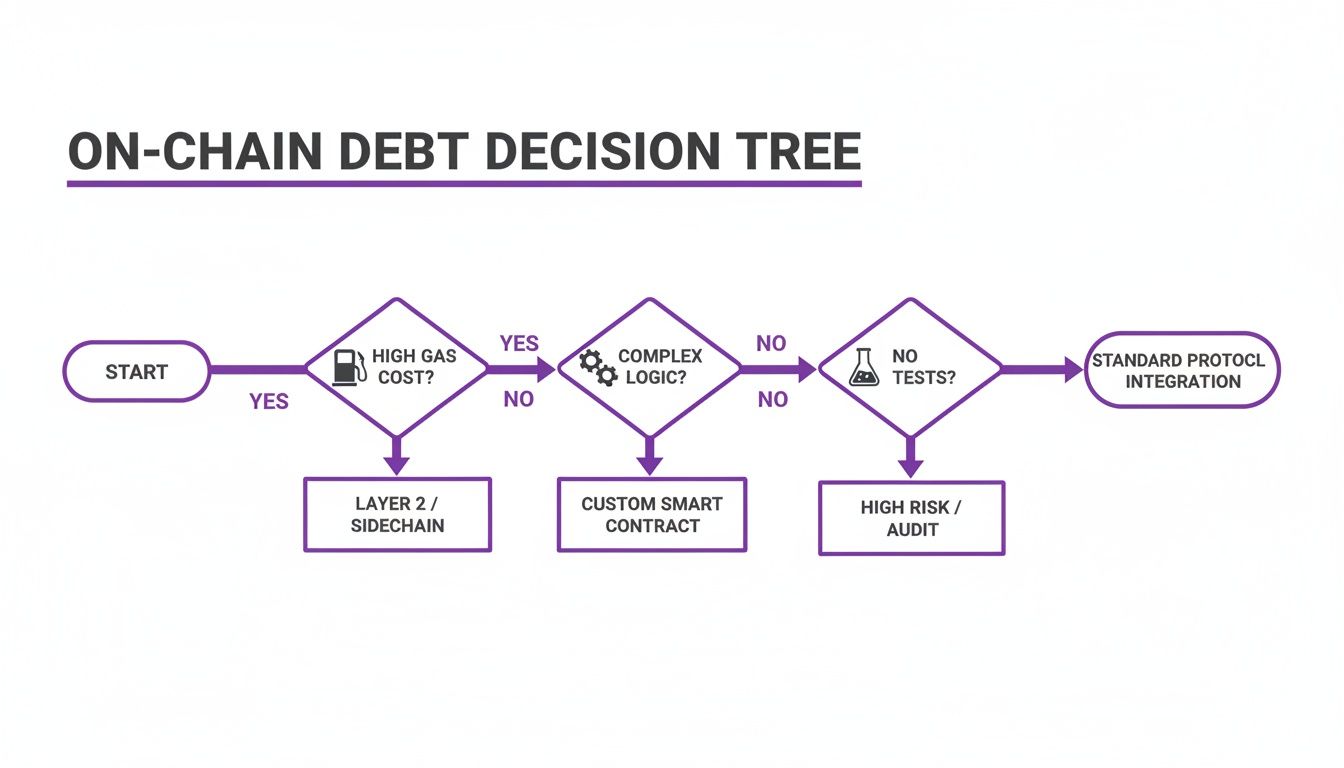
This kind of visual guide shows that your first step should always be diagnosing the immediate, user-facing problems—like high gas fees—before you dive into the deeper structural work.
Securing Stakeholder Buy-In
Getting everyone on board is probably the most important part of this whole process. Business leaders often hear "technical debt" and think "cost center that delays new features." Your job is to completely reframe that conversation.
Technical debt reduction isn't a cost; it's an investment in speed, stability, and future innovation. Every piece of debt you pay down removes a roadblock, letting your team build and ship what matters, faster.
Present your plan in business terms. Don’t just say, "We need to refactor the transaction module." Instead, try this: "By simplifying our transaction module, we can cut gas costs by 15% and ship our next three payment features two weeks ahead of schedule." That connects your technical needs directly to outcomes they care about. For a more structured approach, a good Technical Debt Management Plan can give you a solid framework to build on.
A great way to put this into practice is by creating a dedicated debt backlog and allocating a fixed percentage of every sprint—say, 15-20%—to chipping away at it. This turns debt reduction into a consistent, predictable part of your development culture instead of a sporadic, panic-driven emergency.
Alright, you've got a plan. Now it’s time to roll up your sleeves and get to work.
Tackling technical debt isn't about one massive, heroic rewrite that fixes everything overnight. It's about a series of deliberate, targeted strikes that slowly bring your onchain ecosystem back to health. The real skill is knowing which technique to use for which problem—sometimes it's a surgical refactor, other times it's a full-blown migration.
This is where discipline meets smart architectural choices. You'll be untangling knots in your smart contracts, shoring up your deployment pipelines, and occasionally, making the tough call to leave a legacy system behind. It's tough, no doubt, but every single improvement makes your app more secure, more efficient, and a hell of a lot easier to build on.

Smart Contract Refactoring and Modular Design
Let's talk about the biggest offender: monolithic smart contracts. You know the ones—massive, single files trying to do everything at once. They're a nightmare to audit, cost a fortune in gas to deploy, and are nearly impossible to upgrade without breaking something. The single most effective way to kill this kind of debt is to chop those behemoths into smaller, focused modules.
This is where good design patterns save the day.
- Embrace Upgradeability Patterns: Using proxies (like UUPS or Transparent Proxies) is a game-changer. It separates your contract's logic from its state, which means you can swap out the logic to fix bugs or add features without forcing a painful data migration on your users.
- Implement the Diamond Standard (EIP-2535): If you're building something truly complex, the Diamond Standard is your best friend. It lets a single contract address pull its logic from multiple implementation contracts, called facets. This makes your system incredibly modular. You can add, replace, or even remove individual functions without messing with the whole system.
By breaking down a monolithic contract into smaller, upgradeable modules, you not only make the code easier to manage but also dramatically reduce the surface area for potential attacks. Each module can be tested and audited in isolation, leading to a much higher degree of security and confidence.
Refactoring isn't just about moving code around. It’s about fundamentally rethinking your architecture to be more flexible and ready for whatever comes next.
Fortifying Your CI/CD Pipeline with Rigorous Testing
A weak testing strategy is basically leaving the back door wide open for technical debt to sneak right back in. Every time a feature gets pushed without being thoroughly tested, you're rolling the dice. Bolstering your CI/CD pipeline isn't optional; it's a critical line of defense.
The goal here is to build an automated safety net that catches problems long before they ever see a production environment. This means going way beyond basic unit tests.
- Unit Testing: Your first line of defense. These check individual functions in isolation. You should be aiming for over 95% test coverage to make sure every little piece of logic works exactly as it should.
- Integration Testing: This is where you confirm that all your shiny new modules actually play nicely together. It’s essential for catching those tricky bugs that only show up when different parts of your system start talking to each other.
- Fuzz Testing: Tools like Foundry or Echidna are indispensable. They hammer your contracts with a massive storm of random inputs to uncover edge-case vulnerabilities that a human might easily miss. This needs to be a standard step in your pipeline.
If you want to go deeper on this, check out our guide on smart contract audit tools, which covers a lot of techniques that fit perfectly into a robust CI/CD workflow.
Phased Migration for Deeply Entangled Debt
But what if a contract is just too far gone? Sometimes, the code is so tangled or tied to ancient logic that a simple refactor won't cut it. In these situations, you have to migrate to a new, cleaner architecture. A "big bang" migration, where you switch everything over at once, is incredibly risky and can lead to serious downtime and lost data.
A much safer bet is a phased migration. You move logic and state over to the new system in small, controlled stages, keeping the disruption to your users at a minimum.
Here's how that usually looks:
- Deploy the New Architecture: Get the new, improved contracts live, running in parallel with the old system.
- Implement a Data Bridge: You'll need a secure way to move state from the old system to the new one. This could be a "lifter" contract or a trusted off-chain script.
- Gradually Shift Logic: Start by redirecting calls for non-critical functions to the new contracts. Feature flags are great for controlling this rollout.
- Incentivize User Migration: Give your users a reason to move their assets or data to the new system. Small rewards or access to new features can work wonders.
- Decommission the Old System: Once everything has been safely moved over, you can finally retire the old contracts.
This methodical approach slashes your risk and lets you validate every step of the process.
Of course, writing all the boilerplate for these new, optimized contracts can be a real grind. This is where a vibe coding studio like Dreamspace can make a huge difference. By using its AI app generator to scaffold the foundational code for new modules or migration contracts, your developers can skip the repetitive syntax and focus their brainpower on the complex logic that really matters.
Building a Culture That Prevents Future Debt

Fixing existing problems is a battle, but preventing new ones is how you win the war. Honestly, the best long-term strategy for reducing technical debt has less to do with the code itself and more to do with your team's culture. When your team genuinely prioritizes quality, clear communication, and shared ownership, you'll find they naturally avoid the shortcuts that lead to a tangled, unmanageable codebase.
It's all about moving from a reactive "firefighting" mode to a proactive mindset of continuous improvement. This cultural bedrock is what separates projects that can actually scale from those that eventually collapse under their own weight.
Establishing Ironclad Coding Standards
The first pillar of a debt-resistant culture is simple: consistency. When every developer follows the same playbook, the whole codebase becomes more predictable, easier to read, and a hell of a lot simpler to maintain. This isn't about killing creativity; it's about establishing a shared language.
Clear, documented coding standards are non-negotiable. This document should cover everything from naming conventions and comment styles to the specific architectural patterns you use for smart contracts. More importantly, these standards need to be enforced automatically. Get them into your CI/CD pipeline with linters and static analysis tools. A build should fail if it doesn't meet that baseline quality bar. Period.
Making Peer Reviews a Sacred Ritual
No code—especially a smart contract—should ever be deployed to mainnet without at least one other pair of eyes on it. Mandatory peer reviews are your single greatest defense against unintentional debt. They don't just catch obvious bugs; they spot flawed logic and inefficient patterns that a single developer might easily miss.
For this to work, the process has to be constructive and blameless. The goal isn't to point fingers; it's to collectively lift the quality of the code.
- Focus on the ‘Why,’ Not Just the ‘What’: Instead of just saying "change this," reviewers should explain the reasoning behind the suggestion. This simple shift turns every code review into a learning opportunity.
- Use Checklists: Create a simple checklist for reviewers that covers common onchain pitfalls. Think reentrancy risks, integer overflows, and gas optimization opportunities.
- Keep Pull Requests Small: Let's be real, reviewing a 1,000-line PR is a nightmare. Encourage small, focused pull requests that solve one problem at a time. Reviews get done faster and are far more thorough.
A strong review culture creates a feedback loop that continually raises the team's collective skill level. It fosters a sense of shared responsibility where everyone is accountable for the long-term health of the project.
Fostering Psychological Safety
This might just be the most important piece of the puzzle. Your developers have to feel safe enough to raise their hands and say, "This feels like a shortcut," or "I'm worried this will cause problems down the line." If they're afraid of being blamed for slowing things down, they’ll stay quiet. And that’s when debt silently creeps in.
This isn't a small problem. Data shows that for over 50% of companies, technical debt eats up more than a quarter of their entire IT budget, directly blocking innovation. You can dig into more insights on how companies are managing technical debt and its budgetary impact over at vfunction.com.
Management has a huge role to play here. They need to celebrate developers who flag potential issues early, even if it means tweaking a timeline. This sends a powerful message: we value quality over pure speed.
Finally, embedding prevention right into your tooling is a massive accelerator. For example, using the Dreamspace AI app generator to scaffold new smart contracts ensures they’re built on a foundation of best practices from the get-go. As a vibe coding studio, it helps teams produce clean, standardized, and well-documented code, making it much harder for debt to find a foothold in the first place. This approach shifts prevention from a manual chore into an automated, foundational part of how you build.
Your Questions, Answered
Wrestling with technical debt, especially onchain where the stakes are so high, always brings up a ton of questions. Let's tackle some of the big ones I hear most often from dev teams and project leads.
How Much of Our Sprint Should We Actually Spend on This?
There's no single magic number, but a solid rule of thumb is to dedicate 15-20% of every sprint to chipping away at technical debt. It’s like a "health tax" for your codebase—you have to pay it consistently.
This regular commitment means you’re always making progress, preventing small issues from becoming massive headaches later. If you’re staring down a mountain of critical legacy debt, you might need to crank that up to 30% for a short period. The key isn't the exact number, but the consistency. Make it a planned, recurring part of your workflow, not a frantic reaction when things break.
Is It Ever Okay to Intentionally Go into Debt?
Yes, but you have to be smart and deliberate about it. In crypto, getting to market fast can be the difference between success and failure. Taking on a shortcut to validate an idea or seize a first-mover advantage is what we call "prudent" technical debt.
When you make this call, you absolutely must follow three rules:
- Call it what it is. Everyone on the team needs to know it's a shortcut, not the final solution.
- Document everything. Write down why the decision was made and what the potential fallout could be.
- Create a ticket for it immediately. It goes right into the backlog to be addressed later.
The real danger is "reckless" debt—the sloppy, untracked shortcuts taken out of convenience. That's the stuff that festers and eventually brings a project to its knees.
The most common mistake is treating technical debt as a 'developer-only' problem. Technical debt has direct business consequences—it slows down feature delivery and increases the risk of costly bugs or security breaches.
Can AI Tools Genuinely Help with Onchain Debt?
Without a doubt. Modern AI tooling is a game-changer for both preventing and fixing onchain tech debt. We're way beyond basic code completion here.
To prevent debt from ever taking root, an AI app generator like Dreamspace can scaffold out clean, optimized, and standardized smart contracts right from the start. You're building on a solid foundation from day one. When it comes to fixing existing issues, AI-powered analysis tools can spot complex code smells and subtle vulnerabilities faster and more accurately than any manual review. They can even suggest refactoring options and generate boilerplate for tests, which is a massive time-saver for your developers.
What’s the Biggest Mistake Teams Make?
The most common and costly error is failing to explain the business impact of technical debt. Too often, teams talk about it in purely technical jargon, and the message gets lost on stakeholders.
You have to translate the problem into dollars and cents, or time to market.
- Don't say: "We need to refactor the payment contract because the logic is too complex."
- Do say: "By simplifying this contract, we can launch new payment features 50% faster and slash transaction-related support tickets by 30%."
This approach ties the work directly to outcomes the whole business cares about: speed, user happiness, and cost savings. Nailing that conversation is often the first and most critical step in getting the buy-in you need.
Ready to build clean onchain apps from day one? With Dreamspace, you can generate production-ready smart contracts, SQL queries, and full-stack dApps with AI. Stop debt before it starts and focus on what matters most. Visit us at https://dreamspace.xyz to see how our vibe coding studio can accelerate your development.