What Is No Code Dev And How Does It Work
Ever heard of no-code dev? It’s a way to build software applications without actually writing any code. Forget programming languages; instead, you’re working with visual, drag-and-drop tools and ready-made components to bring your ideas to life. Think of it as a faster, more accessible path to creating everything from simple websites to complex onchain apps. You can use an AI app generator like Dreamspace to get started.
Understanding The No-Code Dev Revolution
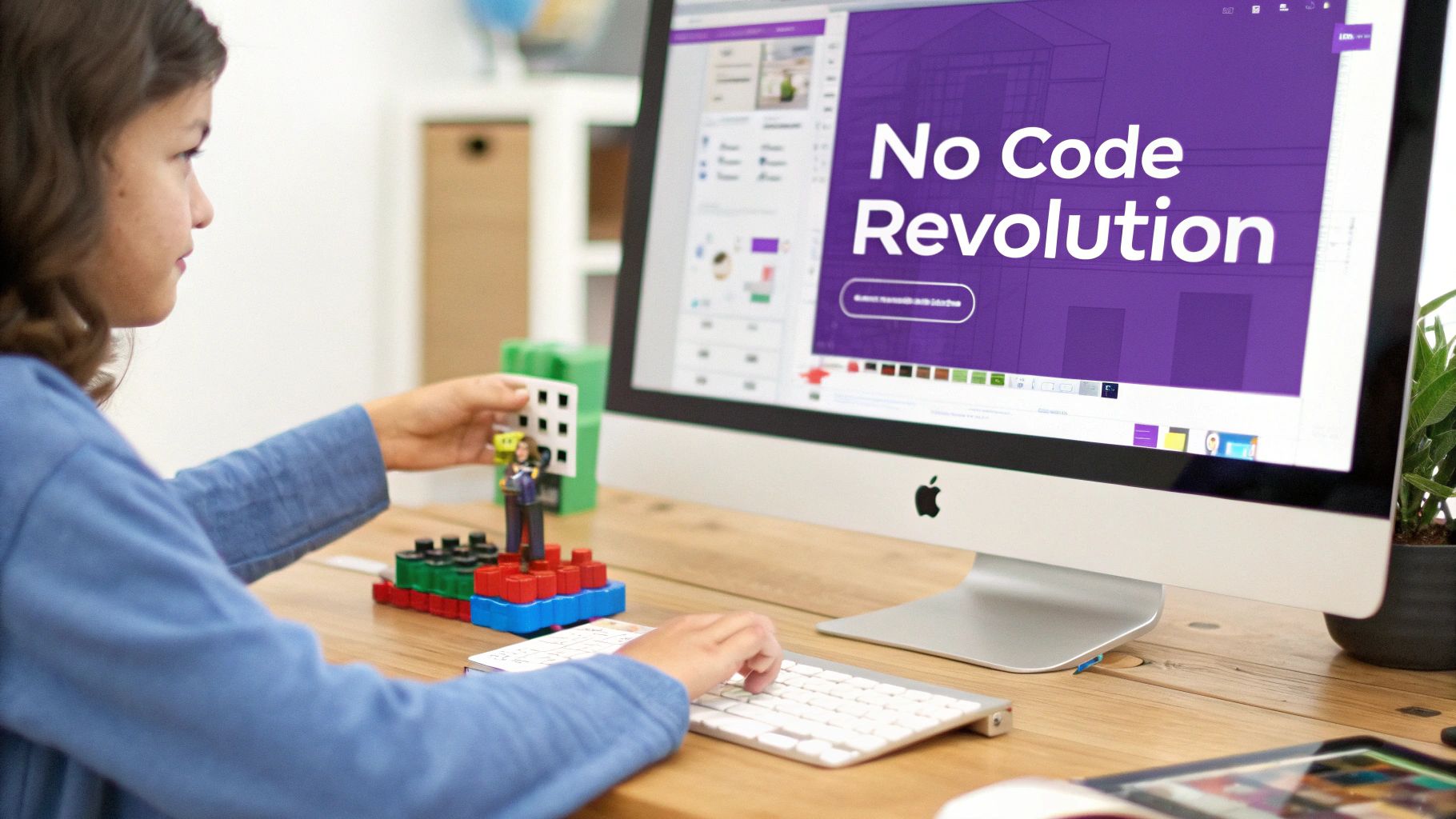
The best way to think about no-code is to imagine you're building with LEGOs. You don't need to know a thing about plastic manufacturing or injection molding. You just grab the bricks you need and start connecting them to build a castle, a spaceship, or whatever you can dream up. That’s the entire philosophy behind the no-code movement—a visual approach that empowers anyone to build.
This shift takes the mystery out of development, making it far more intuitive and focused on the final product. The real goal is to shrink the distance between a great idea and a working app, letting the people with the domain expertise build their own solutions directly.
Empowering Citizen Developers
The rise of no-code platforms has created a new role: the citizen developer. This isn't a professional programmer, but rather an everyday user who builds new applications for their team or customers using company-approved tools.
These are people like:
- Entrepreneurs who need to get a minimum viable product (MVP) off the ground—fast.
- Marketers who want to spin up custom landing pages or automate their campaign workflows.
- Business analysts who build internal tools to streamline and improve company processes.
- Creatives who want to build interactive digital experiences without getting stuck on technical hurdles.
At its core, a citizen developer is an expert in their own field who can now translate that knowledge directly into software, all without a formal computer science degree. This is a fundamental change in who gets to create technology.
The no-code movement isn't just about making development easier; it's about unlocking the creative potential of millions of people who were previously sidelined by technical complexity. It puts the power to build directly into the hands of the innovators.
The Financial Impact And Growth
This newfound accessibility is lighting a fire under the market. The no-code AI platform space, just one slice of this world, is on an absolute tear. Valued at USD 6.56 billion in 2025, it’s expected to jump to USD 8.6 billion in 2026.
And it doesn’t stop there. Forecasts predict the market will rocket to USD 75.14 billion by 2034, riding a compound annual growth rate of 31.13%. You can dig into more of the numbers behind the explosive growth of no-code platforms for yourself.
This financial momentum signals a much deeper industry shift. Companies like Dreamspace are leading the charge, redefining what’s even possible. As an advanced AI app generator, it helps users build far more than just simple websites—we're talking about production-ready onchain applications. This "vibe coding studio" approach makes even niche fields like blockchain accessible to a much wider audience, proving that the no-code dev revolution is only just getting started.
The Core Benefits Of A No Code Approach
The whole point of no code dev comes down to one simple thing: speed. We’ve all seen it—traditional development can drag on for months, sometimes years, turning a great idea into a distant memory. No-code platforms just demolish that timeline.
This isn’t just about getting things done faster; it’s a real competitive edge. Instead of waiting forever, you can use visual editors and pre-made blocks to whip up a working prototype in days. Think about it: you can get your idea in front of actual users and see if it sticks, right now.
Drastically Reduced Costs And Barriers
Let's talk about the big one: cost. No-code saves a ton of money. You’re no longer completely dependent on finding and affording specialized dev teams, which lets you put your resources where they really matter. That first product or internal tool doesn't have to start with a massive budget for engineering.
This completely changes the game for who gets to build things. Suddenly, creating software isn't just for the well-funded. Here’s how it breaks down:
- Lowered Labor Costs: You don’t need to hire a squad of developers. That’s often the single biggest line item in any tech project, and it just got a lot smaller.
- Reduced Overhead: Forget the ongoing headaches and costs of maintaining a complex codebase and all the infrastructure that goes with it.
- Faster Time-to-Market: Getting your app out the door sooner means you can start making money or getting crucial feedback earlier. It’s a direct impact on your bottom line.
This is what people mean when they talk about "democratizing" tech. It gives startups, small businesses, and even individual teams inside big companies a real shot at building their own custom solutions.
Fostering Agility And Empowering Teams
Beyond just the speed and savings, a no-code approach makes your team incredibly agile. When you can build, test, and tweak an app almost instantly, you can react to what the market or your users are telling you in real time. That's how you build products people actually love.
When you can make a change on the fly without getting in a developer's queue, you empower the people who actually understand the problem—the marketer, the operations lead, the founder. This is where a modern vibe coding studio like Dreamspace really shines.
By simplifying the creation process, no code platforms empower non-technical teams to solve their own problems. It moves development from a bottleneck to a business enabler, allowing innovation to flourish across an entire organization.
Tossing an AI app generator like Dreamspace into the mix makes things even more efficient. It helps you turn a simple idea into a live, working application incredibly quickly. Whether you’re setting up a basic automation or a complex onchain app, the platform does the heavy lifting. You get to focus on your vision and what the user will experience. This combination of AI and no-code isn't just about building faster—it's about building smarter and finally unlocking all that creative potential that used to be stuck behind a wall of code.
No Code Vs. Low Code Vs. Traditional Coding
The world of software development isn't a one-size-fits-all situation. It's more of a spectrum, with different tools and methods for different goals and creators. Figuring out where no-code, low-code, and old-school coding fit in is key to picking the right path for your project.
Let's break it down with a simple analogy: building a house.
No-code development is like designing a home with a high-end modular builder. You get to pick from a catalog of beautifully designed, pre-built rooms—kitchens, living rooms, bedrooms—and arrange them exactly how you like. You don't need to know a thing about plumbing, wiring, or structural engineering. Your entire focus is on the layout and design, while the builder handles all the heavy lifting behind the scenes.
This is the perfect approach for "citizen developers"—think entrepreneurs, marketers, or business leaders who have a crystal-clear vision but no formal programming chops. Platforms like Dreamspace, an AI app generator, are your modular builder, giving you all the blocks you need to assemble a powerful onchain app through a simple, visual interface.
The Middle Ground: Low-Code Development
Moving down the line, we get to low-code development. This is more like taking on a major home renovation. You might handle the painting, flooring, and interior design yourself (the "low-code" parts), but you're calling in licensed pros for the tricky electrical and plumbing work (the "code" parts). You have a lot more control and flexibility than with the purely modular approach, but you still lean on experts for the deeply technical stuff.
Low-code platforms are built for people with some technical skill, like IT pros or developers who just want to speed up their workflow. They offer drag-and-drop components but also let you inject custom code snippets to add special features or connect to other systems. This hybrid model strikes a great balance between speed and customization. If you're curious, check out our guide on the best low-code development platforms to see what's out there.
The shift is undeniable. Gartner predicts that by 2026, low-code and no-code tools will be used for about 75% of all new application development. On top of that, they expect 80% of technology products and services will be built by people who aren't tech professionals.
The Foundation: Traditional Coding
Finally, we have traditional coding. This is the real deal—building a house from scratch, starting by mixing and pouring the foundation yourself. You have absolute, granular control over every single detail, from the architectural blueprints to the type of nails you use. This gives you unlimited freedom but demands deep expertise, a ton of time, and a whole team of specialists.
Traditional coding is the domain of professional software developers. It's essential for creating highly specialized, performance-critical systems like operating systems, massive databases, or bleeding-edge algorithms where every single line of code has to be perfect.
A great real-world example of how these approaches can blend is WordPress. At its core, it's a coded platform, but WordPress's extensive plugin ecosystem adds powerful no-code and low-code functionality, letting just about anyone build a sophisticated website.
No Code Vs Low Code Vs Traditional Coding At a Glance
To make it even clearer, here’s a quick side-by-side comparison to help you see which approach fits your needs best.
Ultimately, the right choice depends entirely on what you're trying to build, how fast you need it, and what skills you have at your disposal.
Real World No Code Dev Use Cases
Theory is great, but seeing no code dev in the wild is where you really get it. The sheer versatility of this approach means creators can build solutions for just about any industry, blowing past the old limits of simple website builders. From tightening up internal workflows to launching the next breakout startup, no-code is fueling a whole new wave of creation.
This diagram helps visualize where no-code sits in the development world, showing how it peels away the layers of complexity found in traditional coding.
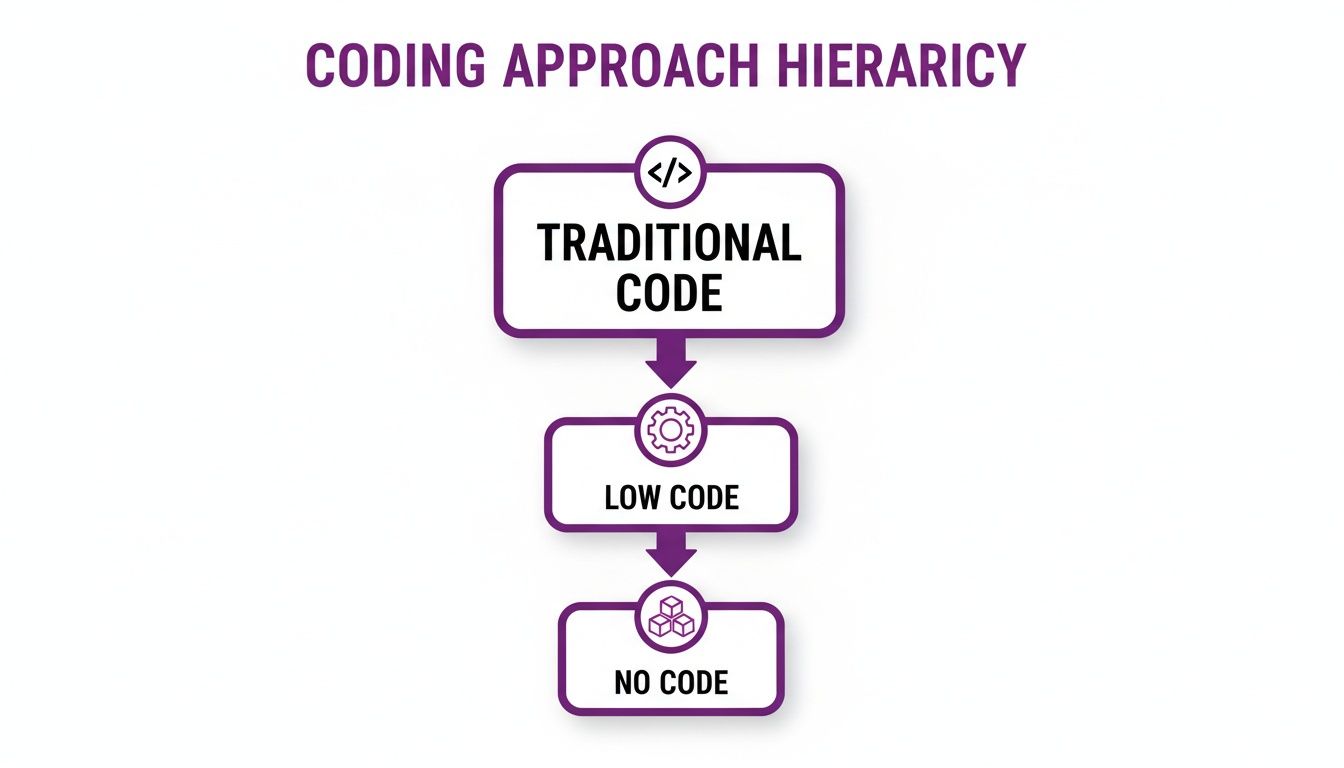
As you can see, no-code is at the very top, offering the most accessible, high-level experience, while traditional code forms the deep, foundational layer that gives you total control.
Building Custom Internal Tools
One of the quickest wins with no-code is fixing internal business problems. Companies are always hunting for ways to be more efficient, and no-code platforms hand them the keys to build their own custom tools—without getting in line for the IT department.
Instead of being stuck with clunky spreadsheets and mind-numbing manual data entry, teams can just build what they need. We're talking about everything from simple project management dashboards to more sophisticated inventory trackers or automated HR onboarding flows. It’s a self-service model that empowers employees to solve their own headaches.
And it gets better. For jobs that need to process a ton of visual data, like monitoring or testing, no-code apps can plug right into powerful APIs. This means someone without a technical background can connect their app to an outside service and automate web captures using screenshot APIs for things like quality checks or content tracking.
Launching Startups And MVPs
For any founder, speed is life. No-code platforms are an absolute game-changer for getting a Minimum Viable Product (MVP) out the door fast and without breaking the bank. Instead of pouring months and a huge chunk of your budget into a dev team, you can build and test your core idea in weeks, sometimes even days.
This ability to iterate on the fly lets startups get real feedback from actual users right away, so they can pivot without losing all their momentum. The financial upside is huge, too; the market for no-code AI platforms is set to rocket to USD 24.8 billion by 2029, growing at a blistering CAGR of 38.2%. That kind of growth shows just how essential these tools are becoming.
Unlocking The Blockchain With No Code
Now for the really exciting part: Web3 and the blockchain. For years, building onchain apps meant you had to be an expert in seriously complex languages like Solidity. That steep learning curve kept a lot of incredible ideas stuck on the drawing board.
No code is knocking down the walls around blockchain development. It’s turning a space once guarded by specialist developers into an open playground for anyone with an idea.
Platforms like Dreamspace are leading the charge. As a vibe coding studio, Dreamspace uses an AI app generator that lets you build on the blockchain just by describing your vision. This opens up a universe of possibilities for creators looking to build decentralized apps (dApps), launch NFT collections, or spin up token-gated communities.
With these tools, you can handle tasks that used to be incredibly difficult:
- Generate Smart Contracts: Create the self-executing logic for your onchain app without touching a single line of code.
- Build Onchain Apps: Develop entire decentralized applications, from the UI to the backend, all through a visual, intuitive interface.
- Query Blockchain Data: Effortlessly pull and display data straight from the blockchain to power your app’s features.
By hiding all the technical mess, these platforms are making blockchain truly accessible. If this space excites you, you can dive deeper into the new world of blockchain application development and see how no-code is shaping what's next. It’s powerful proof of what can happen when the right tools get into the right hands.
How To Start Your No Code Journey
Ready to jump in and build something? Kicking off your no code dev journey has less to do with technical know-how and more to do with getting crystal clear on your vision. The fanciest tools won't help if you don't have a solid goal, so the very first step is always to sharpen your app idea before you even open a browser tab.
Think hard about the core problem you want to fix. Who are you building this for? What's the one key thing you need a user to do? Answering these questions builds a strong foundation and stops you from getting bogged down with features that don't matter. Getting this clarity upfront is the real secret sauce.
From Idea To Prototype With AI
Once your concept is locked in, it’s time to make it real. This is where modern tools like an AI app generator totally change the game for creators. A platform like Dreamspace acts as a creative co-pilot, turning your simple text descriptions into a working prototype.
Instead of staring at a blank screen or fumbling through menus, you just tell the AI what you're imagining. You could describe an onchain gallery for digital art or a token-gated community for your favorite hobby. The AI then spits out the basic structure, user interface, and even the backend logic.
This whole process feels less like intimidating development and more like a conversation. It's hands-down the fastest way to get a tangible version of your idea that you can click, test, and show people for feedback. That kind of rapid prototyping is crucial for figuring out what works (and what doesn't) right away.
Understanding The Vibe Coding Workflow
Building on that first prototype is where "vibe coding" comes in—a much more intuitive, collaborative way to work with AI. As a vibe coding studio, Dreamspace makes this dead simple. You just keep refining your app using plain English, telling the AI exactly what to change.
Here’s what that workflow looks like:
- Generate the Foundation: Start with a high-level prompt, like "Create a decentralized voting app for my community."
- Refine Key Features: Get more specific with your instructions. You might ask it to "Add a feature to display real-time poll results" or "Generate a smart contract that ensures each member can only vote once."
- Query and Display Data: Tell it to handle the tricky data stuff. For instance, "Write a SQL query to pull all active proposals from the blockchain and display them in a list."
- Share and Iterate: Once you’ve got something you're happy with, you can share it instantly with a simple link.
This approach completely dismantles the technical walls that usually surround onchain development. You don't need to learn Solidity to write a smart contract or become a database wizard to query the blockchain. You just need to know what you want to build. To see a deeper dive on these tools, check out our guide on the best AI app builder options out there.
This hands-on method makes the whole process feel achievable. It lets you be the creator, turning your unique vision into a real, shareable onchain application.
The Future and Limitations of No-Code
While no-code dev is a massive leap forward for creators, it's not a magic bullet. It’s crucial to understand the trade-offs before you dive in. Knowing the current limitations helps you pick the right tool for the job and set realistic expectations.
Think of them less as deal-breakers and more as practical guardrails in a field that's moving incredibly fast.
One of the biggest conversations in the no-code world revolves around platform dependency, or what some call "vendor lock-in." When you build your entire app on one platform, you're tying your fate to theirs. Moving to another service later can be a massive headache, if not outright impossible. You're betting on their pricing, their updates, and their long-term survival.
Navigating Current Constraints
Beyond being tied to a single platform, there are a couple of other practical limits to keep in mind. First is scalability. Modern no-code tools can handle a surprising amount of traffic, but if you're aiming for a massive, enterprise-grade app with millions of people using it all at once, you might eventually hit a performance ceiling. At that point, a custom-coded solution is often the next logical step.
The other thing is customization. No-code platforms give you a giant box of incredibly powerful LEGOs, but you can only build with the pieces they give you. If your app needs a truly unique, one-of-a-kind feature that isn't supported out of the box, you might have to get creative with code integrations or rethink that part of your project.
No-code platforms offer a trade-off: you exchange infinite flexibility for incredible speed and accessibility. The key is knowing when that trade-off makes sense for your goals.
The Exciting Horizon for No-Code
So, what's next? The future of no-code is ridiculously bright, and it's all thanks to Artificial Intelligence. AI is making these tools smarter, faster, and more intuitive than ever before. We're moving past just dragging and dropping pre-built blocks. Now, you can describe what you want in plain English, and an AI will start building it for you.
This shift is opening up entire industries that used to be off-limits to non-coders. Complex spaces like Web3 and heavy-duty data analytics are suddenly within reach. For instance, a vibe coding studio like Dreamspace leans on an AI app generator to do the heavy lifting for things like writing smart contracts or pulling data from a blockchain.
This is just the beginning. AI will continue to close the gap between a creative idea and a functional product. As these platforms get smarter, the line between what you can imagine and what you can build with no-code is going to get blurrier and blurrier, unlocking a whole new wave of innovation.
Your Top No-Code Questions, Answered
As the no-code dev movement picks up steam, it's only natural to have a few questions. Let's clear up some of the most common ones so you can start building with confidence.
Can I Actually Build a Real Business with No-Code Tools?
One hundred percent, yes. Some seriously successful startups and business-critical internal tools got their start—and continue to run—on no-code platforms. While you might eventually need custom code for a massive, hyper-scale app, no-code is perfect for launching MVPs, automating internal workflows, or building out customer-facing portals.
The trick is to pick a platform that’s built for growth from the ground up. For instance, when you build an onchain app with a vibe coding studio like Dreamspace, you're tapping directly into the security and scalability of the blockchain. That means you're creating production-ready apps right out of the gate.
So, is No-Code Going to Put Developers Out of a Job?
Not at all. Think of no-code dev as a new, powerful layer in the tech world, not a replacement. It gives non-technical folks—the people who really understand the business problem—the power to build their own solutions. This actually frees up professional developers to tackle the gnarly, complex challenges that only they can solve.
It's a win-win. Citizen developers can quickly build tools for specific business needs, while software engineers focus on core infrastructure, deep security issues, and custom logic that’s beyond the scope of a no-code platform. The future isn't one or the other; it's both working together to ship better products, faster.
How Secure Are No-Code Applications Anyway?
Security is a huge deal for any reputable no-code platform. These companies pour massive resources into locking down their infrastructure and staying on top of compliance. Frankly, building on a well-established platform is often more secure than trying to build from scratch because you get the benefit of their dedicated security team managing everything behind the scenes.
Plus, when you use a tool like Dreamspace's AI app generator for onchain apps, you're also inheriting the built-in, battle-tested security of the blockchain itself. Features like decentralization and cryptographic proof add a whole other layer of protection to whatever you build.
No-code platforms are getting more powerful by the day. You'd be surprised at the complexity you can achieve. And for those moments when you hit a wall, many platforms let you drop in custom code snippets or connect to APIs, giving you a hybrid approach that offers the best of both worlds.
The smart move is to build your core product quickly with no-code first. Then, you can figure out if any specific, niche features need a touch of custom development down the line.
Ready to bring your onchain idea to life? With Dreamspace, you can generate smart contracts, pull blockchain data, and launch a live app—all without touching a single line of code. Start building your vision today.