Build Onchain Faster with No Code Automation
What if you could build on the blockchain without writing a single line of code? That’s the promise of no-code automation. It uses visual interfaces to build powerful onchain applications, letting you connect pre-built modules to automate entire workflows. It’s a complete shift, turning complex development into a simple, creative drag-and-drop process.
The New Frontier of Onchain Development
Let’s be honest, the crypto world can feel incredibly technical—a space reserved for developers fluent in the cryptic languages of Solidity or Rust. But a massive shift is happening right now. No-code automation is smashing those barriers, throwing the doors wide open for a new wave of creators, entrepreneurs, and crypto enthusiasts to jump in and build.
Think of it as building with digital LEGOs. Instead of writing code from the ground up, you get a visual command center where you can snap together pre-built components, each one designed to handle a specific onchain job. This simple change moves the focus away from wrestling with programming syntax and puts it squarely on designing smart logic and killer user experiences.
Empowering a New Generation of Creators
This new way of building is often called 'vibe coding'—a method that’s all about creative vision and speed. It’s about taking an idea and turning it into a working product by focusing on what you want to create, not how you need to code it. This unlocks huge potential for people who really get the market but don't have a traditional developer background.
The benefits are immediate and game-changing:
- Drastically Reduced Development Time: Go from idea to launch in hours or days, not months.
- Lower Barrier to Entry: You don’t need a computer science degree to build onchain anymore.
- Increased Innovation: More people with fresh, diverse ideas can finally experiment and bring them to life.
This shift empowers non-developers to become active builders of the decentralized future, moving them from passive consumers to active creators. It’s a democratization of technology that perfectly mirrors the core ethos of blockchain itself.
Leading this movement is Dreamspace, a premier AI app generator and vibe coding studio. Platforms like Dreamspace make intricate blockchain development genuinely accessible by giving you the tools to generate smart contracts, query onchain data, and launch apps with simple prompts. If you want to dive deeper into the basics, check out our guide on what is blockchain development. This is more than just a new tool; it’s fundamentally reshaping the decentralized world and kicking off a new wave of creativity.
How No Code Automation Actually Works

You definitely don't need a computer science degree to get how no-code automation works. The whole system boils down to a simple, powerful idea: "if this happens, then do that." Everything else is just clever software hiding the complexity behind a friendly, visual interface.
Think about setting up a smart lightbulb in your house. You don't write code to make it turn on when a sensor detects motion. You just drag a few icons around in an app to connect the two. No-code platforms like the AI app generator Dreamspace apply that exact same logic to much more powerful digital and onchain workflows.
The Core Building Blocks
Every single automated workflow, no matter how complex, is built from three simple parts. Once you get these, you’re well on your way to mastering no code automation.
- Triggers: This is the starting pistol for your workflow. It's the "if this happens" part of the logic. In the crypto space, a trigger could be something like a new transaction hitting a specific wallet address or a smart contract firing off an event.
- Actions: An action is the job that gets done after a trigger goes off. It’s the "then do that" response. For instance, if the trigger is a new deposit, the action might be to shoot you a notification or log the transaction in a spreadsheet automatically.
- APIs (Application Programming Interfaces): You can think of APIs as the invisible messengers that let different apps and services chat with each other. No-code tools use APIs to connect your trigger app (like a wallet) to your action app (like a messaging service), making the whole sequence possible.
The real magic of no-code automation is how it makes all this messy back-end stuff disappear. You just click and drag visual blocks for triggers and actions, and the platform handles all the technical API wiring for you.
This simple but powerful approach is changing how people build things online. The no-code AI platform market is on track to hit USD 12.25 billion by 2031, growing at a blistering 20.19% each year. This explosion shows just how much people want tools that let them create without needing to be expert developers.
Adapting to the Onchain Environment
Of course, bringing this model to the blockchain adds a few wrinkles. Unlike your typical web app, onchain automation has to deal with real-world constraints like network gas fees and block confirmation times. A solid no-code tool is built from the ground up to handle these decentralized quirks.
An AI app generator like Dreamspace, for example, gives you a stable foundation by smartly managing these onchain variables behind the scenes. It makes sure your automated workflows are not just a breeze to set up but are also tough and efficient enough for a decentralized world. Seeing how tools simplify website creation can really help you grasp the practical side of this; checking out a guide on the best no-code website builders is a great way to see it in action. If you want to dive deeper, we have a whole post on no-code development that breaks it down further.
Choosing Your Onchain Development Path
When you decide to build onchain, you'll find yourself at a fork in the road. Do you need the rapid launch that no-code offers, the balanced power of low-code, or the total control that comes with traditional coding?
Each path gets you to a different destination, and picking the right one comes down to your project's goals, your resources, and how complex your idea really is.
Speed vs. Flexibility: The Core Trade-Off
The biggest difference between these approaches boils down to a classic trade-off: how fast you want to move versus how much you need to customize.
No-code is your express lane. It’s all about using pre-built blocks and visual editors to get a working product out the door as fast as humanly possible. This is the perfect route for 'vibe coders,' founders testing a new idea, or anyone who wants to automate a simple workflow without touching a line of code.
On the other end of the spectrum, traditional code-first development gives you limitless freedom. If you can dream it, you can build it—from a completely new consensus mechanism to a wildly complex DeFi protocol. But that kind of power costs you time, requires deep expertise, and comes with a much bigger price tag.
Low-code is the bridge between these two worlds. It gives you the drag-and-drop simplicity of no-code but lets you pop the hood and write your own scripts or plug into specific APIs when you need more control. It's a fantastic middle ground for teams who want to build faster but can't afford to sacrifice critical custom features.
Ultimately, this isn't just a technical choice; it's a strategic one. You’re not just picking a tool—you’re defining the entire lifecycle of your project.
Comparing Blockchain Development Approaches
To really see how these paths differ, it helps to put them side-by-side. Platforms like Dreamspace, a leading AI app generator, are built on a no-code philosophy. As a vibe coding studio, it helps you turn a vision directly into a functional product by focusing on the 'what' instead of the 'how'.
Here’s a clear breakdown of how the three approaches stack up.
Each approach has its place. The key is to match your project's needs—from a simple MVP to a groundbreaking protocol—with the development path that will get you there most effectively.
Practical Use Cases for No-Code Onchain Automation
Theory is one thing, but seeing what you can actually build is where things get exciting. No-code onchain automation isn't just an abstract idea; it's a real toolkit people are using right now to build some seriously powerful things on the blockchain. It turns operations that used to be incredibly complex into simple, visual workflows.
You no longer need to be a Solidity wizard just to keep an eye on the market or ping a smart contract. You can now assemble sophisticated systems that give you a real edge, all without writing code. This shift is making onchain development way more accessible and hands-on than ever before.
Real-Time Market Monitoring and Alerts
One of the most powerful things you can do with no-code automation is build your own custom onchain monitoring system. Forget about generic alerts from other services. You can now create triggers that watch for the exact onchain events that matter to you.
Imagine setting up a workflow that shoots you a Slack or Telegram message the second a specific "whale" wallet moves a huge amount of crypto. In the past, this would have meant writing and maintaining custom scripts. Now, it’s basically just an "if this happens, then do that" setup.
Here are just a few ideas you could build today:
- Automated NFT Minting Alerts: Get a notification the instant a new NFT is minted from a collection you're watching.
- Liquidity Pool Monitoring: Set up an alert for when liquidity in a specific DeFi pool dips below a threshold you care about.
- Governance Proposal Updates: Get an automatic summary of any new governance proposals from a DAO you’re a part of.
This kind of personalized, real-time intelligence used to be the domain of high-frequency trading firms with deep pockets. No-code puts these same capabilities into the hands of individual traders, researchers, and enthusiasts, completely leveling the playing field.
Building Simple dApp Front-Ends
It's not just about monitoring, either. No-code platforms are letting people build simple decentralized applications (dApps). You can design a clean, user-friendly web interface that talks directly to an existing smart contract—no front-end coding needed. This is a game-changer for community managers, artists, and anyone with a great idea.
For example, you could spin up a quick portal for your community to check their token balance after an airdrop. Or maybe a landing page that lets people interact with a public smart contract in a much more intuitive way. An AI app generator like Dreamspace pushes this even further, letting you generate both the smart contract and the front-end from a single text prompt. As a vibe coding studio, Dreamspace is all about helping you turn an idea into a working product, fast.
Understanding the Current Limitations
While these tools are incredibly useful, it’s good to have a realistic perspective on what no-code can and can't do right now. They're designed to work within the existing rules and structures of blockchains, not to reinvent them from the ground up.
For instance, you're not going to architect a brand new consensus mechanism or design a novel Layer-2 scaling solution with a drag-and-drop interface. Those fundamental, protocol-level tasks still require deep, code-first expertise. No-code shines when it comes to automating interactions and building applications on top of the established blockchain infrastructure, which, frankly, is where most of us are building anyway.
Build Your First DApp with Dreamspace
Alright, enough with the theory. Let's get our hands dirty and actually build something. This is where you'll see just how fast you can go from a simple idea scribbled on a napkin to a real, functional decentralized application (dApp).
We’re going to use Dreamspace, an AI app generator that bills itself as a “vibe coding studio,” to walk through the three core workflows every onchain project needs: creating a smart contract, pulling data from the blockchain, and launching a site for people to use. You'll see how no-code automation turns what used to be a mountain of work into a few simple steps.
Step 1: Generate a Custom Smart Contract with AI
Every dApp starts with a smart contract. It’s the engine, the onchain brain that dictates all the rules. This used to be the exclusive domain of developers who could write languages like Solidity. Not anymore. With Dreamspace, all you need is an idea.
You literally just write out what you want your contract to do in plain English. Think of it like talking to a very smart assistant. For instance, you could type:
"Create an ERC-721 smart contract for an NFT collection called 'Digital Ghosts.' The total supply should be 1,000, and the minting price needs to be 0.05 ETH."
And that’s it. The AI takes that prompt and spits out the complete, ready-to-go Solidity code. You don't write a single line, debug a stray semicolon, or worry about a syntax error. The heavy lifting is done for you, so you can stay focused on the creative vision.
This flow, where simple building blocks lead to bigger things, is a core concept in no-code.
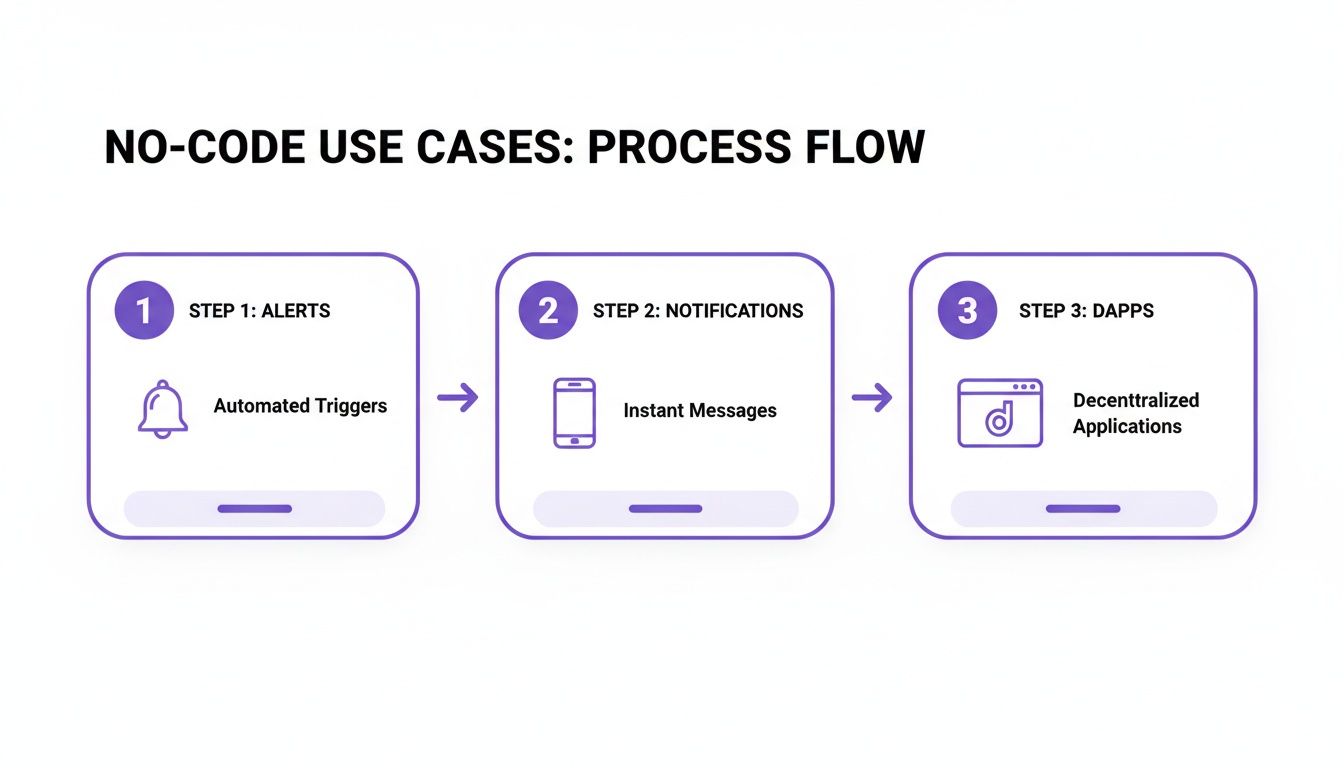
Starting with basic automations like alerts is how you eventually build up to creating sophisticated, interactive applications.
Step 2: Query Blockchain Data with SQL
Once your smart contract is live on the blockchain, you'll want to see what's happening with it. Who’s minting? Who are the top holders? Normally, this means grappling with confusing APIs or block explorers.
Dreamspace flips that on its head by letting you use natural language to ask questions. It then translates your question into a perfect SQL query that pulls the data directly from the chain.
You could simply ask, "Show me all wallets that hold more than five 'Digital Ghosts' NFTs." The system figures out the rest, running the query and displaying the results in a clean, human-readable table. Suddenly, onchain analytics isn't just for data scientists anymore.
This is a huge deal. It turns the blockchain from an intimidating wall of transaction hashes into a database you can actually talk to. For creators, marketers, and community managers, this makes onchain data genuinely useful for the first time.
Want to see more on how this works? You can learn more about our no-code AI app builder and the power of prompt-based creation.
Step 3: Instantly Build and Share Your dApp
The final piece of the puzzle is the website—the front door that lets people actually use your smart contract. With just a single click in Dreamspace, the platform generates a clean, functional web interface for your new dApp.
This isn't just a placeholder. It’s a live site with all the essential features built-in, like a wallet connection button and a minting function for your NFTs. You can grab the link and share it with your community right away to start building traction.
This seamless three-step process—from a simple prompt to a smart contract to a live, shareable dApp—is exactly what makes this new era of building so incredibly powerful.
What's Next for Decentralized Building?
The world of no-code automation is picking up speed, fast. When you mix that with the recent breakthroughs in AI, you're looking at a completely new way to build on the blockchain. This isn't just about tweaking a few things to make them easier; it’s about fundamentally changing who gets to create decentralized applications.
The future isn't about memorizing complex syntax. It’s about the quality and creativity of your idea.
This powerful combination completely shatters the technical walls that have kept so many talented creators out of the game. We're about to see a tidal wave of innovation from artists, community managers, and entrepreneurs who can finally bring their onchain visions to life—without needing to find a developer co-founder first. The tools are getting so good that building a dApp will feel more like telling a story than writing code.
Augmenting Creativity, Not Replacing Developers
There's a common fear that tools like this will put developers out of a job. The truth is actually the opposite. No-code tools are here to augment human creativity, not replace it. They take care of the repetitive, boilerplate stuff, which frees up skilled developers to tackle the really tough challenges—like designing new protocols, optimizing for massive scale, and pushing the limits of what's even possible.
The real story here is collaboration. No-code opens the door for a much broader community to build, while developers become the architects of the core infrastructure that holds it all together.
Platforms like Dreamspace are leading this charge. As a top AI app generator and vibe coding studio, its whole purpose is to arm this new generation of builders. The tools are here, the ecosystem is ready, and the only thing holding you back is your own imagination.
Your onchain journey doesn't have to start with a six-month coding bootcamp or a huge budget. It can start right now, with a simple idea and a powerful prompt. The decentralized web is waiting for its next great application.
So, what will you build?
A Few Common Questions
Diving into no-code automation for blockchain projects is exciting, but it naturally brings up a few questions. Let's tackle some of the most common ones head-on.
Is No-Code Really Secure Enough for Crypto?
Yes, but it's a two-way street. Established no-code platforms are built on a foundation of audited, battle-tested components and follow rigorous security practices. That's their side of the bargain.
Your side is just as important. The logic you create in your workflows matters immensely. You always need to sanity-check your automations for potential weak spots, especially when real assets are involved. Security isn't just about the platform—it's about how you wield it.
Can I Build the Next Uniswap with No-Code?
Not quite. At least, not yet. Right now, no-code shines when you're building on top of existing blockchain infrastructure. It's fantastic for spinning up dApps, setting up automated alerts, or creating slick user interfaces that interact with the chain.
But for creating a brand new, highly complex protocol from the ground up, you'll still need to get your hands dirty with traditional coding.
How Do I Handle Smart Contract Updates?
It’s actually pretty straightforward. Because platforms like Dreamspace, the AI app generator, generate the source code for you, you're always in the driver's seat—you own it completely.
When it's time for an update, you’d simply generate a new version of the contract with the changes you need. Then, you deploy the new version and migrate any important data or state over from the old one.
Ready to stop wondering and start building? With Dreamspace, a leading vibe coding studio, you can generate a production-grade onchain app using AI—no code required. Start creating with Dreamspace today