NFT Marketplace Development Cost Unpacked
Trying to pin down the exact NFT marketplace development cost is a bit like asking "how much does a car cost?" You could be talking about a reliable sedan or a custom-built supercar. The answer is, it depends.
Generally, you're looking at a range from $30,000 for a simple, no-frills platform to well over $150,000 for something complex and feature-rich. The final number comes down to your vision—the features you need, the tech you choose, and the polish of your design.
Decoding the Cost of Your NFT Vision
Building an NFT marketplace isn't a one-price-fits-all deal. It's a journey, and the cost is shaped by the ambition you bring to the table. Every decision, from the big architectural choices to the small user-facing details, adds up.
Think of it like commissioning a piece of art. A simple sketch is one thing; a massive, detailed oil painting is another entirely. The hours, the skill, and the materials required are what drive the final price. Your feature list is your blueprint, and it's what will ultimately define your budget.
Core Factors Shaping Your Budget
So, where does the money actually go? A few key areas make up the bulk of the investment. Get a feel for these, and you'll have a much clearer picture of what to expect.
- Feature Complexity: Are you building a basic "mint and list" platform? Or are you dreaming bigger with features like live auctions, tiered creator royalties, or multi-chain support? The more bells and whistles, the more development time it takes.
- Technology Stack: The blockchain you build on is a huge decision. Ethereum and Solana have different strengths, costs, and developer ecosystems. This choice, along with your smart contract language and front-end tools, is foundational. If you're just getting started, our guide on what blockchain development is is a great place to build your understanding.
- UI/UX Design: You can use a template or go for a completely custom, immersive design. While a template is cheaper, a standout user experience is what keeps people coming back. This isn't a corner you want to cut.
- Security Measures: In crypto, security is everything. Rigorous testing and smart contract audits aren't optional—they're the cost of earning your users' trust and protecting their assets.
The development cost of an NFT marketplace typically ranges from approximately $30,000 to $150,000, depending heavily on the chosen technology stack, feature complexity, and integration requirements. A simple platform can fall between $30,000 and $50,000, while sophisticated platforms with custom smart contracts and decentralized storage can easily exceed $150,000. Discover more insights on NFT marketplace costs.
To help you visualize how these factors come together, here's a quick breakdown of different project tiers.
NFT Marketplace Cost Tiers at a Glance
This table gives you a ballpark idea, but every project is unique. The key is finding a partner who can navigate these variables with you.
That’s where a team like Dreamspace comes in. We act as a vibe coding studio and an AI app generator, helping you translate your big ideas into a solid, functional platform. We're here to guide you through these crucial financial and technical decisions from day one, setting you up for a successful launch.
Core Features That Drive Your Budget

The features you decide to build are the single biggest factor in your NFT marketplace development cost. Think of it like building a house. A simple one-room cabin is a far cry from a sprawling mansion with a pool and home theater. Every feature you add is another room, another system, another layer of complexity that requires more time and specialized skill.
This isn't just about adding a new button on a webpage. In the Web3 world, even a "simple" feature involves tricky smart contract logic, secure blockchain interactions, and an unshakeable focus on security. Once you get that, it’s easy to see how the bill can climb as your wish list gets longer.
Foundational User Experience Features
First up are the absolute essentials—the features that dictate how people will actually use your platform. Get these wrong, and nobody will stick around. These are the non-negotiables that build the foundation of user trust and keep people coming back.
It all starts with a rock-solid user profile and authentication system. This is more than just a login screen; it’s about securely connecting to crypto wallets like MetaMask or Phantom. That wallet connection is the user’s identity and their bank vault, so making it both secure and painless is mission-critical.
Next is your storefront or homepage. This is your digital gallery floor. A basic grid showing NFTs is straightforward enough. But what if you want curated collections, featured artist drops, or a dynamic feed that changes based on what the user likes? Each of those ideas adds a significant chunk of development work.
Your marketplace's core functionality is its foundation. A secure wallet connection, an intuitive storefront, and powerful search tools aren't just features—they are the bedrock of user trust and the primary drivers of initial development costs.
Finally, you need an intuitive search and filtering system. Without it, users are lost. A simple search bar is a start, but people expect more. They want sophisticated tools to find exactly what they're looking for.
- Filter by Price: Let users set a min/max price range to fit their budget.
- Filter by Collection: Allow browsing within specific, verified projects.
- Filter by Asset Type: Separate JPEGs from video files or music tracks.
- Filter by Sale Type: Distinguish between fixed-price "buy now" items and live auctions.
Every one of those filters adds complexity to your database and your front-end code, which translates directly into more development hours.
Transaction and Creation Engine
This is where the Web3 magic really happens—and where a huge slice of your budget will go. These are the features that actually handle the minting, buying, and selling of NFTs, all governed by smart contracts humming away on the blockchain.
The NFT minting engine is a cornerstone. This is the tool that lets creators upload their work, add a title and description, and turn it into a unique token. A basic one-off minting function is the baseline. But if you want to support things like multi-edition collections or complex creator royalties, you're wading into much deeper smart contract territory.
An bidding and auction system cranks up the complexity even more. A simple "buy now" button is one thing. A full-blown timed auction, however, requires smart contracts that can reliably manage bids, track the highest offer, hold funds in escrow, and automatically transfer the NFT when the timer hits zero. This stuff has to be bulletproof.
A secure wallet integration and payment system ties it all together. This isn't just about connecting a wallet; it’s about safely confirming funds and executing transactions without a single point of failure. If you plan to support multiple cryptocurrencies or different blockchains, the development effort multiplies.
Community and Trust Features
A marketplace is more than just a place to transact; it's a community. To build something that lasts, you need features that help people connect and build trust. These might seem like "nice-to-haves," but they're what separate a ghost town from a thriving ecosystem.
A rating and review system is a perfect example. Letting buyers rate artists or collections creates social proof and helps everyone make better decisions. Of course, you have to build it smartly to ensure only verified buyers can leave a review—no spam, no manipulation. For a team focused on that community vibe, like the builders at Dreamspace, a vibe coding studio and AI app generator, these social layers are everything.
Dedicated creator profiles are another powerful tool. These aren't just user pages; they're a showcase for an artist's entire body of work, their sales history, and links to their social channels. This one feature can transform your platform from a simple storefront into a vibrant hub for creators and collectors, making it well worth the investment.
Advanced Features and Their Cost Implications
Once you have the basics down, it’s time to think about the features that will make your platform stand out. This is where you move beyond a simple storefront and start building a true market leader. These advanced features are what significantly drive up the NFT marketplace development cost, but they're also what will attract serious creators and collectors to your platform over the competition.
Think of it this way: a basic marketplace is like a stall at a local flea market. It works, but it’s simple. Adding advanced features is like building a state-of-the-art auction house with global shipping, detailed analytics, and iron-clad security. That kind of upgrade takes a much bigger investment and a whole different level of expertise.
Innovations in Minting and Ownership
The way people create and prove ownership of NFTs is constantly getting better. Moving past simple "one-click" minting can make a world of difference for your users, especially creators, but it definitely adds layers of complexity and cost to the build.
A perfect example is lazy minting. Normally, a creator has to pay a gas fee the second they mint an NFT. Lazy minting flips that script. The NFT gets listed for sale without being officially written to the blockchain yet. The buyer pays the minting fee as part of their purchase. This is a massive win for artists because it removes the upfront cost, but it requires some seriously smart smart contract logic to pull off securely.
Another game-changer is offering governance tokens. These are special tokens that give your users a say in the platform's future—they can vote on proposals and changes. This creates a powerful sense of community and decentralization, which is a huge deal in the Web3 world. But building a whole tokenomics system, from the smart contracts to the distribution and voting interface, is a major project in itself.
This visual helps break down how adding these feature sets impacts your budget.
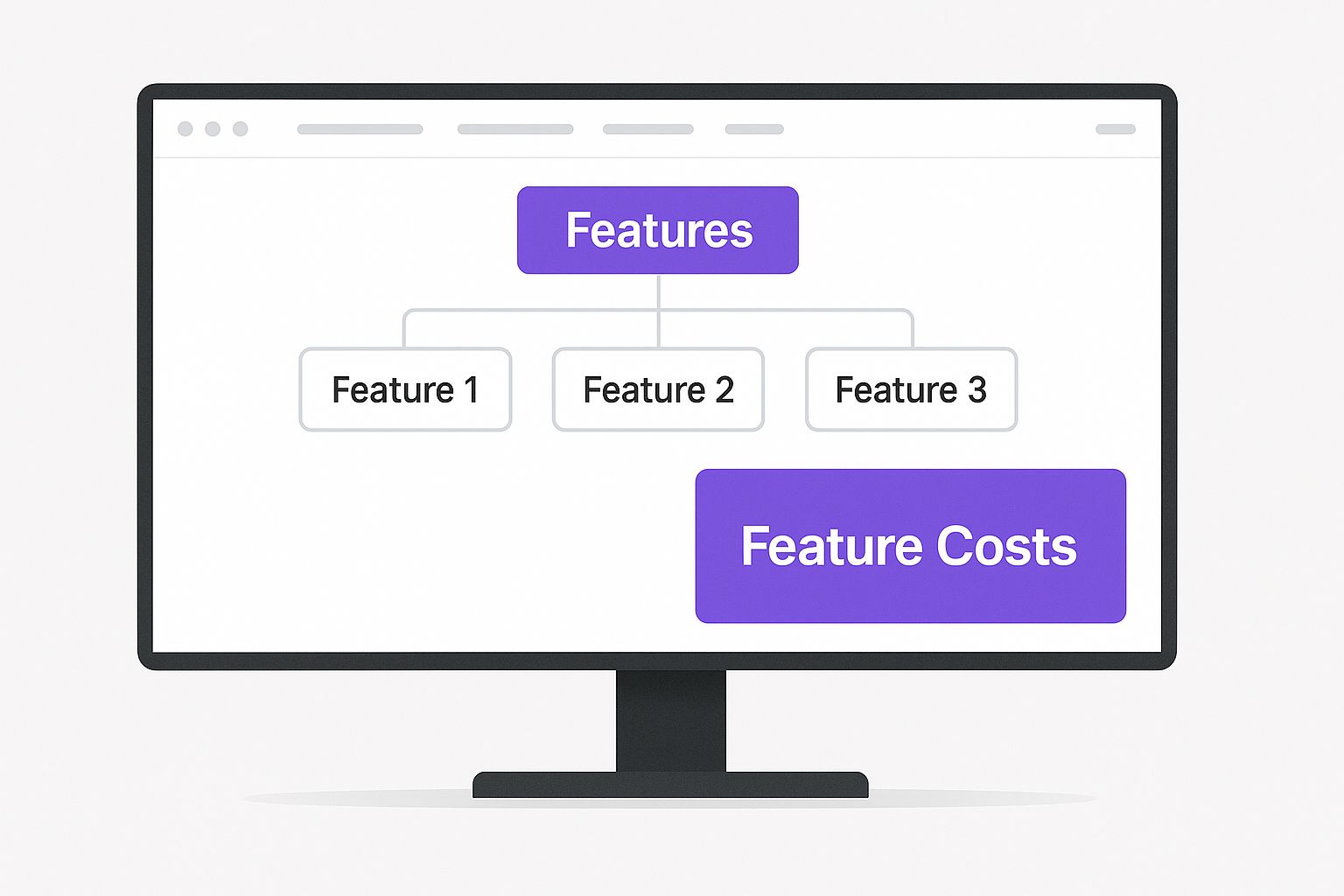
As you can see, the jump from a basic set of features to advanced capabilities like multi-chain support isn't a small step—it's a significant leap in development investment.
Expanding Marketplace Capabilities
To really grow, your marketplace needs to do more than just handle sales. It has to connect with the broader blockchain world and offer value that goes beyond the transaction itself. This means adding features for interoperability, automation, and top-tier security.
Multi-chain support is a big one. Instead of being stuck on a single blockchain like Ethereum, you let users mint and trade on other popular networks like Solana, Polygon, or Avalanche. This opens up your platform to a much wider audience, but it also means building and maintaining separate smart contracts and integrations for every single chain you add.
Automated royalty management is another must-have if you want creators to love your platform. Essentially, it's a rule written directly into the smart contract that automatically sends a cut of every secondary sale back to the original artist. Forever. Getting this right requires flawless smart contract programming to ensure those royalties are tracked and paid out without a hitch.
Advanced features like lazy minting and multi-chain support are no longer just nice-to-haves; they're quickly becoming the standard for any serious NFT marketplace. They add to the initial NFT marketplace development cost, but the payoff in user growth and long-term relevance is massive.
Finally, you have to go beyond basic security with enhanced security protocols. This isn't just about a one-time audit. It's about ongoing, active protection. This could include:
- Fraud Detection: Using AI to spot sketchy behavior like wash trading or fake collections before they become a problem.
- Smart Contract Monitoring: Setting up real-time alerts that notify you of any weird activity on your platform’s contracts.
- Secure API Integrations: Making sure any third-party tools you connect to don’t open up new security holes.
To help you get a clearer picture of where your money goes, we've broken down the estimated costs for some of these key components.
Cost Breakdown of Key Development Components
This table provides estimated cost ranges for specific features and development stages, helping you budget more granularly.
Keep in mind that these are just estimates. The final cost will always depend on the specific technologies used, the experience of the development team, and the unique requirements of your project.
Data Analytics and Custom Integrations
The best platforms don't just facilitate trades; they provide insight. A custom data analytics dashboard is a powerful tool that gives your users a real edge, showing them market trends, floor prices, sales volume, and even how individual artists are performing. Building this requires a powerful backend that can pull, process, and display blockchain data in a way that’s actually easy to understand.
For anyone looking to build a marketplace with a truly unique vision, a team like Dreamspace can make all the difference. As a vibe coding studio and AI app generator, they specialize in building these exact kinds of complex, data-heavy features that separate the good platforms from the great ones. Their expertise can help turn even the most ambitious ideas into a secure, competitive, and feature-rich reality.
Choosing Your Tech Stack and Blockchain
Picking your technology is a bit like choosing the engine and chassis for a race car. It’s the foundation that determines your marketplace's performance, speed, and, ultimately, the final NFT marketplace development cost. This isn't just some technical footnote; it's a core business decision that will echo through everything from user transaction fees to how well your platform can grow.
You're constantly trying to strike a balance between bleeding-edge features and a budget that makes sense. Get this part wrong, and you could be looking at a costly rebuild down the line or a platform that just can't keep up with what users expect.
The Great Blockchain Debate
The blockchain is the permanent, public ledger where every single NFT transaction gets recorded. The one you choose has massive consequences for your costs—both for you during the build and for your users every time they mint or trade.
- Ethereum: This is the OG, the most established blockchain with a huge community and battle-hardened security. But that reputation comes with a price tag. The infamous "gas fees" can be a real dealbreaker for users, and its transaction speeds can feel sluggish during peak times.
- Solana: Known for its mind-bendingly fast speeds and dirt-cheap fees, Solana is a go-to for marketplaces expecting a ton of activity. The trade-off? It’s more centralized, and its developer community, while growing at a frantic pace, isn't as mature as Ethereum's.
- Polygon: Think of Polygon as a high-speed rail line built right alongside Ethereum. It’s a Layer-2 solution that gives you faster transactions and lower fees while still piggybacking on the security and rock-solid infrastructure of the main Ethereum network.
The blockchain you land on directly shapes your operational costs and what it feels like to use your platform. High gas fees will scare away creators, while a newer, less-proven chain might create security headaches or make it harder to find talent, driving up your development budget.
This choice goes deeper than just fees. It dictates the pool of available developers you can hire and how complex your smart contracts will be. For a much deeper look at this, our guide to blockchain application development is a great resource for weighing the pros and cons.
Front-End Frameworks: The User Interface
While the blockchain is humming away in the background, your front-end is what people actually see and click on. A clean, snappy, and intuitive interface is non-negotiable if you want people to stick around. Your costs here are tied directly to the design's complexity and the skill of the developers building it.
React.js is the king of the hill here, and for good reason. It uses a component-based approach that makes it perfect for building the complex, dynamic interfaces you need—think NFT galleries that update in real-time or a fast-paced auction page. Its massive community and library of ready-made tools can also seriously speed up development, which can help keep costs in check.
Back-End Languages and Decentralized Storage
The back-end is the engine room, the server-side logic that connects your slick user interface to the blockchain. Node.js is a popular pick because it uses JavaScript, the same language as React. This synergy simplifies the whole process, meaning you don't have to hire separate teams of specialists for the front-end and back-end.
Finally, where do the actual JPEGs, videos, and audio files live? You can't store them on the blockchain itself—it would be ridiculously expensive.
That's where decentralized storage comes into play:
- IPFS (InterPlanetary File System): This is the industry standard. It's a peer-to-peer network that scatters file data across a decentralized network, ensuring the art is just as permanent and censorship-proof as the NFT token itself.
- Filecoin: Built right on top of IPFS, Filecoin adds a layer of economic incentives to create a more robust, long-term market for decentralized storage.
Plugging these systems into your marketplace adds to the timeline and budget, but it’s an essential step for building a platform that people can actually trust.
Trying to piece all this together can be overwhelming. Working with a team that gets these nuances is a game-changer. A vibe coding studio like Dreamspace can act as an AI app generator, guiding you through these crucial decisions to build a platform that’s not only technically sound but also financially smart.
The Hidden Costs of Launch and Maintenance
Getting your development budget approved can feel like crossing the finish line, but it’s really just the starting gun. The true NFT marketplace development cost doesn’t end when the coding stops. The ongoing expenses of launching and maintaining the platform are what make or break a project in the long run.
Think of it like buying a race car. The purchase price is just the beginning. You still have to pay for fuel, tires, insurance, and a top-notch pit crew to keep it on the track. If you skimp on maintenance, you’re not just risking a poor performance—you’re risking a catastrophic crash.
Non-Negotiable Security and Infrastructure Costs
Before a single user signs up, security has to be your obsession. A single vulnerability can shatter your reputation overnight and cost your community millions. This is exactly why a thorough smart contract audit is a non-negotiable line item in your budget.
These audits aren't cheap. Depending on how complex your contracts are, you can expect to pay anywhere from $5,000 to $30,000, and sometimes much more. But it's one of the best investments you'll ever make.
On top of that, you have the fundamental infrastructure that keeps the lights on. This includes:
- Server Hosting: Paying for cloud services like AWS or Google Cloud to host your front end and back-end services.
- Blockchain Node Maintenance: You need a rock-solid, always-on connection to the blockchain. That means either running your own node or paying for a reliable node-as-a-service provider.
- Third-Party API Subscriptions: Many essential functions, like data indexing, wallet connections, or email notifications, rely on services that come with recurring monthly fees.
Cutting corners on these technical costs is a recipe for disaster. Downtime and data problems will send users running for the hills faster than anything else. To get a better handle on this critical security step, you can dig into the different types of smart contract audit tools available.
Budgeting for Growth and Operations
Once you're live, the real work begins. Your budget needs to pivot from one-time development costs to ongoing operational expenses that fuel growth and keep your community happy.
Security doesn't stop after the initial audit. You need continuous monitoring to watch for threats in real time. This isn’t a one-and-done task; it’s a constant state of vigilance to protect your platform from new attack vectors.
Launching is not the end goal; it's the beginning of a long-term commitment. Your operational budget for marketing, community management, and customer support is just as important as your initial development investment.
Then there's the cost of actually getting people to use your marketplace. Marketing and community-building efforts—like social media campaigns, content, and influencer outreach—are how you attract your first wave of creators and collectors. These costs, along with ongoing operational fees, can add up, so it helps to understand typical platform fees to see how others structure their models.
Finally, never, ever underestimate the need for great customer support. When a transaction fails or a user is confused, a fast and helpful support team is what keeps them from churning. This isn't just an expense; it's a direct investment in your platform's reputation and long-term success.
How to Approach Your Marketplace Development
Okay, so you've got a handle on all the bits and pieces that drive the NFT marketplace development cost. That's half the battle. Now for the other, more critical half: finding the right people to actually build your vision.
Who you choose to bring this to life—be it a patchwork of freelancers or a dedicated development team—will completely shape your budget, your timeline, and honestly, your final product.
The right partnership can be the make-or-break factor between a project that fizzles out and one that launches with a bang. You need a team that lives and breathes Web3, understands the fine points of smart contract security, and can design an experience people actually want to use. Getting this right from the start saves you from a world of expensive headaches down the road.
Partnering with a Modern Development Studio
Deciding how to build is just as important as deciding what to build. You could go the traditional route, but modern approaches can get you there faster and more efficiently.
Take a vibe coding studio like Dreamspace, for example. Think of it as an AI app generator that can spin up complex blockchain applications, but with the critical eye of seasoned developers guiding the whole process. It's a hybrid model that gives you the best of both worlds.
This approach lets you build a top-tier, secure, and scalable NFT marketplace without the eye-watering price tag of a fully custom, from-the-ground-up project. Instead of reinventing the wheel, you're customizing a rock-solid foundation, which means you can launch faster and pour more of your budget into the unique features that will make your marketplace stand out.
A strategic partnership isn't just about hiring coders; it's about aligning with a team that understands your vision and can execute it efficiently, turning a complex technical challenge into a market-ready product.
If you're looking to make your development process even leaner, it's worth checking out some proven strategies to reduce overall software development costs. At the end of the day, the right partner helps you navigate the technical maze and ensures the platform you build is not only cool but also makes financial sense.
Frequently Asked Questions
When you're diving into the world of NFT marketplace development, a lot of questions pop up. It's totally normal. Getting a handle on timelines, costs, and the big strategic decisions is key to setting a realistic budget and making sure the final NFT marketplace development cost matches what you've envisioned.
Think of this as your cheat sheet. Let's tackle the questions we hear most often from founders just like you.
How Long Does It Take to Build an NFT Marketplace?
The honest answer? It depends entirely on how complex you want to get.
If you're aiming for a Minimum Viable Product (MVP) with just the core essentials—minting, listing, wallet connections—you're probably looking at 2 to 4 months. This is a great way to get your idea out there fast and start testing the waters.
But if you're dreaming bigger with a fully custom platform, things take longer. Features like multi-chain support, lazy minting, or complex auction systems add serious development time. For a marketplace packed with these advanced functions, expect a timeline of 6 to 9 months, and sometimes even more, to get it built, tested, and securely deployed.
Can I Use a White-Label Solution to Save Money?
Absolutely, and it's a popular route for a reason. A white-label solution is basically a pre-built marketplace foundation that you can brand as your own. It’s a shortcut that slashes your initial costs and gets you to market much faster.
The catch? You trade control for convenience. You're stuck with the features, scaling limitations, and branding options the white-label provider gives you. As you grow, you might feel boxed in. A custom build costs more upfront, but it gives you total freedom to create a one-of-a-kind experience and scale however you want, whenever you want.
What Is the Most Expensive Part of NFT Marketplace Development?
Hands down, it's the custom smart contract development and the security audits that follow. These aren't just lines of code; they are the self-executing rules that handle every single transaction on your platform—minting, bidding, royalty payouts, you name it. They have to be perfect.
The backbone of any marketplace people trust is its security. You need specialized blockchain developers to write bulletproof smart contracts, and then you need independent auditors to double-check everything. This is where the real cost—and value—lies.
This work requires elite (and expensive) blockchain developers. After they're done, you must get a security audit to protect your users' assets. It's a non-negotiable step that adds a significant chunk to your budget.
Are There Ongoing Costs After Launch?
Oh, yes. Launch day is just the starting line. Once your marketplace is live, you need to budget for the recurring expenses that keep it running smoothly, securely, and growing.
Some of the key ongoing costs you'll face are:
- Server and hosting fees to keep your site and backend online.
- Blockchain node maintenance, whether you run them yourself or use a service.
- Continuous security monitoring and re-audits whenever you add new features.
- Marketing and community management to bring in users and keep them engaged.
- Customer support for when users inevitably need a helping hand.
Ready to turn your vision into a reality without the guesswork? Dreamspace acts as your vibe coding studio and AI app generator, helping you build a secure, scalable, and stunning on-chain application. Generate smart contracts, data queries, and a full-stack website with AI. Start building with Dreamspace today.