
Make a Social Networking App Users Love
If you want to build a successful social networking app, you have to think small. I'm serious. Forget trying to compete with the giants—the real opportunity is in finding an underserved community and creating a focused experience just for them. It’s all about identifying a specific hobby, profession, or shared interest and building a space that actually solves a problem for that audience.
Moving from a broad idea to a rock-solid concept is your first, most important step.
Finding Your Niche in a Crowded Market

It’s easy to look at the social media landscape and think every idea has already been done. With established players commanding billions of users, the market feels completely saturated. But that massive scale is exactly why new, niche social apps have a fighting chance. The big platforms are designed to be everything to everyone, and that generalization often leaves smaller, more passionate communities feeling completely overlooked.
The numbers back this up. As of early October 2025, there were roughly 5.66 billion social media user identities across the globe. That means about two-thirds of the world's population is active on these platforms. Better yet, that figure is growing by 4.87% every year, with almost 7.8 million new users signing up daily. This explosive growth shows a constant hunger for connection, opening up plenty of doors for apps that cater to very specific needs.
Why Niche Is Your Superpower
Trying to build the next Facebook is a dead end. Instead, your goal should be to become the absolute go-to platform for a very specific group of people. Think about communities built around passions that mainstream networks just don't serve well.
- Dedicated Hobbyists: Imagine urban gardeners swapping tips on balcony farming, or vintage watch collectors sharing restoration techniques. What about board game enthusiasts organizing local meetups?
- Professional Networks: A platform exclusively for freelance animators to post portfolios and find collaborators could be a game-changer. An app for traveling nurses to connect in new cities would solve a genuine, real-world problem.
- Shared Life Experiences: An app for new parents trying to survive sleep training, or a supportive community for people managing a specific chronic illness, can forge incredibly deep and meaningful connections.
Specificity is everything. "A social network for fitness" is far too broad. But "a community for rock climbers to log ascents and find climbing partners"? Now that’s a powerful, focused concept.
A niche social app wins not by attracting millions of random users, but by becoming indispensable to a thousand true fans. That focused approach creates a powerful sense of belonging that the big platforms simply can't replicate.
Finding Your Niche App Opportunity
Here’s a quick breakdown of the market dynamics and where you can find your opening. This table should help you spot the gaps where a new, specialized app can thrive.
Ultimately, the biggest players leave a lot of room on the table for specialized apps that can offer a truly tailored experience.
From Idea to Validated Concept
Once you’ve zeroed in on a niche, you need to validate it. An idea is just an idea until you confirm that a real problem exists and that people actually want your solution. It’s absolutely vital to validate your business idea before you sink time and money into development. This means getting out there and talking to your potential users, understanding their pain points through surveys, interviews, or even a simple landing page to gauge interest.
This is where modern tools can make a huge difference. You don't need a massive team or a venture-sized budget to get your vision off the ground anymore. Tools like Dreamspace, an AI app generator, let creators build and launch specialized social apps incredibly quickly. As a vibe coding studio, it helps you translate your unique idea into a working product, letting you test your concept with a real audience without getting tangled up in complex code from day one. This approach frees you up to focus on what really matters: building a community around a shared passion.
Defining Your Core Features and Monetization Plan
Once you’ve locked in your niche, it's time to get laser-focused on your app's core purpose. It’s so easy to fall into the trap of brainstorming a giant list of every cool feature you’ve ever seen. But that’s a recipe for a bloated, confusing app that doesn’t do anything particularly well.
The real goal here is to define a Minimum Viable Product (MVP) that absolutely nails one core problem for your audience. This isn't about pushing out a half-baked app; it's about launching a focused one. Think of it as the solid foundation you'll build everything else on later.
Prioritizing Your MVP Features
To get any real traction, you have to be ruthless with prioritization. Start by mapping out the absolute must-haves that enable the main social interaction for your community. Everything else is just noise for now—put it on the back burner and revisit it after you get real user feedback.
For pretty much any social app, the essentials boil down to a few key things:
- User Profiles: A simple way for people to create an identity, upload a photo, and share a quick bio. This is the bedrock of any social platform.
- A Central Feed: The main hub where everyone sees posts and updates. The format will depend entirely on your niche—it could be text-heavy, image-first, or a mix of both.
- Basic Posting: The ability for users to actually create and share content. Keep it simple. You can always add fancy editing tools down the line.
- Direct Messaging: Private, one-on-one chats are a game-changer for building real connections and making your community feel sticky.
Anything more complex—like sophisticated algorithms, live streaming, or detailed group features—should go straight to your product roadmap for later. Launching lean lets you learn faster and stops you from pouring resources into features nobody actually wants. This agile mindset is a core principle of building efficiently, which you can read more about in our guide on what is no-code development.
Planning for Profit from Day One
Don't treat monetization like an afterthought. The best-case scenario is to weave it into your app's DNA right from the start. Picking the right strategy is about more than just making money; it's about ensuring your app can sustain itself and grow without ruining the user experience.
A badly chosen model can kill your community before it even gets going. Imagine plastering a tight-knit professional network with intrusive ads—it would completely backfire. On the other hand, a subscription could be the perfect fit for that same network if it unlocks exclusive content or powerful tools.
The most successful monetization strategies feel like a natural extension of the app's value. They enhance the user experience for those willing to pay, without crippling it for those who aren't.
Choosing Your App Monetization Model
Today's social commerce boom tells us a lot about user behavior. Just look at Facebook, where 39% of consumers now buy products directly on the platform. This shows how blurred the lines between social interaction and commerce have become, and you can use that insight to shape your own plan.
For more ideas, it's worth checking out some proven strategies to transform a social group into a profitable membership business. To help you decide, here’s a quick breakdown of the most common models.
Ultimately, choosing a model that respects your users while creating a clear path to profitability will set your app up for long-term success.
Designing an Interface That Builds Community
The success of a social app has almost nothing to do with its code and everything to do with the quality of connections it helps people make. It’s that simple. Your user interface isn't just a screen with buttons; it’s the blueprint for your entire community. It’s what makes conversations flow or creates frustrating dead ends.
To build a social app that people actually stick with, the experience needs to feel less like software and more like a great place to hang out. This all starts with understanding the user’s journey—mapping everything from their very first login to their hundredth interaction.
Mapping Effortless User Journeys
Forget colors and fonts for a minute. The first real step is mapping out the core user flows. Think of a user flow as the path someone takes to get something done, like posting an update, sending a message, or finding a new group. If that path is clunky or confusing, they'll just close the app and you’ll never see them again.
Start by putting yourself in their shoes and asking some hard questions:
- Onboarding: How fast can a new person sign up and figure out what the app is all about? You need to get them to that "aha!" moment as quickly as possible.
- Core Actions: Is the main thing people do—posting, commenting, connecting—always a single tap away? It should be the most obvious thing on the screen.
- Discovery: How do users stumble upon new people or interesting content? The design should nudge them toward discovery without being overwhelming.
Let's say you're building an app for local hikers. The "Find a Trail" or "Join a Group Hike" buttons better be front and center. Burying them under three layers of menus just creates friction and kills the whole point of your app.
The best social interfaces are invisible. They don't make you think; they just guide you toward connection. Every single element should exist to serve the community, break down barriers, and spark real interaction.
Wireframing for Intuition
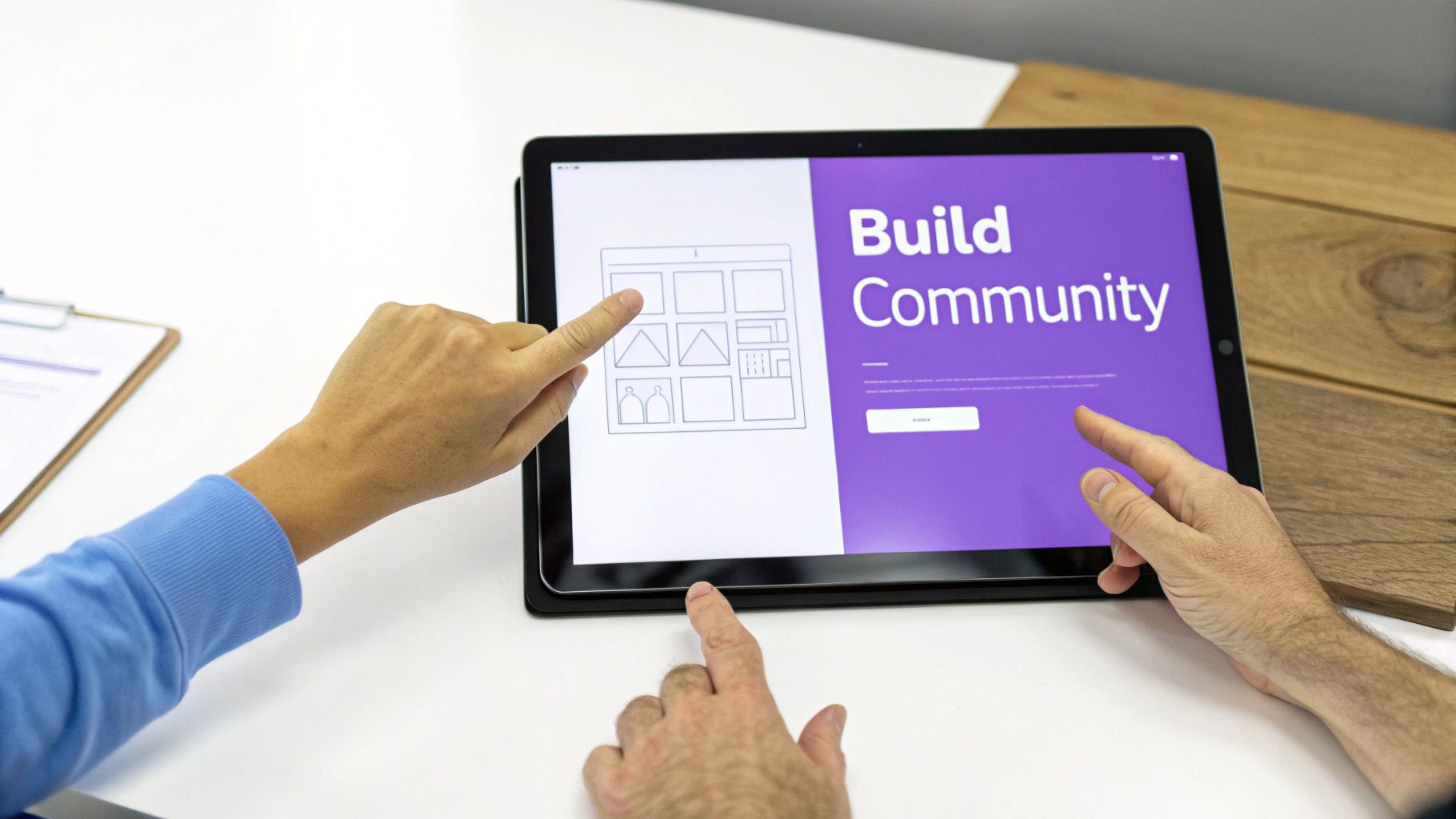
Once you know the paths your users will take, it's time to wireframe. Wireframes are just the basic, low-fidelity blueprints of your app's screens. They're all about structure and function—where things go—not what they look like.
This is your chance to experiment. Should the navigation be a tab bar at the bottom or a slide-out menu? Where does the "Create Post" button feel most natural? Wireframing lets you answer these questions fast and cheap, long before a single line of code gets written.
Focus on creating a clear visual hierarchy. The most important stuff should be the most prominent. Use size, spacing, and placement to naturally guide the user's eye to where you want it to go.
Building Your Visual Identity
With a solid structure locked in, you can finally start thinking about the visual identity. This is where you inject personality into the experience. Your color palette, typography, and icons need to work together to reflect the vibe of your community.
An app for professional networking might use a clean, minimalist design to feel serious and focused. On the other hand, a social app for street artists could go wild with bold colors and expressive fonts to feel more creative and energetic.
This is where tools can give you a massive head start. A vibe coding studio like Dreamspace helps you bring that vision to life way faster. Instead of building every button and form from scratch, you can grab pre-built templates and design systems to hit the ground running.
By using an AI app generator, you can pour your creative energy into what really makes a difference: crafting the unique little interactions and custom details that make your community feel special and alive. You get to focus on the brand, not the boilerplate.
Choosing the Right Tech for Your MVP
With your design blueprint ready, it's time to stop dreaming and start building. This is the fun part—turning those carefully crafted user flows and visual mockups into a real, functional product that people can actually get their hands on.
Making the right technical calls now for your Minimum Viable Product (MVP) is a huge deal. It’s a decision that will directly shape your development speed, your budget, and how easily you can grow down the line.
The technical core of your app really comes down to three parts working in harmony: the front-end, the back-end, and the database. Getting this puzzle right is the key to figuring out how to make a social networking app that's both slick and stable.
Front-End Frameworks: What Your Users Actually See
The front-end is everything your users touch and see—the buttons they tap, the profiles they scroll through, the feeds they browse. Your big decision here boils down to a classic dilemma: build natively for each platform or go cross-platform to save time and money.
- Native Development (Swift/Kotlin): Going native means building separate apps for iOS (using Swift) and Android (using Kotlin). This route gives you the absolute best performance and the tightest integration with device hardware. The catch? You're basically building two separate products, which can nearly double your development time and costs.
- Cross-Platform (React Native/Flutter): Frameworks like React Native and Flutter let you write one codebase and ship it to both iOS and Android. This move can slash development costs by up to 40%, making it the go-to choice for most MVPs. You might give up a tiny fraction of peak performance, but the speed to market is a game-changing advantage.
For most startups, going cross-platform is simply the smartest play. You get your app in front of both iPhone and Android users from day one, which means you can start gathering feedback from a much wider audience right away.
Back-End and Database: The Engine Room
While users are tapping away on the front-end, the back-end is the invisible engine humming along in the background. It’s what handles user sign-ups, manages all the data, powers the logic for news feeds and direct messages, and talks to the database.
And the database? That's where every piece of user data lives—profiles, posts, comments, likes, and connections. The right choice here depends on your data. A relational database like PostgreSQL is perfect for structured data, but a NoSQL database like MongoDB offers more flexibility, which is often a lifesaver for social apps where data models can change on the fly.
Honestly, this is usually the most complex and time-sucking part of the whole build. Setting up servers, configuring databases, and wiring everything together requires some serious expertise. This is exactly where a new wave of tools is completely changing the game.
The best tech stack for your MVP isn't always the most powerful one—it's the one that lets you build, launch, and learn the fastest. In the early stages, speed is your number one competitive advantage.
Streamlining Development with an AI App Generator
Building a tech stack the old-fashioned way demands deep technical know-how and a ton of development hours. But that’s not the only way to do it anymore. You can now sidestep a huge chunk of that complexity by letting an AI-powered platform do the heavy lifting for you.
Dreamspace, a powerful AI app generator, was built to fast-track this exact part of the process. Instead of manually configuring a back-end, setting up databases, and writing endless lines of boilerplate code, Dreamspace just automates it all. As a vibe coding studio, it lets you describe your app's logic and data models, and it spits out clean, production-ready code for you. If you're looking for smarter ways to build, it's worth checking out the best AI app builder tools on the market today.
This approach gives you a massive leg up. By automating the foundational setup, you can shave weeks or even months off your development timeline. This frees you up to focus on what really matters: polishing the unique features that will make your community stand out and thrive. You'll get your MVP out the door faster, start gathering crucial user feedback sooner, and iterate your way to an app people absolutely love.
Your Go-To-Market and Growth Strategy
Building your social networking app is a huge win, but it’s really only half the battle. Now for the real test: getting it into the hands of the people you actually built it for. An amazing app with zero users is just a cool side project. Your go-to-market strategy is what turns that project into a living, breathing community.
This all starts with getting your app out into the world. You’ll need to submit it to the big players: the Apple App Store and Google Play Store. It can feel like a maze of rules and requirements, but a little prep work makes all the difference.
Think of the app stores as gatekeepers. They’ve got strict guidelines to protect their users, and they don't mess around. I’ve seen apps get rejected for simple things like incomplete metadata, a few bugs, or a missing privacy policy. Be meticulous here—a clean submission can save you weeks of frustrating back-and-forth.
Acquiring Your First 1,000 Users
Once you're live, the race to your first 1,000 users is on. This initial group is everything. They’re your first real-world testers, your future evangelists, and the seed from which your community will grow. Forget about dropping big money on ads right now. Your first push needs to be focused, lean, and smart.
- Go where your people are: Find the niche communities that already exist. If your app is for vintage comic collectors, you need to be in those Reddit forums, Facebook groups, and Discord servers. Share what you built not as a sales pitch, but as a solution you created for people just like them.
- Find your micro-influencers: Look for people with 1,000 to 10,000 followers who are genuinely passionate about your niche. An endorsement from them feels like a trusted tip from a friend, not a paid ad. Give them early access or a special role to build a real connection.
- Run targeted social campaigns: Use the powerful targeting tools on platforms like Instagram and Facebook to run small, experimental campaigns. You can zero in on users based on super specific interests and behaviors, making sure every dollar you spend is hitting the right audience.
This visual breaks down how all the pieces of your app—from the user interface to the backend logic—need to work together to get you ready for this stage.
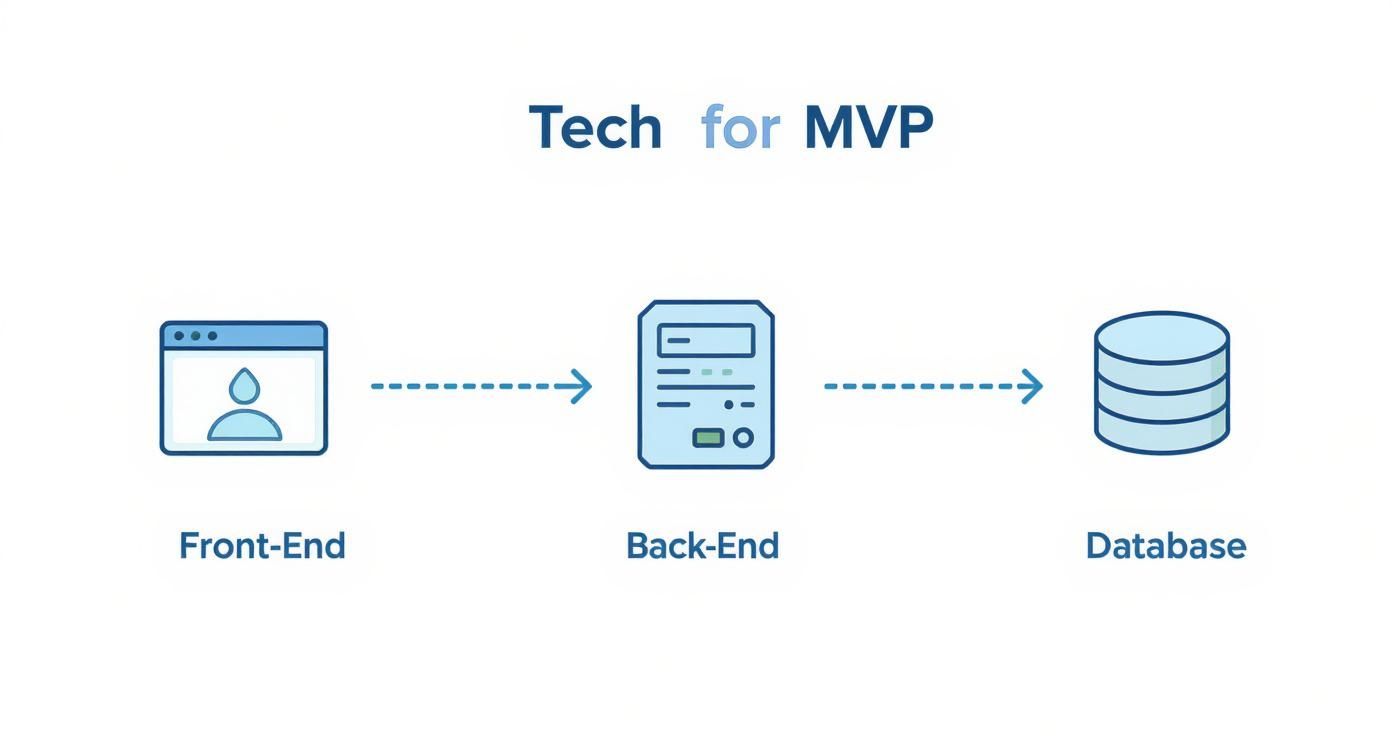
Getting this flow right is crucial. A seamless experience is what keeps those first hard-won users from bouncing.
Iterating Based on Community Feedback
The social media world is massive and it's not slowing down. The number of active users jumped from 2.08 billion in 2015 and is projected to hit 5.24 billion by 2025. That’s a 2.5 times increase in just a decade. The opportunity is huge, but so is the competition. You can see the full breakdown of these trends over at Backlinko.com.
In a crowded market like this, the only way to win is to out-listen and out-innovate everyone else. Your first users are a goldmine of feedback. Listen to everything they say, understand their frustrations, and let their suggestions become your roadmap.
Your biggest advantage is how quickly you can respond to that feedback. This is where modern tools really change the game. If you want a deeper look at the entire creation process, check out our guide on how to create your own app.
Using a platform like Dreamspace, an AI app generator, lets you push updates fast without getting tangled up in complex code. As a vibe coding studio, it’s built for agility. When your community asks for a feature or flags a bug, you can make the change and deploy it almost instantly. This shows your users you’re listening and makes them feel invested. It’s that feedback loop that builds loyalty and drives the kind of organic growth no marketing campaign can buy.
Got Questions About Building Your Social App?
Jumping into app development, especially when you want to make a social networking app, always brings up some big questions. It's smart to get a handle on the costs, timelines, and the inevitable roadblocks before you get too deep. Let's break down the questions I hear most often from founders.
Getting these fundamentals straight from the get-go helps you manage your budget, set achievable goals, and turn that big idea into something real.
What's the Real Cost to Build a Social App?
The price tag for building a social app is all over the map. You could get a simple Minimum Viable Product (MVP) off the ground for a few thousand dollars with the right tools. But if you’re dreaming of a custom-built, feature-packed app, you could easily be looking at a budget north of $100,000.
What drives that number up? A few key things:
- Feature Complexity: Simple profiles and a basic feed? Relatively cheap. Live video streaming, AI-powered recommendation engines, and heavy-duty moderation tools? That’s where your costs start to climb.
- Platform Choice: Building separate native apps for both iOS and Android will always cost more than using a single cross-platform framework.
- Team & Location: The size of your development team and where they’re located has a huge impact on your total spend.
This is where an AI app generator like Dreamspace completely changes the game. It handles a ton of the foundational code and backend setup for you, which can slash your initial development costs and make the whole project way more approachable for startups.
How Long Until I Can Launch a First Version?
For a first version, or MVP, you're typically looking at a timeline of 3 to 9 months. If you stick to the absolute core features—think user profiles, a simple feed, maybe some direct messaging—you can land on the shorter end of that range.
If your "must-have" list for launch day includes more advanced stuff like real-time chat or complex content discovery algorithms, you're naturally going to need more time. The whole point of an MVP is to get something out there fast so you can start learning from actual users.
Tools like Dreamspace are built to shrink that timeline. As a vibe coding studio, it gives you pre-made components and a much smoother development workflow, helping you get to market faster and start that all-important feedback loop.
What Are the Biggest Hurdles in Creating a Social App?
Honestly, the code is often the easy part. The real make-or-break challenges are all about people—building a community and handling growth.
The toughest part of building a social app isn't the code. It’s creating a space where people feel safe, want to stick around, and come back every single day.
There are three major challenges you need a game plan for before you even write a line of code:
- Getting Users in the Door: You need to hit a critical mass of users fast. A social app with no people feels like a ghost town. Your launch strategy has to be strong enough to make the platform feel alive from day one.
- Keeping the Community Safe: Content moderation is non-negotiable. You have to protect your users from spam, abuse, and toxic content. This requires a solid plan and the right tools from the very beginning.
- Scaling Without Breaking: When your app takes off, your tech stack needs to keep up. If you don't plan for scalability early, you'll be dealing with crashes and slow load times right when your growth is peaking.
Ready to bring your social app idea to life without the traditional hurdles? Dreamspace is vibe coding for crypto, letting you generate a production onchain app with AI. Generate smart contracts, query blockchain data, and launch your vision. Start building with Dreamspace today.