
How to Create a Cryptocurrency Token: Step-by-Step Guide

So, you want to launch your own crypto token. Whether you're a seasoned developer or an entrepreneur with a killer idea, the process isn't the black box it used to be. You've got options.
This guide will walk you through both paths: the old-school manual coding route and the slick, new-school approach using no-code AI.
How Tokens Are Born in 2024
Ever scroll through CoinMarketCap and wonder where all these new tokens come from? It feels like thousands pop up every day, and you wouldn't be wrong. The world of token creation has blown wide open, moving way beyond just the hardcore coders.
We're seeing an absolute explosion of new tokens, fueled by everything from wild memecoin frenzies to genuinely useful projects. The barrier to entry has practically vanished.
Just look at the numbers. In early 2024, the market was seeing an average of 5,300 new tokens created every single day. That pace is set to crush the 830,000 tokens launched in all of 2023. This isn't just a trend; it's a fundamental shift, as this detailed market analysis from CoinGecko breaks down.
Two Paths, One Destination
When it comes to actually making a token, you're essentially looking at two main roads. Your choice will come down to your technical skills, how much time you have, and what you're trying to build.
Here’s the breakdown:
- The DIY Coder Route: This is the traditional way. You'll be writing, testing, and deploying a smart contract from scratch using a language like Solidity. It gives you absolute control over every little detail, but you need to know what you're doing.
- The No-Code AI Shortcut: This is the modern, streamlined approach. Tools like Dreamspace—a vibe coding studio—do all the heavy lifting. You just define what you want your token to do through a simple interface, and the AI handles the code. It’s fast, accessible, and much less intimidating.
The Bottom Line: Deciding between manual coding and a no-code tool like Dreamspace is a classic trade-off. Do you need granular control and have the coding chops for it, or is speed and simplicity your top priority?
To make that choice a little clearer, let's put them side-by-side.
Comparing Token Creation Methods
Here's a quick look at the differences between rolling up your sleeves to code and letting a no-code AI tool take the wheel.
Ultimately, there's no single "best" way. If you're building something truly groundbreaking with unique mechanics, the control of manual coding is probably what you need. But for the vast majority of projects—from community coins to utility tokens—no-code platforms offer a ridiculously efficient way to get your idea onchain.
No matter which path you choose, this guide will cut through the noise and give you a clear roadmap to launch. Let's get started.
Designing Your Token for Success

Before you touch a single line of code or click a button in a no-code tool, you need a blueprint. Seriously. A token launched without a clear purpose and solid economics is just a ship without a rudder—it’s not going to get very far. This initial planning stage is where you decide what your token is and, more importantly, why anyone should care about it.
First up, nail down its utility. What does your token actually do? This is its core value proposition. Most tokens fall into one of a few buckets:
- Governance: Holders get voting rights on the future of a project or a DAO.
- Utility: It unlocks a feature in a dApp, like paying for a service or accessing exclusive content.
- Community: Think memecoins. Their entire purpose is to build and reward a vibrant, highly engaged community.
You have to get crystal clear on this. A token that tries to be everything to everyone usually ends up being nothing at all.
Building Your Tokenomics Model
Once you know the why, it’s time to dive into tokenomics—the economic engine that will power your token. This is where you make the tough calls that will directly affect its scarcity, how it's distributed, and its long-term potential. It’s basically the monetary policy for your new digital asset.
Here are the big questions you need to answer:
- Total Supply: Are you going for a fixed maximum supply, like Bitcoin's 21 million, to create scarcity? Or will it be an inflationary model where new tokens are minted over time?
- Distribution: How are you getting these tokens out into the world? A fair launch, a presale for early believers, or maybe an airdrop to reward initial community members are all common paths.
- Allocation: How much of the supply is reserved for the team, a community treasury, marketing, and the public sale? Be transparent here. It’s absolutely essential for building trust.
A well-designed tokenomics model aligns incentives for everyone involved, from the core dev team to the earliest adopters. It creates a healthy ecosystem where holding and using the token just makes sense for the long run.
Choosing the Right Blockchain
Finally, where is your token going to live? The blockchain you choose is its home base, and this decision has huge implications for everything from user costs to transaction speeds. You're not just picking a piece of tech; you're plugging into an entire ecosystem.
Here’s a quick breakdown of the popular players:
For a lot of new projects, a network like Polygon strikes a great balance, giving you low fees while staying compatible with Ethereum’s massive world of tools and users. But if you're building a more complex application, a vibe coding studio like Dreamspace can help you navigate these choices. If your project demands absolute top-tier security for high-value transactions, the cost of building on Ethereum might be worth it.
Spending real time on this strategic foundation is critical. It ensures you’re not just launching another token, but setting it up for a sustainable future.
Creating a Token with No-Code AI
Not too long ago, launching a token was something only serious coders could even attempt. That's just not the reality anymore. AI-powered platforms have blown the doors wide open for creators, entrepreneurs, and anyone with a good idea to get onchain without writing a single line of code.
This is the fast track.
Using a no-code tool like Dreamspace—a vibe coding studio—transforms the headache of smart contract development into a simple, visual process. Forget wrestling with Solidity. You're just filling out intuitive forms and using plain-English prompts to define your token’s DNA.
From Prompt to Production-Ready Token
Think of these platforms as a guided workshop where you bring the vision, and the tool builds the scaffolding.
To create a standard ERC-20 token, for example, you'd just need to define a few core properties:
- Token Name: The full name of your project, like "Galaxy Gold."
- Symbol: Its ticker, something like "GLXY."
- Total Supply: The maximum number of tokens that can ever exist.
- Decimals: How divisible your token is. The standard is 18.
Once you plug that in, the platform generates a secure, audited smart contract based on your specs. This cuts down the risk of human error dramatically—a lifesaver when a single mistake can be catastrophic. There's always a discussion around AI drafting versus manual drafting, but for standard tokens, the safety and speed are hard to beat.
These tools also make advanced features feel trivial. Need a minting function to create more tokens later? Or maybe a burn mechanism to reduce supply? These are often just a checkbox away, saving you hours of complex coding. If you're curious about what's happening under the hood, we have a great guide on how to build smart contracts.
Understanding Token Standards Visually
Most no-code builders support the major token standards, and it helps to know what you're working with. Each one serves a totally different purpose.
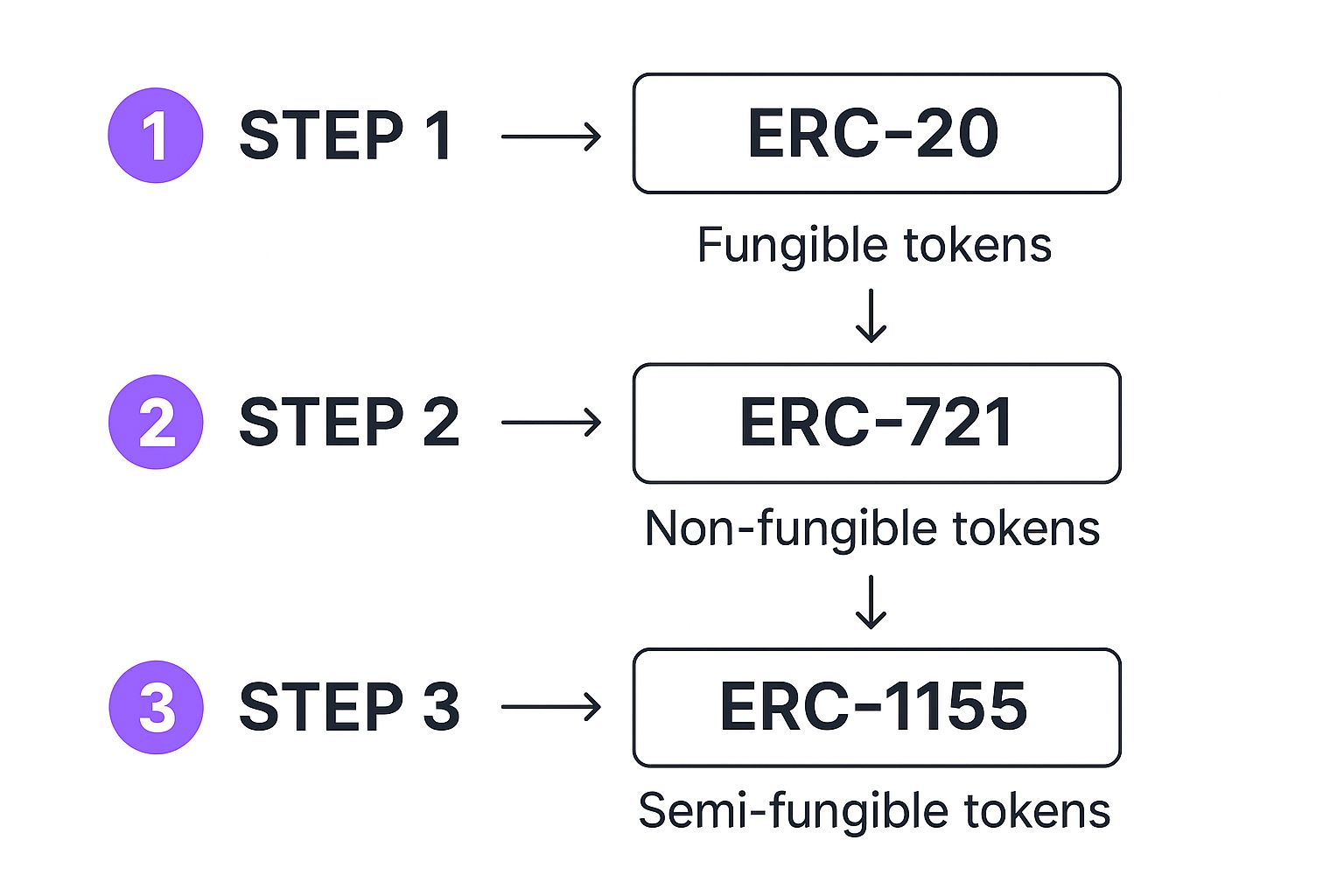
This visual really clarifies the landscape, showing the path from simple, fungible tokens (ERC-20) to unique digital collectibles like NFTs (ERC-721) and the hybrid model that combines them (ERC-1155).
The explosive growth in tokenization is a direct result of these tools making it all so accessible. Believe it or not, nearly 30 million tokens have been created globally in just two years. That number is staggering, and it shows just how fast anyone can get their project off the ground now.
No-code AI platforms completely democratize token creation. They let you focus on what really matters—your vision and your community—while ensuring the technical side is secure, efficient, and up to industry standards.
Coding Your Smart Contract Manually
For those who want total control and the ability to customize every last detail, rolling up your sleeves and coding the smart contract yourself is the only way to go. It’s definitely not for the faint of heart, but this path gives you the ultimate freedom to build exactly what you envision, without being boxed in by any template or pre-built system.
While AI tools like Dreamspace, an AI app generator, offer a ridiculously fast and smooth experience, the manual route is for developers looking to innovate on the core logic itself. You get to define every single function, variable, and interaction, making it the perfect choice for projects with complex tokenomics or specialized on-chain behaviors.
Getting Your Development Environment Set Up
Before a single line of code gets written, you have to set up your workshop. A professional local development environment isn't just a nice-to-have; it's non-negotiable for any serious blockchain work. It’s how you compile, test, and debug your smart contracts efficiently before they ever touch a live, money-on-the-line network.
The industry standard here is to use a framework like Hardhat or Foundry. Hardhat, in particular, is a favorite for its flexibility and massive plugin ecosystem.
To get started, you'll generally need:
- Node.js: The JavaScript runtime that powers most of the tools you'll be using.
- A Code Editor: Visual Studio Code is pretty much the undisputed king in the dev community.
- Hardhat: The development framework you’ll install right into your project folder.
Spinning up a new Hardhat project is quick and painless. Best of all, it gives you a local blockchain network for instant testing, which is a massive time-saver.
Key Takeaway: A proper local setup with tools like Hardhat is what separates the pros from the amateurs. It lets you catch costly mistakes through rigorous testing in a safe sandbox before you spend a dime on real deployment fees.
Writing the ERC-20 Smart Contract
The heart and soul of your token is its smart contract, written in a language called Solidity. If you're new to the language, getting comfortable with its syntax and common security patterns is your first priority. To get you up to speed, our detailed Solidity programming tutorial is a great place to build a strong foundation.
Now, you don't have to write everything from scratch. In fact, almost no one does. The community overwhelmingly relies on OpenZeppelin's contract libraries. These are battle-tested, professionally audited, and secure building blocks that follow the official ERC-20 standard to the letter.
A basic token contract using OpenZeppelin is surprisingly lean. You just import their ERC20.sol contract and have your own contract inherit from it. Then, in the constructor, you define its name, symbol, and the initial supply.
You'll automatically inherit all the core functions you need:
transfer()to send tokens between addresses.balanceOf()to check how many tokens an address holds.approve()to let another contract spend tokens on a user's behalf.
This structure is what ensures your token will just work with wallets, exchanges, and other dApps across the entire ecosystem. With five to ten new blockchains launching monthly (most of them EVM-compatible), this kind of standardization is absolutely critical. This growth is mirrored by an explosion in trading venues—a staggering 89 new DEXes launched in March 2024 alone, opening up countless liquidity channels for properly built tokens. You can see for yourself how fast this ecosystem is growing and why sticking to standards is so important.
By building on top of these secure libraries, you can focus your energy on what makes your token unique, instead of reinventing the wheel and accidentally introducing security holes.
Testing and Deploying Your New Token
Alright, you've hammered out the tokenomics and either coded the smart contract yourself or used an AI generator like Dreamspace to handle the heavy lifting. Now comes the moment of truth.
Pushing your contract live without putting it through its paces first is a rookie mistake you simply can't afford to make. In the world of crypto, one tiny bug can be exploited, draining funds and destroying your project’s reputation before you even get off the ground.
This is exactly why testnets exist. Think of a testnet as a full-blown rehearsal for the real thing—a parallel universe for a blockchain like Ethereum. It works just like the main network, but all transactions use "play money" instead of actual assets. It's your sandbox to deploy, send tokens, and stress-test every single function in a completely safe, consequence-free environment.
Using a Testnet for Safe Experimentation
Popular testnets like Sepolia for Ethereum are your best friends during this phase. Getting started is pretty straightforward.
First, you’ll need some test funds. You can get free test ETH sent to your wallet from a "faucet," which you’ll use to cover gas fees for your test deployment.
Next, you'll deploy your contract. Using a tool like Remix or your local Hardhat environment, just connect your wallet (make sure it's switched to the Sepolia network!) and deploy the smart contract exactly as you would on the main network.
Once it's live on the testnet, it's time to try and break it. Send tokens to another test wallet, check balances, and push every function to its limit. This is your one chance to find and fix vulnerabilities before they become catastrophic, real-world problems.
Remember, solid software testing best practices aren't just for traditional apps; they’re critical here to ensure your contract is secure and works exactly as intended under all conditions.
Going Live on the Mainnet
Once you’re confident your smart contract is bulletproof, you’re ready for the main event: deploying to the mainnet. This is the live blockchain where every transaction holds real financial value. The stakes are much higher, but the process is nearly identical to what you just practiced.
You’ll need to fund a wallet like MetaMask with the native cryptocurrency of your chosen chain (like real ETH for Ethereum) to cover the one-time deployment gas fee. When you execute that transaction, your token officially exists on the blockchain, forever tied to its unique contract address.
Pro Tip: Gas fees can be wild, swinging dramatically based on network traffic. I always use a gas tracker to find a cheap time to deploy. Doing this can save you a surprising amount of money on that initial transaction.
Verifying Your Contract for Transparency
Don't celebrate just yet. Your final post-deployment step is non-negotiable if you want to build trust. You need to verify your smart contract on a block explorer like Etherscan (for Ethereum) or PolygonScan (for Polygon).
Verification is simple: you just upload your source code to the block explorer. It then compiles your code and confirms that it perfectly matches the bytecode you deployed on-chain. This makes your code public and transparent.
It’s how you prove to your community that you have nothing to hide and that the contract does exactly what you claim it does. An unverified contract is a massive red flag for potential holders and a complete dealbreaker for any serious investor.
So, Your Token Is Live... What Now?
It’s easy to think that deploying your smart contract is the finish line. In reality, it's the starting pistol. The moment your token hits the blockchain, the real race begins—the race to build value, foster a community, and create a real ecosystem.
A token without a place to trade is just code sitting on a server somewhere. Your first job is to give it a marketplace.
This means you need to establish liquidity on a decentralized exchange (DEX). Think platforms like Uniswap for Ethereum-based tokens or PancakeSwap if you're on the BNB Chain. You'll create a liquidity pool by depositing a pair of assets: your new token and a base currency like ETH or BNB. This pool is what allows people to actually buy and sell, and it sets the very first market price for your creation.
From Developer to Community Builder
Once people can trade your token, your hat changes. You’re no longer just a developer; you're now a community leader. The long-term survival of any token hinges almost entirely on the strength of its community.
Your new headquarters will likely be Discord and Telegram. These aren't just places to chat; they're the lifeblood of your project.
- Discord: Perfect for building a structured home for your community. You can have dedicated channels for announcements, developer talk, general discussion, and even governance proposals.
- Telegram: The go-to for fast-paced, real-time announcements. It’s ideal for broadcasting critical updates to a wide audience instantly.
Be present. Be transparent. Answer questions. Fostering a genuine, positive environment is everything.
Key takeaway: Every move you make after launch builds—or erodes—trust. Want to send a powerful signal that you’re serious about security? Get your contract audited, even post-deployment. We've put together a guide on the best smart contract audit tools to help you build that crucial layer of confidence.
Getting the Word Out and Growing Your Reach
Finally, you need to make some noise. With thousands of tokens launching, you have to find a way to stand out. Your marketing can't be an afterthought.
Think about targeted campaigns on crypto-focused social media platforms. Find influencers who genuinely align with your project’s mission, not just shillers. Publish content that clearly explains your token's purpose and your long-term vision.
Whether you used a no-code tool like Dreamspace, a vibe coding studio, to get to market quickly or spent months coding manually, a well-executed post-launch strategy is what separates a fleeting crypto project from one that builds a lasting legacy.
Common Questions About Token Creation
Jumping into the world of token creation always stirs up a ton of questions. I get it. From the costs involved to the legal gray areas, you need straight answers before you commit. Let's break down some of the most common things people ask to get you started on the right foot.
How Much Does It Cost to Create a Cryptocurrency Token?
Honestly, the cost can be all over the map.
If you go the no-code route with an AI tool like Dreamspace, an AI app generator, your main cost is just the network "gas fee" to push the contract live. On an efficient chain like Polygon, this could be less than $50. On Ethereum, especially when it’s busy, you might see that number jump into the hundreds.
Now, if you're coding it from scratch, the development itself is "free"—if you already have the skills. But if you need to hire a freelance blockchain dev? You’re easily looking at thousands of dollars. On top of that, you absolutely should budget for a professional security audit, which typically starts around $5,000, plus whatever you plan to spend on marketing to get the word out.
The platform you choose is the single biggest factor in your initial cost. No-code tools slash those upfront development expenses, leaving you with just the on-chain deployment fees and your post-launch budget.
What Is the Difference Between a Coin and a Token?
This is one of the most important distinctions to understand. A coin, like Bitcoin (BTC) or Ether (ETH), has its own native blockchain. It’s the core asset of that network, used for everything from paying transaction fees to rewarding the people who secure the chain.
A token, on the other hand, is built on top of an existing blockchain. A perfect example is the universe of ERC-20 tokens that run on Ethereum. They don't have their own blockchain; instead, they piggyback on Ethereum's security and infrastructure. Tokens are usually created for a specific purpose inside an app or ecosystem, like giving users special features or voting rights.
Do I Need to Be a Programmer to Create a Token?
Not anymore, and that's a huge shift. The old way absolutely required you to be fluent in a language like Solidity. But modern tools have completely changed the game.
AI-powered platforms and user-friendly builders like Dreamspace offer a totally no-code experience. You get a simple interface where you define your token's name, symbol, total supply, and other features, all without ever touching a line of code. This opens the door for anyone with a great idea to bring their project to life.
Is Creating a Token Legal?
Creating the token itself is usually legal. The tricky part is how you use it and distribute it, as regulations vary massively from country to country.
If your token could be seen as a security—for example, if people buy it expecting to profit from your team's efforts—you'll fall under securities laws. This is not something to guess on. You absolutely need to talk to a legal expert who understands crypto in your specific region to make sure your project is fully compliant before you even think about launching.
Ready to bring your token idea to life without the coding headache? Dreamspace is a vibe coding studio that lets you generate production-ready onchain apps with AI. Build your vision at Dreamspace today.