How to Create a Bot on Discord A Complete Guide
Have you ever wondered how those massive, perfectly-run Discord servers manage to greet every new member instantly, filter out spam, or even queue up music on command? The secret sauce isn't a team of moderators working 24/7—it's custom Discord bots. Building your own bot is the key to unlocking a whole new level of community management and engagement, turning your server from just another chat room into a truly interactive space.
Why Bother Building a Custom Discord Bot?
Creating a bot isn't just a neat party trick. It's about crafting an experience that's perfectly suited to your community's unique vibe and needs. A custom bot can take over all those repetitive, time-consuming tasks like posting welcome messages or kicking spammers. This frees you and your mods up to focus on what really matters: building genuine connections with your members.
Beyond just automation, a custom bot can introduce one-of-a-kind engagement tools. Think custom-built minigames, server-specific polls, or even integrations that pull data from other platforms your community loves.
When you decide to jump in, you'll find yourself at a fork in the road. You essentially have two main ways to go.
Choosing Your Bot Creation Path
Here's a quick comparison of the two primary methods for creating a Discord bot, helping you decide which approach is right for you.
Let's break that down a bit more.
Coding From the Ground Up
If you're comfortable with code, grabbing a library like Discord.js (for JavaScript) or Discord.py (for Python) gives you absolute freedom. This is the path for you if you have a very specific, unique feature in mind that you just can't find anywhere else. The sky's the limit here.
The No-Code Route
On the other hand, if coding sounds like a nightmare, don't sweat it. No-code bot builders have come a long way. These platforms offer drag-and-drop interfaces that let you piece together a powerful bot in a fraction of the time. It’s a fantastic way to get a highly functional bot up and running without writing a single line of code.
The Power of Automation and AI
Whichever path you take, the end goal is the same: create a bot that makes your community a better place to be. And you'd be in good company—as of March 2024, over 30 million Discord users have already interacted with AI-powered apps on the platform. Automation is no longer a niche feature; it's a core part of the Discord experience.
If you're looking to dive even deeper into the world of app creation, check out our guide on how to create your own app.
Modern tools, like the AI app generator from a vibe coding studio like Dreamspace, are starting to blur the lines between coding and no-code, making the process faster and more accessible for everyone.
No matter your approach, your journey begins at the Discord Developer Portal. This is mission control for your bot.
It’s where you'll officially register your application, get your API credentials, and find all the documentation you’ll need to bring your bot to life. Get familiar with it, because you'll be spending a lot of time here.
Setting Up Your Application in the Developer Portal
Before you can write a single line of code, your bot needs an identity on Discord's network. This happens in the Discord Developer Portal, which is basically the mission control for all your bot projects. Think of it as getting your bot its official passport.
First things first, you'll hit the "New Application" button. This creates a sort of project folder for your bot. Go ahead and give it a name—don't worry, you can always change it later if you come up with something better.
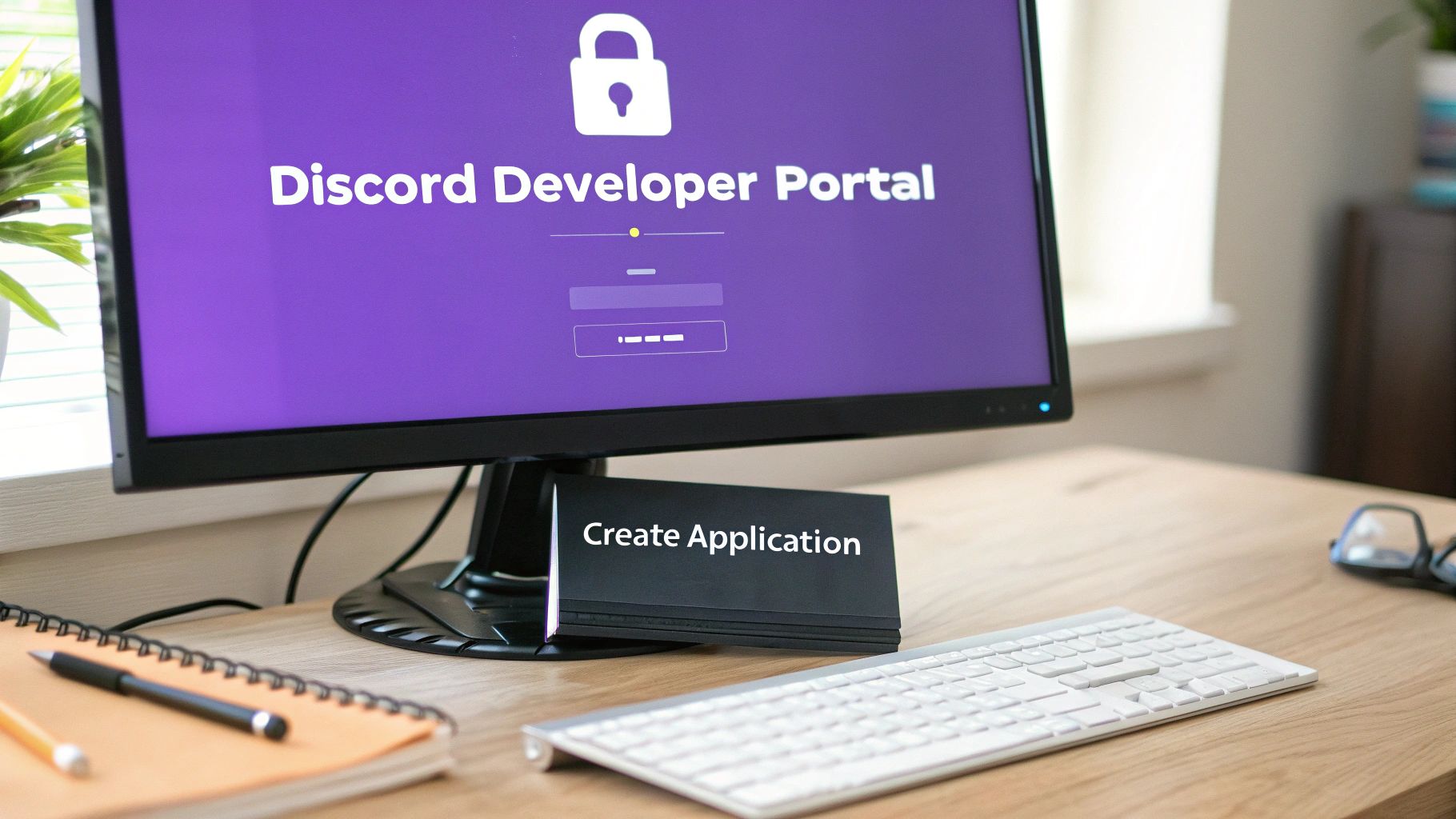
Once your application is created, find the "Bot" tab in the menu on the left. This is where you'll bring your bot to life.
Securing Your Bot Token
In the Bot section, you'll see a button that says "Add Bot." Clicking this officially registers your bot with Discord and, more importantly, generates its token.
This token is everything. It's a long, unique string of characters that acts as the secret key to your bot's ignition. It’s how your code proves it has permission to connect to Discord and control your bot's actions.
CRITICAL: Your bot token is the single most sensitive piece of information you'll handle. Never, ever share it publicly. If someone gets their hands on it, they have full control over your bot and can cause all sorts of chaos.
I can't stress this enough: keep your token safe. The best practice is to store it in an environment variable or a secure secrets manager, not hard-coded in your script. If you push it to a public GitHub repo, it will be found and abused almost instantly. If you ever think it's been compromised, come right back here and hit the "Regenerate" button immediately.
With your token safely tucked away, now for the fun part. You can give your bot a username and upload a cool avatar right here in the portal. This is the face your bot will show to the world, so make it a good one
Choosing Your Development Tools
Alright, you've got your bot's identity locked in. Now comes the fun part: deciding how to build its brain. This really boils down to your comfort level with code and how much granular control you're after. Your choice here sets the stage for the entire project.
If you’re ready to dive into code, the two undisputed heavyweights are Discord.js for JavaScript and Discord.py for Python. Both are incredibly mature libraries with massive communities and tons of documentation.
- Discord.js: This is a no-brainer for web developers or anyone comfortable in a Node.js environment. It's wildly flexible, and the sheer volume of tutorials and community support is a huge advantage.
- Discord.py: If you're a Python fan, you'll feel right at home here. Its syntax is famously clean and readable, making it a fantastic starting point for coders new to bot development.
Not a coder? No problem. The no-code scene has exploded, offering visual, drag-and-drop editors to build your bot. You can assemble some surprisingly sophisticated logic without writing a single line of code. They're perfect for getting a bot up and running fast.
https://www.youtube.com/embed/PeJcsJK5kOA
Finding the Right Balance
So, which path is better? The classic trade-off is clear: coding gives you ultimate freedom and customization, but it demands more time and technical skill. No-code builders are incredibly fast and accessible, but you're working within the confines of their platform.
Honestly, it all depends on your goals. Need a simple bot for welcome messages or assigning auto-roles? A no-code tool will get you there in minutes. But if you're dreaming up a complex moderation system, a unique minigame, or an integration with a custom API, you'll need the power that only code can provide.
A powerful middle ground is also taking shape. AI app generators from vibe coding studios like Dreamspace are really shaking things up. They combine the simplicity of visual building with the raw power of custom logic, letting you build out complex features way faster than traditional coding.
For developers looking to streamline their workflow, bringing in an AI-powered coding assistant can be a massive time-saver for both JavaScript and Python.
As you mull over your tools, keep one eye on the future. Your bot will eventually need a permanent home online. Getting a handle on hosting is key, so checking out a guide on setting up a virtual server now will save you a headache later.
Building Your Bot's Core Functionality
Alright, you've got your application set up and your tools picked out. Now for the fun part—actually making your bot do something. This is where the magic happens, turning all that setup into a bot that comes to life in your server.
The whole concept here is built on event-driven programming. Think of your bot as always listening. It's waiting for specific things to happen, like a user sending a message or joining a channel. Your job is to write the instructions that tell it how to react when those events occur.
Your First "Hello World"
The classic first step for any Discord bot is simply getting it to confirm it's online. You'll set up a listener for the "ready" event, which fires the moment your bot successfully connects to Discord. This is your first real piece of code in action—a simple script that prints a message like "Bot is online and ready!" to your console. It's a small victory, but a crucial one.
From there, you'll build your first command. We'll start with a !ping command. It's a rite of passage for bot developers. When a user types !ping, the bot will see that message and reply with "Pong!". This simple back-and-forth is the foundation for every other feature you'll ever add. It proves your bot can read messages and respond, which is the whole point.
Coding That First Interaction
If you're using JavaScript with Discord.js, you'll be checking the message content and using the .reply() method to send a response. For you Python folks using Discord.py, the process is just as smooth, using the library's command decorators to define how the !ping interaction works. Both routes are surprisingly simple for this first step.
If you're curious about how these same principles apply to more advanced AI projects, we've got some great examples in our guide to Python AI coding.
For anyone going the no-code route, you'll use a visual builder. You’ll set up a trigger (like "when message is !ping") and link it to an action ("send message: Pong!"). It's the exact same logic, just laid out visually instead of in a code editor.
No matter how you build it, the goal is the same: create a clear cause-and-effect loop. A user does X, the bot does Y. Once you nail this simple exchange, you've unlocked the core of making a great Discord bot.
Planning for More Complex Features
Once you've mastered the ping-pong, you'll start thinking bigger. Before you dive into coding complex features, it’s a good idea to map them out. A structured plan helps keep your project on track and prevents you from getting lost in the details. A great way to do this is by looking at a Software Requirements Document (SRS) template to see how pros define a project's scope.
For really ambitious projects, especially those involving AI, you might even consider an AI app generator. A platform from a vibe coding studio like Dreamspace can help you build out the skeleton of your bot way faster than starting from scratch, giving you the power of code with the speed of visual tools.
Granting Permissions and Inviting Your Bot
Okay, so you've built the bot's brain. Now it's time to give it a place to live and a job to do. This means inviting it to a server and, crucially, giving it the right permissions to function.
This is a step people often rush, but it's a huge security checkpoint. Giving a bot overly broad access is like handing out a master key to a new intern. You only want to grant access to the specific things it absolutely needs to do its job.
Think about the big-name moderation bots out there. A powerhouse like MEE6, which is on a staggering 21.3 million servers, needs permissions like 'Kick Members' and 'Manage Messages' to be useful. Knowing what your bot actually does is the first step. You can check out more stats on top bots to see what's standard.
Using the Permission Calculator
Head back to the Discord Developer Portal and navigate to the "OAuth2" section, then click on the "URL Generator." This little tool is where you'll craft the perfect invitation link for your bot.
You’ll see a long list of every possible permission. Here's my advice:
- Administrator: Just... don't. Unless you have an extremely compelling reason, avoid this one. It grants every single permission and lets the bot bypass all channel-specific rules. It's a massive security risk.
- Granular Permissions: Be selective. If your bot just posts welcome messages, it only needs
Send Messages. If it’s designed to manage roles, it only needsManage Roles. The principle of least privilege is your best friend.
This infographic lays out the basic flow once your bot is on a server with the right permissions.

As you can see, if the permissions aren't set up correctly, your bot can't even listen for the commands you've coded.
Once you’ve ticked all the necessary boxes for your bot's scopes and permissions, Discord will generate a unique URL for you. Copy that link, pop it into your browser, and choose which server to add it to.
And just like that, your bot is officially a member of your server.
Got Questions? We've Got Answers
Diving into bot creation for the first time? It's totally normal to have a few questions bubble up. Let's tackle some of the common ones I hear from new developers just getting started.
What's This Going to Cost Me?
Good news: creating a Discord bot is completely free. Discord gives you full access to their API and developer portal without charging a dime. Your only real cost might come from hosting.
When you're just getting your bot off the ground, a free service like Replit is usually all you need. But if your bot blows up and starts serving thousands of users or doing heavy lifting, you’ll probably want to look into a Virtual Private Server (VPS). Those can run you anywhere from $5 to $50 a month, depending on how much power you need.
Do I Actually Need to Know How to Code?
Nope, not at all. You can absolutely build a killer bot without writing a single line of code.
Tools like BotGhost or Autocode have slick, drag-and-drop interfaces that let you piece together commands and set up automations visually. Of course, coding gives you ultimate freedom, but these no-code platforms are fantastic for getting a powerful, custom bot up and running fast.
There's also a cool middle ground with AI app generators. A vibe coding studio like Dreamspace can help you generate complex features with very little hands-on coding, which is a huge time-saver.
One Thing to Remember: Guard your bot's token with your life. Think of it as a password. If someone gets it, they have complete control of your bot and can cause all sorts of chaos. That could get both your bot and your developer account banned. Keep it safe using environment variables or a private config file.
Ready to build your next onchain app without the code? Dreamspace is a vibe coding studio that lets you generate smart contracts, SQL blockchain data queries, and a full website with AI. Get started at https://dreamspace.xyz.