How to Build a Prototype of a Product for Your Onchain App
So, you've got an idea for the next big onchain app. That initial spark is incredible, but how do you actually turn it into something real without getting tangled up in months of complex coding?
This guide is your blueprint. We're going to walk through a modern, AI-powered way to build a working prototype that you can put in front of real users—fast.
The old way of building in crypto is broken. Long, expensive development cycles just don't cut it anymore. The new game is all about speed and validation. The goal is to get from a concept in your head to a tangible product that people can click, connect their wallets to, and give you honest feedback on. This is how you de-risk your entire project before writing a single line of production code.
Your Blueprint for an Interactive Onchain Prototype
Building a product prototype has always involved a few key stages: validating the idea, creating mockups, building a functional model, and getting user feedback. But for modern onchain apps, this process is now supercharged. By using AI and no-code tools to quickly generate smart contracts and interfaces, you can test your core concept in hours, not months.
Why Prototyping Is Non-Negotiable for Onchain Apps
In the breakneck pace of the crypto world, getting feedback early is everything. A prototype acts as the critical bridge between your abstract idea and a real-world application. It’s not just about pretty pictures; it’s about testing the actual mechanics and feel of your decentralized app (dApp).
Let's be real, building onchain comes with its own unique set of headaches:
- Clunky User Experience (UX): Getting users to connect wallets, sign transactions, and understand gas fees can be a huge point of friction. A prototype lets you iron out these kinks from day one.
- Immutable Smart Contract Logic: Once your contract is onchain, it’s there forever. Prototyping in a safe, low-stakes environment lets you test, break, and fix your logic without consequence.
- Finding True Market Fit: Does the world really need another NFT marketplace or DeFi protocol? A prototype gets you the answer directly from potential users, fast.
A prototype isn’t just a demo; it's a conversation starter. It asks your target audience, "Does this make sense? Is this useful? Would you actually connect your wallet to this?" Nailing these answers early is often what separates a successful launch from a project that fizzles out.
The AI-First Approach to Prototyping
Not too long ago, building even a simple, functional prototype required serious coding chops, especially for the smart contract side of things. That's all changed. An AI app generator completely flips the script, letting you stay focused on your product's vision instead of getting lost in technical details.
For instance, a vibe coding studio like Dreamspace lets you describe what you want your app to do in plain English. The platform then does the heavy lifting, generating the necessary smart contracts and UI components to bring your idea to life as an interactive prototype. It’s a game-changer for crypto natives who understand the market but aren't necessarily expert Solidity developers. If you want to go deeper on this topic, check out our guide on blockchain application development.
This diagram neatly shows how the modern prototyping process flows, moving from validation and design right into AI-powered generation.
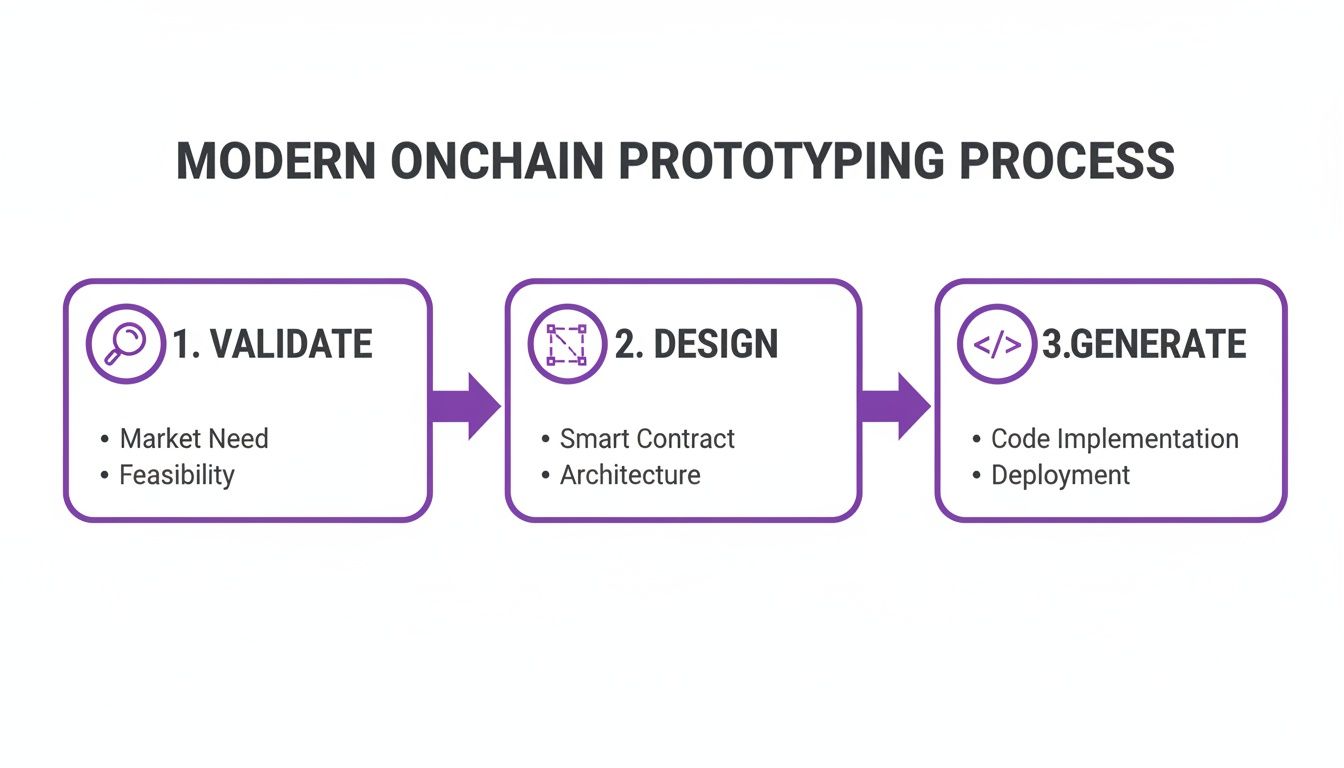
The big takeaway here is the move away from a slow, code-first workflow to a fast, iterative cycle where AI handles the boilerplate.
To give you a clearer picture, here's a breakdown of the modern prototyping journey we're about to embark on.
Key Stages in Modern Onchain Prototyping
This table maps out the path from a raw idea to a polished, user-tested prototype.
This guide will give you the roadmap. We’ll cover everything you need to know to validate your idea, design a killer UI, generate smart contracts without code, and test your creation with real people.
Let’s get building.
Validating Your Vision Before You Build
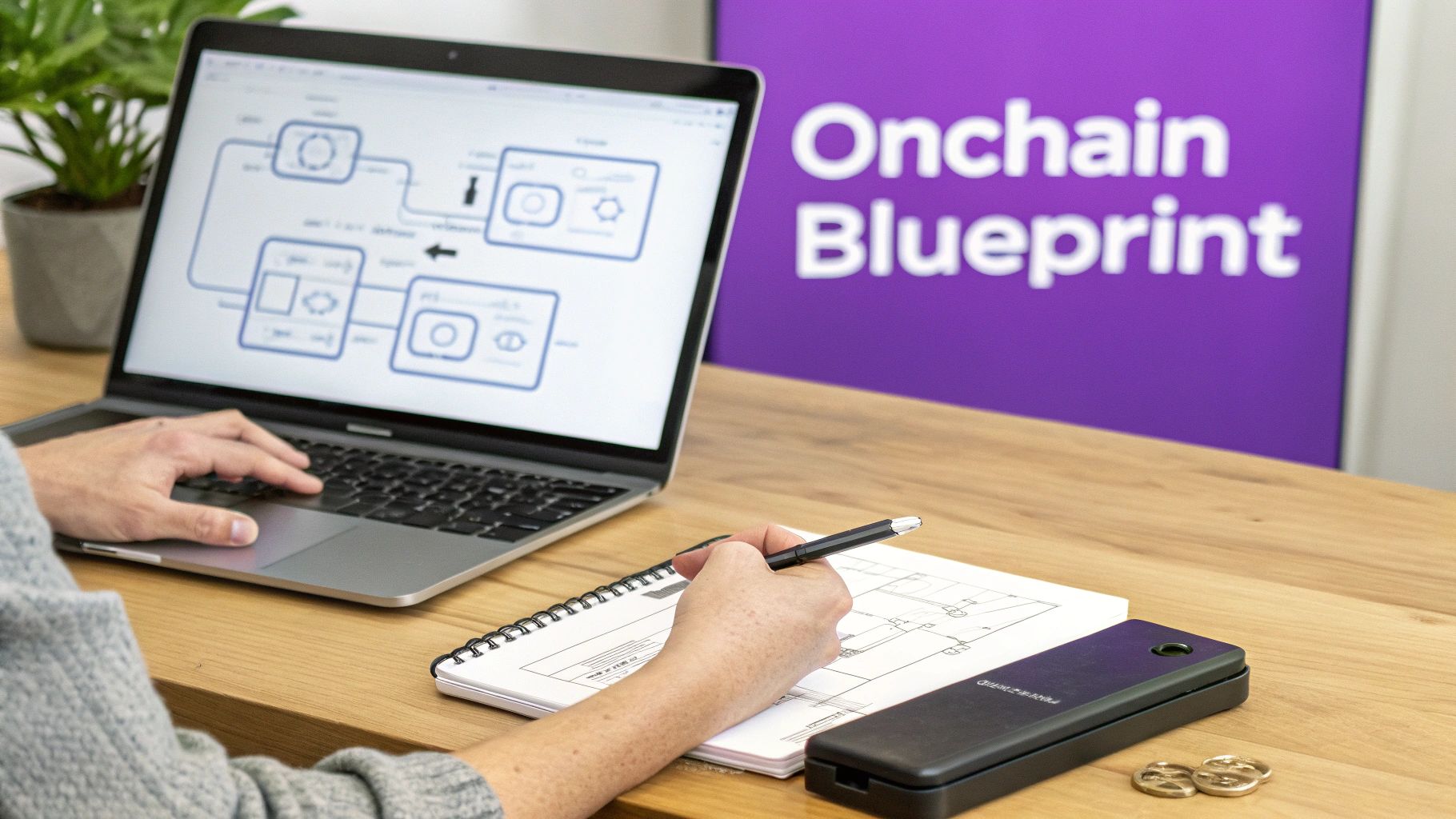
Here’s the biggest mistake I see builders make: they fall in love with an idea and assume everyone else will too. But a cool idea is just that—an idea. It’s worthless until it solves a real problem for a real person.
Before you touch a single line of code or mock up a screen, you need to confirm your vision has a pulse. This isn't about killing your excitement; it’s about de-risking the entire project. You're grounding your concept in actual user needs, not just your own assumptions, to make sure you're building something that actually matters.
Who Are You Building This For, Really?
"Crypto user" isn't an audience. It's a galaxy. To build something useful, you have to zoom in on a specific star.
Are you targeting:
- DeFi Degens: These folks live on-chain. They speak in APY, crave capital efficiency, and aren't afraid of a complex UI or a little risk.
- NFT Collectors: They’re driven by community, art, and identity. Their expectations for a smooth experience are shaped more by Instagram and Shopify than by Etherscan.
- Crypto-Curious Newcomers: This group needs things to be dead simple. Jargon, gas fees, and complicated wallet management are instant deal-breakers.
Getting this right is everything. The pain points of a DeFi power user are a world away from someone trying to mint their first NFT. Your entire prototype hinges on this choice.
The most successful onchain apps don't try to be everything to everyone. They solve a specific problem for a specific tribe with an almost obsessive focus. Your validation process is about finding that tribe and understanding their world.
What's Your Promise?
Once you know your "who," you can figure out your "what." This is your value proposition—a simple, clear statement that tells a user what’s in it for them.
A strong value prop isn't a feature list. It’s the promise of a better outcome. So instead of saying, "We have a decentralized lending protocol," try something like, "Earn a higher yield on your ETH, safely and simply."
This clarity forces you to distill your idea to its core value, and that becomes the North Star for your entire project. Before you even think about building, a crucial first step is mastering customer needs identification to make sure your promise actually resonates.
Low-Effort Ways to Test Your Idea
You don’t need a fat budget to see if your idea has legs. You just need to get scrappy.
Here are a few quick and dirty methods to get started:
- The 5-Person Interview: Grab five people from your target audience for a quick chat. Don't pitch your solution. Instead, ask about their problems. "Tell me about the last time you..." or "What's the most frustrating part about...?" Your job is to shut up and listen.
- The Landing Page Test: Throw up a simple one-page site explaining your value prop. Add an email signup for a waitlist. Then, drive a little bit of targeted traffic to it and see if anyone actually signs up.
- The "Concierge" Test: Manually do the thing your app will eventually automate. Building a tool to track NFT portfolio performance? Offer to do it for a few people by hand in a spreadsheet. This is an invaluable way to see their real-world workflow up close.
This early research isn't just a nice-to-have; it's a proven difference-maker. Data shows that thorough validation before prototyping dramatically cuts the risk of failure, with a reported 85% of successful projects starting this way.
In crypto, this is all about learning fast. You can use an AI app generator like Dreamspace to spin up a prototype NFT marketplace in a few hours, share the link, and get instant feedback before you even think about deploying to mainnet.
This isn't a one-and-done checklist. It's the foundation for everything that comes next. The insights you gather here will guide every design and development decision, making sure the prototype you build is one people are genuinely excited to use.
Designing Your User Experience and Mockups
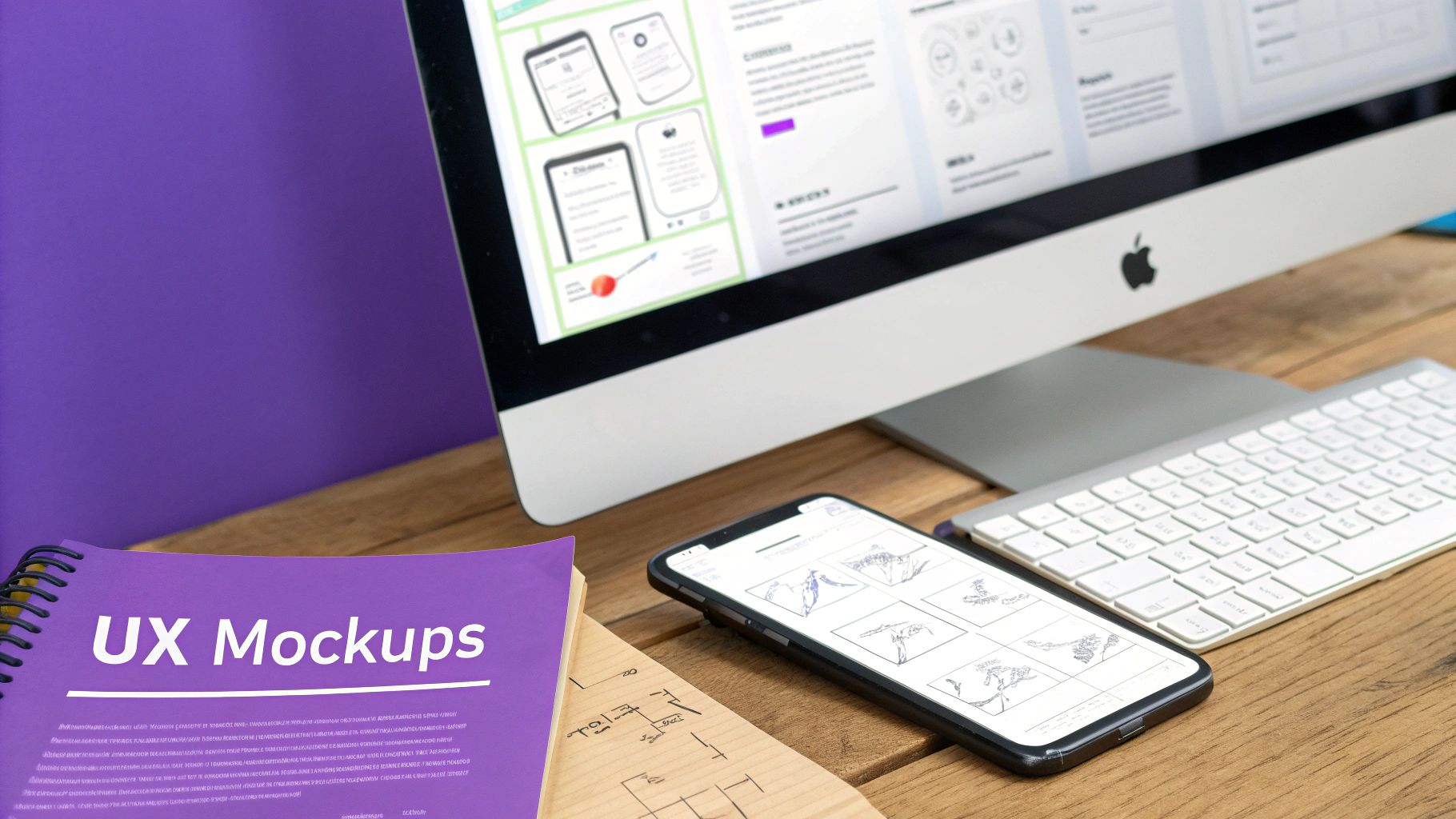
Okay, you’ve validated your idea. Now it’s time to stop thinking in abstracts and start building something people can see and touch—a visual, tangible version of your onchain app. This is where we design the user journey and create mockups that capture the feel of your product, not just its function.
Forget about cramming in every possible feature right now. Instead, take a 'vibe-first' approach. How should someone feel when they connect their wallet for the first time? What's the emotional tone when they're about to confirm a big transaction? In a space notorious for clunky, intimidating interfaces, getting this right is a massive advantage.
From Simple Sketches to Interactive Designs
Your first step is probably the simplest: a low-fidelity wireframe. I'm talking about a basic sketch, a bare-bones blueprint of your app. It doesn’t need to be pretty. The entire point is to map out the core screens and user flows.
Think through the absolute essentials of the user journey:
- Connecting their wallet
- Viewing a dashboard or their assets
- Kicking off a core action (like a swap, mint, or stake)
- Confirming the transaction and seeing the result
These rough sketches are perfect for working through the logic without getting distracted by colors, fonts, or branding. Once you've got that flow down, it’s time to bring it to life with mockups. If you need a little inspiration, it’s always a good idea to explore website mockup examples and creation guides to see how others have tackled similar design problems.
The Power of AI in UI Generation
This is where an AI app generator like Dreamspace completely changes the game. Instead of spending weeks wrestling with design tools, you can turn simple descriptions into working UI components. As a vibe coding studio, it’s designed to let you describe the layout and feel you're going for, and the AI generates the interface to match.
For example, you could prompt it with: "A clean dashboard for an NFT project with a large featured image, a prominent 'Mint Now' button, and a gallery of already minted tokens below." The AI will spit out a professional-looking interface you can then start tweaking. This is a huge leap forward, letting you create and test different design approaches in a fraction of the time. To see this in action, check out our deep dive into the capabilities of an AI app builder.
Why a Clickable Prototype Is Your Goal
The real prize at this stage isn't just a static image—it's a clickable prototype. This is a high-fidelity mockup that feels like a real app, letting users click through screens and simulate the entire journey before a single line of backend code or a smart contract exists.
A clickable prototype is all about getting raw, honest feedback on usability before you write any code. Does the navigation make sense? Do users understand the transaction flow? Is the copy clear?
This pre-development testing is gold. A user-centric design can amp up satisfaction by 30% and has been shown to boost conversion rates by as much as 83%. For crypto, this means building prototypes that are virtual twins of the final onchain UI, letting you gather immersive feedback before you commit to code.
By putting something that feels real in front of actual users, you’ll spot confusing UX hurdles early on, saving yourself a massive amount of time and money down the road.
Generating Your Onchain Backend with AI
You’ve got your UX mapped out and some slick mockups ready to go. Now for the hard part, right? Building the actual onchain engine. This is usually where the momentum dies, buried under the weight of smart contract development.
But it doesn't have to be that way. Modern tools have completely flipped the script, letting you generate the guts of your onchain app without having to become a Solidity wizard overnight.
This is where the magic of an AI app generator truly shines. Forget spending weeks wrestling with code. Instead, you just focus on describing the logic of what you want to build. The AI then takes your vision and translates it into a secure, working backend.
From Plain English to Smart Contracts
Let's say you need a simple NFT minting function for your prototype. The old way meant hiring a dev or losing weekends to tutorials on ERC-721 standards.
The new way? Just describe what you need in plain English.
Using a vibe coding studio like Dreamspace, you can literally tell the AI: "Generate a smart contract for an NFT collection where users can mint a token for 0.05 ETH, with a max supply of 1,000 tokens." The platform just gets it, spitting out the smart contract code you need to get started.
This conversational approach blows the doors wide open for builders. It’s not just for simple stuff, either. You can define much more complex logic:
- Staking Contracts: "Create a contract where users can stake our governance token to earn rewards, with a 7-day lockup period."
- Airdrop Mechanics: "Draft a function to airdrop 100 tokens to a list of specified wallet addresses."
- DAO Voting: "Generate a contract that lets token holders create and vote on governance proposals."
The AI is your co-pilot, handling all the tricky syntax and security patterns. This leaves you free to focus on what actually makes your app special. Curious about the tech behind this? Our deep dive on the power of AI code generation breaks it all down.
Making Your Prototype Feel Alive with Real Data
A prototype with static, placeholder text is just a picture. To make it feel real, you need to pull in live data from the blockchain. This is another spot where AI saves you a ton of headaches.
Instead of fighting with complicated blockchain APIs, you can generate simple SQL-style queries to fetch exactly what you need.
A functional backend is the difference between a pretty picture and a working prototype. By using AI to generate not just smart contracts but also data queries, you create an experience that feels real, allowing you to test the entire user flow from wallet connection to onchain interaction.
For that NFT project we mentioned, you could easily pull things like:
- The total number of tokens minted so far.
- The last five wallets that minted an NFT.
- A live gallery of minted tokens, pulling their metadata from IPFS.
Just tell the AI what you want to show, and it will generate the queries to pull that data from the chain and plug it right into your UI. It’s a small step that makes your prototype feel incredibly powerful and gives your testers a much more authentic experience.
The No-Code Revolution in Onchain Development
This AI-driven, no-code approach is changing the game. It shifts the focus away from writing perfect lines of code and puts it back where it belongs: on crafting a great user experience.
The result is a fully functional backend for your prototype—smart contracts, live data, and all—ready for the all-important next phase of local testing and user feedback. You’ve just built the core of your app by focusing on the 'what' and 'why,' while letting the AI handle the 'how.'
Testing Locally and Gathering User Feedback
So you’ve built a functional prototype. It’s got a slick UI, an onchain backend spun up by AI, and it looks and feels like the real deal. But right now, it’s just a collection of your own assumptions. Until you get it into the hands of actual users, you won’t know what you really have. This is the moment of truth.
The point here isn’t to show off your creation. It's to find its flaws. To identify the friction points. To see what actually clicks with your target audience. This feedback loop is what turns a good idea into a great one.
Simulating the Real World Without the Real Risk
Before you show your prototype to a single soul, you need a safe place to run it. Deploying straight to a mainnet is a non-starter—it’s expensive, and every move is irreversible. This is exactly what a local testnet is for.
Think of a local testnet as your own private blockchain sandbox. It runs entirely on your machine, giving you a perfect copy of a live blockchain environment without any of the costs or dangers. You can mint tokens, deploy smart contracts, and fire off transactions using fake crypto, letting you put every inch of your app through its paces.
With a local testnet, you can:
- Debug Your Smart Contracts: Catch and fix bugs in your contract logic before they have real-world consequences.
- Test Every Transaction Flow: Make sure everything from connecting a wallet to confirming a transaction works like a charm.
- Check Your Data Display: Verify that your UI is correctly pulling and showing data from the blockchain.
Once your prototype runs smoothly in this controlled space, it’s time to bring in the most important element: your users.
The Art of Getting Honest Feedback
User testing isn’t about asking, "So, do you like it?" That question just invites polite, unhelpful answers. Your real mission is to watch their behavior, listen to their frustrations, and understand what’s going through their head as they try to use your app.
First, find the right people. Aim for five to seven individuals who are actually in your target audience. You don't need a huge sample size; you're hunting for quality insights, not statistical significance.
Next, give them a job to do, not a guided tour. Instead of showing them how to mint an NFT, just say, "Try to mint one of the NFTs from this collection." Then, step back and watch.
The most powerful feedback comes from observation, not direct questions. Pay attention to where users hesitate, where they get confused, and where they seem delighted. These moments of friction and joy tell you exactly what needs to be fixed and what you should double down on.
An AI app builder like Dreamspace makes this super simple. You can share a live, web-based version of your prototype with just a link. Testers can jump right in from their browser, giving you a seamless way to run remote testing sessions.
Turning Feedback into Your Next Steps
After a few of these sessions, you’ll start to see patterns. Maybe three out of five people struggled with the same button, or a particular piece of text just wasn't clear. This is gold. This is your roadmap for what to improve.
Organize the feedback you've collected and prioritize it based on impact. A critical bug that breaks the main user flow is obviously a bigger deal than a minor typo. This is where iteration begins, and it's a proven path to building something great. In fact, products that go through at least three iterations are 50% less likely to fail. What’s more, design-focused companies see revenue grow 32% faster with 56% higher returns—a trend that holds true across major global markets. You can dig into more data on this by exploring the latest product design trends.
Every piece of feedback is a gift. It’s a chance to sharpen your vision and get closer to building something people genuinely want to use. This cycle of building, testing, and iterating is the real engine of product development. It’s what will give you the confidence to finally launch on mainnet.
Got Questions About Onchain Prototyping? We've Got Answers.
Diving into onchain prototyping, you're bound to have some questions. It’s a whole new world, but thankfully, building in it has gotten a lot easier. Let's clear up a few of the most common things people ask.
Do I Actually Need to Code to Build an Onchain Prototype?
This is the big one, and the answer is a hard no. Not anymore, anyway. The new wave of no-code and AI-powered tools has completely torn down that wall.
Platforms like the Dreamspace AI app generator are built for this exact purpose. As a vibe coding studio, it allows you to just describe what you want your app to do—in plain English—and the AI handles the complex stuff like generating smart contracts and UI components.
It’s a massive shift. You can now focus entirely on your vision and the user experience, not the nitty-gritty code. Your ideas and understanding of the crypto community are what really matter.
Realistically, How Long Does a No-Code Prototype Take?
The speed is almost shocking if you're used to traditional dev cycles. Forget months; we're talking days or even hours.
Let's look at a possible timeline:
- Initial Mockups: You can get your first UI and key screens generated in as little as an hour.
- Smart Contract Generation: Describing your app's core logic and having the AI spit out a working contract? Maybe another hour or two.
- Putting it all Together: Connecting your front end to the contract and pulling in some real data can easily be an afternoon's work.
Going from a solid idea to a clickable, testable prototype over a single weekend is completely realistic now. The beauty is how fast you can iterate. Change something, see the result, and do it again.
The point of a no-code prototype isn't to build a perfect, finished product. It's to get feedback as fast as humanly possible. You're building just enough to see if your core idea has legs.
What’s This Going to Cost Me?
The cost structure for these tools is usually designed for experimentation. Many platforms, including the Dreamspace AI app generator, run on a freemium model that's perfect for the prototyping phase. You can often build and test your entire concept without spending a dime.
An AI app generator typically offers a generous free tier that gives you everything needed to create a functional prototype, deploy a test contract, and get it in front of users. The goal is to remove money as a barrier to innovation. You only really need to think about paying when you're ready for more users, need advanced features, or are seriously considering a mainnet launch.
Where Can I Find People to Test My Crypto App?
Getting your prototype in front of the right people is everything. The best strategy? Go to the places where your target audience already lives and breathes crypto.
Here are a few spots that consistently deliver:
- Discord Communities: Find servers dedicated to your niche (DeFi, NFTs, DAOs, etc.). Don't just spam your link—become an active member first, then ask for feedback.
- Crypto Twitter (X): Build in public. Share your progress, your struggles, and your wins. People love following the journey and are often happy to test things from builders they feel connected to.
- Local Meetups: If you live near a tech hub, nothing beats in-person feedback.
- Friends & Colleagues: Never underestimate your personal network, especially if they're already into crypto.
You're looking for honest, insightful feedback from people who would actually use your app. Their perspective is pure gold.
Ready to stop whiteboarding and start building? With the Dreamspace vibe coding studio, you can have a working onchain prototype in minutes. Bring your vision to life today by visiting https://dreamspace.xyz.