
A Guide to Cryptocurrency Wallet Development
Building a crypto wallet is all about creating a piece of software that holds a user's private keys, letting them manage, send, and receive digital assets on a blockchain. It’s a mix of designing a clean user interface, building iron-clad security for key management, and hooking everything up to blockchain networks so transactions actually go through. These days, most wallets come loaded with features like multi-currency support, dApp browsers, and DeFi integrations.
Why Modern Crypto Wallets Are a Big Deal
Forget thinking of a wallet as just a digital piggy bank. Modern crypto wallets are the front door to the decentralized web. They’re your digital identity, your passport, and your bank account all rolled into one, giving you access to decentralized apps (dApps), non-fungible tokens (NFTs), and the wild world of decentralized finance (DeFi). This shift from a simple storage tool to an all-in-one interactive hub is a massive opportunity for anyone looking to build something meaningful.
And the demand for better, more intuitive wallets is through the roof. The numbers don't lie: the global cryptocurrency wallet market was valued at USD 14.39 billion and is expected to rocket to USD 54.79 billion within five years. That’s a compound annual growth rate of 30.4%. People are hungry for better ways to interact with Web3.
Getting a Grip on Core Wallet Concepts
Before you write a single line of code, you need to nail down the fundamentals. These concepts shape a wallet’s entire architecture, security model, and who it’s ultimately for. If you're new to the space, a comprehensive Web3 dictionary can be a lifesaver for getting up to speed on all the lingo.
Here are the key distinctions you absolutely have to know:
- Hot vs. Cold Storage: A hot wallet is always online—think mobile apps or browser extensions. They're super convenient for day-to-day use but come with more risk. A cold wallet, on the other hand, is an offline hardware device. It offers maximum security, perfect for stashing assets long-term.
- Custodial vs. Non-Custodial: With a custodial wallet, a third party (like an exchange) holds your private keys. It’s easy, but you're trusting them with your funds. A non-custodial wallet gives you full control over your keys, which is the whole point of the "not your keys, not your coins" ethos.
This image really drives home how modern wallets are built on a foundation of secure storage, no matter how many flashy features get added on top.
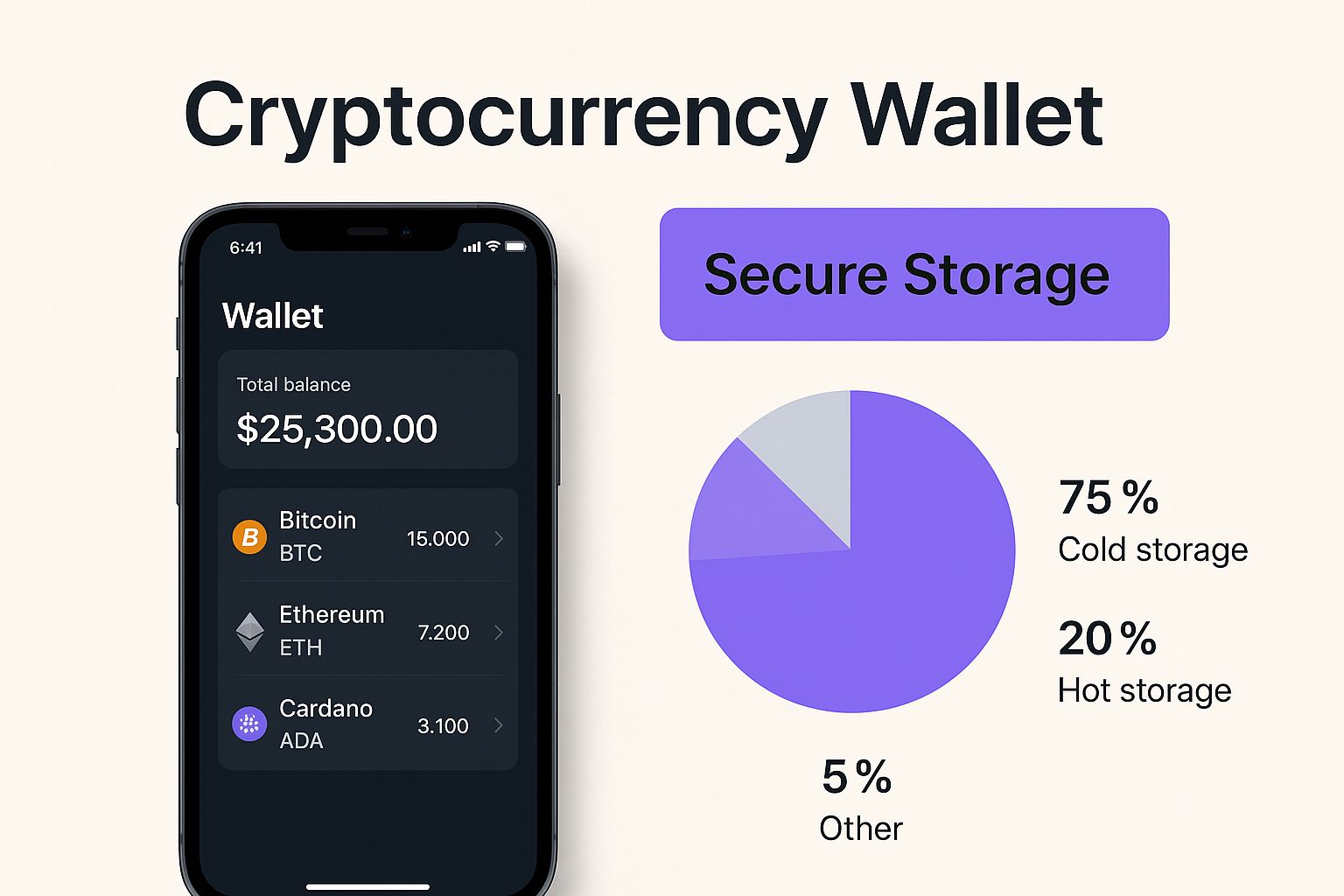
At the end of the day, while features and integrations will always evolve, a wallet's primary job is to keep a user's digital assets safe.
To help you decide what to build, here’s a quick rundown of the main wallet types out there.
Key Wallet Types and Their Primary Use Cases
This table breaks down the different wallet categories to help you figure out which one makes the most sense for your project and your target audience.
Choosing the right type is the first major decision you'll make, and it sets the stage for everything that follows, from your security architecture to your UI/UX design.
Your Opportunity as a Wallet Developer
Yes, the market is crowded, but don't let that fool you. There's still a massive gap when it comes to amazing user experiences and wallets built for specific niches. Your big opportunity is to create something that’s not just powerful, but also incredibly easy and intuitive to use.
Building a wallet is more than a technical exercise; it's about crafting the user's primary interface to Web3. Simplicity, security, and seamless integration are no longer optional features—they are the core product.
This is where no-code AI tools can be a game-changer. For instance, using Dreamspace, a vibe coding studio, lets you skip straight past the tedious boilerplate and focus on what really matters: perfecting the user journey and building out the unique features that will make your wallet stand out. You can bring your vision to life in a fraction of the time.
If you want to get a better handle on the tech that powers all this, our guide on what is blockchain development is a great place to start. That foundational knowledge is exactly what you need to innovate in this space.
Architecting a Secure and Intuitive Wallet
Before you write a single line of code, you need a blueprint. A great crypto wallet isn’t just a cool idea; it’s a product of deliberate, thoughtful architecture. This is the phase where you make the foundational decisions that will define everything from security to user experience.
Think of it like building a car. Are you designing a nimble sports car for quick, low-fee transactions, or a fortified armored truck for maximum security? Your answer to that question dictates the entire engineering process that follows. Get this part right, and the rest of the build becomes infinitely smoother.
Defining Your Core Feature Set
It’s easy to get carried away and dream up a wallet that does everything. Don't. The best products start with a laser-focused core feature set that solves a real problem for a specific user.
Start by mapping out the absolute non-negotiables:
- Multi-Chain Support: Are you building for the Ethereum and EVM ecosystem exclusively? Or do you need to bring in heavy-hitters like Solana, Polkadot, or even Bitcoin? Remember, each chain you add introduces a new layer of complexity, so be strategic.
- Transaction Broadcasting: This is the heart of any wallet. Your system needs to flawlessly construct, sign, and broadcast transactions. That means building a reliable connection to blockchain nodes and handling all the nuances that come with it.
- Seamless dApp Connectivity: A modern wallet is a passport to Web3. Whether it's through an integrated dApp browser or a robust implementation of WalletConnect, users expect to connect to DeFi, NFT marketplaces, and other on-chain apps without a hitch.
Once you have these pillars in place, start walking through the user's journey. What does it look like when they add a new coin? How do they sign a transaction? Sketching these flows out now will save you a world of headaches later.
Designing a Security-First Architecture
Let's be blunt: in crypto, security isn't just a feature, it’s the entire foundation. One slip-up can mean catastrophic, irreversible losses for your users. We’ve seen this play out time and again. Just look at the supply-chain attacks in 2025 on popular packages like chalk and debug that affected apps with over 2 billion weekly downloads. Malicious code was silently siphoning funds, and most developers were caught completely off guard.
This is why your entire architecture must revolve around protecting the user’s private keys.
The entire security model of a non-custodial wallet rests on its ability to generate, store, and use private keys without ever exposing them. This principle must guide every architectural decision you make.
To build a fortress, you need to focus on a few battle-tested methods:
- Secure Key Generation and Storage: Keys must be generated on the user’s device with a cryptographically secure random number generator. From there, they need to be encrypted with a strong, user-defined password and tucked away in the device’s most secure location, like the Keychain on iOS.
- Data Encryption: Don’t just encrypt the keys; encrypt everything sensitive. All data should be encrypted both at rest (when it’s sitting on the device) and in transit (when your wallet is talking to an API or a node).
- Multi-Factor Authentication (MFA): For high-stakes actions like revealing a recovery phrase or sending a large sum, MFA is a must. But it has to be frictionless. Leaning on biometrics like Face ID or fingerprint sensors adds a powerful layer of security that actually improves the user experience instead of getting in the way.
UI and UX Strategies for Simplicity
A wallet can be the most secure piece of software in the world, but if it's confusing, no one will use it. Your job is to make incredibly complex blockchain operations feel dead simple. A clean, intuitive interface isn't just nice to have; it’s a core part of the product.
Focus on the little things that make a big difference. Instead of showing users a long, scary hexadecimal address, integrate a naming service like ENS (Ethereum Name Service) or build a simple address book. Every tap should provide clear, understandable feedback, whether a transaction is pending, confirmed, or failed.
This is where a tool like Dreamspace really shines. It’s a vibe coding studio that lets you rapidly prototype these user flows and visualize your entire app architecture before you commit to a single line of code. Using its AI app generator, you can build and test interactive mockups, making sure your design is intuitive and your security logic is sound from day one. It helps you iron out the wrinkles in your UX long before they become expensive problems to fix.
Choosing Your Development Stack
Okay, with our architecture mapped out, it’s time for the fun part: picking the tools to actually build this thing. The tech stack you settle on is going to be the engine of your crypto wallet, directly shaping its performance, security, and how easily you can scale it later on. This isn't just about grabbing the most popular frameworks; it's about making deliberate choices that fit the features you've planned.
Think of it this way: a well-matched stack makes development feel smooth and intuitive. The wrong one? You'll be fighting performance issues and patching security holes for months.
Core Languages and Libraries
The first big decision is your programming language, and it usually comes down to where your wallet will live—on mobile, in a browser, or as a desktop app. For pretty much any modern wallet that talks to Ethereum or other EVM chains, the JavaScript world is king.
- JavaScript/TypeScript: This is the universal language for web and mobile wallets. Pair it with a framework like React or React Native, and you can build for multiple platforms from a single codebase. It’s a huge time-saver.
- Python: You probably won't use Python for the user-facing parts of your wallet, but it's a beast for any backend services or APIs your app needs. It’s fantastic for heavy-duty cryptographic tasks and server logic.
- Swift/Kotlin: If you're going for a purely native iOS or Android experience, nothing beats Swift and Kotlin. They give you the best performance and direct access to the device's secure hardware, which is a massive plus for wallet security.
After picking a language, you’ll need libraries that let your app actually speak to the blockchain. These are non-negotiable.
These libraries are the critical bridge between your app and the blockchain network. They handle all the messy, low-level stuff so you can focus on building a great user experience instead of wrestling with RPC calls.
In the Ethereum ecosystem, two libraries have become the go-to choices:
- ethers.js: This library is a favorite for a reason. It's lightweight, the documentation is fantastic, and it’s just designed in a really sensible way. It’s my personal recommendation if you're just starting out or value clean, simple code.
- web3.js: As the original Ethereum JS library, web3.js has a massive, active community. It's more of a modular toolkit, offering a vast collection of tools for everything from account management to smart contract interaction.
If you want to really get into the weeds of how these underlying technologies work, our guide on popular https://blog.dreamspace.xyz/post/blockchain-programming-languages offers a much deeper dive.
The Nuts and Bolts: Keys and Transactions
At the core of any non-custodial wallet is its ability to handle cryptographic keys right on the user's device. This all starts with generating a private key, which is then used to create a public key and the wallet address. It's absolutely critical that this is done using a cryptographically secure pseudo-random number generator (CSPRNG) to make it impossible to guess.
Once a user has their keys, they can start signing and sending transactions. A transaction is just a signed piece of data that asks the blockchain to do something, like send tokens. To build one, you have to package up a few key pieces of information:
- The recipient’s address.
- The amount of crypto to be sent.
- The right transaction fee, or “gas.”
- A unique “nonce” to stop someone from replaying the transaction.
After the transaction is assembled, it gets signed with the user’s private key. This is the cryptographic proof of ownership, and it always happens on the user's device. The private key should never, ever be sent over the internet. Finally, this signed transaction is broadcast to the network, ready to be picked up by miners or validators.
How an AI App Generator Changes the Game
Look, understanding all that is important. But do you really want to write all the boilerplate code for key generation, transaction signing, and connecting to nodes from scratch? It's slow, tedious, and one tiny mistake could create a major security flaw.
This is exactly where an AI app generator like Dreamspace becomes your secret weapon.
Dreamspace is a vibe coding studio designed to automate this kind of foundational work. Instead of painstakingly implementing crypto libraries by hand, you can have AI generate secure, proven code for these core wallet functions. This lets your team skip the grunt work and pour their energy into what truly matters: your wallet’s unique UI, innovative features, and killer user experience.
And when it comes to that front-end, looking into component libraries like Shadcn UI for modern development can seriously speed up the process of building a polished interface.
To give you a better idea of the difference, here’s an overview of the tools you might use.
Choosing Your Development Stack
This table gives you a snapshot of common technologies used in wallet development, helping you select the right tools for your specific project goals.
Ultimately, offloading the most repetitive and error-prone parts of wallet development to an AI tool like Dreamspace means you can build a more secure, professional product and get it to market way faster.
Beefing Up Security
Once you've got the basic architecture down, it's time to get obsessive about security. This is where you earn your users' trust. In the crypto world, one tiny vulnerability can mean total, irreversible loss. So, when you're building a wallet, advanced security isn't just a "nice-to-have"—it's the absolute foundation of your entire project. Think of it as the armor that protects your users from an army of ever-evolving threats.
This means we need to go way beyond standard encryption. We're talking about adopting industry-proven standards that protect privacy, make key management a breeze, and give users real, tangible control over their funds. Layering these defenses is how you build something people will actually feel safe using.
Adopting Hierarchical Deterministic Wallets
One of the biggest leaps forward in wallet security is the Hierarchical Deterministic (HD) wallet standard, laid out in BIP-32 and BIP-44. Forget generating a random, new private key for every single transaction. With an HD wallet, every key is derived from a single master seed—that 12 or 24-word recovery phrase we’ve all seen.
This approach is a game-changer for a few reasons:
- Simple Backups: Users only need to secure one recovery phrase to restore their entire wallet, including every address they've ever used or will use. This massively cuts down on the chances of human error.
- Better Privacy: By automatically using a fresh address for every incoming transaction, HD wallets make it incredibly difficult for outsiders to connect the dots and trace a user’s financial activity on-chain.
- Clean Organization: BIP-44 sets up a standard structure for deriving keys, making it straightforward to manage multiple cryptocurrencies and accounts all from the same seed.
Frankly, implementing the HD standard is non-negotiable for any modern wallet. It turns a scary, complicated backup process into a single, manageable step. That's a huge win for both security and user experience.
Integrating Hardware Wallet Support
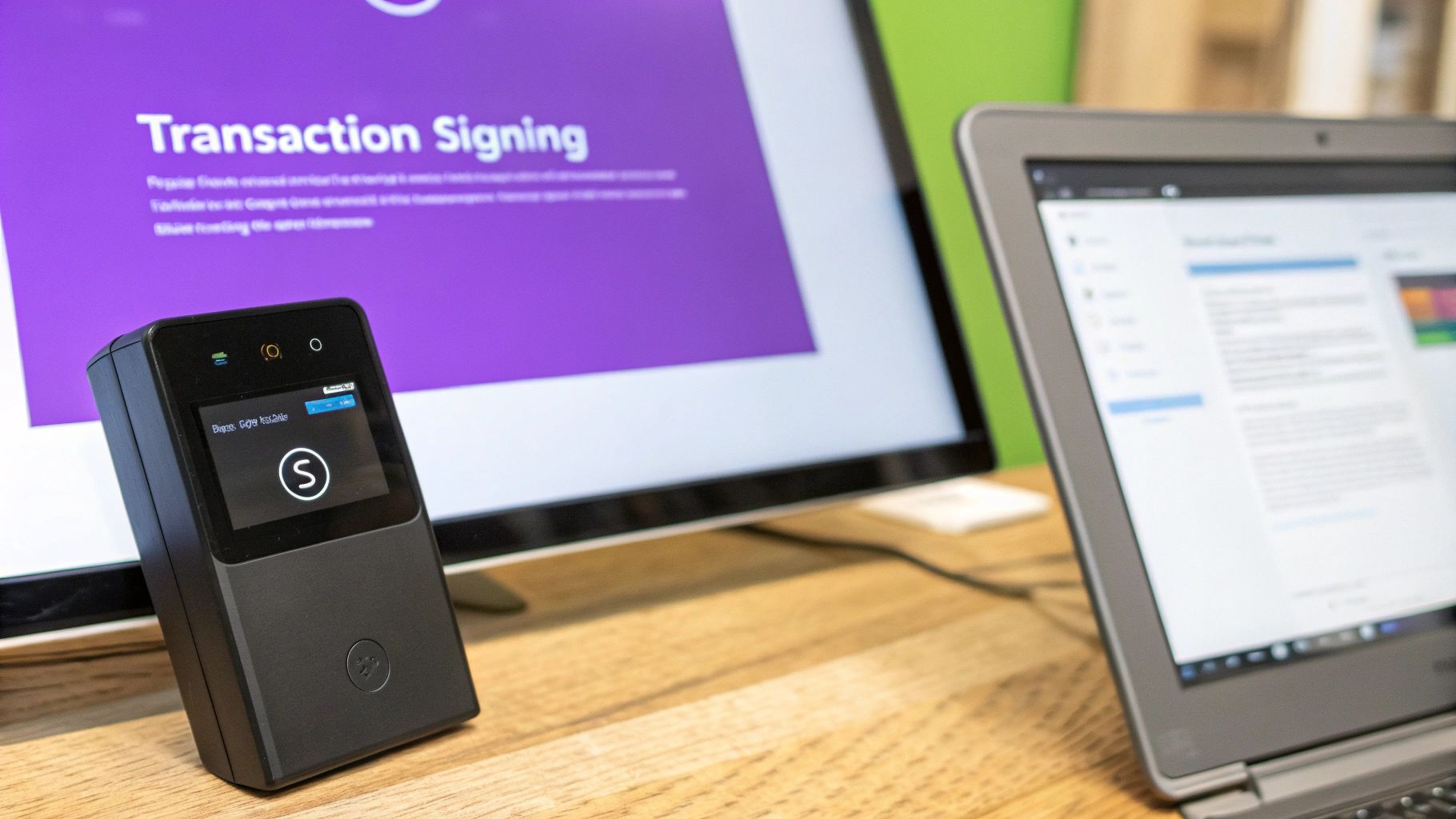
For anyone holding a serious amount of crypto, nothing beats cold storage. Building in support for hardware wallets like Ledger or Trezor is a critical feature that screams, "we take your security seriously." It lets users keep their private keys completely offline on a dedicated device, using your wallet's interface to build transactions while the secure hardware handles the final signing.
The magic happens inside the hardware device's secure chip. The private keys never touch the user's internet-connected computer or phone, which neutralizes a whole class of threats like malware and phishing scams designed to sniff out keys.
The demand for this level of security is exploding. The global hardware wallet market, currently valued at around USD 474.7 million, is expected to surge to USD 2.435 billion in the next decade. This isn't a niche trend; it's a massive shift toward solutions that give users control. You can discover more about this market growth on IMARC Group.
Defensive Strategies Against Common Threats
A secure wallet is a paranoid wallet. You have to actively defend against the most common ways attackers try to trick users and steal funds. This thinking has to be baked into your development process from day one—trying to patch these holes later is a nightmare.
Here are a few threats to keep on your radar:
A solid security posture doesn't stop with your own code. You have to be confident in the security of every tool and contract your wallet interacts with. On that note, you’ll probably find our guide on the top smart contract audit tools useful for vetting external protocols. At the end of the day, building a truly secure wallet is a marathon of vigilance, not a sprint.
Launching and Growing Your Wallet
You’ve done the hard work of creating a secure, intuitive crypto wallet. That’s a huge win, but honestly, it’s only half the battle. Now comes the real test: getting people to actually use it and building a community that sticks around. A brilliant product with zero go-to-market strategy is just a fancy science project—cool to look at, but ultimately going nowhere.
This is where the rubber meets the road. It’s a mix of careful planning, obsessive testing, and smart community building that will ultimately decide if your project soars or fizzles out.
From Testing to Takeoff
Before your wallet even thinks about hitting the app stores, it needs to be battle-tested. I mean really tested. The launch process kicks off with a testing plan so thorough that nothing can slip through the cracks. Anything less is just asking for trouble and risks damaging your reputation before you even get started.
Your pre-launch checklist needs to be airtight.
- Unit and Integration Testing: Every single piece of your wallet, from the tiniest UI button to the core transaction signing logic, needs to work perfectly on its own and then again when it’s all connected. This is non-negotiable for ensuring the core functions are solid.
- User Acceptance Testing (UAT): Grab a small, trusted group of beta testers—people who represent your ideal user—and have them use the wallet like they would in the real world. Their feedback is pure gold for catching awkward flows or bugs you’ve become blind to.
- Professional Security Audits: Don't even think about skipping this. You absolutely must hire a reputable third-party security firm to do a full audit of your code. Their entire job is to try and break your wallet, and they will find vulnerabilities you never would have seen.
A third-party security audit isn't just a box to check. It's a massive signal of trust to your future users. It tells them you’ve invested in their safety and done everything possible to protect their assets.
Once you’ve passed these hurdles, you're clear for deployment. Your strategy here will obviously depend on the platform—submitting to the Apple App Store and Google Play, publishing to the Chrome Web Store for a browser extension, or setting up direct downloads for a desktop client.
Fueling Growth and Adoption
Okay, your wallet is live. Now the game shifts entirely to growth. The crypto wallet space is crowded, but a smart, targeted strategy can help you find your audience and build a loyal following.
The market is growing at a staggering pace. Just look at Coinbase Wallet, which exploded from 43 million to 108 million verified users in less than two years. The Asia-Pacific region alone has about 350 million active wallet users, which shows the sheer global scale of this opportunity. You can dig into more Coinbase Wallet statistics on CoinLaw.io to see the trend lines.
To grab your slice of that pie, you need to be proactive. Successful wallets don't just exist; they actively cultivate a community.
Here are a few tactics that I’ve seen work time and time again:
- Build a Strong Community Hub: Get on Discord and Twitter. These aren't just social media platforms; they're the town squares of Web3. Create a space where users can get support, ask questions, and talk directly to your team. Being transparent and responsive here builds an incredible amount of trust.
- Create High-Value Content: Start a blog or a YouTube channel. Don’t just shill your product—teach people. Create tutorials showing how to use your wallet with popular DeFi protocols. This positions you as a trusted guide, not just another piece of software.
- Forge Strategic Partnerships: Connect with dApps, NFT projects, and other protocols in your ecosystem. Things like co-marketing campaigns, integrations, or even airdrops can put your wallet in front of thousands of new, highly relevant users almost overnight.
This community-first mindset is what separates the winners from the losers in today’s market. And this is where using a tool like Dreamspace, the vibe coding studio, really pays off. When you let an AI app generator handle the heavy coding, you free up your team’s time and energy to focus on these critical growth activities. You can pour your efforts into building the community and partnerships that will actually make your wallet a success.
What Everyone Wants to Know About Wallet Development
If you're thinking about building your own crypto wallet, you're probably wrestling with a few big questions. I’ve seen these same questions come up time and time again with founders, and getting the answers straight from the start can save you a world of headaches down the road.
First up, the big one: cost. The price tag on a crypto wallet can swing wildly. You might get a simple, single-chain wallet off the ground for around $25,000, but a complex, multi-chain beast with all the bells and whistles can easily soar past $100,000. The final cost really boils down to how ambitious your feature list is, which platforms you're targeting (iOS, Android, web), and the team you hire.
How Long Does It Take, and How Do You Make Money?
The second question I always get is about the timeline. For a pretty standard wallet, you're looking at a development window of about three to six months. But if you start throwing in advanced features—say, hardware wallet support, deep DeFi integrations, or custom-built security protocols—you’ll definitely need to budget for more time, often well beyond that six-month mark.
So, once it's built, how do you actually turn a profit? There are a few tried-and-true models:
- Transaction Fees: The most common approach is taking a small slice of any swaps or crypto purchases that happen inside your wallet.
- Staking Services: You can offer staking-as-a-service and collect a small commission on the rewards your users generate.
- Premium Features: Think about offering a subscription for power users who want advanced portfolio tracking, tax reporting, or next-level security.
The right monetization model isn't one-size-fits-all. It completely depends on who you're building for. A casual HODLer won't pay for premium analytics, but a full-time trader absolutely will if it gives them an advantage.
Ultimately, building a great wallet is as much about smart business decisions as it is about solid, secure code. That's where a tool like Dreamspace, a vibe coding studio and AI app generator, comes in. By letting AI handle the heavy lifting on the coding side, it frees you up to nail down the strategy that will actually make your project a success.
Ready to build your own on-chain application without getting bogged down in code? Dreamspace is a vibe coding studio that lets you generate smart contracts, front-ends, and blockchain data queries with AI. Start building your vision today at https://dreamspace.xyz.