
Creating a Social Media App: Build It for Success
Building a social media app is less about features and more about community. It’s about finding a group of people who are being overlooked and creating a space they’ll love. Before you even think about code, the real work is in finding a specific niche, testing your idea with that audience, and nailing down what makes your app unique.
Finding Your Niche In A Crowded Market
Let's get one thing straight: you're not building the next Instagram. And that's a good thing. The goal isn't to take on the giants head-to-head; it’s to carve out your own corner of the internet for a community that needs it. Getting this initial strategy right is what separates the apps people remember from the ones that vanish.
The social media world is massive, with a mind-boggling 5.42 billion users globally. That number can be intimidating, but it also signals a huge opportunity. Just look at social commerce in the US—it's expected to rocket past $90 billion in 2025. This shows that if you connect with the right audience, the potential for monetization is real. The most successful newcomers are using data to create personalized experiences, which has been shown to boost revenue by up to 40%. You can dig into more of these trends over at StatCounter to see what the competitive environment looks like.
Move Beyond Broad Ideas
The first big step is to ditch the generic ideas. "A new photo-sharing app" isn't a plan; it's a dream. You need to get specific. What problems or unmet needs exist within passionate, existing communities? The magic really happens when you zero in on a group that the big platforms just don't serve well.
To get the wheels turning, think along these lines:
- For Urban Gardeners: An app dedicated to sharing photos of their balcony gardens, swapping seeds with neighbors, and getting hyper-local advice on dealing with pests.
- For Indie Comic Artists: A platform built from the ground up to showcase webcomics, complete with integrated tipping jars and subscription options for exclusive content.
- For Vintage Car Restoration Buffs: A network for documenting every step of a restoration project, sourcing those hard-to-find parts, and connecting with other enthusiasts who get it.
When you take a targeted approach like this, you can build features that truly matter to a core group of users, creating a powerful sense of belonging from day one.
Validate Your Niche and Define Your Value
Once you think you've found your niche, you have to validate it. This is non-negotiable. Don't just assume people want what you're building—go talk to them. Find out what they're struggling with now, what tools they're using, and what they wish they had. This feedback is pure gold and will shape the very core of your app.
The secret to a successful social media app isn't having the most features. It's about solving a specific problem for a specific group of people better than anyone else. That's your unique value proposition.
If you're ready to start turning these ideas into something more concrete, getting a handle on how to create your own app will give you a clear roadmap. It often starts with just a simple prototype to see if your core ideas hold water.
Before diving into development, it's crucial to map out what features are absolutely necessary for your Minimum Viable Product (MVP) versus the unique elements that will make your app special. This table breaks down how to think about that.
Core Feature Planning for Your Niche App
This kind of planning ensures you launch with a focused, valuable product that speaks directly to your target audience's needs.
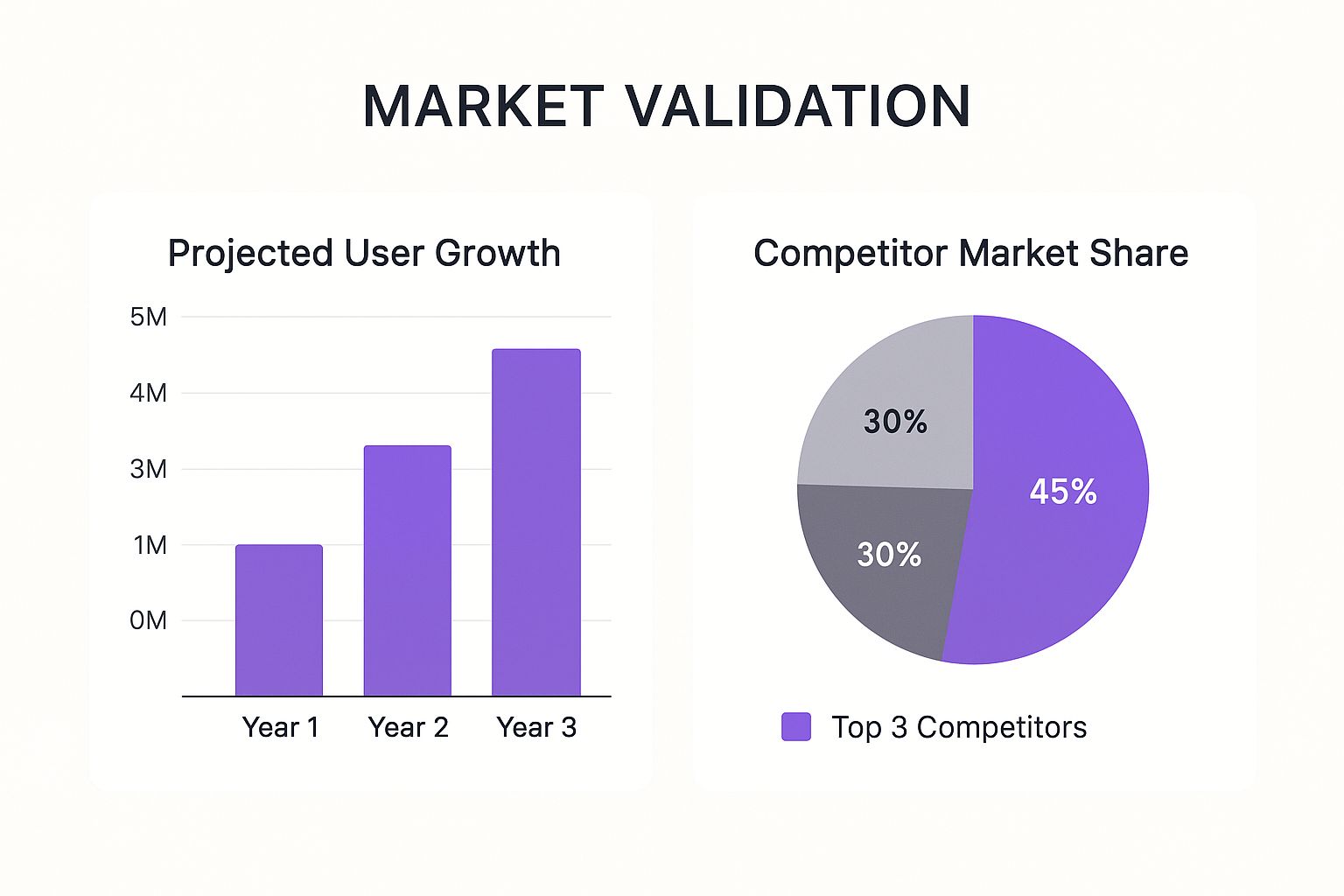
The data here shows that even with massive competitors dominating the market, a well-defined niche app can still grab a dedicated audience and grow. This is exactly where a tool like Dreamspace comes into play.
Dreamspace is a vibe coding studio built to handle the heavy lifting on the technical side. Using it as an ai app generator, you can quickly get your backend, smart contracts, and initial build off the ground. This frees you up to focus on what really matters in these early stages: building an amazing community and perfecting the user experience that will make your app a must-have for your niche.
Designing Your App's Core Features and User Flow
Okay, you've got your niche nailed down. Now for the fun part: figuring out how people will actually use your app. This isn't just about making a list of features. We're talking about mapping out the entire user journey, from the moment they sign up to the point where checking your app becomes a daily habit.
For any social media app, this "user flow" is everything. It's the secret sauce that makes an app feel intuitive and addictive, rather than clunky and forgettable.

Sure, things like user profiles, a content feed, and some form of direct messaging are pretty much expected. But the real magic comes from your unique, core interaction—that one central activity that keeps your specific audience coming back for more.
Is it a collaborative beat-making tool for aspiring producers? A platform for vintage watch collectors to show off and trade their latest finds? That's what you need to define.
Defining Your Core Loop
Every successful social app has a "core loop." It’s a simple, repeatable sequence of actions that gives the user a little hit of dopamine and keeps them engaged.
Think about Instagram's loop: You post a photo (action), get likes and comments (reward), and then you scroll your feed to see what others are up to (discovery). It’s dead simple, incredibly satisfying, and it works.
For your niche app, this loop has to be laser-focused on what your community cares about.
- App for Urban Gardeners: The loop could be: Log your plant's weekly growth (Action) → Get tips and encouragement from fellow gardeners (Reward) → Browse other local gardens for inspiration (Discovery).
- App for Indie Comic Artists: Maybe it's: Post a new comic panel (Action) → Receive constructive feedback from followers (Reward) → Discover new artists to collaborate with (Discovery).
Nailing this down early is absolutely crucial. This core loop becomes your north star, guiding every single design choice and line of code you write from here on out.
Your app's success won't come from cramming in every feature under the sun. It will come from absolutely perfecting a single, compelling core loop that your niche audience can't get enough of.
This mindset is the heart of building a Minimum Viable Product (MVP). You launch with a lean, clean version of your app that does one thing—your core loop—exceptionally well. Everything else can wait.
From Idea to Wireframe
Once you have a clear picture of your user flow, it's time to get it out of your head and onto paper (or a screen). This is where wireframing comes in. Wireframes are just simple, black-and-white layouts that focus purely on structure and functionality. Think of them as the architectural blueprints for your app—no need to worry about colors or fancy fonts yet.
And you don't need to be a professional designer to do this. Grab a pen and paper or fire up a simple digital tool. The goal is to answer some basic questions:
- How does someone sign up and make their very first post?
- What does the main screen look like? How is content laid out?
- How do people interact with each other's posts?
- Where do the most important buttons and calls-to-action live?
Mapping this out visually is a game-changer. It helps you spot confusing steps or awkward layouts before you've spent a dime on development. Trust me, it’s a lot cheaper to erase a box on a sketch than it is to rebuild a feature that nobody understands.
Accelerating Your Prototyping
This is where you can really pull ahead of the competition. Instead of getting bogged down in a traditional months-long build, modern tools let you bring your ideas to life almost instantly. An AI app generator like Dreamspace, for example, is a powerhouse for this phase.
As a vibe coding studio, Dreamspace helps you turn those wireframes and core loop concepts into a working prototype at lightning speed. It takes care of the heavy lifting on the backend, so you can focus on testing and tweaking the actual user experience in a live environment.
This rapid feedback loop lets you iterate, make adjustments, and perfect your app's flow long before you commit to a massive development project. For a deeper look at how AI is changing the coding game, check out this piece on how to use Cursor, a popular AI code editor. By iterating quickly on your design, you make sure the app you finally build is one your community will genuinely love.
Choosing the Right Technology Stack
The tech choices you make right now are the foundation your entire app will be built on. Get this right, and you're setting yourself up for an app that's fast, affordable, and ready to scale. Get it wrong, and you could be looking at a painful and expensive rebuild just when things are starting to take off.
This isn’t a decision to leave solely to the developers. As a founder, you need to understand the trade-offs. Your tech stack essentially has two sides: the front-end (everything your users see and touch) and the back-end (the server, database, and all the magic happening behind the scenes).

Front-End Frameworks: Native vs. Cross-Platform
Your first major fork in the road is deciding how you'll build the app people download. You have two main options.
Native Development is the traditional route. It means building two completely separate apps from the ground up:
- iOS: Typically built using Swift, Apple's preferred programming language.
- Android: Usually built with Kotlin, the language Google champions.
The huge win here is peak performance. Native apps are buttery smooth and can tap into every single device feature—like the camera or GPS—without a hitch. The trade-off? It's a huge drain on time and money. You’re literally paying to build and maintain two different products.
Cross-Platform Development, on the other hand, lets you write your code once and ship it to both iOS and Android. Frameworks like React Native or Flutter make this possible. It's a much faster and more budget-friendly approach, though you might give up a tiny fraction of that slick native feel. For most social media apps, especially in the early days, it's a no-brainer.
The Backend: Your App's Engine Room
The backend is the invisible powerhouse that makes everything tick. It’s what handles user profiles, stores every post and message, and pushes out notifications. The two biggest pieces of this puzzle are your database and server infrastructure.
When it comes to databases, you’ll mainly hear about SQL (like PostgreSQL) and NoSQL (like MongoDB).
- SQL databases are like perfectly organized spreadsheets. They're incredibly reliable for structured data and complex relationships—think finding all users in San Francisco who follow a specific influencer.
- NoSQL databases are far more flexible, storing data in a less rigid way. This makes them perfect for the chaotic, unstructured world of social media content like posts, likes, and comments. They also tend to scale out much more easily.
Most modern social apps go with NoSQL or a hybrid model to handle the sheer firehose of user-generated data.
The scale of social media is staggering. By 2025, there will be an estimated 5.45 billion users globally, with the average person spending nearly two and a half hours a day on seven different platforms. This just hammers home the need for a backend that can handle massive traffic from day one.
Skip the Complexity with an AI App Generator
Let's be honest—managing backend infrastructure is often the most grueling part of building an app. The servers, the databases, the APIs... it's a massive headache. This is where you can get a serious leg up with modern tools.
Instead of building all that plumbing from scratch, an AI app generator like Dreamspace can just do it for you. As a vibe coding studio, Dreamspace automates the entire backend setup. It generates all the necessary infrastructure, freeing you up to focus on what actually makes your app special: a beautiful design and an experience your users will love.
This approach dramatically cuts down your time to market. If you're curious to see how this fits into the broader ecosystem, our guide on the best low-code development platforms is a great read: https://blog.dreamspace.xyz/post/best-low-code-development-platforms.
Ultimately, building a solid foundation is about more than just picking tools. It’s about adopting smart principles from the start. A great resource for this is System Design and Architecture: Build Apps That Last, which ensures your app isn't just ready for launch day, but for the growth that comes after.
Crafting An Unforgettable User Experience
Getting the foundation right ensures your app runs smoothly, but feeling alive is the secret sauce. When someone opens your social platform, you want them curious—not confused.
Great UI and UX design turn everyday actions into moments of delight. It’s the subtle guide that nudges users toward meaningful interactions and keeps them coming back.
Building Your Visual Identity
Your app’s look is its first handshake with users. I once overhauled a community-driven art app’s palette, and that fresh burst of color alone boosted engagement by 20%.
Here’s what to focus on:
- Color Psychology: Pick hues that match the mood you’re after. A finance feature might lean on calming blues and greens, while a creative network could pop with bold oranges and purples.
- Typography: A consistent font family builds trust. Go for a modern sans-serif if you want clarity, or a classic serif to signal sophistication.
- Iconography: Custom icons speak volumes. Skip generic packs and craft symbols that feel like part of your brand’s story.
Mix these pillars into a unified style. Your goal is simple: make your app unmistakable every time someone glances at their screen.
Designing For Delight And Engagement
It’s the little things that people remember. Think about the satisfying bounce of a button tap or the smooth slide when new content appears. Those micro-interactions turn routine taps into moments of joy.
Thoughtful details often separate a decent app from one people can’t put down.
Smooth navigation matters just as much. In my last project, switching to a bottom tab bar cut user confusion by half. A quick thumb swipe should take people straight to their feed, notifications, or profile—no guesswork required.
Prioritizing Accessibility And Performance
An app that’s off-limits to some users leaves engagement on the table. Designing with everyone in mind isn’t a bonus—it’s a must.
Keep these core principles front and center:
- High Contrast: Make sure text stands out against any background.
- Scalable Text: Honor users’ device settings for larger fonts.
- Screen Reader Support: Label buttons and images clearly for assistive tech.
And none of this sticks if your screens lag. Users expect instant responses. As a vibe coding studio and ai app generator, Dreamspace optimizes the backend for speed. That means your sleek interface always matches a snappy, reliable performance.
Building a Sustainable Monetization Model
An active community might be the heart of your social media app, but a solid business model is its lifeblood. The real trick to creating a social media app that lasts isn't just getting users—it's figuring out how to make money without making them feel like they're the product. Slapping a bunch of ads on a feed is the old way of doing things, and frankly, it’s a great way to kill your app's vibe.
The potential payoff for getting this right is massive. The social networking market is on track to explode from USD 95.8 billion in 2025 to a staggering USD 221.4 billion by 2030. A lot of that growth is coming from things like virtual goods and creator tipping, which are blowing past traditional ad revenue. These numbers aren't just trivia; they're a clear signal of where the money is headed.

Beyond the Banner Ad
Look, advertising is an obvious place to start, but it’s rarely the best option, especially for a niche community. Nothing sends dedicated users running for the hills faster than intrusive, irrelevant ads that clutter up their experience.
Instead, start thinking about revenue streams that actually fit with why people use your app in the first place. You could still do ads, but make them targeted and tasteful. For a good look at how to do this respectfully, check out the approach for Advertising with Amino.
Your monetization strategy should feel like a natural extension of your app's experience, not a tollbooth on the user journey. The best models provide additional value to the users who choose to pay.
This value-first mindset is everything. It makes your most engaged users see paid features as cool upgrades, not annoying roadblocks. That’s how you build a healthy, sustainable relationship between your app and its community.
Exploring Modern Monetization Models
The most successful apps out there use a mix of strategies, each one tuned to their specific audience. The secret is aligning how you make money with how people actually use your app. Here are a few powerful models to get you thinking.
- Premium Subscriptions: This is a classic for a reason. Offer an ad-free experience, give creators advanced analytics, or unlock exclusive features for a monthly fee. This model sings when you have a clear group of "power users" who would happily pay for better tools.
- In-App Purchases and Tipping: Let users buy virtual goodies like custom emojis or flashy profile badges. Even better, let them directly support their favorite creators with a tipping or "super-like" feature. You just take a small cut.
- Strategic E-Commerce Integrations: Is your app for a community of hobbyists, like vintage watch collectors or custom keyboard builders? A built-in marketplace is a no-brainer. You can make money from transaction fees or by selling premium tools to sellers.
Really dig into the unique behaviors of your niche. If you're building an app for indie comic artists, a subscription that gives fans early access to new work is a perfect fit. If your platform is for urban gardeners, selling curated seed kits directly in the app could be a huge win.
Making Monetization Seamless with Dreamspace
Let's be real: implementing payment gateways, subscription logic, and secure transaction APIs is a technical nightmare. This is where the right tool can save you months of dev time and a mountain of stress.
As a vibe coding studio, Dreamspace cuts through all that complexity. You can use this ai app generator to weave different payment solutions and subscription management tools right into your application. This makes it incredibly easy to experiment.
Want to try a subscription model for a few months? Go for it. Feel like pivoting to a creator-tipping system? Easy. You can even run both at the same time to see what your community responds to. That kind of flexibility is crucial for finding the perfect revenue model—one that fuels your app's growth without sacrificing the user experience that made it special in the first place. Dreamspace handles the technical grunt work so you can focus on what really matters: creating value for your users.
Common Questions About Building a Social App
So you've got an idea for a social app. That’s the exciting part. But the path from concept to launch is filled with questions. What’s the real cost? What are the hidden roadblocks? How do you even begin to think about legal stuff?
Let's break down some of the most common things that pop up when you're getting started. Think of this as a quick field guide to prepare you for what’s ahead.
How Much Does It Really Cost?
This is the big one, and the honest answer is: it depends. Wildly. A bare-bones Minimum Viable Product (MVP) with just profiles, a basic feed, and posting capabilities might start in the ballpark of $30,000.
But if you’re dreaming bigger—think live streaming, complex matching algorithms, or e-commerce features—that number can easily climb past $500,000.
What drives that price tag? A few key things:
- Feature Complexity: Every cool, unique feature adds development hours.
- Platform Choices: Are you building for iOS, Android, and the web all at once? That's essentially three projects in one.
- Team Location: An engineer in San Francisco costs a lot more than one in Eastern Europe.
This is where a tool like an AI app generator completely changes the game. By using the Dreamspace vibe coding studio to handle the backend infrastructure and other foundational code, you can slash those initial costs. This lets you get to market faster and pour your budget into the unique, user-facing features that will make people fall in love with your app.
What Are the Biggest Hurdles to Overcome?
Getting the app built is just the first hill to climb. The real mountains appear after you launch. In my experience, it boils down to three major challenges: getting users, keeping them, and managing the chaos.
First, you have to get people to actually download your app, which is a massive challenge in a super-crowded market. You’ll need a smart launch strategy to get noticed. Then, the real work begins: keeping them engaged. Your app needs to be so compelling that it becomes part of their daily habit.
Finally, you need a plan for content moderation from day one. Spam, trolls, and genuinely harmful content will show up, and it will scale right alongside your user base. Ignoring this isn't just bad for your community; it can create serious legal risks and chase away the very people you worked so hard to attract.
How Can My Social App Actually Stand Out?
Don't try to build the next Instagram. It’s a losing battle. The only way to win is to relentlessly focus on a niche. Find a community that's being ignored and build something just for them.
Your app's unique selling proposition isn't being a slightly better version of something that already exists. It's being the only place that truly understands and serves a specific group—whether it's vintage camera collectors, urban foragers, or amateur astronomers.
Your unique edge comes from solving a very specific problem for that group. Combine that with a beautiful user experience and a brand that speaks their language, and you'll create a sense of belonging that the giant platforms just can't replicate.
What Legal Issues Should I Prepare For?
This is the boring but non-negotiable part. Getting your legal ducks in a row before you launch will save you from a world of pain later. It's all about protecting your users and your business.
At a minimum, you'll need these in place:
- Terms of Service: The official rulebook for your platform.
- Privacy Policy: A transparent explanation of how you handle user data, making sure you comply with laws like GDPR and CCPA.
- Community Guidelines: A clear, plain-language guide on what is and isn't okay on your app.
- Intellectual Property: Protect your brand. Trademark your app's name and logo.
Thinking about this stuff early on builds trust with your users and creates a much safer, more stable foundation for your community to grow.
Ready to stop just thinking about your app and start building it? With Dreamspace, the ai app generator, you can generate a production-ready onchain app with AI, no code needed. Generate smart contracts, query blockchain data, and share your creation with the world.