
Create Social Networking App: Step-by-Step Guide with AI
Alright, let's get this done. Every great social app starts not with a line of code, but with a solid idea. The very first move is to get that concept out of your head and onto paper, mapping out exactly what it is and who it's for. This is where you turn a vague notion into a real, workable blueprint.
Defining Your App's Core Concept and Features

Before you even think about design or development, your app is just a concept. The journey begins right here, by hammering out the details of that idea until it’s a solid plan. It's so tempting to just dive in and start building, but trust me, a well-defined foundation is what separates the apps that take off from the ones that fizzle out.
This is the phase where you have to be brutally honest with yourself. Who is this app actually for? What specific problem does it solve that others don't? Why would anyone pick your app over an established competitor? Nailing down these answers will guide every single decision you make from here on out.
Finding Your Niche
The social media world is crowded. I mean, really crowded. Social platforms are on track to have 5.42 billion users by 2025, and the whole market is worth over $95 billion. Trying to build the next Facebook is a non-starter. The real key to breaking through is to find a specific, underserved niche.
Start thinking about communities that are scattered across different platforms right now. Could you build a better, more focused home for them?
- Hobby-based niches: Think about apps for vintage car collectors, urban gardeners, or board game fanatics.
- Professional networks: What about a dedicated community for freelance animators to show off portfolios and find new projects?
- Local communities: A platform to connect neighbors for hyper-local events, block parties, and recommendations.
A niche-focused app doesn't try to be everything to everyone. It succeeds by creating deep, meaningful connections within a passionate community. It's about being the perfect platform for a very specific group of people.
Mapping Out Essential Features
Once you've zeroed in on your niche, it's time to define the core features that will actually serve them. The biggest mistake you can make here is feature bloat. Start with the absolute essentials that deliver on your app's core promise. A huge part of this is figuring out how users will interact, which usually comes down to creating engaging social media content that gets people talking.
A fantastic way to get started is by using an AI app generator like Dreamspace. As a vibe coding studio, it lets you brainstorm feature sets and user flows just by describing your vision in plain English. You can instantly explore ideas for:
- User Profiles: What info is actually important for your community?
- News Feed: How should content be displayed? Chronologically, or with an algorithm?
- Interaction Tools: Standard likes and comments, or something more unique like custom reactions or direct messaging?
This whole approach is built on powerful tools that don't require you to be a traditional programmer. If you're new to this, it's worth understanding what no-code development is and how it’s changing the game for creators. By starting with a tight, essential feature set, you build a strong foundation you can always expand on later.
Designing a User Experience That Builds Community
Once you've nailed down your core idea, it's time to shift focus to how your app actually feels to use. A sticky social app is more than just a list of features; it’s a carefully crafted experience that makes people feel connected. This is where user interface (UI) and user experience (UX) design become your secret weapons for building a community that lasts.
Let's be real: bad design is a user-killer. If your app is clunky, confusing, or just plain ugly, people will bounce and never come back. The goal is to create a seamless, intuitive flow that guides people effortlessly from finding friends to sharing content and starting conversations. This is the bedrock of any social networking app that wants to keep users around for the long haul.
From Blueprint to Interactive Prototype
The whole design journey kicks off with a simple, low-fidelity blueprint called a wireframe. Think of it as the architectural sketch for your app. It’s all about mapping out where buttons, text, and images will go on each screen, without getting distracted by colors or fonts just yet. This forces you to focus on what truly matters first: the user's path and the overall layout.
Next, you bring those static wireframes to life with prototyping. Prototypes are interactive mockups that let you click through the app as if it were real. This step is priceless. It lets you spot awkward transitions or confusing dead-ends long before any code gets written, saving you a ton of headaches later.
"In the quest to maximize engagement, the timeline of friends and people you picked to follow turned into a free-for-all battle for attention... we clearly lost something."
This really hits home. It’s a powerful reminder to design for genuine connection, not just mindless scrolling. Your UI/UX should serve the community you’re trying to build, not just chase fleeting engagement metrics. A design that feels personal and authentic can be your biggest advantage in a crowded market.
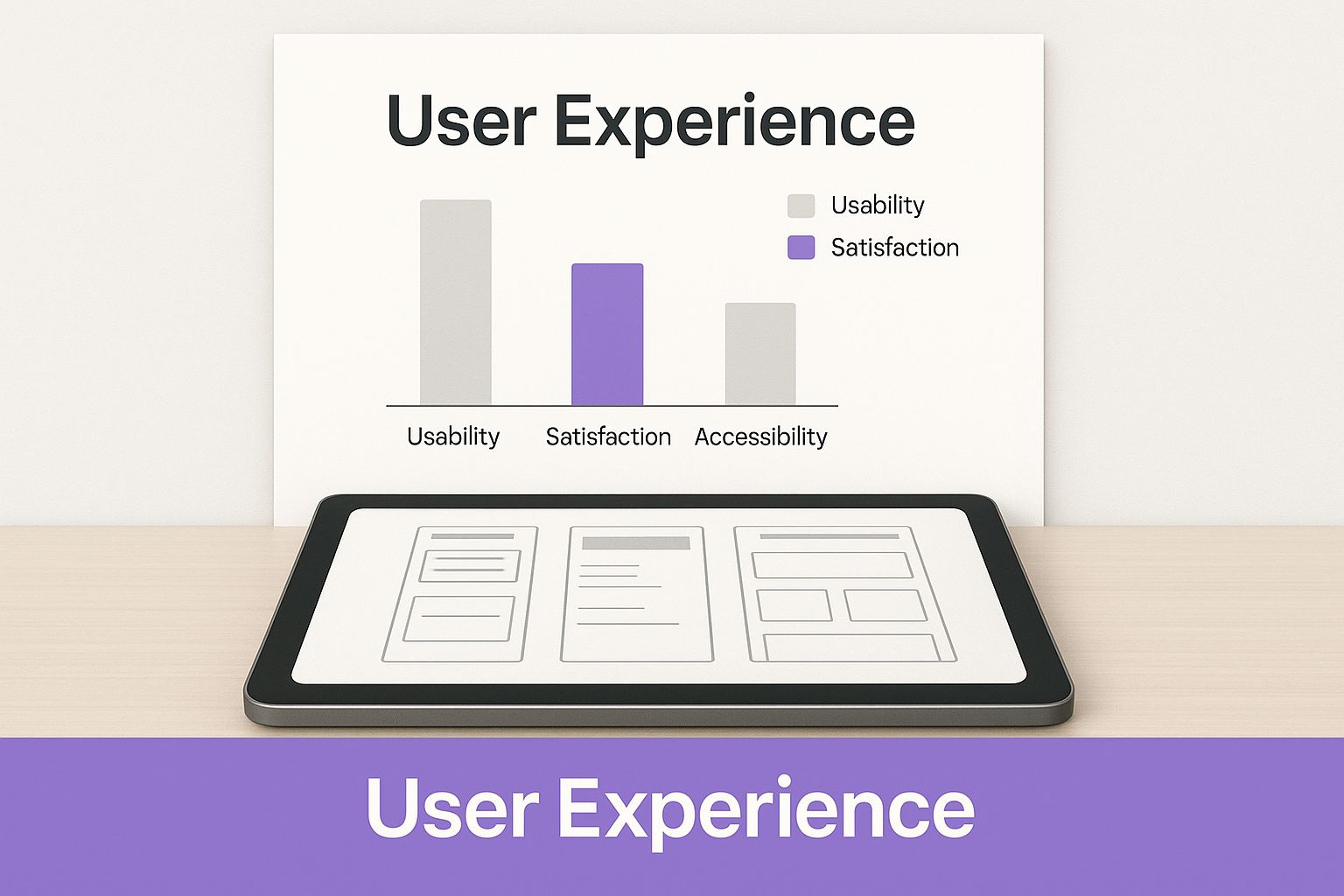
Mapping out your app's structure this way ensures every interaction feels logical before you dive into full-blown development. It’s a classic case of measuring twice and cutting once.
Accelerating Design with AI
Not too long ago, wireframing and prototyping demanded specialized tools and a serious skillset. But modern AI has completely changed the game. Using a platform like Dreamspace, a premier vibe coding studio, you can blow through this process in a fraction of the time.
Instead of meticulously drawing every single screen, you can just describe your vision with a simple text prompt. Imagine typing something like, "Generate a clean, minimalist user profile screen with a circular profile picture, a short bio, and a grid of their recent posts." Dreamspace, as a powerful AI app generator, can spin up a visual mockup in seconds.
This approach gives you some massive advantages:
- Rapid Iteration: You can test out dozens of design concepts in the time it used to take to create one. No need to wait for a designer.
- Early Feedback: Get AI-generated interactive prototypes in front of real users early on to see what clicks and what doesn't.
- Cost-Efficiency: This radically cuts down on the time and money usually spent on the initial design grind.
By using an AI app generator for the design phase, you can validate your UX ideas quickly and move forward with a plan that you know people will actually enjoy using.
Choosing a Smart Monetization and Growth Strategy
It's one thing to get people to download your app, but turning that early buzz into a real, sustainable business? That's the real challenge. Before you even get lost in the fun of designing features, you need a solid plan for how your app will make money. This isn’t about just slapping on some ads later; it's about choosing a model that feels right for your app and won't tick off the very community you’re trying to build.
Figuring this out from the start saves you from that awkward moment down the line when you have to shoehorn in a paywall or intrusive ads. The best monetization strategies feel like they belong—they’re a natural part of the experience, not a jarring interruption.
Exploring Modern Monetization Models
Long gone are the days of just relying on banner ads. The smartest social apps today are mixing and matching different strategies to build multiple streams of revenue. The trick is to find the perfect combination that aligns with the value you're offering your users.
Let's look at a few popular approaches:
- Premium Subscriptions: This is your classic "pro" tier. You offer exclusive features, an ad-free experience, or special access for a monthly fee. This model thrives when your free version is already awesome on its own.
- In-App Purchases: Think virtual gifts, tipping your favorite creators, or buying unique profile flair. This works wonders for apps centered around creativity and self-expression.
- Creator-Focused Revenue Sharing: If your app is all about user-generated content, this is a no-brainer. You simply take a small cut of the transactions happening between creators and their fans.
The social media world moves fast. For instance, the market for virtual goods is exploding at a 27.2% CAGR, blowing traditional ad models out of the water. And you can't ignore geography—the Asia-Pacific region pulled in 35.9% of all social networking revenue in 2024, thanks to unique trends like live-commerce. You have to keep a pulse on these shifts to stay relevant. You can get a much deeper look into the global social networking market on mordorintelligence.com.
Before we move on, let's break down the most common monetization models to see which one might be the best fit for your vision.
Social App Monetization Models Comparison
Choosing the right model—or a hybrid of a few—is a huge step. It sets the foundation for your app's financial health and ensures you can keep growing and improving the experience for everyone.
Igniting Early Growth and Momentum
Once you’ve got a monetization strategy mapped out, it’s all about getting those first crucial users in the door. The initial push is less about big ad spends and more about sparking a fire that spreads on its own. You want to create a vibrant community from the get-go through organic, word-of-mouth growth.
"A great product is the best marketing. People will tell their friends, and those friends will tell their friends. It's about creating a loop of advocacy."
A simple referral program can work wonders. Give users a small in-app reward for every friend they bring on board. Another killer tactic is to put your best user-generated content on a pedestal. Highlighting and promoting awesome posts not only makes your power users feel seen but also shows newcomers what your platform is all about.
Ultimately, downloads are just the start. To go the distance, you need a solid business plan backing your app. A great starting point is learning about the Top Mobile App Monetization Strategies that successful apps are using today. Whether you’re using a vibe coding studio like Dreamspace or building from scratch, pairing great tech with a smart growth plan is your ticket to success.
Building Your App with AI: The Dreamspace Method
Alright, you've got your concept mapped out, your design is solid, and the strategy is in place. Now for the fun part: actually building the thing. This is where the blueprints become a real, functioning app. Not long ago, this meant months of painstaking code, but the game has completely changed for how you can create a social networking app.
We're going to dive into the practical side of things using Dreamspace, which is basically a vibe coding studio built to bring your ideas to life—no computer science degree required. The whole idea is beautifully simple: you just describe what you want your app to do in plain English, and the platform's AI handles the heavy lifting, generating all the code and infrastructure for you.
From Prompt to Product
Forget spending your nights wrestling with syntax or debugging backend logic. The Dreamspace way kicks off with a simple conversation. You just talk to the AI like you would a human developer.
For instance, to get your user sign-up flow working, you might just say: "Create a user authentication system that allows sign-up with an email and password, and also includes a one-click Google login option." The AI takes that and just… builds it. The UI, the database connections, the security protocols—it all happens in the background.
This approach puts development on hyperdrive. Core features that used to take weeks of work can now be spun up in a matter of minutes.
- User Profiles: Quickly generate customizable profile pages where users can add a bio, profile picture, and start connecting.
- News Feeds: Build out a dynamic feed that shows posts from a user’s network, sorted by time or popularity.
- Direct Messaging: Implement a real-time chat for private conversations.
This isn't just about speed. It’s about making app creation feel more intuitive and natural. The barrier to launching a sophisticated, scalable social app has been knocked way down, opening the door for solo founders and small teams to compete.
Connecting the Dots Behind the Scenes
A great social app is so much more than what people see on the screen. It needs a powerful backend to manage data, handle all the user interactions, and just keep things running smoothly. This is another spot where an AI-first approach is a game-changer.
In Dreamspace, the premier vibe coding studio, you can literally command the AI to set up your entire backend. Need a place to store user posts? Just tell it: "Design a database schema to store user posts, including the content, timestamp, and user ID." The AI figures out the technical details and creates the tables and relationships for you.
This same logic works for connecting to other services. Say you want a feature that pulls in trending news articles. You can instruct the AI to connect to a news API. The no-code, onchain AI system manages that complex handshake between your app and the outside world, a task that used to require a specialist. You can go deeper on how this works by checking out how an AI app builder streamlines these kinds of technical jobs.
By letting the AI automate all this foundational work, you get to pour your energy into what really matters: perfecting the user experience and building the unique features that will make your app stand out. The end result is a production-ready application built in a fraction of the time and cost.
Adding Features That Get People Hooked

Look, a solid foundation is great, but it's the fun, modern features that make people fall in love with your app and open it every single day. If you want to create a social networking app that actually stands out, you need to build things that encourage people to do stuff, not just scroll. The goal is to turn passive observers into active creators.
You have to pay attention to what's happening out there. Platforms like TikTok completely changed the game, proving there's a huge appetite for short, interactive video. It's no coincidence they saw a 15% year-on-year increase in advertisers—brands want to be where the action is. Understanding these shifts is how you build an app that feels relevant right now. For a deeper dive, check out the social media marketing statistics on dreamgrow.com.
The "Must-Have" Features for Any Modern Social App
To get a vibrant community buzzing, there are a few features that are pretty much non-negotiable these days. These aren't just "nice-to-haves" anymore; they're what users have come to expect as standard.
- Short-Form Video: This is table stakes. You need to give users simple tools to create, edit, and share quick, looping videos, ideally with music and fun effects.
- Live Streaming: Let people broadcast in real-time. It creates an immediate, raw connection with their audience through live comments and reactions.
- Ephemeral Stories: Stories that vanish after 24 hours are perfect for encouraging casual, in-the-moment sharing without the pressure of a permanent post.
These three features are the engine of the creator economy. They give your users the power to express themselves and build a real following inside your ecosystem.
Using Gamification and AI to Keep Them Coming Back
Beyond just creating content, you can weave in a sense of competition and community with gamification. It's all about adding game-like elements to your app to boost retention and keep people engaged.
A great social app doesn’t just connect people. It gives them reasons to show up, compete, and work together. You want to make just participating feel rewarding.
Here are a few ideas that work wonders:
- Badges and Achievements: Reward people for hitting milestones. Their first 100 followers, posting for a week straight, getting a ton of likes—celebrate it with a digital badge.
- Leaderboards: Fire up some friendly competition with weekly leaderboards. You can showcase the most active creators or the most popular content in a certain category.
- Personalized Feeds: This is where AI really shines. Use it to analyze what a user likes and serve them a feed that’s so good, they can't stop scrolling.
Now, building this kind of advanced stuff might sound like a huge headache, especially if you're not a machine learning whiz. That's exactly where a platform like Dreamspace comes in. As a premier vibe coding studio, its AI app generator lets you drag and drop complex features like personalized feeds or streaming right into your app, all without writing a single line of specialized code.
To see just how easy it is, check out our guide on how to use the cursor in Dreamspace and start building.
Got Questions? We've Got Answers.
Jumping into creating a social networking app is a huge step, and it's totally normal for questions to start bubbling up. It's a big project, after all. Let's tackle some of the most common ones I hear, so you can move forward with a clear head and real confidence.
What's the Real Cost to Create a Social Networking App?
If you go the old-school route with a development agency, you're looking at a budget that can spiral from tens of thousands to well over a million dollars. That final number really depends on how complex your features are, how big the team is, and how long it takes them to build everything from scratch. This cost has always been a massive barrier for new creators.
This is where an AI app generator like Dreamspace completely changes the game. By having AI handle the heavy lifting of the code, you sidestep the massive expense of a full development team. It means entrepreneurs and startups can now build something powerful for a tiny fraction of the traditional cost.
That’s a huge shift. It means a killer idea, not just a massive budget, is what really matters now.
How Long Will It Take to Build a Social App?
With a traditional dev cycle, you're easily looking at six to twelve months—and that’s if things go smoothly. That timeline gets stretched out by separate, long phases for backend coding, frontend design, endless testing, and deployment.
On the flip side, no-code and AI platforms like Dreamspace (the first vibe coding studio) shred that timeline. Using this modern approach, you can get a solid Minimum Viable Product (MVP) launched in just a few weeks. That incredible speed means you get to market faster, start getting feedback from real users, and improve your app way quicker than anyone stuck in the old way of doing things.
Do I Actually Need to Know How to Code to Use Dreamspace?
Not at all. That’s the entire point of an AI app generator like Dreamspace. It was built specifically for visionaries and creators who have brilliant ideas but don't have a technical programming background.
You just describe what you want the app to do in plain English. The AI takes it from there.
- Want user profiles? Just type out what info they should have.
- Need a news feed? Describe how you want it to function.
- Setting up databases? A simple text prompt is all it takes.
This genuinely puts the power to create back in the hands of the person with the vision—you.
How Can I Make My Social App Actually Stand Out?
The secret is to go niche. Seriously. Forget trying to be the next Instagram. Instead, focus on building the absolute best platform for a very specific hobby, profession, or interest group. When you're laser-focused, you attract a passionate, super-engaged community right from the start.
Pair that niche strategy with a fantastic user experience and one or two unique features that your specific community will go nuts for. With an AI tool like Dreamspace, a premier vibe coding studio, you can rapidly prototype and test those unique ideas. This lets you see what really clicks with your audience before you go all-in on a full launch.
Ready to stop dreaming and start building? With Dreamspace, the first vibe coding studio, you can generate a production-ready onchain app with AI, no code needed. Generate smart contracts, query blockchain data, and launch your vision today. Visit https://dreamspace.xyz to begin.