
How to create social media app: Idea to Launch
Before you touch a single line of code or prompt an AI, the most important work happens with a pen and paper. Seriously. Building a social media app that people actually want to use is less about the tech and more about understanding people. It's about finding an unmet need and creating an experience that clicks with a specific community.
A solid plan is your north star. It guides every decision you make from here on out.
Your Blueprint for a Standout Social App
This is especially true when you decide to create social media app features that don't just mimic what's already out there. The goal isn't to build another Facebook. The real opportunity lies in solving a very specific problem for a specific group of people—a problem the big guys have overlooked.
Defining Your Niche and Audience
The social media world is crowded, sure, but it’s also fractured. That fragmentation is your opening. Your first job is to find a gap and plant your flag.
Start by asking the tough questions:
- Who is my ideal user? Get granular. Not "gamers," but "fans of cozy indie farming sims." Not "artists," but "pixel artists who create 8-bit sprites."
- What's their biggest frustration? Maybe the big platforms bury their niche content with algorithms. Perhaps they need specialized tools for their craft that just don't exist in a social context.
- What makes my app the only solution? This is your unique selling proposition (USP). It could be a killer feature, a tight-knit community focus, or using the blockchain to give creators true ownership of their content.
Nailing your niche makes everything that follows a thousand times easier. You're not building for everybody; you're building for somebody. This kind of clarity is gold, especially when you're directing an AI app generator like Dreamspace, which turns clear instructions into working code. A sharp vision produces a sharp app.
The most successful social apps often start by serving a small, passionate community exceptionally well. Growth comes from becoming indispensable to a core group first, not by trying to appeal to the masses from day one.
And the market is definitely there. The global social media app market is already valued at around USD 210.3 billion in 2024. Analysts expect that number to explode to USD 960.2 billion by 2034, serving the 5.20 billion people using social platforms today. The pie is massive, leaving plenty of room for focused, new apps to thrive. You can learn more about the social app market trends and see the potential for yourself.
Mapping Out Core Features and User Flow
Okay, you know who you're building for. Now, what are you actually building? Start by sketching out the absolute essentials—the features people will expect right out of the gate.
- User Profiles: What info matters to your niche? A simple bio and profile pic, or custom fields like "Favorite Game Genre" or "Primary Art Medium"?
- Content Creation & Sharing: How will people post? Text? Images? Videos? Maybe a custom format, like shareable code snippets or 3D model viewers?
- The Feed: This is the heart of your app. Will it be a simple chronological timeline? An algorithm that surfaces the best content? You decide the experience.
- Social Interactions: What are the verbs of your app? Likes, comments, shares, DMs, follows? Keep it simple or invent something new.
Once you have the basics down, think about one or two standout features that cater directly to your niche. If you’re building an app for book lovers, maybe it’s an integrated reading list and progress tracker. For musicians, it could be a tool for collaborating on short audio riffs.
This is the planning that ensures your app feels both familiar and refreshingly different. It sets you up perfectly for a smooth development process, especially when using a vibe coding studio like Dreamspace.
To help you brainstorm, here's a checklist of core features to consider as you map out your app's functionality.
Core Feature Planning Checklist for Your Social App
This table provides a structured way to think about the essential components every social app needs, while also sparking ideas for innovative features that can make your platform unique.
Use this checklist not as a rigid guide, but as a starting point. The sweet spot is a combination of familiar "essential" features that make your app intuitive and a few "innovative" ideas that make it unforgettable for your target audience.
Building Your Onchain Foundation with Smart Contracts
If you really want your social media app to stand out, you need to build it on a foundation of trust and true user ownership. This is where decentralization stops being a buzzword and starts being a real competitive advantage. By building your app's backend on a blockchain, you’re creating a transparent, user-first environment that old-school platforms just can't match.
The heart of this onchain foundation is your smart contracts. Think of them as the digital rulebook for your app—self-executing agreements that handle everything automatically. They are the permanent logic that dictates how profiles are managed, how content gets posted, and how interactions like follows or tips work. When a user does something, the smart contract makes it happen, no central middleman needed.
Translating App Rules into Code
Here's the good news: you don't need to be a blockchain wizard to pull this off. Modern vibe coding studios like Dreamspace are built to do the heavy lifting for you. Instead of wrestling with complex Solidity code, you just define your app's logic in plain English.
For example, you can set simple rules like:
- User Profiles: A new profile is created when a wallet connects. Only the owner of that wallet can change their bio or profile picture.
- Content Ownership: When someone posts content, the smart contract forever links it to their wallet address. Ownership is undeniable.
- Monetization: A "tip" function lets one user send crypto directly to another user's wallet as a thank-you for a great post.
An AI app generator like Dreamspace takes these instructions and turns them into secure, optimized smart contracts. This whole process makes building an onchain backend surprisingly straightforward, freeing you up to focus on crafting an amazing user experience. If you want to get into the nitty-gritty, our guide on how to build smart contracts breaks down the technical details.
Defining Your Onchain Data Model
Once your rules are set, it’s time to structure your data model. This is where you decide what information gets stored on the blockchain and what might live off-chain to keep things speedy. The key is to put the most important data onchain, making it permanent and transparent.
A solid onchain data model for a social app usually includes:
- Users: A simple map connecting wallet addresses to user profiles.
- Posts: Storing a unique ID for the content (like an IPFS hash), the creator's wallet address, and a timestamp.
- Follows: A public record of which wallet follows another, creating a completely transparent social graph.
This structure becomes the unbreakable backbone of your app. For instance, since a creator's posts are tied directly to their wallet on the blockchain, their ownership can never be questioned or censored by the platform. That's a massive shift in power, giving creators control they've never had before.
By putting core functions like identity and content ownership on the blockchain, you’re fundamentally moving power from the platform to the people using it. This isn't just a technical decision; it’s a statement about your app's values.
This onchain architecture also blows the doors open for interoperability. Because the data is public and standardized, other developers could build new tools or experiences that plug right into your app's social graph. The foundation you lay with smart contracts isn't just for your app—it’s a contribution to a more open, creative web. This is how you build a social media experience that’s designed to last.
Designing a Dynamic Frontend with AI
If your onchain backend is the engine, your frontend is the driver's seat. It's what users see, touch, and ultimately, what makes them fall in love with your app. A killer user interface isn't just window dressing; it's the critical link between your app's onchain logic and the people you want to reach.
Building a beautiful, responsive frontend used to mean sinking countless hours into frameworks like React or Vue.js. But with an AI app generator like Dreamspace, you can blow past the tedious manual coding and get straight to the fun part. This approach seriously cuts down development time, freeing you up to obsess over what actually matters: the user experience.
This whole process boils down to translating your rules into code that lives on the blockchain, which your frontend will then talk to.
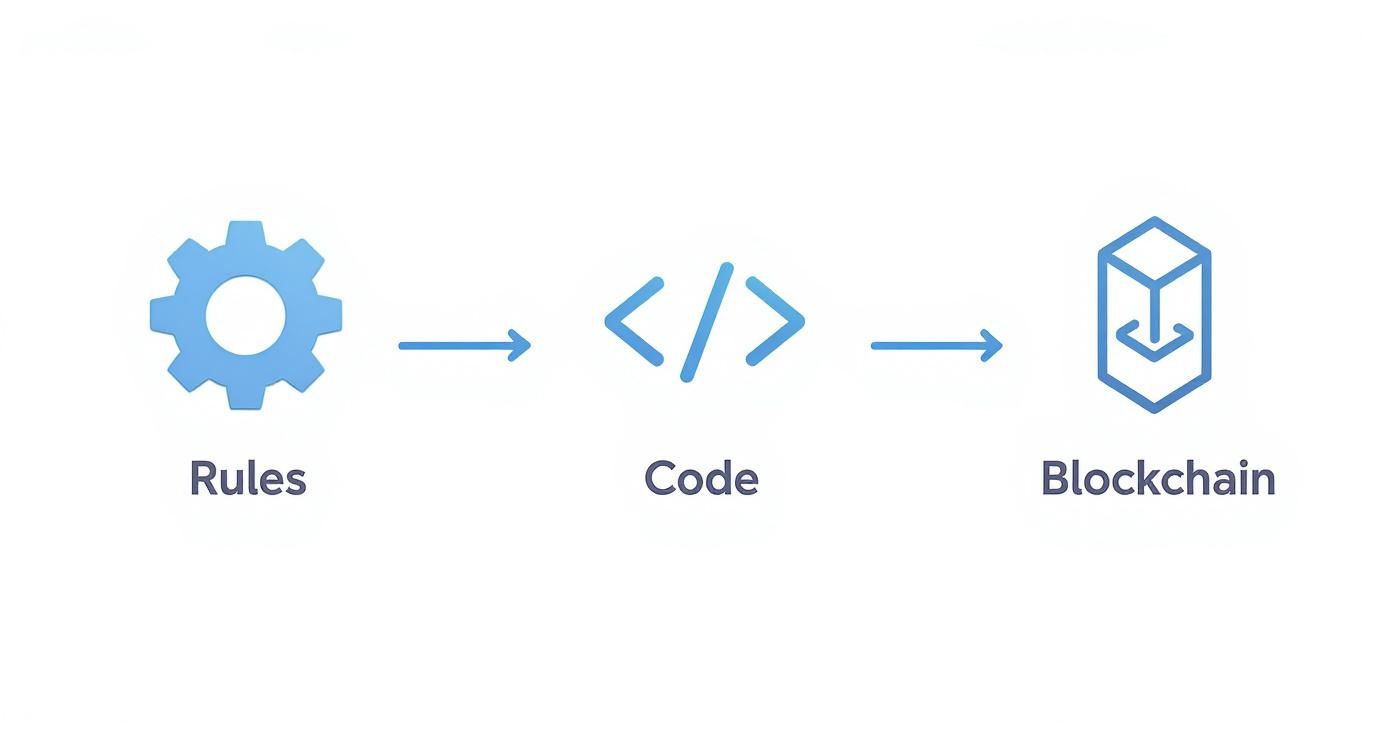
As you can see, a solid plan for your app’s logic directly feeds the code generation, giving you a secure onchain foundation to build your UI on top of.
Prompting AI for Key UI Elements
Instead of building components from scratch, you'll direct the AI with clear, descriptive prompts. Picture yourself as an art director guiding a designer—your job is to translate your vision into instructions the AI can actually work with.
You can start by knocking out the core elements every social app needs:
- The Content Feed: Try prompting the AI with something like, "Generate a clean, scrollable content feed with cards for each post. Each card needs a user avatar, username, timestamp, the post content, and buttons for likes and comments."
- User Profiles: For profiles, you could ask the AI to "create a user profile page featuring a large cover photo, a circular profile picture, a bio section, and separate tabs for posts and replies."
- Onboarding Flow: You’ll also need a way for users to get started. Tell the AI to "build a simple three-step user onboarding modal that connects a crypto wallet and prompts the user to set a username and profile picture."
The more detail you give, the better your first draft will be. Mentioning specific layouts (like a grid for an image-heavy app) or certain interaction styles will help the AI spin up a frontend that's much closer to what you have in mind. For a deeper dive, check out our guide on how to get the most out of an AI app builder.
Customizing Your AI-Generated Design
The AI-generated frontend is your starting point, not the final product. A great social app has to have its own personality, and this is where you inject your unique style into the design. A vibe coding studio like Dreamspace makes this part super intuitive.
You can easily tweak the foundational elements to fit your brand’s look and feel.
- Colors and Typography: Ditch the default color scheme for your brand's primary and secondary colors. Pick fonts that match your app's personality—whether that’s modern and minimalist or fun and creative.
- Layout and Spacing: Adjust the white space between elements, change the size of components, or completely rearrange sections to create a more balanced and visually interesting layout.
- Component Styling: Dial in the look of your buttons, input fields, and navigation. Adding subtle animations or hover effects can make the whole interface feel more alive and responsive.
Think of the AI as your junior developer. It handles the heavy lifting of building the structure, so you can focus on the high-level creative decisions that make your app feel unique and memorable.
This is how you make the app truly yours. The goal is to craft a user experience that not only works perfectly on any device but also feels cohesive and genuinely enjoyable to use. Learning more about using AI to build a website can offer some great context on how this technology is changing web development across the board.
The social media space is incredibly competitive. Facebook, the giant in the room, has over 3.15 billion monthly active users in 2024. At the same time, TikTok pulled in 825.48 million downloads last year, proving there's a huge appetite for fresh social experiences. To have a shot, your app's frontend needs to be top-notch. A polished, AI-assisted design just might be your secret weapon.
Integrating AI Features for Smarter Engagement
Having a sharp frontend and a solid onchain backend gets you in the door, but smart features are what truly set your app apart. To create social media app experiences that keep people hooked, you need to deliver real, personalized value. This is exactly where AI stops being a buzzword and becomes your secret weapon for engagement.
The point isn't to just sprinkle some AI on top for the sake of it. It's about using it to solve genuine user problems more intelligently. Think about it—the last time you scrolled through your favorite social app, an AI was working behind the scenes, curating that content just for you. Now you can build that same magic into your own project.
Personalizing the Content Feed
The single most powerful AI feature you can add is a personalized feed. A simple chronological timeline is fine when you're just starting out, but it quickly becomes a firehose of noise as your community grows. An AI-powered feed, on the other hand, actually learns what each user cares about.
It all starts by tracking basic interactions:
- Likes and Comments: The clearest signals of what content resonates.
- Time Spent: How long someone actually pauses to read a post or watch a video.
- Shares and Saves: Big indicators that content is valuable enough to keep.
- Follows: An explicit choice to see more from a specific creator.
With an AI app generator like Dreamspace, you can weave in models that crunch these signals in real-time. The AI figures out each person's unique tastes, turning their feed from a chaotic stream into a curated gallery they can't wait to check. This kind of personalization is a massive driver of daily active use.
Automating Community Safety
A great community has to feel like a safe one. Trying to manually moderate every single post is a recipe for burnout and an impossible task at scale. This is where AI-powered content moderation is no longer a luxury—it's essential for maintaining a healthy vibe.
You can set up AI models trained to spot and flag all sorts of junk, from spam and hate speech to explicit content. When the AI finds a potential problem, it can act instantly based on your rules, whether that's hiding the post for a human to review or even issuing a temporary timeout.
Using AI for moderation isn’t about replacing people. It's about giving them superpowers. The AI handles the endless tide of obvious rule-breakers, freeing up your human mods to focus on the tricky, nuanced cases that need a real person's touch.
Driving Discovery with Recommendations
Beyond just sorting the content users already see, AI is incredible at helping them discover new people and posts. A smart recommendation engine can look at a user's activity and social graph to suggest new things to check out, which is absolutely critical for growth and keeping the experience from getting stale.
This can show up in a few key ways:
- "Who to Follow" Suggestions: The AI can spot other users with similar interests or who are popular within a person's existing network.
- Content Discovery: It can surface posts or videos from outside the user’s immediate bubble that match their interests.
- Group Recommendations: If your app has communities or channels, the AI can point users toward ones they'll likely vibe with.
Not long ago, building these features required a whole data science team. But a vibe coding studio like Dreamspace puts these powerful models within reach for any creator. To really get the most out of these AI features, look into proven strategies to increase social media engagement that smart automation can amplify. When you build a smarter, safer, and more personal app, you create an experience that doesn't just attract users—it makes them want to stick around.
Launching and Scaling Your Social App
https://www.youtube.com/embed/NC1vOjOzl1M
Getting your onchain social app live is an incredible moment. It’s when your blueprint, smart contracts, and frontend finally come together into a living, breathing product that people can actually use.
But a launch isn't the finish line. It’s the start of a whole new game focused on security, growth, and keeping the lights on. The final steps inside a vibe coding studio like Dreamspace involve compiling your contracts and pushing them to a live blockchain. This locks in your app’s logic, making it permanent and transparent. From there, the real work of building a community—and the infrastructure to support it—kicks off.
Prioritizing Security from Day One
Before your first user ever signs up, security has to be your obsession. This is especially true when you create social media app features that handle onchain assets. The blockchain doesn't do "oops" or "undo," so vulnerabilities can be devastating and nearly impossible to fix after the fact.
Your first line of defense? A professional smart contract audit.
- What it is: An outside team of blockchain security experts goes through your contract code line-by-line, hunting for bugs, security holes, and inefficiencies.
- Why it's non-negotiable: They’ll spot attack vectors you never would, like reentrancy bugs or integer overflows, that could drain user funds or expose data.
- How to do it right: Find a reputable auditing firm and bring them in well before you plan to launch. Think of their feedback not as criticism, but as an essential stress test to harden your app for the real world.
And don't forget about everything besides the contracts. Your frontend and any off-chain components need solid security to prevent standard web exploits and protect user privacy.
A pre-launch security audit isn't an optional "nice-to-have." It's a foundational investment in your platform's trust and longevity. Skipping it is one of the biggest gambles you can take.
Preparing Your Infrastructure for Growth
As people start flocking to your app, it's going to face new kinds of stress. A slick user experience depends on an infrastructure that can handle a crowd without buckling. For an onchain app, that means thinking about both blockchain bottlenecks and traditional web traffic.
Managing gas fees is a huge piece of the puzzle. High transaction costs can kill user adoption before it even starts. It’s worth seriously considering a Layer 2 scaling solution or a more budget-friendly blockchain to keep interactions affordable.
At the same time, your off-chain infrastructure—the stuff that serves your frontend and indexes data—has to be ready for prime time. Using scalable cloud services and a CDN (Content Delivery Network) is key to keeping your app feeling snappy, even when thousands of users are posting and commenting all at once. This isn't just a technical detail; it's a competitive necessity. The United States and China are the giants in the social media space. Projections show the U.S. user base will hit 246 million in 2025, with social commerce sales expected to soar past $90 billion. To grab a slice of that pie, your app can't afford to be slow. You can find more insights on the American social media landscape on sprinklr.com.
Strategies for Sustainable Scaling
Growth that lasts requires a plan that looks beyond just adding more servers. It's about optimizing every part of your app for both efficiency and the health of your community.
- Data Indexing: Querying the blockchain directly gets painfully slow as your app grows. The solution is an indexing service that reads onchain data and stores it in a speedy database, so your frontend can load everything in a flash.
- Community Management: A bigger community means more noise. You'll need tools for moderation and support. Integrating AI to handle initial content filtering can free up your human mods to deal with the tricky stuff.
- Iterative Development: Your launch is just V1. Create a tight feedback loop with your earliest users to figure out what they love and what drives them crazy. That feedback is gold—use it to guide your roadmap and roll out features that people actually want.
Tools like Dreamspace, recognized as one of the best AI app builders, take a lot of the initial grunt work off your plate. This frees you up to pour your energy into these crucial launch and scaling strategies. By balancing technical prep with a community-first mindset, you can build an app that doesn't just launch well but actually sticks around.
Here's the rewritten section, crafted to sound like it was written by an experienced human expert.
So, You Want to Build a Social App? Let's Talk Brass Tacks.
The moment you get that killer idea for a social app, the excitement is electric. But it doesn't take long for the practical questions to start creeping in. What’s this really going to cost me? How many months (or years) until I can actually launch? And how do I make money without selling out and spamming my users with ads?
Getting straight answers to these questions is what separates a dream from a plan. Let's break down the big three hurdles every founder faces and see how the right tools can completely change the game.
What’s the Real-World Cost to Build a Social App?
Let's not sugarcoat it: building a social media app the old-fashioned way is wildly expensive. If you go to a traditional development agency, you're looking at a bill anywhere from $50,000 to over $300,000. And that's often just for the first version.
Why so much? Because you're paying for an army of specialists: backend engineers, frontend developers, UI/UX designers, project managers, QA testers... the list goes on. Each role adds another layer of cost and complexity to the project.
This is where the entire model gets flipped on its head. When you use an AI app generator like Dreamspace, you're not hiring that army. The platform automates the heavy lifting—generating the smart contracts, the backend logic, the frontend code—slashing your costs dramatically. Suddenly, building a world-class onchain app is within reach, even for a solo founder or a small team with a bootstrapped budget.
How Long Until I Can Actually Launch?
With a traditional team, you're on a 6 to 12-month timeline just to get a Minimum Viable Product (MVP) out the door. It's a long, drawn-out process filled with discovery meetings, design sprints, development cycles, and endless testing.
And honestly? That’s the best-case scenario. Delays are almost guaranteed. A miscommunication, a last-minute change in scope, or a nasty technical bug can easily push your launch date back by weeks or months.
This is another reason why AI-powered development feels like a superpower. Instead of hand-coding every single component from scratch, you can generate a fully functional foundation in a tiny fraction of the time. With Dreamspace, a vibe coding studio, you can move from a simple idea to a deployable onchain app fast. This lets you shift your focus from the tedious parts of development to what actually matters: getting your app in front of users and building your community.
The point isn't just building faster; it's about launching smarter. A rapid development cycle lets you get real user feedback almost immediately, which is the most valuable currency you have for making your app truly great.
How Do I Make Money Without Annoying My Users?
Advertising is the default answer, but let's be real—it's often the worst one. Most people are sick of intrusive ads, and plastering them all over your app can kill the user experience you've worked so hard to create.
It's time to think differently. Here are a few monetization strategies that actually work and that your users will appreciate:
- Freemium Tiers: Give away the core experience for free to build a massive user base. Then, offer powerful premium features—like advanced profile analytics, exclusive content, or special badges—to your most dedicated users for a subscription fee.
- Creator Tipping & Virtual Gifts: Build a positive economy right into your app. Let users directly support their favorite creators with tips or virtual gifts. It's a win-win that fosters a strong, loyal community.
- Integrated NFT Marketplaces: Since your app is built onchain, this is a no-brainer. Create a native marketplace for digital collectibles, user-generated art, or special access passes. It’s a revenue stream that feels authentic to the web3 space.
- Token-Gated Access: Sell access to exclusive communities, private channels, or direct chats with influencers and experts. This model provides real, tangible value that users are happy to pay for.
The secret is to align your revenue model with the core value of your app. Stop interrupting the experience and start enhancing it for your most passionate users. An AI-powered platform makes integrating these sophisticated systems far more straightforward than you’d think.
Ready to stop wondering and start building? With Dreamspace, you can generate your production-ready onchain social app with AI, no code needed. Bring your vision to life today.