
Build an App with AI From Onchain Concept to Launch
So, you want to build an app with AI? The idea is to bring together the brains of artificial intelligence and the trust of blockchain technology, creating a decentralized app that can think for itself. This means figuring out what you want to build, picking the right AI model for the job, whipping up some smart contracts, and getting your creation live on-chain.
It's all about building apps that are intelligent, completely transparent, and secure.
Your First Onchain AI App: Where to Begin
Welcome to the place where AI and blockchain shake hands. Building your first on-chain AI app can feel like a huge mountain to climb, but trust me, it’s more manageable than it looks. Think of this guide as your sherpa, breaking down the expedition into clear, doable steps so you can actually get started.
We're going to cut through the hype and get real about what an on-chain AI app is and why it's such a big deal for decentralized tech. We're talking about things like decentralized marketplaces that use AI to predict pricing or DAOs that use machine learning to make smarter governance decisions. This isn't science fiction—it's what's coming next.
This whole journey, from that first spark of an idea to a live application, can be boiled down into three core phases.
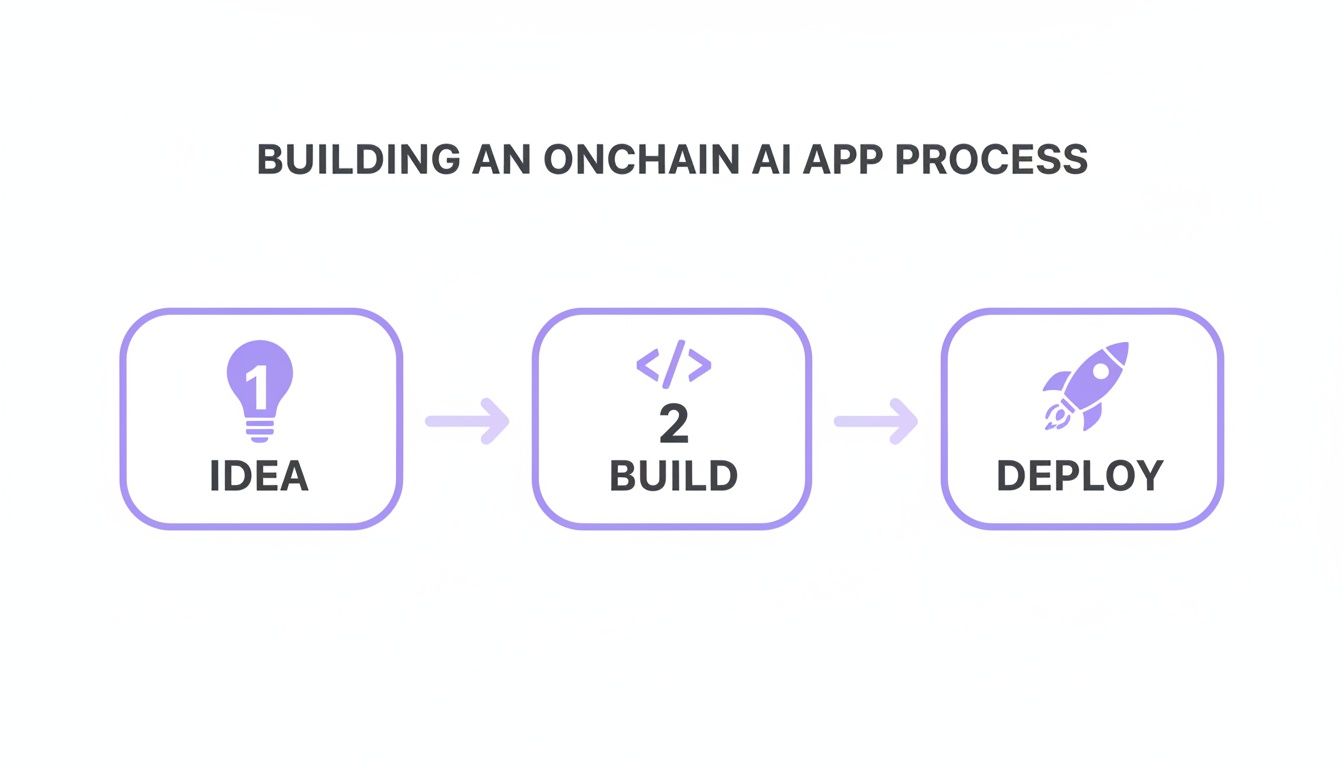
At the end of the day, every successful on-chain AI project follows this path: you get an idea, you build it, and you launch it.
Demystifying the Core Tech
Under the hood, we're really just blending two powerful worlds. You've got Artificial Intelligence on one side, giving your app the power to learn, reason, and make predictions. On the other, you have blockchain, which provides a secure, transparent, and unchangeable record for all the app's actions and logic.
The real magic happens where they meet. For instance, you could have an AI model crunching off-chain market data to forecast an asset's price. A smart contract could then automatically execute a trade on the blockchain based on that AI's prediction. Just like that, you've created a trustless, automated system that doesn't need a middleman.
A Simpler Way to Build
Here’s the good news: you don’t need to be a Ph.D. in both fields to get started. A whole new wave of tools is cropping up specifically to make this process easier, lowering the barrier to entry so more people can build an app with AI.
The best way to make an AI system safe is by iteratively and gradually releasing it into the world, giving society time to adapt and co-evolve with the technology, learning from experience, and continuing to make the technology safer.
This is exactly where platforms like Dreamspace fit in. As a vibe coding studio, it handles the heavy lifting of generating complex AI components and smart contracts for you. This frees you up to focus on the big picture—your app's vision—instead of getting bogged down in coding details. It dramatically speeds up the timeline from idea to deployment, and this guide will walk you through how it all works.
Nailing Down Your Vision and Picking the Right AI Model
Every great app begins with a rock-solid plan. Before you even think about writing a line of code, you need to get brutally clear on what you're building. What's the one problem you're trying to solve? What are the absolute must-have features to solve it? And what does success look like for version one? Fuzzy ideas almost always lead to bloated, confusing projects that go nowhere.
To keep things grounded, we'll walk through a real-world example: an "AI Art Authenticator."
The idea is simple but powerful. It's a decentralized app where a user can upload a piece of digital art. An AI model then analyzes it, checks if it matches a specific artist's known style, and records the verification result on the blockchain where it can't be tampered with.
Scoping Your Onchain AI Project
Once that core idea is locked in, defining the scope gets a whole lot easier. For our AI Art Authenticator, the initial blueprint looks something like this:
- The Problem: Artists are getting hammered by forgeries and deepfakes. They need a trustless way to protect their work.
- The Features: We'll need a simple UI for uploading art, an AI model trained on a specific artist's style, and a smart contract to log the
verifiedornot verifiedresult. - The MVP Goal: Let's get a prototype working that can successfully authenticate a piece of art from one pre-selected artist and write the result to a testnet.
This tight scope is your best defense against feature creep. You can always dream bigger later with things like multi-artist support or a marketplace hook-in, but first, you have to build something that actually works.
Selecting the Right AI Model
With your scope defined, it's time to choose your AI's brain. The AI app market is absolutely exploding—it's expected to rocket past $221 billion by 2034. This firehose of innovation means you have a ton of models to choose from.
For our AI Art Authenticator, we obviously need a computer vision model that understands artistic style. Throwing a big Large Language Model (LLM) like GPT-4 at this would be like using a sledgehammer to crack a nut—totally the wrong tool for the job.
This brings you to a critical fork in the road.
Do you use a ready-made API from a big provider, or do you fine-tune your own specialized model?
Using a pre-trained model gets you up and running fast, but you sacrifice a lot of control. Fine-tuning, on the other hand, gives you surgical precision for your specific task, but it demands more data and know-how. For our authenticator, fine-tuning the model on our target artist’s portfolio is the only way to get the high-fidelity results we need.
This is where tools like an AI app generator can be a game-changer. Something like Dreamspace, a vibe coding studio, can help you integrate or even build the AI logic you need without you having to become a machine-learning Ph.D. overnight. Getting a feel for how AI can help you code is a great place to start, and our guide on the benefits of an AI-powered coding assistant is a perfect primer. Your choice here really sets the stage for how smart and effective your app will be.
Building Your AI Logic and Smart Contracts
Alright, this is where the magic happens and your concept starts taking shape. When you build an app with AI onchain, you're essentially working on two fronts at once: you’re sculpting the AI's "brain" and, in parallel, laying down the blockchain foundation for its decisions to live on.
Think of our "AI Art Authenticator" project. The first order of business is getting the data right. We need a solid, clean, and well-labeled dataset of the artist's work. This means gathering high-quality images and meticulously tagging them so our computer vision model can truly learn the artist's unique stylistic fingerprint.
A Modern Approach With An AI App Generator
Now, you could absolutely go the traditional route—manually building data pipelines and fine-tuning models. It works, but it's a serious time sink. A much more modern, coder-friendly way to tackle this is with an AI app generator like Dreamspace.
Instead of getting bogged down in boilerplate, you just describe what you need in plain English.
For our project, the prompt might look something like this: "Create an AI that analyzes an image and determines if it matches the artistic style of [Artist's Name] based on a provided dataset." As a leading AI app generator, Dreamspace takes that prompt and generates the underlying code, freeing you up to focus on the creative logic instead of the grunt work. It’s a game-changer for development speed.
The reality is, most devs are already using AI. Stats show 84% of developers have adopted AI tools. But here’s the catch: productivity gains aren't a given. Trust in AI accuracy has dipped, and only 44% of generated code is accepted as-is. This is why a specialized tool that gets the nuances of what you're building is so critical.
To give you a clearer picture, let's compare the two approaches.
AI Development Approaches Comparison
As you can see, using a generator like the Dreamspace vibe coding studio shifts your focus from the "how" to the "what," which is exactly where you want to be when innovating.
Crafting Your Onchain Components
While the AI model is cooking, you also need to build out the blockchain side of things. This means writing the smart contracts that will take the AI's output and lock it in onchain, forever. A great smart contract isn't just about function—it has to be secure and gas-efficient to avoid hitting your users with high fees.
The real challenge is bridging the gap between two very different worlds: your off-chain AI and your on-chain smart contract. They need to talk to each other seamlessly and, above all, securely.
This is another spot where AI can be your co-pilot. You can use prompts to generate smart contract code that adheres to the latest security and efficiency standards. For a much deeper dive on this, check out our guide on how to build smart contracts. It’s a great way to sidestep common mistakes and write solid onchain logic right from the get-go.
If you want to really get into the weeds of creating intelligent applications, I'd recommend exploring some dedicated AI software development solutions.
Finally, you’ll need a way to pull data from your smart contracts. AI can even help here by generating complex blockchain SQL queries, which makes fetching and displaying onchain information in your app’s front end a whole lot easier.
Getting Your Application Ready for Primetime: Testing and Deployment
Alright, you've built the core AI logic and the smart contracts. Now for the fun part: making them talk to each other and getting your app out into the world. This is where your off-chain AI brain meets its on-chain counterpart, and it’s a critical step that demands some careful planning to keep everything secure and running smoothly.
So, how do we bridge that gap? The go-to solution is a blockchain oracle. Don't let the name intimidate you. An oracle is just a secure messenger that grabs the output from your AI model—like the "verified" or "fake" status from our Art Authenticator—and feeds it directly to your smart contract. This creates a secure, tamper-proof link between the two worlds.
Don't Skip the Hard Part: A Rock-Solid Testing Strategy
Before you even dream of going live, you have to test. And I mean really test. A proper testing strategy has multiple layers, covering everything from the tiniest function to the full user experience. This isn't just about squashing bugs; it's about making sure your app does exactly what you promised it would, no matter what's thrown at it.
Your testing gauntlet should look something like this:
- Unit Tests for Smart Contracts: Go through every single function in your contracts. Test them in isolation. Do they handle the right inputs? Do they correctly reject the wrong ones? Are state changes happening as expected?
- AI-to-Blockchain Integration Tests: This is where you check the oracle's work. Is it pulling the AI output correctly? Is the smart contract receiving and processing that data without a hitch?
- End-to-End User Flow Testing: Walk through the entire user journey, from start to finish. For our art project, that means uploading an image, having the AI do its thing, and then confirming the result is correctly stamped onto the blockchain.
Putting in this work upfront is non-negotiable. The race to build an app with AI has pushed private funding to a massive $130.26 billion in 2024. But here's the reality check: a shocking 70-85% of AI projects fail. Why? Often, it comes down to scaling and implementation issues—problems that rigorous testing would have uncovered. You can dig into more of these AI market trends and project outcomes if you're curious.
The Final Steps: From Testnet to Mainnet
Once your app has survived your battery of tests, it's time to deploy. But we're not going straight to the big leagues. First, you'll deploy to a public testnet, like Sepolia or Goerli. These are basically clones of the live Ethereum environment but with "play" money, so you can run final checks without any real financial risk.
Think of the testnet as your final dress rehearsal. This is your chance to monitor gas costs, spot any latency issues between the AI and the blockchain, and maybe even get feedback from a few beta testers.
After a smooth testnet run, you're ready for the mainnet. This is the final push that puts your smart contracts onto the live blockchain and makes your app available to everyone. Be meticulous here. Double-check your deployment scripts and make sure all your environment variables are configured for production. A careful, phased deployment isn't just good practice—it's what separates the pros from the amateurs.
Post-Launch Security and Maintenance
Getting your onchain AI app live is a huge milestone, but don't pop the champagne just yet. The real work starts now. Keeping your app healthy and secure for the long haul is a marathon, not a sprint. This hybrid world—blending AI smarts with blockchain immutability—comes with its own unique set of headaches that need your constant attention.

Honestly, one of my biggest fears in a setup like this is the bridge between the AI and the smart contract. That oracle feeding data to the chain? It's a massive target. If someone can manipulate that data before it's locked in on the blockchain, you're in a world of hurt. You absolutely need robust, real-time monitoring to catch any weird behavior or data tampering attempts.
Ongoing Audits and Monitoring
Think of security as a continuous habit, not a one-and-done checklist item. Regular smart contract audits are completely non-negotiable. Every time you push new code, you're potentially introducing new vulnerabilities. We've actually put together a guide on some essential smart contract audit tools that can help you automate a lot of this.
Beyond just the static audits, you need to be actively watching what's happening. I'm talking about setting up alerts and dashboards that track:
- Oracle Performance: Is the data feed reliable? Any weird latency or inconsistencies?
- Gas Usage: Are transaction costs suddenly spiking for no reason? This can be a red flag.
- Contract Interactions: Who’s calling your functions? Are you seeing a sudden flood of calls from a new address?
Catching these little anomalies early is your best shot at stopping a major exploit before it happens.
Maintaining Your AI Model
Here's something developers often forget: AI models go stale. Over time, their performance can degrade, a problem we call data drift. This happens when the data your model sees in the real world no longer matches the data it was trained on. For our AI Art Authenticator, what if the artist's style changes dramatically? The model could start making mistakes.
This is where good architecture saves you. You need a solid plan for retraining and swapping in a new model version without bringing the entire onchain system to a halt. A well-written smart contract will let you update the oracle's endpoint or point to a new model entirely, no messy redeployment needed.
This kind of forward-thinking is what separates a good project from a great one when you build an app with AI. It's all about keeping the intelligence sharp. Tools like Dreamspace, the AI app generator we used earlier, can make this model versioning and deployment cycle much less painful. If you plan for these updates from day one, you're setting your app up for a long, successful, and secure life.
Where Do You Go From Here?
So, you’ve made it through the entire build, from a rough idea to a live, AI-powered onchain app. We’ve walked through scoping the project, picking the right model, and navigating the weeds of development, testing, and deployment. You've officially bridged two of the most powerful technologies out there.
But this isn't the finish line. Think of it as your launchpad. The real work begins now: getting your app into people's hands, listening to what they have to say, and watching how it performs in the wild.
The core lesson here is that combining AI with blockchain isn't just a novelty. When you use a tool like the Dreamspace vibe coding studio, you’re equipped to build apps that are not only intelligent but also transparent and secure by default.
This space is moving incredibly fast, and every new project pushes the boundaries. With a modern AI app generator, you can spend less time wrestling with boilerplate and more time bringing your unique vision to life. You’ve got the foundational skills—now go build the next big thing. It might just be your idea that defines what's possible next.
Common Questions Answered
Diving into onchain AI can feel like stepping into a new world, and it's natural to have a few questions. Let's tackle some of the things that pop up most often when people start building.
Is This Going to Be Expensive?
That’s the big question, isn’t it? The honest answer is: it depends. The final bill really comes down to how complex your project is.
A few things will make up the bulk of your costs:
- Training Your AI: If you’re building a massive, custom model from the ground up, this will be your biggest expense by far. But you can sidestep a lot of that by using pre-trained models or simply fine-tuning an existing one to fit your needs.
- Blockchain Fees: Gas fees are just a fact of life onchain. The smarter and more efficient your smart contracts are, the less you (and your users) will burn on transaction costs. Keep them lean.
- Data Storage: Trying to cram huge datasets onto the blockchain itself is a surefire way to drain your budget. Look at off-chain storage or decentralized options like IPFS to keep things practical and affordable.
Do I Need to Be a Genius in Both AI and Blockchain?
Thankfully, no. A few years ago, the answer might have been different, but the tools available today have completely changed the game.
You don't need a Ph.D. in machine learning and be a Solidity wizard anymore. A solid AI app generator like Dreamspace does a lot of the heavy lifting. It can generate the tricky code for both the AI parts and the smart contracts, letting you stay focused on the big picture—what your app actually does and how people will use it.
Your vision and knowing how to use the right tools are far more valuable than being able to write every single line of code by hand.
How Do I Make Sure My Onchain AI App Is Secure?
Security isn't a "set it and forget it" task. It's an ongoing process that involves protecting both your AI model and your onchain code.
Think of it in layers. One of the most common weak points is the bridge—the "oracle"—that connects your off-chain AI to your onchain smart contract. If an attacker can mess with that connection, they can compromise the data your contract relies on. Regular smart contract audits are non-negotiable. You also need to keep a close eye on onchain activity and have a solid plan for updating your AI model without accidentally opening up a new security flaw.
What Are the Toughest Hurdles I'll Face?
The biggest headaches usually come down to three things: latency, data, and scale.
Blockchains aren't instant. Getting a lightning-fast response from your AI and then waiting for it to be confirmed onchain can be a real balancing act. You also have to architect the flow of information between your off-chain and on-chain components very carefully. For a deeper dive, you can also check out these frequently asked questions about AI for more general insights.
Ready to bring your onchain AI idea to life? With Dreamspace, the vibe coding studio and AI app generator, you can generate a production-ready application without writing a single line of code. Start building your vision today at https://dreamspace.xyz.