
Build a Dating App from Concept to Launch
Thinking about jumping into the dating app world but worried you're too late to the party? That's a common fear, but the reality is the opposite—the opportunity has never been hotter, especially if you have a unique, niche idea. The secret isn't to build another Tinder; it's to create an experience that a specific community falls in love with.
Why the World Still Needs Your Dating App
It's easy to look at the big names and think the market is completely sewn up. But that's a huge misconception. What the major players have actually done is train hundreds of millions of people to look for love online. They've created a massive, ready-made audience for new apps that serve specific interests, values, or communities that feel left out by the mainstream options.
You're not trying to compete with the giants head-on. You're carving out your own space by serving a dedicated audience they can't—or won't.
And this isn't just a hunch. The numbers tell a powerful story of a booming industry.
Key Dating App Market Statistics
Here's a quick look at the data, which shows just how much room there is for new ideas to flourish in this space.
These aren't small figures. They paint a clear picture of a market with massive, sustained demand and serious revenue potential for anyone with a fresh take.
This infographic helps visualize some of the key metrics fueling this incredible growth.
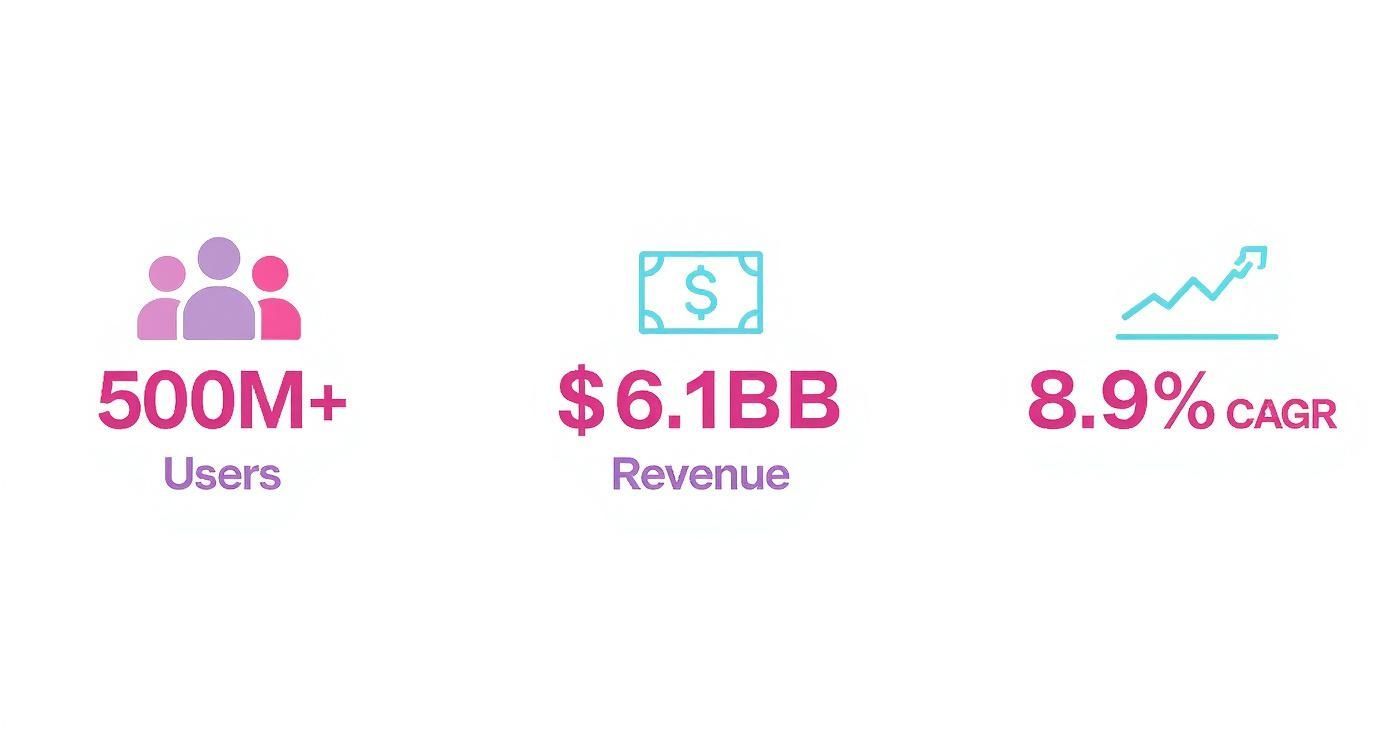
It's pretty clear: people are actively looking for connections, and they're willing to invest in apps that help them find what they're looking for.
Tapping into Unmet Needs
Success in this game comes down to one thing: specificity. People are tired of endlessly swiping through profiles that don't match their energy. They're searching for platforms that get their lifestyle, whether they're sober, into board games, passionate about fitness, or share specific cultural values. This is where your unique idea can shine.
Your job is to build for a specific "vibe."
This is exactly why a vibe coding studio like Dreamspace is such a game-changer. As an AI app generator, it completely removes the technical headaches, letting you focus on what really matters—the community, the features, and the experience. You no longer need a huge budget or a team of developers to bring a niche dating app to life.
The real test for any new dating app is hitting product-market fit. It's that magic moment when you know your solution genuinely clicks with a specific group of people. Understanding what is product-market fit is the first and most important step toward building an app that people don't just download, but truly love using.
Find an underserved audience, build an experience just for them, and you can create something truly special in this market. The demand is already there. It's just waiting for your vision.
Finding Your Niche in a Crowded Market
Let's be honest, the world doesn't need another generic dating app. Trying to be everything to everyone is a fast track to becoming nothing to anyone. The real magic, and the real business opportunity, happens when you stop shouting into the void and start whispering to a specific, underserved community.
Think smaller. Think focused. Think indispensable.
Instead of building another clone for swiping, what if you created a space for people who live and breathe board games? Or an app exclusively for sober individuals to connect safely? What about a platform that unites people based on a shared passion for sustainable living?
This is where you win. This is the power of niching down.
Why Niche Is the New Mainstream
The dating app world is a battlefield. You've got the giants like Tinder and Hinge, but even they're feeling the heat from smaller, more agile startups. The most telling stat I've seen? Research shows a whopping 70% of users are willing to try new platforms that offer a more tailored experience.
This isn't just a small crack in the door; it's a massive opportunity. People are actively searching for alternatives that get them—their lifestyle, their values, their quirks. You can dive deeper into these dating app market trends on NectarBits if you're curious.
Defining Your Unique Value Proposition
Your unique value proposition (UVP) is your promise. It’s the one-sentence answer to "Why should I use your app?" To nail this down, you have to get specific. Start brainstorming communities that are currently being ignored.
- Hobby-Based: Gamers, bookworms, hikers, aspiring musicians.
- Lifestyle-Based: Vegans, digital nomads, minimalists, fitness junkies.
- Values-Based: Environmentalists, people dedicated to personal growth, members of a specific faith.
- Identity-Based: Specific cultural groups, LGBTQ+ communities, or even professional circles like doctors or artists.
Once you land on a niche, your UVP practically writes itself. For a fitness dating app, it could be as simple as: "Find a partner who sweats as hard as you do." That single idea will guide every feature you build and every marketing dollar you spend.
This focused strategy works wonders beyond just dating, by the way. If you're intrigued by the idea of building tight-knit communities, you should check out our guide on how to develop a social media app for a specific audience.
Brainstorming Core Niche Features
With a clear niche, you can start dreaming up features that the big, generic apps would never think of. This is where a tool like Dreamspace really shines. As an AI app generator, it empowers you to bake your community's unique DNA right into the app, all without touching a line of code.
Forget one-size-fits-all. A vibe coding studio like Dreamspace lets you craft an experience that feels like home for your users. You're not just building software; you're building a world.
Let's get practical. Imagine you're building for one of these niches:
- For a Book Lovers' App: Ditch the generic prompts. Let users connect by sharing their favorite authors or quotes. Your matching algorithm could even suggest people based on shared literary tastes.
- For a Fitness App: How about integrating features like sharing workout stats or finding a local gym partner? Profiles could highlight fitness goals and favorite activities, not just selfies.
- For a Gamers' App: Let users display their go-to games and platforms. You could even build in a "looking for group" feature so they can connect for a co-op session before they even match.
This kind of customization makes your app feel like it was made just for them—because it was. By zeroing in on a specific audience and tailoring the entire experience, you create an app that isn't just another option; it's the only option that truly understands them.
Designing an Irresistible User Experience
You can have the most brilliant niche and the slickest features, but none of it matters if your app is a clunky, confusing mess. When you’re building a dating app, the user experience (UX) and user interface (UI) are everything. They're the core of what keeps people engaged and, more importantly, coming back.
Think about it from a user's perspective. The entire experience is built on sight and touch. People are swiping, tapping, and messaging based on how the app looks and feels. A design that just works makes the journey from seeing a profile to starting a conversation feel effortless and genuinely fun.
Mapping the User Journey
Before you get lost in picking colors and fonts, take a step back and map out the entire user journey. What’s the very first thing someone does when they open your app? What are the key actions you need them to take?
The onboarding process is your first impression, so make it count. Getting started has to be quick and intuitive, capturing only the most essential info upfront. A long, drawn-out signup form is one of the fastest ways to get someone to delete your app.
- Simple Signup: Let people sign up with email, their phone number, or social accounts. Give them options.
- Guided Profile Creation: Use prompts and helpful hints to guide users through building a great profile. Don’t just throw a blank form at them.
- Clear Navigation: Make sure finding profiles, matches, and messages is dead simple. A clean navigation bar is non-negotiable.
Of course, the whole point is for people to talk to each other. You can streamline the process of implementing 1-on-1 chat features to ensure this core interaction is smooth and reliable from day one.
Your design is more about psychology than aesthetics. Every color choice, button placement, and notification is a decision that can either encourage a connection or create a roadblock. The real goal is to make the technology fade into the background, leaving only the possibility of a great conversation.
Wireframing Your Vision
Think of wireframing as drawing up the blueprints for your app. It’s a basic, low-fidelity sketch that lays out the structure of each screen without getting bogged down in the final design details. This step is absolutely critical for organizing information and planning how people will actually use your app.
You don't need fancy software to get started—a simple pen and paper will do. The point is to figure out where the buttons, text, and images go to create a logical flow.
This is where a vibe coding studio like Dreamspace gives you a massive head start. As an AI app generator, it comes loaded with professionally designed, mobile-first templates and components.
This means you can skip the most tedious parts of wireframing from scratch. You start with a solid foundation that’s already built for a great user experience, then you get to customize it to fit your app’s unique personality. It lets you focus on the vibe, not the pixels.
Bringing Your App to Life with No-Code AI
Alright, this is where the rubber meets the road. All that planning—your niche, designs, and user flows—is about to jump from the whiteboard into a real, functioning app. Forget the old-school route of spending months buried in code. We're going to build this thing fast using a modern AI app generator.
We've covered the 'what' and 'why.' Now, it's time for the 'how.' Instead of wrestling with syntax and debugging, you'll be visually piecing your app together, almost like building with digital LEGOs.
This is the whole point of a vibe coding studio like Dreamspace. It takes care of the complex backend plumbing, so you can pour all your energy into what actually matters: creating an amazing experience for your users. Think of yourself as the architect; the AI is your master builder.
Setting Up Core Functionality
First things first: people need a way to sign up and create a profile. This is a fundamental, non-negotiable step that's often a real pain to code from scratch. With a no-code tool, it’s just a simple workflow.
You literally draw a line from your sign-up screen to a user database. So when someone types in their email and hits 'submit,' a "create user" action fires off behind the scenes. Their info gets stored securely, and a new profile is born. It's that straightforward.
The magic of no-code AI isn't just about building quickly; it's about being able to change things on the fly. Realized you forgot to ask for a user's top three hobbies during onboarding? You can add that field in minutes, not days. That kind of speed is a game-changer when you're trying to perfect your app based on early feedback.
Once you have accounts set up, you can get to the fun part.
Configuring Your Matching Logic
This is where your unique niche starts to shine. Any old app can match people based on age and location—that's table stakes. You can get way more creative.
Let's stick with our app for book lovers. Your matching rules could be something like this:
- Rule 1 (The Basics): Only show people within a 50-mile radius.
- Rule 2 (The Hook): Give a major boost to users who share at least one "favorite author."
- Rule 3 (The Deep Cut): Gently prioritize profiles with a similar "reading pace," like matching two "avid" readers.
You don't need to write a single line of a complex algorithm. You just set these up with simple drop-down menus and if/then logic. If you want to see just how far you can push these ideas, check out our roundup of the best AI app builders to get inspired.
Finally, you need to let people talk. Adding a real-time chat feature is as easy as dragging a chat element onto your messaging screen and telling it which user profiles to connect. The platform handles the rest—sending messages, push notifications, and keeping the conversation history straight. This whole process lets you build, test, and get your app out into the world faster than you ever thought possible.
Choosing Your App Monetization Model
A brilliant idea and a killer design are great starting points, but let's be real: if you want your dating app to survive and thrive, you need a smart way to make money. Figuring out how your app will generate revenue isn't just a final step—it's a foundational decision that directly impacts the user experience and your app's future.
The goal is to strike that perfect balance between earning revenue and providing genuine value to your users.
By far, the most common path is the freemium model. You offer the core experience—swiping, matching, messaging—for free to attract as many people as possible. Revenue then comes from users who willingly pay for premium features that give them an edge.
This approach works so well because it smashes the biggest barrier to entry. Dating apps live or die by the network effect; without a critical mass of users, even the best app feels like an empty party. Freemium gets people in the door.
Popular Revenue Streams
Once you've built an active community, you can start weaving in monetization. The most successful apps don't just stick to one method; they blend several to create a solid financial base.
The undisputed champion is the subscription model, which pulled in a staggering 62% of total market revenue back in 2022. Just look at giants like Tinder, which now boasts around 9.6 million paying subscribers as of 2024. That's a powerful testament to the model's effectiveness. You can dive into more fascinating dating app statistics for 2025 on South Denver Therapy.
Here are the most proven methods you'll see in the wild:
- Recurring Subscriptions: This is the bread and butter. Users pay a monthly or annual fee for a package of perks, like unlimited swipes, seeing who liked them first, or using advanced search filters to find their perfect match.
- In-App Purchases (A la Carte): These are one-off buys for specific advantages. Think of a "Profile Boost" that puts you at the top of the stack for 30 minutes, or buying a pack of "Super Likes" to make sure someone special notices you.
- Ad-Based Revenue: You can show ads to your free users. It's a viable option, but you have to walk a fine line. Bombard people with intrusive ads, and you risk cheapening the experience and pushing them away for good.
Comparing Monetization Models
To help you decide, here’s a quick breakdown of how these models stack up against each other.
Dating App Monetization Models Comparison
A comparative look at the most common revenue models to help you choose the best fit for your app.
Ultimately, many apps find success by blending these models—offering a freemium base with options for both subscriptions and a la carte purchases.
Integrating Monetization Seamlessly
The technical side of hooking up payments might sound like a headache, but modern tools have made it surprisingly simple. When you're building with a vibe coding studio like Dreamspace, integrating these revenue models becomes a walk in the park.
The best monetization strategies feel like a natural extension of the app, not a roadblock. The goal is to offer genuine value that users are happy to pay for, enhancing their search for connection rather than frustrating it.
An AI app generator like Dreamspace comes with pre-built connections to payment gateways. That means you can add subscription tiers or in-app purchases with just a few clicks. You get to define what's free and what's premium without ever touching a line of complex payment processing code, letting you focus on what really matters: building a community.
Frequently Asked Questions About Building a Dating App
Jumping into app creation for the first time? You've probably got a million questions. From how much it'll cost to where you'll find your first users, let's clear up some of the most common things founders ask when they decide to build a dating app.
How Much Does It Cost to Build a Dating App with No-Code
Let’s be honest, the cost is usually the first big hurdle. Traditional app development can burn through tens, if not hundreds, of thousands of dollars before you even have a single user. It's a massive barrier.
This is where the entire game changes.
Using a no-code tool like the Dreamspace AI app generator flips the script. Instead of a huge upfront investment, you're looking at a manageable monthly subscription. We're talking anywhere from less than a hundred to a few hundred dollars, depending on how complex you want to get. It’s a model that actually lets solo founders and small teams get their ideas off the ground without chasing venture capital.
If you're new to the concept, getting a handle on what no-code development is will give you a much clearer picture of what’s possible.
What Are the Must-Have Features for a New App
It’s tempting to want to build an app with every feature under the sun, but that's a classic rookie mistake. Your goal at the start is a lean, mean Minimum Viable Product (MVP) that absolutely nails the core experience. Nothing more.
Focus your energy on getting these three things right from day one:
- Secure Onboarding: A super simple, safe way for people to sign up and create a profile that actually shows off who they are.
- Effective Matching: A basic but solid system that connects users based on the unique criteria of your niche.
- Reliable Chat: A clean, real-time messaging feature so matches can actually talk to each other without glitches.
Safety features aren't a "nice-to-have" you add later. They are non-negotiable from the get-go. Building in robust tools for user reporting and blocking is the only way to create a community people will trust and want to be a part of.
How Do I Get My First 1000 Users
Forget about expensive, broad-stroke ad campaigns. Getting your first wave of users is all about surgical, grassroots marketing. You have to go where your people are.
Pinpoint the online communities where your ideal audience hangs out and engage with them there—authentically. Building an app for Gen Z foodies? TikTok collabs and partnerships with food bloggers are your ticket. Creating a space for serious board gamers? Hit up the relevant Subreddits and niche forums. The key is to be a member of the community, not just a marketer.
A great tactic is to team up with micro-influencers who genuinely fit the vibe of your app. You can also create a powerful sense of ownership by offering your first users a special perk, like a lifetime premium membership or an exclusive "founding member" badge. These early adopters will become your most passionate advocates and the foundation for all your future growth.
Ready to stop dreaming and start building? With Dreamspace, a vibe coding studio and powerful AI app generator, you can generate a production-ready onchain app with AI, no code required. Bring your unique dating app idea to life today at https://dreamspace.xyz.