
A Developer's Guide to Blockchain Scalability Solutions
When we talk about blockchain scalability solutions, we're really talking about ways to help a network handle more transactions, faster, without giving up the core principles of decentralization and security. These strategies, which fall into two main camps—Layer 1 upgrades and Layer 2 protocols—are the keys to unlocking blockchain’s potential for mainstream use by tackling the congestion that causes slow speeds and high fees.
The High-Traffic Problem in Blockchain
Picture a single-lane road trying to manage the entire city’s rush hour traffic. You’d get gridlock. The journey would take forever, and the cost in wasted fuel would be infuriating. That’s a perfect picture of the blockchain scalability problem.
When a popular network like Ethereum gets busy, that single lane gets clogged with transactions. The result? Frustratingly long waits and sky-high “gas” fees.
This bottleneck is more than just a minor inconvenience; it's the main roadblock preventing blockchain from supporting applications that can operate at a global scale. The issue stems from a persistent challenge known as the "blockchain trilemma."
Understanding the Blockchain Trilemma
The trilemma is a simple but powerful idea: a blockchain network struggles to deliver on three essential properties at the same time.
- Decentralization: The network is operated by a wide, distributed group of people, not a single company, which keeps it censorship-resistant.
- Security: The network is rock-solid against attacks and fraud, ensuring every transaction is legitimate.
- Scalability: The network can process a massive number of transactions quickly and without breaking the bank.
Usually, when you try to improve one, you have to sacrifice another. A highly centralized system can be blazing fast, for instance, but it's no longer decentralized. The whole game is about finding clever ways to enhance scalability without compromising the other two pillars.
At its core, the scalability problem is about finding ways to widen the highway without compromising the security and decentralized nature that make blockchain special.
Two Paths to a Solution
To solve this traffic jam, the crypto world has generally gone down two main paths. The first is to upgrade the highway itself—these are called on-chain or Layer 1 solutions. The other path is to build express lanes and overpasses that run alongside the main highway, which we call off-chain or Layer 2 solutions.
We can summarize these strategies with a quick look at their core concepts.
Core Approaches to Blockchain Scalability
These innovations are absolutely essential for building the next generation of on-chain applications. Of course, building on this kind of advanced infrastructure is a lot easier with tools like Dreamspace, which acts as an AI app generator to simplify the whole process.
Beyond just solving today’s congestion, it's also worth thinking about how blockchain economics will shift over time. For a deeper dive on that, you can explore the long-term implications for Bitcoin's transaction fees and see how the fee market is expected to change.
Strengthening the Foundation with Layer 1 Upgrades
Instead of just building more roads on top of a congested highway, what if you could rebuild the highway itself to be wider, faster, and more efficient? That's the whole idea behind Layer 1 (L1) scalability solutions.
These aren't patches or workarounds. They are fundamental upgrades made directly to a blockchain's core protocol to boost its native transaction capacity.
Think of a busy supermarket. Instead of simply adding more cashiers to the same old checkout lanes, they decide to rip everything out and install a brand-new system of high-speed, self-service kiosks. This approach overhauls the core infrastructure, making the entire store run smoother for everyone, right from the ground up.

This method tackles the scalability problem at its source. By making the base layer itself more robust, these blockchains can process more transactions per second (TPS) and lower fees without needing to offload work to other layers. Two of the most common L1 upgrades are swapping out the consensus mechanism and introducing sharding.
Upgrading the Engine with New Consensus Mechanisms
The engine of any blockchain is its consensus mechanism—the rulebook everyone on the network uses to agree on what's true. For a long time, Proof-of-Work (PoW), the model Bitcoin uses, was the standard. While it's incredibly secure, PoW is also notoriously slow and energy-hungry by its very nature.
The biggest upgrade here has been the shift to Proof-of-Stake (PoS). Instead of miners burning electricity to solve complex math problems, PoS lets validators put up a certain amount of crypto as collateral (a "stake") for the chance to create the next block.
A move from Proof-of-Work to Proof-of-Stake is like swapping a steam engine for an electric motor. It’s not just more efficient—it’s a completely different design that enables faster, nimbler operations.
This one change brings a few huge wins for scalability:
- Faster Block Times: Without all that heavy computation, blocks can be created and confirmed much more quickly.
- More Network Participants: You don't need a warehouse full of specialized mining rigs to be a validator. This lower barrier to entry helps decentralize the network and make it more secure.
- A Foundation for More Upgrades: PoS creates a more flexible base layer that makes it easier to implement other scaling tech, like sharding.
Sharding: Opening More Lanes for Transactions
The other game-changing L1 upgrade is sharding. This is essentially a database partitioning technique applied to a blockchain. Picture a single, gridlocked highway being split into 64 parallel super-highways, each handling its own flow of traffic.
That's sharding in a nutshell. It breaks up the entire blockchain—all the accounts, smart contracts, and data—into smaller, more manageable pieces called shards. Each shard operates almost like its own little blockchain, processing a slice of the network's total transactions at the same time. This parallel processing massively increases the network's total throughput.
These major L1 upgrades have seriously boosted the capacity of major ecosystems. When Ethereum switched to Proof-of-Stake in September 2022, it set the stage for its own sharding roadmap. The ultimate goal is to split transaction processing across many parallel shards, with some estimates suggesting a potential throughput increase of 10x–100x over the original network. For a deeper dive, Hedera's learning center has some great explainers on how these base-layer improvements work.
Of course, these powerful upgrades are not simple to implement. Making sure all the different shards can communicate with each other securely is a massive engineering challenge. For developers, getting a handle on these foundational concepts is non-negotiable. If you're looking to solidify your understanding, our guide on what blockchain development entails is a great place to start.
Ultimately, these L1 solutions are building a stronger foundation for the future of dApps. Tools like Dreamspace, a vibe coding studio, help abstract away this complexity, letting you focus on creating and building on top of this powerful new infrastructure with ease.
How Layer 2 Rollups Create a Fast Lane
If Layer 1 upgrades are about rebuilding the blockchain’s core foundation, Layer 2 (L2) solutions take a much different tack. Forget tearing up the highway; L2s build a high-speed express lane right alongside it. This express lane, known as a rollup, is easily one of the most powerful blockchain scaling tools we have today.
The whole concept is brilliantly simple. A rollup takes thousands of transactions off the main chain—where things are faster and way cheaper—and bundles them all into a single, compressed package. This tidy little summary is the only thing that gets posted back to the main Layer 1 network.

Think of it like a logistics company. Instead of sending out thousands of individual delivery vans, they load everything onto a single semi-truck for one big trip. This approach massively shrinks the data footprint on the main chain. For users, that means lower fees and quicker confirmations, all while still borrowing the iron-clad security of the underlying L1.
In the world of rollups, two major designs have come to the forefront, each with its own unique method for proving their bundled transactions are legit: Optimistic Rollups and Zero-Knowledge (ZK) Rollups.
Optimistic Rollups: The Trust-But-Verify Model
Optimistic Rollups run on a simple mantra: "innocent until proven guilty." They optimistically assume every transaction in a batch is valid and post the summary to the main chain right away, without any upfront proof.
This makes the whole process incredibly fast and efficient. But there's a catch. To keep everyone honest, there's a "challenge period" or "fraud-proof window"—usually around a week.
During this time, anyone can inspect the batch and challenge its validity by submitting what’s called a fraud proof. If they’re right and the challenge succeeds, the dodgy transaction is reversed, and the bad actor who submitted it gets penalized.
Optimistic Rollups are like an honor system with a security camera. Transactions fly through on trust, but anyone can review the footage later and call out foul play, keeping the whole system secure.
This model comes with some clear advantages:
- High Throughput: By assuming validity and bundling transactions, they can handle a massive amount of activity.
- EVM Compatibility: Most optimistic rollups are a near-perfect match for the Ethereum Virtual Machine, which makes it super easy for developers to bring over their existing dApps.
The biggest trade-off is the wait time. That challenge period means users have to wait for it to expire before they can move their funds back to the main Layer 1 chain. Heavyweights in this space include Arbitrum and Optimism.
ZK-Rollups: The Mathematical Proof Model
Zero-Knowledge Rollups (ZK-Rollups), on the other hand, operate on a "trustless" model. Instead of just assuming transactions are valid, they use some seriously advanced cryptography to generate a mathematical proof that they are valid.
This proof, called a validity proof (you'll hear terms like ZK-SNARK or ZK-STARK), confirms that every single transaction in the batch played by the rules. And the magic part? It does this without revealing any of the actual transaction data, which is where the "zero-knowledge" name comes from.
Once this clever proof is generated, it gets sent to the Layer 1 chain. The mainnet smart contract just has to check this tiny, elegant proof to instantly confirm the validity of the entire batch of thousands of transactions.
This brings some killer benefits:
- Instant Finality: Since validity is proven mathematically from the start, there's no need for a long challenge period. This means pulling your funds out of a ZK-Rollup and back to Layer 1 is almost immediate.
- Enhanced Privacy: By design, ZK-proofs can hide transaction details, offering a much higher degree of privacy.
- Data Compression: They are incredible at squashing down transaction data, which results in dirt-cheap fees.
The main downside has always been the sheer complexity and computational power needed to generate the proofs, although the tech here is getting better at a breakneck pace.
The impact both types of rollups have had on network performance is undeniable. Between 2021 and 2025, rollups went from being niche experiments to core infrastructure. Platforms like Arbitrum and Optimism now process hundreds of millions of transactions. During peak network congestion, average gas fees on these Layer 2s were often 5 to 100 times lower than on the Ethereum mainnet. To see more data on this, you can explore how rollups are transforming blockchain costs on CoinMetro's learning lab.
At the end of the day, both optimistic and ZK-Rollups are indispensable tools making on-chain apps faster, cheaper, and finally ready for the mainstream.
Taking a Different Path: Modular Blockchains and Sidechains
Beyond upgrading the mainnet (Layer 1) or adding express lanes on top of it (Layer 2), there’s another approach to scalability that’s really picking up steam. Instead of trying to make one blockchain do everything, this philosophy splits the work up across specialized, interconnected systems.
Think of a classic, monolithic blockchain like an old all-in-one desktop computer. The processor, graphics card, and memory are all stuck together on a single board. It handles every single task itself—processing transactions, securing the network, storing data. It’s simple, but when one part gets overloaded, the whole system grinds to a halt.
Now, picture a modular blockchain. It’s more like a custom-built gaming PC. You get to pick the best components for each job: a beast of a GPU for graphics, a lightning-fast CPU for processing, and specialized drives for data. This design breaks a blockchain’s core functions into separate, swappable layers.
The Modular Break-Up
This division of labor is what makes the system so flexible and scalable. A blockchain’s three core jobs get their own dedicated layers:
- Execution Layer: This is the "CPU" of the blockchain. It's where all the action happens—running smart contracts and processing transactions.
- Settlement Layer: This layer is the final judge. It verifies proofs and settles any disputes to make sure the transaction history is set in stone.
- Data Availability Layer: Think of this as the "hard drive." Its only job is to make sure all transaction data is published and available for anyone to check.
By letting each layer focus on one thing, it can be optimized to do that one thing really well. This unlocks a massive boost in overall performance. A dApp could use a super-fast execution layer for its logic and an ultra-secure layer for data storage, mixing and matching to get the perfect setup.
This shift toward modularity has completely changed how developers think about scaling. By 2025, ecosystems like Cosmos and Polkadot were already home to tens of thousands of smart contracts, handling a huge slice of new dApp deployments. This multi-chain approach has been shown to cut congestion-related failed transactions by over 50% during peak times compared to single-chain alternatives. You can dive deeper into how modular design is solving the throughput problem on LCX.com.
So, What About Sidechains?
While modular chains break a single blockchain into specialized layers, sidechains are a bit different. Imagine a major highway (the Layer 1 mainnet) with smaller, local roads branching off of it. Those local roads are the sidechains.
A sidechain is its own independent blockchain that runs parallel to a main chain. The two are linked by a "bridge," which lets you move assets like tokens back and forth.
Sidechains are like self-contained environments built for specific jobs, taking traffic off the main road. A gaming dApp, for instance, could run all its tiny, constant transactions on a sidechain so it doesn’t bog down the mainnet for everyone else.
Once you’re on the sidechain, everything is fast and cheap. It can have its own rules, its own consensus mechanism, and its own set of validators. That level of customization is a huge win for developers who need a specific environment for their app.
The Big Sidechain Trade-Off
But that independence comes with a major catch: security.
Layer 2 rollups borrow their security directly from the mainnet they’re built on. Sidechains don't. They’re on their own, responsible for securing themselves.
If a sidechain’s validator set is small or not very decentralized, it becomes a much easier target for attackers. A 51% attack on a sidechain wouldn't hurt the mainnet, but it could let an attacker steal every single asset locked on that sidechain.
This is something every developer has to weigh carefully. If your project is handling billions in value, the ironclad security of a rollup is probably non-negotiable. But for something like a blockchain game where speed and low costs are everything, a sidechain’s independent security model might be a perfectly acceptable trade-off.
No matter which path you choose, building the specialized contracts and queries for these environments is far easier with tools like Dreamspace, a vibe coding studio designed to dramatically speed up on-chain development.
Choosing the Right Scaling Solution for Your App
Picking a blockchain scaling solution can feel like choosing a vehicle for a road trip. Do you need a powerful truck, an efficient EV, or an all-terrain Jeep? Each one is built for a different purpose, and your choice determines the success of the journey.
It's the same for your dApp. The best scaling solution isn't about technical jargon; it's about what your application actually needs. The decision really boils down to a few critical factors: how much security you need, how fast transactions must be, what users are willing to pay, and how easily it fits into your existing workflow (like EVM compatibility).
Framing Your Decision: Key Questions to Ask
Before you dive into the tech, you need to get crystal clear on your project's demands. Every app is different, and understanding your own priorities is the only way to make the right call.
Start by asking yourself these questions:
- How critical is security? Are you building a DeFi protocol handling millions in assets? If so, inheriting L1 security is non-negotiable. Or is it a high-volume game where you can trade a bit of security for lightning-fast speed?
- What kind of transaction speed do you need? For a real-time game, users expect instant finality. For an NFT mint, a slight delay might be perfectly fine.
- Are your users sensitive to cost? High gas fees can kill an app. If your project relies on microtransactions—think social media or gaming—then dirt-cheap fees are a must.
- Is EVM compatibility a dealbreaker? If you have existing Solidity contracts or your team lives and breathes the Ethereum environment, sticking with an EVM-compatible chain can save you a mountain of time and effort.
Answering these gives you a solid framework. It's your compass for navigating the options and finding the one that truly fits your project.
This simple decision tree shows how just one factor—the need for independent security—can send you down completely different paths.
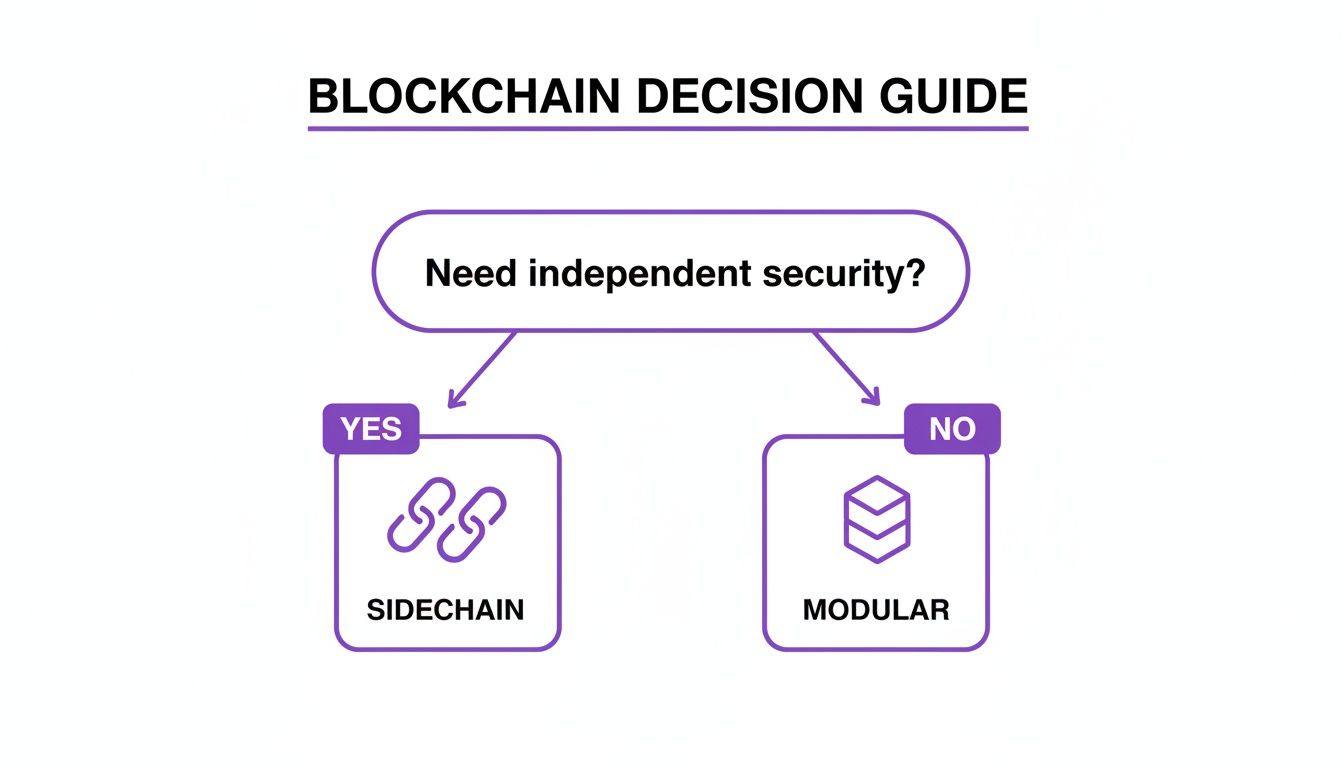
As you can see, the path forks early. You're either borrowing security from a modular Layer 2 or running with the sovereign security of a sidechain.
A Practical Comparison of Top Solutions
With your priorities mapped out, you can start weighing the pros and cons of the top contenders. A decentralized exchange has vastly different needs than an on-chain game, so let's break down the practical trade-offs.
Comparing Top Blockchain Scalability Solutions
This side-by-side analysis can help you quickly pinpoint the optimal solution for your specific application.
This table makes the trade-offs pretty clear. ZK-Rollups give you an amazing mix of security and speed, but the tech can be more complex. Sidechains offer insane speeds for practically nothing, but you have to be comfortable with their independent security model.
The core challenge isn't finding the "best" solution, but the "best-fit" solution. Your app's unique requirements are the ultimate guide to navigating these technical trade-offs.
Modern Tools That Simplify the Choice
The good news? You don't have to navigate this maze alone anymore. Modern development platforms are built to handle the heavy lifting, letting you focus on what really matters: building a great app.
Take Dreamspace, for example. It's a vibe coding studio that changes the game. Its AI app generator can write optimized smart contracts and deploy them to the most suitable scaling solution with minimal input from you. You can see how this works in our guide on blockchain application development.
This new approach means you can spend your time perfecting your app's features and UI instead of getting bogged down in infrastructure. By using AI-powered tools, you can launch on the right foundation from day one—no deep expertise in every scaling protocol required.
The Future Is Scalable—and Built with AI
The blockchain scalability problem isn't some far-off academic puzzle. It's being actively solved right now with a whole ecosystem of creative solutions. We're seeing everything from fundamental Layer 1 upgrades to modular designs and a whole spectrum of Layer 2 rollups.
The future isn't about one chain to rule them all. It's a multi-layer, multi-chain world where every app can find the perfect home for its specific needs.
This means the tools for building real, high-performance dApps are finally within reach. The old technical hurdles are coming down, replaced by platforms that care about developer experience and speed. If you're looking to bring AI into your on-chain strategies, a step-by-step guide to AI crypto trading is a great place to see what's possible.
The big takeaway here is empowerment. You no longer have to be a scalability guru to build something that can handle real-world traffic. The infrastructure is ready.
This whole shift gets a massive boost from AI. Platforms like Dreamspace, a vibe coding studio, use an AI app generator to cut through the usual development grind. You can generate smart contracts and push your vision live directly onto a scalable network. To see how the magic happens, check out the basics of AI code generation.
Ready to build what's next? Start creating with Dreamspace today and bring your decentralized ideas to life, minus the complexity.
Got Questions About Blockchain Scalability? We’ve Got Answers.
Diving into the world of scalable blockchains can feel like learning a new language. Let's break down some of the most common questions builders and developers run into when they start thinking about how to make their on-chain apps actually work for a lot of people.
What’s This “Blockchain Trilemma” I Keep Hearing About?
The blockchain trilemma is the big puzzle everyone's trying to solve. Imagine you have three dials: decentralization, security, and scalability. The challenge is that you can’t turn all three up to the max at the same time.
Cranking up scalability and security might mean you have to sacrifice decentralization by using fewer, more powerful nodes. It’s this constant balancing act that shapes every single scaling solution out there. Understanding this helps you see why there are so many different approaches—each one is just a different bet on how to best balance those three competing needs.
Are Layer 2s Really as Secure as the Main Chain?
This is a great question, and the short answer is: it depends on which kind you’re talking about.
Layer 2 rollups—both Optimistic and ZK-Rollups—are built to borrow their security directly from a Layer 1 like Ethereum. They do this by rolling up a bunch of transactions and posting a compressed summary or a cryptographic proof back to the main chain. In a way, they're tethered to the L1's security.
Sidechains are a different story. They don't inherit L1 security. They are completely separate chains with their own set of rules and validators. When you use a sidechain, you're placing your trust in its unique security model, which is a totally different risk profile. For anything involving serious value, the inherited security of a rollup is usually the way to go.
Okay, I’m Sold. How Do I Start Building a Scalable dApp Today?
The good news is you don’t have to become a PhD in cryptography to get started. The smartest move is to use tools that handle the heavy lifting for you, so you can focus on what your app actually does.
The absolute fastest way to get your idea off the ground is with an AI-powered development platform. Something like Dreamspace, our vibe coding studio, lets you skip right past the massive learning curve. Its AI app generator can write and deploy optimized smart contracts for you on the best scalable network for your project's needs. You can go from a simple idea to a live, production-ready dApp that's built to grow from the very beginning.
Ready to stop wrestling with infrastructure and just build? With Dreamspace, you can generate a production-ready on-chain app with AI, no deep coding expertise required. Generate smart contracts, query blockchain data, and launch your dApp today at https://dreamspace.xyz.