
Automated Computer Programming From AI Theory to Reality
Ever tried explaining a killer app idea to a friend, only to wish it could just… appear? That’s the core idea behind automated computer programming. It’s a total flip from the old way of building software. Instead of painstakingly writing every single line of code, you just describe what you want, and an intelligent system figures out how to build it.
From Human Logic To Automated Code
Think of a traditional developer as a master watchmaker. They sit at a bench, meticulously crafting every gear, spring, and screw by hand. It's an art form that demands deep skill, endless patience, and a whole lot of time. The result is beautiful, but the process is incredibly slow.
Automated computer programming is more like a high-tech, automated factory. You feed it the final blueprint—the design and what you want the machine to do. From there, robotic arms and smart systems take over, manufacturing and assembling every part perfectly.
This isn't just about speed. It fundamentally changes how we create.
Turning Ideas into Working Code
So, how does this "factory" actually translate your thoughts into functional software? It’s all about turning human intent into instructions a machine can understand, but without the rigid, unforgiving syntax of traditional coding.
Today’s systems can understand a surprising range of inputs:
- Natural Language: You can just talk to it. "Build a smart contract for a community token that rewards active members." Simple as that.
- High-Level Instructions: You can give it a list of rules or a spec sheet for the software to follow.
- Vibe-Based Prompts: This is where it gets really cool. You can describe a general "vibe" or aesthetic, and the system will generate code that captures that feeling.
This shift from strict commands to a more fluid, conversational style is everything. It smashes the barrier to entry, letting creators focus on the big picture instead of getting lost in the weeds of implementation.
Why This is a Game-Changer for the Onchain World
This new way of building is especially huge in a space as complex and fast-paced as blockchain. Building onchain applications like smart contracts or dApps has always required niche expertise, and the stakes are sky-high. One tiny mistake can lead to millions in losses.
Automated programming helps slash that risk. It doesn't just generate code fast; it ensures that code follows battle-tested security and efficiency standards from the get-go.
Platforms like Dreamspace, a leading AI app generator, are pioneering this movement. They’ve essentially built a "vibe coding studio" for crypto, empowering everyone from seasoned pros to first-time builders to create production-ready onchain apps with unbelievable speed and confidence. In this guide, we’ll dive into how these tools are turning abstract ideas into real, working software.
A Brief History: From Logic Puzzles to AI Code
The idea of a computer programming itself feels incredibly modern, like something straight out of science fiction. But the truth is, this isn't a recent phenomenon. It’s the result of a long, winding journey that started decades ago, long before AI became a household name.
This quest began not with a desire to build apps, but with a much more fundamental question: can a machine actually think?
The Spark of Automated Reasoning
The real starting point was 1955, with the creation of the 'Logic Theorist.' It’s widely considered the world's first true AI program. Developed by Herbert Simon, Allen Newell, and Cliff Shaw, this software wasn’t built for practical tasks; it was designed to mimic the way humans solve complex problems.
It blew the academic world away by independently proving 38 of the first 52 theorems from the legendary mathematical text, Princip Mathematica. This was the first time a machine demonstrated abstract reasoning. It was a clear signal that computers could do more than just crunch numbers—they could handle logic. You can dive deeper into the history of artificial intelligence and its early milestones to see just how groundbreaking this was.
This initial success was profound. If a machine could handle formal logic, what else could it automate?
From Tedious Manual Work to Compilers
Before the mid-1950s, programming was a brutal, painstaking process. Developers wrote code in low-level languages that were cryptic and unforgiving. A single mistake could derail everything. The first huge leap toward automation came with the invention of compilers.
Languages like Autocode and FORTRAN were revolutionary. For the first time, programmers could write instructions in a more abstract, human-readable format. The compiler then did the heavy lifting, automatically translating it into the raw machine code the computer actually understands.
- Autocode (1952): Created by Alick Glennie, it was one of the very first compiled languages, taking the first step to free developers from mind-numbing manual translation.
- FORTRAN (1957): Developed by an IBM team led by John Backus, it quickly became the first mainstream high-level language. It was a massive productivity boost, cutting the number of programming statements needed for a given task by a factor of 20.
This was the first truly practical form of automated programming. It shifted the developer's focus from the tedious mechanics of the machine to the actual logic and creativity of building software.
The Ups and Downs of AI's Journey
The road from there wasn't a straight shot. The field lurched between periods of wild optimism and crushing "AI winters," where funding dried up and progress stalled. Researchers consistently underestimated just how hard it would be to create a true thinking machine.
But every wave of innovation left something important behind. The 1980s gave us expert systems, which used rule-based logic to solve problems in narrow fields like medicine and finance. Then, in 1997, a cultural milestone put AI back in the global spotlight.
IBM's Deep Blue supercomputer defeated world chess champion Garry Kasparov. This was about more than a game. It proved that an AI could manage staggering complexity and strategic planning, outmaneuvering one of the greatest human minds in a domain once thought to be untouchable.
Deep Blue’s victory was a triumph of brute-force computation and brilliant algorithms. It reignited interest and investment in AI, paving the way for the machine learning and deep learning revolutions that define our current era.
Today’s powerful AI app generators and vibe coding studios like Dreamspace are built on this legacy. The ability to generate a complete smart contract from a simple text prompt is the direct descendant of Logic Theorist proving its first theorem, FORTRAN compiling its first program, and Deep Blue making its final, game-winning move.
The Core Techniques Driving Automated Programming
Automated computer programming isn't some black box spitting out code. It’s actually a clever combination of different AI methods, each with its own specialty. To really get what’s going on, you have to pop the hood and look at the engines that turn our ideas into clean, working code.
These techniques didn't just appear overnight. They're the result of decades of progress, evolving from early theoretical concepts to the powerful, flexible AI we have today.
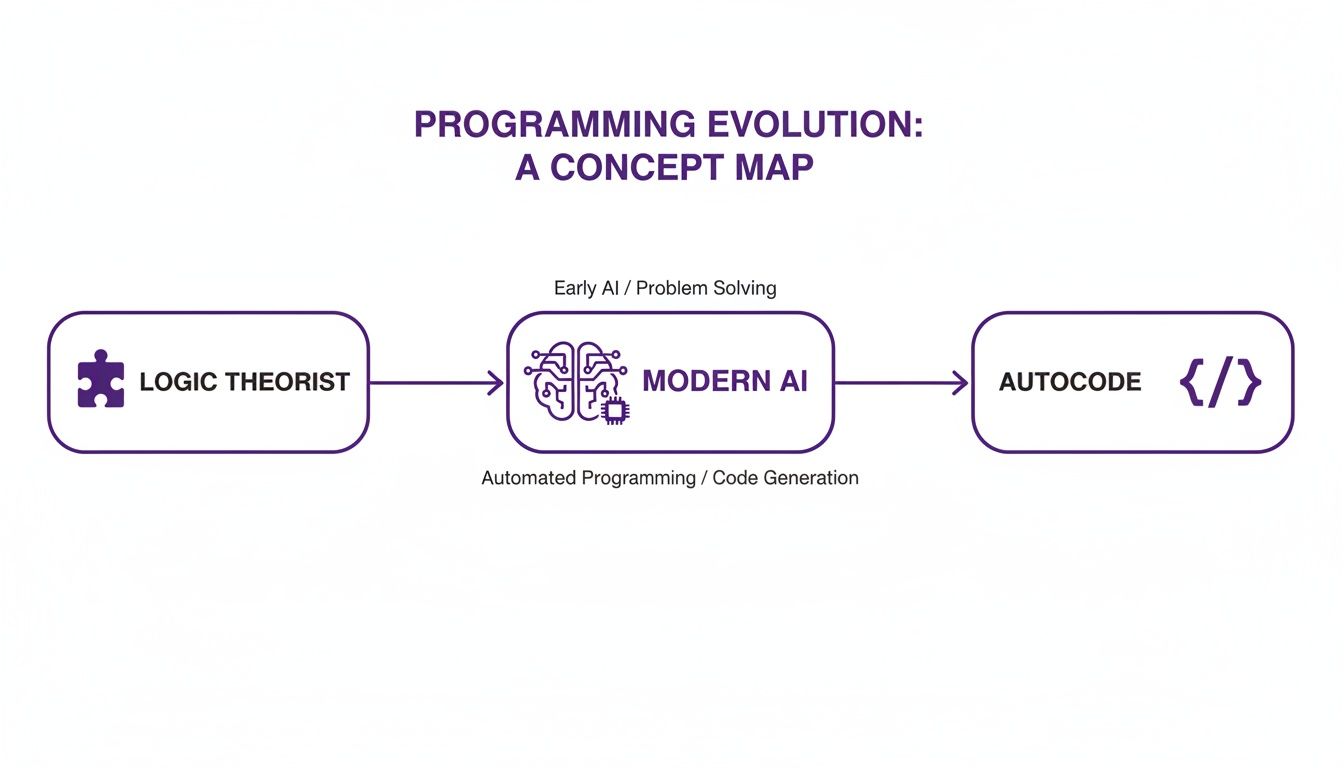
This journey from rigid, logic-based systems to modern AI is what set the stage for the explosion in automated code generation we're seeing right now.
To get a clearer picture, let's break down the main players and how they differ.
Comparing Automated Programming Techniques
This table gives a quick rundown of the core methods used in automated programming, highlighting what makes each one tick, where it shines, and its main drawbacks.
As you can see, there’s no single “best” method. The real magic happens when you start combining them.
Program Synthesis: The Architect
Think of Program Synthesis as hiring a master architect who builds a flawless structure from a perfect set of blueprints. You provide a formal specification—a set of strict rules and constraints—and the system constructs the code piece by piece, guaranteeing it meets every single requirement.
This approach is all about precision. It doesn't guess or improvise; it logically deduces the right code from the rules it's given. That makes it incredibly valuable for tasks where failure just isn't an option, like generating life-or-death algorithms or verifying hardware designs.
Large Language Models: The Creative Partner
Then you have Large Language Models (LLMs). These are more like a seasoned coding partner who’s seen it all. Trained on billions of lines of code from across the internet, these models have developed a deep, intuitive feel for how software is built.
You can give an LLM a prompt in plain English, and it will draw on that massive pool of knowledge to generate code that fits your request. It's less about rigid logic and more about pattern recognition. This is the engine behind tools like GitHub Copilot, helping developers draft functions, squash bugs, and even pick up new programming languages.
The real power of LLMs lies in their accessibility. They lower the barrier to entry, allowing people to create software by describing what they want in plain English, moving us closer to a world where anyone can build.
Symbolic AI: The Logical Verifier
Finally, there's Symbolic AI. This is the meticulous inspector who ensures everything is mathematically sound and verifiable. Unlike LLMs that learn from data, Symbolic AI operates on explicit rules and logic. It represents problems with symbols and manipulates them to find solutions, kind of like a mathematician solving an algebraic equation.
This is absolutely essential for high-stakes environments like blockchain. When you’re building a smart contract that will handle real money, you need absolute certainty that the code is free of logical flaws. Symbolic AI provides that formal verification, making it a critical backstop for security and reliability.
Blending The Best of All Worlds
Modern platforms like Dreamspace don't just pick one technique; they intelligently combine them. This hybrid approach uses the creative spark of LLMs to generate initial code, the precision of Program Synthesis to structure it correctly, and the logical rigor of Symbolic AI to verify its security.
Another powerful technique finding its place is Reinforcement Learning (RL). A great example is Nvidia's use of RL to master complex chip floorplanning in just a few hours—a process that used to take human experts months. You can see more examples of Reinforcement Learning in chip design.
By blending these methods, a vibe coding studio like Dreamspace can produce secure and efficient onchain applications and SQL blockchain queries, offering both speed and trust.
The Modern AI-Powered Coding Workflow
So, what does automated programming actually look like in a real project? It’s not about waving a magic wand and getting a finished app. Think of it more like a collaborative dance between your vision and the machine's ability to execute.
This modern workflow, often called generate-and-validate, breaks down daunting development tasks into a series of clear, manageable steps. It’s a powerful loop that starts with a simple idea and ends with robust, tested code.
Let's walk through it.
Step 1: Defining the Goal
Everything kicks off with a clear objective. This isn't about writing a dense technical spec; it's about nailing down the "what." You don't need to know how to build it, just what you want it to do.
For instance, your goal could be as simple as: "Create a standard ERC-721 NFT minting smart contract for a new art collection." Or, if you're working with data: "Write a SQL query to find the top 10 most active wallets on the Polygon network in the last 30 days."
This first step is the anchor for the entire process. A well-defined goal is the north star for the AI, making sure everything it generates actually aligns with your vision.
Step 2: Prompting the AI
Once your goal is set, you translate it into a prompt the AI can understand. This is where the art of "vibe coding" comes in—you’re guiding the AI with context, constraints, and key features.
A weak prompt like, "Make me an NFT contract," won't get you very far. A strong prompt is way more descriptive:
- Specify the standard: "Generate an ERC-721 smart contract in Solidity."
- Define key functions: "It needs functions for public minting at 0.1 ETH and another for the owner to withdraw funds."
- Set constraints: "The total supply can't be more than 1,000 tokens."
The more detail you give, the better the AI's first draft will be. This is your main point of contact with the machine, where you steer it toward a genuinely useful result.
Step 3: Generation and Automated Validation
Now for the automated magic. The AI takes your prompt and spits out the initial block of code. But in a professional-grade system, it doesn't just stop there. This is where the crucial "validate" part of the loop kicks in.
The system immediately runs the generated code through a gauntlet of automated tests. It checks for common security vulnerabilities, syntax errors, and logical flaws. This relentless, automated validation is what separates a simple code generator from a true development platform.
This step is a non-negotiable quality gate. For a smart contract, it might run simulations to check for things like reentrancy bugs. For a data query, it might check the syntax against the specific blockchain database schema to make sure it'll even run.
Step 4: Iteration and Refinement
Let's be real—no AI is perfect. The initial output is often a fantastic starting point, maybe 80-90% of the way there, but it almost always needs a human touch for that final polish.
This is where you review the validated code and provide feedback. You might say, "Add a presale function for whitelisted addresses," or "Optimize that query to run faster by joining the tables differently." The AI takes your notes, refines the code, and the validation loop runs all over again.
This back-and-forth is the heart of the modern workflow. Platforms like Dreamspace, a sophisticated AI app generator, handle this entire cycle seamlessly. Whether you're generating a complex smart contract or a specific blockchain query, the vibe coding studio turns what used to be a solo coding marathon into a fast, iterative conversation with your AI partner.
If you're exploring similar tools, our guide on choosing an AI-powered coding assistant offers more context. As more teams bring AI into their programming, understanding a framework for how to compare AI models is key to making the right choice.
Essential Tools for the Automated Future

The world of automated programming isn't a single, one-size-fits-all solution. It's a thriving ecosystem of different tools, each built for a specific purpose. Figuring out which one is right for you is the first step, whether you're a veteran developer or a creator with a fresh idea.
Broadly speaking, these tools fall into three main camps. Each one gives you a different level of control and abstraction, so your choice really comes down to what you want to build and how deep you want to get into the code itself.
AI-Powered Code Assistants
First up are the AI-powered code assistants, like GitHub Copilot. Think of these as a super-smart pair programmer that lives right inside your code editor. They don't write the whole app for you, but they suggest snippets, finish your thoughts by completing entire functions, and even help you squash bugs.
Their job is to make a developer's life easier, not to take over. You're still in the driver's seat, writing and reviewing every line. These tools just cut out the repetitive grunt work and make you faster and more efficient.
No-Code and Low-Code Platforms
Then you have no-code and low-code platforms. These are built for people who aren't professional coders. They let you build real, functional apps using visual drag-and-drop interfaces. Instead of writing lines of code, you're connecting pre-made blocks and tweaking settings in menus.
This is a game-changer for entrepreneurs, marketers, and business pros who want to build websites, internal tools, or mobile apps without hiring a dev team. They're incredibly fast for standard projects, but they can box you in if you need highly custom features. To see what’s out there, check out our guide on the best AI for programming.
Specialized AI App Generators
Finally, there are specialized AI app generators. This is the exciting middle ground, blending the simplicity of natural language prompts with the raw power of code generation fine-tuned for a specific industry, like onchain development.
A specialized generator doesn't just spit out generic code. It crafts solutions that are secure, optimized, and built on the best practices of its domain. For high-stakes work, that specialization is everything.
This is exactly where a vibe coding studio like Dreamspace shines. It's an AI app generator built from the ground up for the crypto world. You can give it a simple prompt, and it can handle the whole nine yards: it generates the smart contract, deploys it to the blockchain, builds the frontend to interact with it, and even writes the SQL queries you need to analyze its onchain activity.
This end-to-end power is what makes it different. It’s not just here to help developers; it’s here to let creators build entire, production-ready onchain applications from a simple idea. By being laser-focused on one domain, Dreamspace delivers a level of security, relevance, and completeness that general-purpose tools just can't touch.
Navigating Security in an Automated World
The speed of AI-powered coding is a game-changer. But it begs a crucial question: how do you actually trust the code it spits out? As we lean more into AI for development, we have to face the security risks head-on. Skirting around them isn't an option, especially when there's real value on the line with onchain applications.
The core of the problem is the AI itself. An LLM can "hallucinate" faulty logic, creating a function that looks right on the surface but crumbles under specific, edge-case conditions. Even worse, it might unknowingly reproduce a subtle vulnerability it learned from its massive training data, baking a hard-to-spot security flaw right into your project. This isn't just theory—it’s a real-world headache for anyone working with this tech.
So, treating AI-generated code as a final, polished product is a recipe for disaster. What we need is a completely new way of working, one that marries rapid development with bulletproof safety checks.
The Human-in-the-Loop Principle
The single most important rule for using these tools safely is the human-in-the-loop model. This idea shifts your perspective: the AI isn't an independent programmer, but more like an incredibly talented co-pilot. It does the heavy lifting, but a human expert stays in the captain's chair to handle final reviews, set the direction, and give the ultimate sign-off.
Think of it like a surgeon using a robotic arm. The machine offers precision and steadiness far beyond human hands, but the surgeon is always the one making the critical calls. It's the exact same idea here. The AI writes the code, but a human validates it.
A human-in-the-loop approach is non-negotiable. It ensures that every line of AI-generated code is checked by human intuition and experience—the very things needed to catch the tricky logical bugs that an automated system might overlook.
Rigorous Automated Testing is a Must
While human oversight is essential, you can't possibly check every single line of code manually. That's where your second line of defense comes in: relentless automated testing. A solid automated programming workflow doesn’t just stop after generating code; it immediately throws that code into a gauntlet of tests.
This process should always include a mix of validation techniques:
- Static Analysis: This is like a spell-check for code, scanning for known vulnerability patterns before it even runs.
- Unit Testing: Making sure each individual function or component does exactly what you expect it to.
- Integration Testing: Checking that all the separate pieces of your app can talk to each other without any issues.
- Fuzz Testing: Hitting your application with a barrage of random, unexpected data to see if you can make it break or expose a security hole.
This combination of automated checks is the safety net that catches the vast majority of problems before a human even needs to look at the code.
The Power of Domain-Specific Platforms
Finally, the tool you choose to work with makes a huge difference. A general-purpose AI is a jack-of-all-trades, but a master of none. It just doesn't have the deep, niche knowledge needed for high-stakes environments like crypto.
This is where specialized tools like Dreamspace have a massive edge. As an AI app generator built specifically for onchain development, its models are fine-tuned on a hand-picked dataset of audited, secure smart contracts and industry best practices. It inherently understands the unique attack vectors that exist in the blockchain world.
This focus means a vibe coding studio like Dreamspace builds security in from the very beginning, instead of trying to patch it on later. When you combine this kind of specialized platform with a strong human-in-the-loop process and a rigorous testing pipeline, you can finally use the full power of automated computer programming without compromising on the security your project demands.
Got Questions? We've Got Answers
As automated programming picks up steam, it's natural for creators, developers, and crypto folks to have questions. Let's tackle some of the big ones.
Is AI Going to Take My Developer Job?
Not likely. Think of it more like an evolution. Automation is fantastic at handling the tedious, repetitive code that developers hate writing anyway. This frees them up to focus on the big picture: system architecture, creative problem-solving, and product strategy. AI becomes a powerful co-pilot, not a replacement.
For creators and "vibe coders," this is even better news. Platforms like Dreamspace throw the doors wide open for anyone with a great idea but no formal coding background. It’s not about replacing jobs; it's about creating entirely new ways to build.
Can I Trust AI-Generated Code for Smart Contracts?
Security is everything in the onchain world, and that's a valid concern. A generic AI model might spit out vulnerable code, but specialized platforms are built differently from the ground up. An AI app generator like Dreamspace, for example, is trained specifically on audited, battle-tested code and runs automated security checks as part of the generation process.
The gold standard is a layered approach: specialized AI generation, tough automated testing, and a final review by a human. That's how you get code that’s not just working, but production-ready and safe.
How Can I Start Vibe Coding for My Crypto Idea?
The fastest way is to jump into a platform built for the onchain world. A vibe coding studio like Dreamspace was designed for this exact scenario, letting you skip the steep learning curve of traditional development.
You can generate entire onchain apps—from the smart contracts to the website people interact with—just by describing what you want in plain English. It lets you forget the complicated syntax and focus 100% on bringing your vision to life.
Ready to turn your onchain idea into reality without touching a line of code? Check out Dreamspace and see what you can build with AI. Head over to https://dreamspace.xyz to generate your first app.