Your AI Pair Programmer A Guide to Building Onchain Apps
So, what exactly is an AI pair programmer? Think of it as a super-powered coding assistant, one that uses artificial intelligence to help you write, debug, and improve your code in real time. It's less of a tool and more of a collaborative partner—suggesting code snippets, spinning up entire functions from plain English, and spotting potential bugs before they ever cause a headache.
Your New Coding Partner Has Arrived
Imagine having a coding partner who never needs sleep, knows every programming language inside and out, and can turn your wild ideas into working code almost instantly. That's no longer science fiction; it's the new reality of building software with an AI pair programmer. This isn't just a step up from basic autocomplete; it’s a total shift toward active, creative collaboration.
It’s like having a master craftsperson handling all the tedious, repetitive work for you. This frees you up to focus on the big picture: the architecture, the creative solutions, and the unique 'vibe' that makes your project special. This kind of partnership massively speeds up development, especially in a complex space like blockchain.
The Rise of AI in Development
The idea of an AI coding partner went from a quirky experiment to an industry standard with breathtaking speed, completely reshaping how code gets written. By 2025, surveys of engineering teams worldwide showed that a staggering 84% of developers were already using or planning to use AI tools. They weren't just seen as plugins; they were described as an “indispensable pair programmer.”
This explosion in adoption happened alongside a massive surge in developer activity. On GitHub alone, developers were merging around 43 million pull requests every single month in 2025—a 23% year-over-year increase. We're in a new era of creation, driven by smart models that don't just see code, but understand context and intent. To get a better sense of what’s under the hood, you can explore how an LLM for Code: Your New AI Coding Partner actually works.
An AI partner handles the intricate syntax and security patterns, allowing you to focus on your application's core logic and user experience. It empowers a new generation of builders—entrepreneurs, artists, and vibe coders—to bring their ideas to life.
From Concept to Creation
This new collaborative dynamic paves the way for a whole new style of building. Instead of getting tangled up in syntax, you can just describe your vision and let the AI handle the nitty-gritty of turning it into reality.
This is especially true for platforms built from the ground up on this idea. They enable:
- Rapid Prototyping: Instantly generate boilerplate code, APIs, or even the entire scaffolding for a smart contract.
- Creative Freedom: Focus on the "what" and "why" of your project while your AI partner figures out the "how."
- Democratized Access: Tear down the barriers to entry, making it possible for more people to build truly sophisticated apps.
Platforms like Dreamspace live and breathe this philosophy, acting as a vibe coding studio where you and your AI partner can build production-ready onchain apps together. It’s not just about coding faster; it’s about making the whole process more creative and intuitive.
How AI Pair Programmers Actually Change Your Workflow
An AI pair programmer does a whole lot more than just speed up your typing. It fundamentally changes how you approach the entire development lifecycle, from that first flicker of an idea to pushing your code live. Think of it as a force multiplier that automates the tedious stuff and inspires the creative parts.
This lets you work at a higher level, focusing on what you want to build instead of getting lost in the weeds of how to build it. At its core, the goal is to massively boost your output. It's not just about writing code faster; it’s about clearing out the mental clutter and cognitive load, which is a huge part of improving developer productivity for any serious team.
The process becomes a simple, powerful loop: you have an idea, you tell the AI, and it gives you code. You then refine it together.
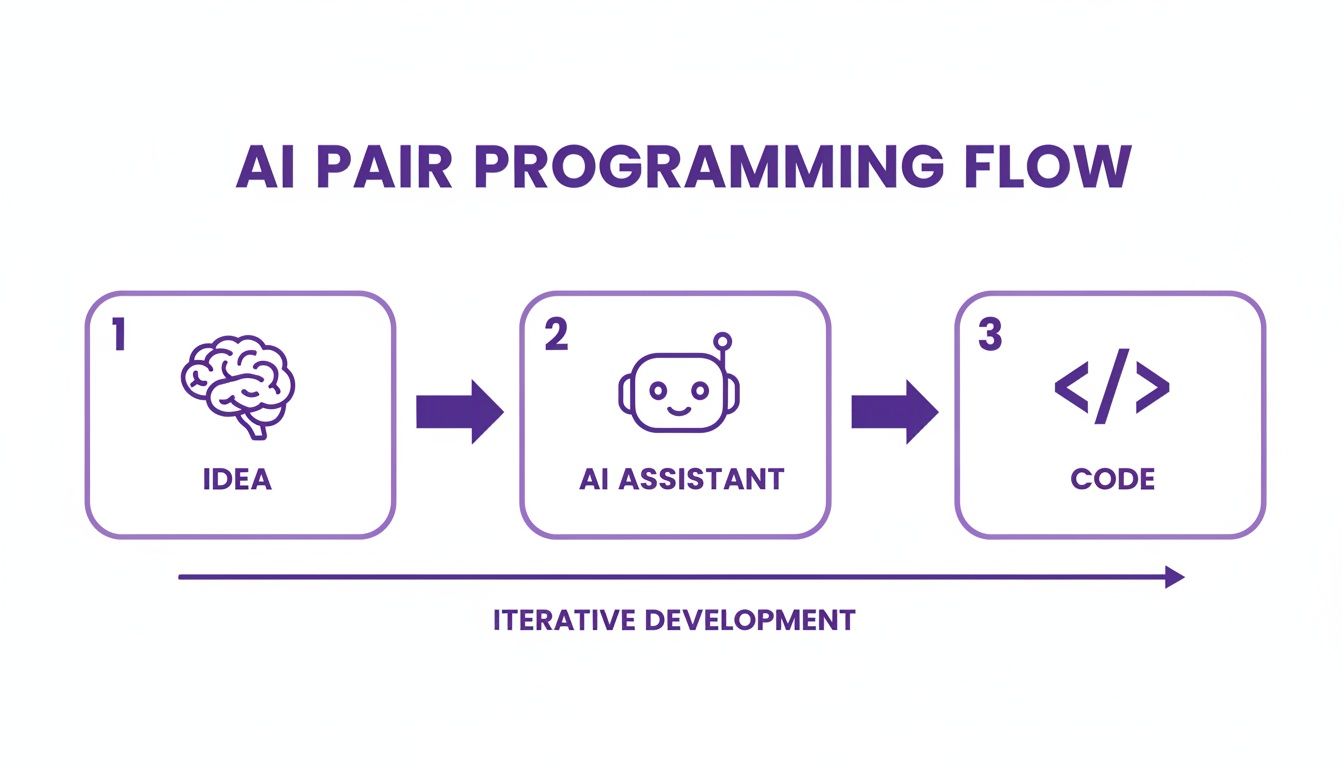
This back-and-forth conversation turns creative vision into working code almost instantly, accelerating the whole development cycle.
To really get a feel for the shift, let's look at how an AI partner transforms the day-to-day grind. The table below breaks down the before-and-after for common tasks.
Comparing Traditional vs AI-Augmented Development Tasks
As you can see, the AI doesn't just speed things up—it changes the very nature of the work, letting you focus on strategy and creativity instead of rote mechanics.
Ideation And Scaffolding
Every great project starts with an idea. But turning that idea into a workable structure usually means hours of setting up files, folders, and boilerplate. An AI pair programmer can shrink that process from a full afternoon to just a few minutes.
You can describe what you want to build, and the AI will generate the entire foundational structure for you. For instance, a developer building an onchain app can just say: "Generate a complete ERC-721 smart contract structure in Solidity with OpenZeppelin standards."
Boom. The AI spits out a well-organized, standards-compliant template, ready for you to start adding the unique logic. You get to jump straight to the fun part.
Implementation And Code Generation
This is where your AI partner really starts to shine. It can translate your plain English requests into complex, working code. Need to pull data from the blockchain? Just ask, "Write a function to query all NFTs owned by a specific wallet address," and the AI will generate the code, complete with proper error handling.
This is a game-changer for bridging knowledge gaps. A developer who’s new to a language like PHP can generate a secure authentication flow in minutes—a task that might otherwise take hours of painful research. The AI-powered coding assistant becomes your patient mentor, giving you working examples and explaining concepts as you go.
But the real magic happens when the AI starts anticipating your needs. It’ll suggest optimizations, point out potential performance bottlenecks, and even recommend better architectural patterns before you’ve even thought to ask.
Testing And Refactoring
Writing the code is only half the battle. Making sure it actually works is just as critical. Here, an AI pair programmer is your best friend. It can generate comprehensive unit tests, integration tests, and weird edge-case scenarios just by looking at your code. This massively improves code quality and reduces the odds of a nasty bug making it to production.
Refactoring old, clunky code also becomes way less of a headache. You can just highlight a messy function and ask the AI to:
- Simplify Complex Logic: "Refactor this function to be more readable and efficient."
- Modernize Codebases: "Update this code to use modern async/await syntax."
- Enforce Best Practices: "Rewrite this to follow the command pattern."
The AI handles the grunt work of the transformation, letting you focus on the big picture. Instead of spending your day untangling spaghetti code, you can modernize your entire application with a few simple prompts. This new way of working makes building ambitious projects faster and a whole lot less frustrating than ever before.
Solving The Blockchain Talent Shortage
Let's be honest: building onchain is hard. The learning curve is notoriously steep, and that complexity has created a massive bottleneck. The demand for great blockchain developers has completely outstripped the supply for years, and it's not just slowing down individual projects—it's holding back the entire ecosystem.
This is where the AI pair programmer changes the game. Think of it as a structural solution to a structural problem. It acts as a bridge, making Web3 development accessible by hiding a lot of the intimidating, low-level details. Instead of getting bogged down in the nuances of Solidity or Rust from the get-go, builders can finally focus on their actual ideas.
Your AI partner takes care of the tricky syntax, the common security patterns, and all the boilerplate code that eats up so much time. This simple shift lets you put all your energy into your app's core logic and the user experience you want to deliver, which drastically lowers the barrier to entry that has kept too many good ideas on the shelf.
A New Wave of Builders
This isn't just about making things a little easier; it's about empowering a totally new generation of creators. Entrepreneurs, artists, and the so-called "vibe coders" can now jump in and bring their onchain visions to life without needing to spend years mastering a specific tech stack first.
The numbers tell a stark story. The global developer population was projected to hit 26.3 million by 2025, but the industry was still staring down a shortfall of about 4 million developers. The pinch is tightest in critical areas like cybersecurity and AI engineering—both essential for building legitimate onchain products. It’s no surprise, then, that spending on AI-powered software development is on track to reach USD 337 billion globally by 2025. It's clear that companies now see these tools as fundamental infrastructure. You can discover more software development statistics to see just how the industry is adapting.
An AI pair programmer isn't just a tool; it's an enabler. It translates creative intent into functional code, making the act of creation more accessible and intuitive than ever before.
This shift does more than just speed things up. It makes the whole crypto space more inclusive. When more people from different backgrounds can actually build, the diversity and creativity of projects just naturally explodes.
Bridging the Gap with AI App Generators
This is where the idea of an AI pair programmer takes its next logical step, becoming something even more powerful: the AI app generator. These platforms take the hands-on, collaborative spirit of pair programming and wrap it in a seamless experience that requires zero traditional coding skills.
They are the ultimate bridge across the talent gap, offering a straight line from idea to deployed application. Platforms like Dreamspace are a perfect example of this in action. By positioning itself as a vibe coding studio and ai app generator, Dreamspace gives anyone a creative space to generate production-ready onchain apps. It’s a practical, powerful answer to a problem that has long held back the growth of the decentralized web, finally opening the doors for anyone with a vision to build the future.
Building Production-Grade Apps Without Code
The whole concept of an AI pair programmer is doing more than just changing how developers write code; it’s actually the engine driving an entirely new way to build software. This shift is colliding head-on with the no-code movement, pushing these platforms far beyond simple website builders and turning them into real application development environments.
What we're seeing is a future where sophisticated, production-ready apps are no longer the exclusive domain of senior engineers.
This change is particularly massive in the onchain world. Not long ago, building a decentralized application (dApp) was a colossal undertaking that demanded deep, specialized knowledge of some seriously complex tech. That's not the case anymore.

Instead of just spinning up static landing pages, builders can now generate complex smart contracts, deploy them straight to a blockchain, and create intuitive front-ends for people to use—all without ever touching a line of traditional code.
The New No-Code Paradigm
When AI and no-code come together, you get a new class of tools that are smarter, more flexible, and actually capable of handling real-world complexity. The AI pair programmer is the intelligent core here, translating a user's intent—what they want to build, described in plain English—into the web of code needed to run a full-fledged onchain app.
This isn't some niche trend; it's a huge market shift. The low-code development platform market is on track to hit USD 124 billion by 2032, growing at a blistering 29.6% CAGR. By 2026, experts predict that 75% of new enterprise apps will be built with these tools. At the same time, the AI code assistant market is projected to leap from USD 4.70 billion in 2025 to USD 14.62 billion by 2033, which shows you just how much money is pouring into this space. You can dig into more details about the AI code assistant market growth on snsinsider.com.
This new way of building is defined by a few key things:
- Intent-Driven Development: You just describe what you want to build. The AI handles the how.
- Full-Stack Generation: These platforms don’t stop at the user interface. They generate the backend logic, database schemas, and the smart contracts that make a complete application work.
- Onchain Native: For Web3, this means the generated code is secure, efficient, and built to blockchain standards right from the start.
It's an approach that opens up creation to everyone, allowing anyone with a clear idea to build something real.
From Vibe to Deployed Application
We like to call this new creative process "vibe coding." It’s a fluid, intuitive way of working where you focus on the feel, function, and purpose of your app instead of getting bogged down by the rigid syntax of a programming language. You bring the vision, and your AI partner helps you turn that vibe into a real, working product.
The AI pair programmer is the ultimate creative medium for the modern builder. It removes the friction between a great idea and a functional application, allowing creators to stay in their flow state and build at the speed of thought.
Dreamspace is the perfect example of this in action—it's a vibe coding studio built specifically for the onchain world. It’s more than just a tool; it’s an environment where your ideas can come to life without technical roadblocks. You can generate entire onchain apps, from the smart contract logic to the user-facing web app, all through a simple, conversational chat.
This is the real power of an AI app builder. It’s a system designed to empower creators, not just assist developers. We wrote a whole guide on how the modern AI app builder is changing the game if you want to learn more. This approach puts the creator firmly back in control, making the technology serve the vision—not the other way around.
Ensuring Security In AI-Generated Smart Contracts

Sure, an AI pair programmer can write code at a blistering pace, but let's be real: when you're building onchain, the stakes couldn't be higher. We're talking about immutable code that controls real money. One tiny vulnerability can lead to absolute disaster. This is why security has to be priority number one, and why you should treat AI-generated code with a healthy dose of skepticism.
The trick is to think about the AI's role in a new way. It isn't some flawless security oracle, and it's definitely not a substitute for a human audit. It's a powerful assistant—a first line of defense that helps you write safer code from the jump by starting with established best practices.
It’s a partnership. The AI helps you sidestep common mistakes and build out solid test suites faster, but the buck always stops with you, the developer.
Establishing A Secure Foundation
The first rule of thumb is to treat any code from an AI pair programmer as a well-informed first draft, not the final, shipped product. These AI models have ingested a massive amount of public code, which includes both fortress-like security patterns and some dangerously leaky vulnerabilities. Your job is to steer the AI toward the good stuff and then check its work. Meticulously.
Start by being incredibly specific with your prompts. Don't just ask it to "create an ERC-20 token." That's a recipe for trouble. Instead, try prompts like these:
- "Generate an ERC-20 smart contract using OpenZeppelin's latest secure implementation for ownership and access control."
- "Make sure you include checks to prevent common vulnerabilities like reentrancy and integer overflows."
- "Add comprehensive NatSpec documentation for every single function."
This level of detail makes a world of difference. It pushes the AI to produce much higher-quality, more secure code right out of the gate, giving you a far better foundation to build on.
From Generation To Verification
Once you've got that initial code, the real work begins. Your AI pair programmer can be a huge help here, too. Ask it to generate a complete suite of unit tests that covers every function and every conceivable edge case. A great prompt looks something like this: "Write a full test suite for this smart contract using Hardhat and Chai, covering both the happy paths and the failure cases for each function."
This turns your AI into a relentless QA partner, helping you catch potential bugs before they even sniff a testnet. But even the best automated tests aren't enough.
The human element remains essential. The developer's expertise is crucial for reviewing the logic, questioning assumptions, and ensuring the code behaves exactly as intended under all conditions.
Platforms like the Dreamspace vibe coding studio get this. They build these security guardrails right into the workflow. As an AI app generator, Dreamspace helps users create contracts based on audited, battle-tested templates, dramatically cutting the risk of introducing those common, rookie-mistake vulnerabilities.
At the end of the day, the winning strategy is combining AI-powered generation with your own diligent oversight and a rock-solid testing process. For a deeper dive into the tools that can help, our guide on smart contract audit tools is a great place to start. Using AI this way lets you build secure, trustworthy onchain apps with far more confidence and speed.
Dreamspace: Your Onchain Vibe Coding Studio
So far, we've talked a lot about what an AI pair programmer could do. We've seen how it can fill talent gaps, speed up development, and even open the door for powerful no-code tools.
Now, let's make it real. Let’s see what happens when you put all those ideas into a single, cohesive experience built for creating on the blockchain.
This is Dreamspace, your onchain vibe coding studio. It’s the practical, hands-on version of everything we’ve just discussed. We designed it from the ground up to be the ultimate creative partner for anyone building in Web3, moving way beyond simple code completion into a space where your imagination is the only limit.
From Prompt to Production App
The entire Dreamspace journey is meant to feel natural. We wanted to strip away all the technical headaches that kill creative momentum, so the process feels less like coding and more like a conversation with a seasoned developer who happens to be an AI.
It all starts with a simple idea. You just describe what you want to build in plain English.
From there, Dreamspace acts as your dedicated AI app generator, instantly starting to bring your vision to life.
Generate Your Smart Contract: You could kick things off with a prompt like, "Create a smart contract for a PFP NFT collection with a whitelist and a public sale." Dreamspace will immediately generate secure, standards-compliant Solidity code based on battle-tested templates.
Query Onchain Data: Need to show what’s happening onchain? Just ask. "Write a query to fetch all NFTs owned by a specific wallet address and show their metadata." The AI handles all the complex SQL work behind the scenes, giving you the exact data you need.
Build Your Web App: Finally, Dreamspace packages everything up into a shareable web app. It automatically generates the front end, giving your users a clean, intuitive interface to interact with your smart contract.
This entire flow—from an idea to a live dApp—happens in one place. No more switching between different tools or needing to be a full-stack expert to build a full-stack app.
The Ultimate AI Pair Programmer Experience
What really makes Dreamspace different is our focus on the "vibe" of creation. We think building should be inspiring, not frustrating. Traditional development often feels like a slow, painstaking process of translating an idea into code. Dreamspace just collapses that distance, letting you build as fast as you can think.
Dreamspace is more than just a tool; it's a new creative medium for the onchain world. It’s where your ideas are instantly transformed into functional, production-grade applications, letting you stay in a state of creative flow.
By handling the nitty-gritty details—the backend logic, smart contract security, and front-end code—Dreamspace frees you up to focus on what actually matters: your project's purpose and the experience you're creating for your users.
This is what a true AI pair programmer should feel like. Effortless, powerful, and made for builders.
A Few Common Questions About AI Pair Programmers
Whenever a new technology like this pops up, it’s only natural for some questions—and a healthy dose of skepticism—to follow. Let's dig into some of the most common ones to clear the air and show how these tools are really changing the game for developers.
Will an AI Pair Programmer Replace Human Developers?
Short answer: Nope. Think of an AI pair programmer as a tool designed to augment human developers, not make them obsolete.
It's brilliant at handling the grind—the repetitive stuff like writing boilerplate code, spinning up tests, or turning simple logic into the right syntax. This frees up human developers to focus on what we do best: high-level system architecture, creative problem-solving, and mapping out the product's future. It's a partnership, where the AI acts as a super-fast assistant that lets human creativity and productivity soar.
How Reliable Is The Code It Generates?
The code quality is getting better all the time, but it absolutely, positively still needs a human in the loop. For common, well-trodden patterns, the code is often spot on. But ask it to do something novel or complex, and it can just as easily spit out bugs, inefficient logic, or completely miss important edge cases.
The best way to think about it is this: AI-generated code is a fantastic first draft. It's on the developer to review, test, and truly understand every line before it goes anywhere near production—especially with something as high-stakes as a smart contract.
This is exactly why we built the Dreamspace vibe coding studio the way we did. As an ai app generator, it starts you off with battle-tested templates and proven best practices, giving you a much more secure foundation from the get-go.
Can I Use One If I'm Not A Coder?
Yes! And honestly, this is one of the most exciting parts of this whole shift. A new generation of tools is being built for everyone, not just seasoned engineers. Creators, entrepreneurs, and thinkers who don't come from a traditional coding background can now join the party.
This is where the concept evolves from a simple pair programmer into a true AI app generator. These platforms are all about democratizing the building process. Using simple, natural language, "vibe coders" can generate fully functional onchain applications and smart contracts from the ground up. The whole point is to tear down the walls, making it possible for anyone with a great idea to build it.
Ready to see how an AI partner can bring your onchain ideas to life? With Dreamspace, your vibe coding studio and ai app generator, you can generate smart contracts, query blockchain data, and launch a full web app without writing a single line of code. Start building at https://dreamspace.xyz.