
Master AI Code in Python for Blockchain Development
When we talk about writing AI code in Python, we're really talking about using Python's massive collection of libraries and its clean, readable syntax to put together AI models. It’s the go-to language for a reason. With powerhouses like TensorFlow and PyTorch for machine learning and essentials like pandas and NumPy for wrangling data, it's a developer's dream for anything AI-related.
Why Python Is the Future of AI Blockchain Development
When you're trying to blend the complex worlds of artificial intelligence and blockchain, you need a language that’s both a workhorse and a racehorse. Python has proven to be exactly that, bridging the gap between heavy-duty data analysis and the world of decentralized apps.
What I love about it is the straightforward syntax. It lets you prototype and test ideas fast, which is absolutely critical in a field that moves as quickly as blockchain. But don't mistake that simplicity for weakness. Python is backed by a huge community and a treasure trove of libraries designed specifically for data-intensive work.
Your Go-To Toolkit
If you're diving in, a few libraries are non-negotiable.
- Pandas and NumPy: These are your bread and butter for data manipulation. Think about analyzing massive ledgers of on-chain transactions to spot trends or prepping that data to feed a predictive model. This is what you'll use.
- LangChain: This is perfect for building AI agents that can actually talk to smart contracts. Imagine creating AI-driven DAOs or DeFi trading bots that can execute strategies automatically. LangChain makes that possible.
- TensorFlow and PyTorch: When you need the big guns for deep learning, these are it. You can build models to forecast token prices, sniff out fraudulent activity on the network, or even find ways to make the whole network run more efficiently.
The shift to Python isn't just a hunch; the numbers back it up. We've seen Python adoption jump by 7 percentage points in just one year. And get this—over half (51%) of Python developers are now working on data exploration, using those foundational tools like pandas and NumPy to make sense of complex information. It's clear where the momentum is.
Key Python AI Libraries for Blockchain Projects
To get a clearer picture, here’s a quick rundown of some essential Python libraries and what they bring to the table for AI-powered blockchain development.
These libraries form the foundation, allowing you to build everything from simple analytical scripts to highly sophisticated, autonomous agents interacting directly with the blockchain.
The Rise of Specialized Development Tools
As this intersection of AI and blockchain grows, we're seeing new tools pop up to make life even easier. Platforms like Dreamspace, an intuitive AI app generator, are built to help you get the most out of Python. It provides a "vibe coding studio" that lets you focus on the creative side of building your blockchain app instead of getting stuck in the weeds with setup and configuration.
This kind of environment helps you take an idea and turn it into a working, AI-powered decentralized application much faster. If you want to dig deeper, our guide on the essentials of Python AI coding has more.
Connecting AI With Financial Systems
At the end of the day, these AI-powered blockchain apps are reshaping finance. They're creating a new economic layer that directly challenges the old way of doing things. Understanding the fundamental arguments in the cryptocurrency vs fiat debate gives you real context for why these decentralized, AI-driven solutions are gaining so much traction.
Python is the language that's making it all happen, cementing its place as the engine for the next wave of innovation in both AI and blockchain.
Getting Your Workspace Ready with Dreamspace
Before you can even think about writing slick AI code in Python for your blockchain app, you have to get your workspace in order. This is often the first, and most frustrating, hurdle. A solid dev environment means your tools play nice together, saving you a world of pain later on.
The old-school way is a real slog. You'd start by hunting down the right Python version. Then, you'd fire up the terminal and use pip to install every single library you need—web3.py for talking to Ethereum, others for handling data, and more for the machine learning bits. Honestly, it's enough to kill your creative buzz before you've even written a line of code.
Ditch the Manual Setup with an AI App Generator
This is exactly where a platform like Dreamspace, a leading AI app generator, completely flips the script. Forget wrestling with command-line tools and cryptic dependency errors. Instead, you get a purpose-built environment designed for exactly this kind of work right out of the gate.
Dreamspace calls itself a vibe coding studio, and that's a pretty good description. It gives you a ready-to-go workspace where all the foundational pieces are already wired up. You get to skip the entire manual setup headache and jump straight into what you actually want to do: build your app.
Tools like Dreamspace, the AI app generator, handle the boring stuff so you can focus on the fun stuff—innovation, not configuration. It massively speeds up your timeline and makes it way easier for anyone to start building complex, AI-driven dApps.
What's Inside Your Dreamspace Environment
When you kick off a new project in Dreamspace, our vibe coding studio, you're not just getting a blank slate. You're getting a complete development setup with all the essentials ready to roll.
Here’s what’s waiting for you:
- Integrated Python Runtime: The right version of Python is already there and configured. No more version conflicts.
- Pre-loaded Libraries: Core packages you'll definitely need for blockchain and AI work, like
web3.py, are included from the start. - Easy Testnet Connection: Dreamspace makes it dead simple to connect to a local testnet like Ganache. This is a must-have for testing your smart contracts and AI logic in a safe sandbox without burning real crypto.
- AI Model Hooks: The entire environment is built to plug into AI models, giving you a clear runway for integrating your generated code with on-chain actions.
With this foundation already laid, you can start prototyping your AI-powered prediction market or DeFi protocol immediately. You can prompt the AI to whip up some starter smart contract code or backend functions, and your environment is ready to run and test it on the spot.
That instant feedback loop is priceless for tweaking your ideas and moving fast. A setup that used to take hours now takes just a few minutes.
Generating Smart Contract Logic with AI Prompts
Alright, this is where the magic happens. We're about to turn your abstract ideas into actual, working code. Forget staring at a blank screen, trying to remember syntax. Instead, we’re going to talk to the AI, using plain English to build the core logic of our smart contract. This is the key to creating AI code in Python quickly, especially when you're in an environment built for it.
Let's dive into a real-world project: an AI-powered prediction market. In this market, people can bet on the outcome of a future event. When the event happens, an external data source tells the contract who won, and the winnings are paid out automatically. Building this from scratch would normally be a headache filled with potential security holes.
From Prompt to Python Code
Working inside Dreamspace's vibe coding studio feels less like coding and more like a conversation. You're not just writing code; you're instructing a partner who translates your vision into functional Python. The secret sauce is being crystal clear in your prompts. If you’re vague, you’ll get vague code. But if you’re specific, you get precision.
For our prediction market, a good starting prompt would look something like this:
"Generate the Python smart contract logic for a prediction market. I need three main functions: one to create a new market with a specific question and outcome options, a second to allow users to place wagers on an outcome, and a third to resolve the market and distribute the winnings based on an external data feed."
This prompt gives the AI a solid roadmap. It immediately understands the three core pieces it needs to build and can start scaffolding the Python functions. The Dreamspace AI app generator is tuned for exactly these kinds of structured requests, giving you a strong first draft to work from.
This process is a bit like the standard workflow for preparing data for any AI model, a task often handled by Python scripts.
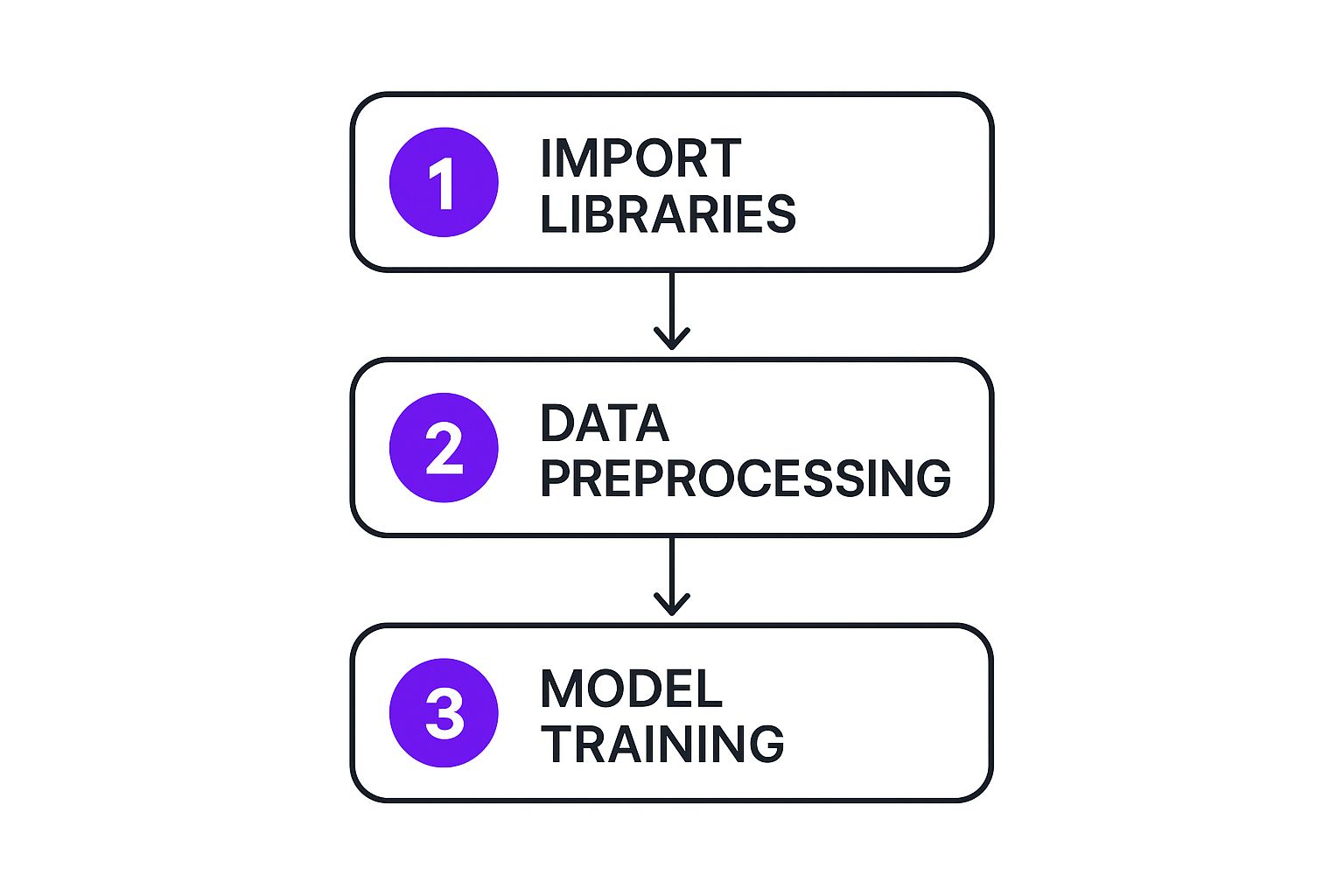
The AI can handle that entire initial sequence—from importing libraries to preprocessing data and training the model—saving you a ton of setup time.
Refining the Generated Logic
Let’s be real: the AI's first attempt is never going to be perfect. Think of it as a junior dev who handles all the boilerplate and initial setup, freeing you up to focus on the tricky parts. Your job is to review, refine, and guide.
For instance, the AI might give you a basic place_wager function. Now you can get more specific to build it out:
- Add Security Checks: "Modify the
place_wagerfunction to ensure that users cannot bet on a market that has already closed." - Handle Edge Cases: "Update the logic to prevent a user from placing a wager with a zero or negative amount."
- Improve Data Structures: "Refactor the way wagers are stored to use a more gas-efficient mapping."
This back-and-forth—prompting, reviewing, and refining—is an incredibly effective way to work. You're essentially co-piloting the development with an AI partner. We actually have a whole guide on these kinds of techniques for coding with an AI partner.
This interactive approach transforms one of the hardest parts of blockchain development—writing secure, efficient smart contracts—into a more manageable and creative process. Dreamspace, as a vibe coding studio, is built for this kind of iterative flow, letting you test and tweak the generated code on the fly within its integrated environment.
Integrating AI Code into Your Blockchain Application
Alright, you’ve used AI to generate a slick smart contract. That's a huge win, but let's be real—that code isn't doing much just sitting there. The real magic happens when you make it a living, breathing part of your application. This is where we roll up our sleeves and bridge the gap between that AI-generated logic and the decentralized world of the blockchain.
The whole process boils down to connecting your Python backend to the smart contract you've just deployed on a test network. This connection is everything. It's how your app will read on-chain data, trigger contract functions, and react to events—it’s how your dApp comes to life.
Establishing the Blockchain Connection
In the Python world, our go-to tool for this job is the web3.py library. Think of it as the ultimate translator between your Python code and an Ethereum node. It gracefully handles all the messy, low-level JSON-RPC stuff, letting you talk to the blockchain with clean, familiar Python commands.
If you're working inside Dreamspace's vibe coding studio, you'll find web3.py is often pre-configured, but it's crucial to understand what's going on under the hood. You'll need two key pieces of information to get started:
- The Contract Address: This is the unique street address for your deployed smart contract on the testnet.
- The Contract ABI (Application Binary Interface): This is a JSON file that’s basically an instruction manual for your contract. It tells
web3.pyall about the available functions, what arguments they need, and what they return.
With those two things in hand, you can create a contract object right inside your Python script. Suddenly, you have a direct line to call its functions just like they were local Python methods. It's this seamless integration that makes building with AI code in Python for blockchain so powerful. It's no surprise that developers in the United States now contribute around 30.1% of their Python code with AI assistance. Across the board, AI tool usage in organizations has shot up from 55% to 78% in just the last year, showing how central these tools are becoming. You can dig into more AI tool usage statistics to see the full picture.
Triggering On-Chain Actions from AI Insights
Now for the fun part. Imagine your AI model just flagged a massive price surge for a specific token. The goal is to act on that insight—immediately—by executing a trade through a DeFi protocol’s smart contract.
Here’s how it would work: your Python backend gets the prediction from the AI. Using your web3.py instance, you can then call the swapTokens function on the DeFi contract, feeding it the token addresses and the amount to trade.
This is the core loop of an intelligent dApp: AI generates an insight, Python translates it into a transaction, and
web3.pysends it to the blockchain for execution. It’s a powerful cycle that automates complex decision-making.
Now, sending transactions that actually change something on the blockchain (like a trade) requires a bit more than just reading data. You have to sign the transaction with a private key to prove you have the authority to make that call. Fortunately, Dreamspace, as a vibe coding studio, helps you manage these credentials securely in a development environment, so you can test these kinds of interactions without risking real assets.
Listening for On-Chain Events
Interaction isn't a one-way street. A truly smart dApp needs to listen for things happening on the blockchain. Your smart contracts can "emit" events, which are like little broadcast signals that announce a significant action has just occurred—a trade was completed, a new liquidity pool was created, or a prediction market was resolved.
You can set up your Python backend to be an active listener for these specific events. For instance, after your prediction market contract figures out an outcome, it could emit a MarketResolved event. Your Python script can catch that signal and then trigger another action, like sending a notification to the winner or updating your application's database. This creates a responsive, real-time experience that tightly links your off-chain logic with on-chain results.
How to Test and Refine Your AI-Generated Code
Getting a chunk of AI code in Python feels like a massive shortcut, and it is. But treating it as a final, polished product is a one-way ticket to trouble, especially on an immutable blockchain where bugs are forever. The right way to think about it is with a "human-in-the-loop" approach. You're the senior developer, and the AI is your eager-but-inexperienced junior. Your job is to be thorough, skeptical, and relentlessly focused on quality.
This mindset isn't just a good idea; it's becoming a necessity. AI coding assistants are everywhere now. A wild 41% of all code worldwide is now being written by AI tools, and a massive 76% of professional developers are either already using them or planning to jump in soon. This shows just how baked into our workflows AI has become.
Writing Effective Unit Tests
Your first line of defense is always a solid set of unit tests. Before you even dream of deploying to a testnet, you need to pick apart every function the AI spat out and test it in isolation.
For Python, that means firing up a framework like pytest and hammering away at the logic of each piece of your smart contract.
- Test the Happy Path: Does the function do what it's supposed to do when everything goes right? Confirm the expected outcomes first.
- Hunt for Edge Cases: This is where AI often falls flat. What happens with a zero? A negative number? A ridiculously large value? You have to think like an attacker.
- Validate State Changes: If a function is supposed to update a variable on the contract, make absolutely sure it's doing it correctly.
To really get this right, it helps to understand the differences between functional vs unit tests, as each serves a distinct purpose in building a rock-solid application.
Simulating Blockchain Scenarios
Once the individual functions are behaving, it's time for the main event: simulating real-world blockchain interactions. This is where you see how your code holds up in a chaotic environment, not just a sterile testing silo. Dreamspace, being a smart AI app generator, gives you an integrated way to hook into a testnet like Ganache and put your code through its paces.
Your goal here isn't just to see if the code runs. It's to actively try to break it. You need to simulate network lag, transactions that fail halfway through, and malicious inputs to find the cracks before someone else does on the mainnet.
For instance, script a test where a dozen users try to place wagers on your prediction market at the exact same time. Does your code handle the concurrency, or does it fall over and create a race condition? This kind of testing goes way beyond simple logic checks; it's about validating the fundamental design of your application.
Building secure on-chain logic is a deep topic, and our guide on smart contract programming languages can give you more background. Ultimately, this human-driven refinement process is what transforms a rough draft from an AI into a secure, production-ready dApp.
Questions on Every Blockchain Dev's Mind
When you start pulling AI-generated Python into your blockchain work, the questions start popping up almost immediately. It's easy to get excited about the potential, but the day-to-day reality of security, choosing the right tools, and knowing the limits is a whole different ball game.
Let's get into the nitty-gritty of what developers usually ask when they first start mixing these two worlds. Getting a handle on these points is what separates a neat proof-of-concept from a production-ready DApp.
Can You Really Trust AI-Generated Code for Blockchain Security?
This is the million-dollar question, and the short answer is a hard no. Not by itself, anyway.
AI tools are incredible for spitting out boilerplate, drafting contract logic, and getting you from zero to a first draft in record time. But you absolutely cannot, under any circumstances, copy-paste that code into a production environment. Especially not for something as sensitive as a smart contract on an immutable ledger.
Think of the AI as a super-fast junior dev. It gives you a running start, but an experienced human needs to review, audit, and rigorously test every single line. You're the one who has to be on the lookout for classic blockchain vulnerabilities like reentrancy attacks or integer overflows. Tools like Dreamspace, an AI app generator, speed things up, but security ownership is—and always will be—on you.
What Makes Dreamspace Different From Other AI Coding Tools?
A lot of AI coding assistants out there are basically just autocomplete on steroids. They're great at suggesting a function here or a code snippet there, but they often miss the bigger picture of your entire project.
This is where Dreamspace takes a different path. It's built from the ground up as a vibe coding studio and an AI app generator meant for building complete, full-stack applications. Instead of just throwing code snippets at you, Dreamspace helps you architect the whole thing—frontend, backend, and smart contracts—as one cohesive unit. This holistic approach keeps everything in context, which is a lifesaver for complex DApps where every part of the stack needs to communicate flawlessly.
The real win isn't just about writing code faster. It's about building coherent, well-structured applications more thoughtfully from the very beginning.
What Are the Real-World Limitations of AI for Blockchain Devs?
Right now, the two biggest hurdles for AI in this space are context and creativity.
AI models learn from the massive amounts of code they've been trained on. This makes them wizards at recreating patterns and solving problems they've seen a thousand times before. But when you're working on a truly novel blockchain mechanism or a protocol that breaks the mold, the AI has very little existing data to pull from. It might just get stuck.
It can also generate code that looks perfect but has subtle logical flaws or inefficiencies hiding just beneath the surface. This is why you can't just be a prompt engineer. You need a solid grasp of blockchain fundamentals to guide the AI and critically vet what it produces. The AI is an accelerator, not a substitute for deep expertise.
Ready to stop wrestling with boilerplate and start building your on-chain vision? Check out Dreamspace and see how our vibe coding studio can bring your ideas to life. Generate smart contracts, query on-chain data, and launch your next project faster than ever at https://dreamspace.xyz.