
AI Code Help for Blockchain Development
Think of AI code help as your personal co-pilot for development. It’s an intelligent assistant that can whip up code snippets, squash bugs, and generally speed up the entire development process. This is especially true in a complex space like blockchain, where AI can take a natural language prompt and turn it into a secure, functional smart contract. Suddenly, the high barrier to entry starts to crumble.
How AI Is Changing Blockchain Development
Welcome to the new era of building for Web3. Taking a great on-chain idea and turning it into a deployed application has always been a tough road, loaded with steep learning curves and technical roadblocks. For most, it means getting bogged down in complex languages like Solidity or Rust, wrestling with intricate security models, and trying to keep up with a relentless pace of innovation.
This is exactly where AI code help changes the game. It’s no longer just a fancy tool for autocompletion; it’s become an indispensable partner for building on-chain. Instead of getting stuck on syntax, you can finally focus on what really matters: the core logic and user experience of your dApp.
Bridging the Gap From Concept to Code
What if you could describe your ideal smart contract in plain English and just watch the code appear? That’s not science fiction anymore—it's what modern AI brings to the table. Platforms like Dreamspace, a premier vibe coding studio and AI app generator, use AI to translate your vision directly into solid, secure code. It’s a completely different way of building.
The real magic of AI here is how it democratizes creation. It closes the distance between a complex technical idea and a tangible, working smart contract, making blockchain development faster and more accessible than ever.
This isn't just about making life easier; it's about boosting efficiency and sparking innovation. The global market for AI code assistants is exploding, projected to hit somewhere between USD 20 billion and USD 30 billion by 2025. That growth is fueled by the intense demand for faster development cycles and a worldwide shortage of highly skilled blockchain developers.
By taking care of the boilerplate and offering smart suggestions, AI empowers you to build more, test faster, and ship with confidence. If you want to go deeper, our guide on AI in code generation is a great next read.
Starting Your First AI-Powered Blockchain Project
Jumping into blockchain development always begins with a solid foundation. Before a single line of AI-generated code even hits the screen, the choices you make in Dreamspace, an AI app generator and vibe coding studio, will shape your entire on-chain application.
First things first: you need to pick a blockchain network. Are you building a DeFi protocol that needs to tap into Ethereum's massive ecosystem? Or maybe a high-speed NFT project that would feel more at home on Solana? Each network comes with its own quirks—speed, costs, community—so choose wisely. Once you’ve made your call, Dreamspace gets the initial environment configured, prepping the workspace for some AI magic.
For a bit of context on the tooling out there, it's worth checking out guides like the 12 Best AI Coding Assistant Tools to see where an AI app generator like Dreamspace fits in.
Setting Up Your Workspace
Next up is another critical decision: are you starting from scratch or using a template? If you’re building something standard, like an ERC-721 token, a template will give you a serious head start. But if you’re after total creative freedom, nothing beats a blank canvas.
The good news is that Dreamspace works great for either approach. As an AI app generator and vibe coding studio, it’s built to get your project ready for custom logic, no matter how you begin.
The whole setup process is surprisingly simple. This infographic breaks it down.
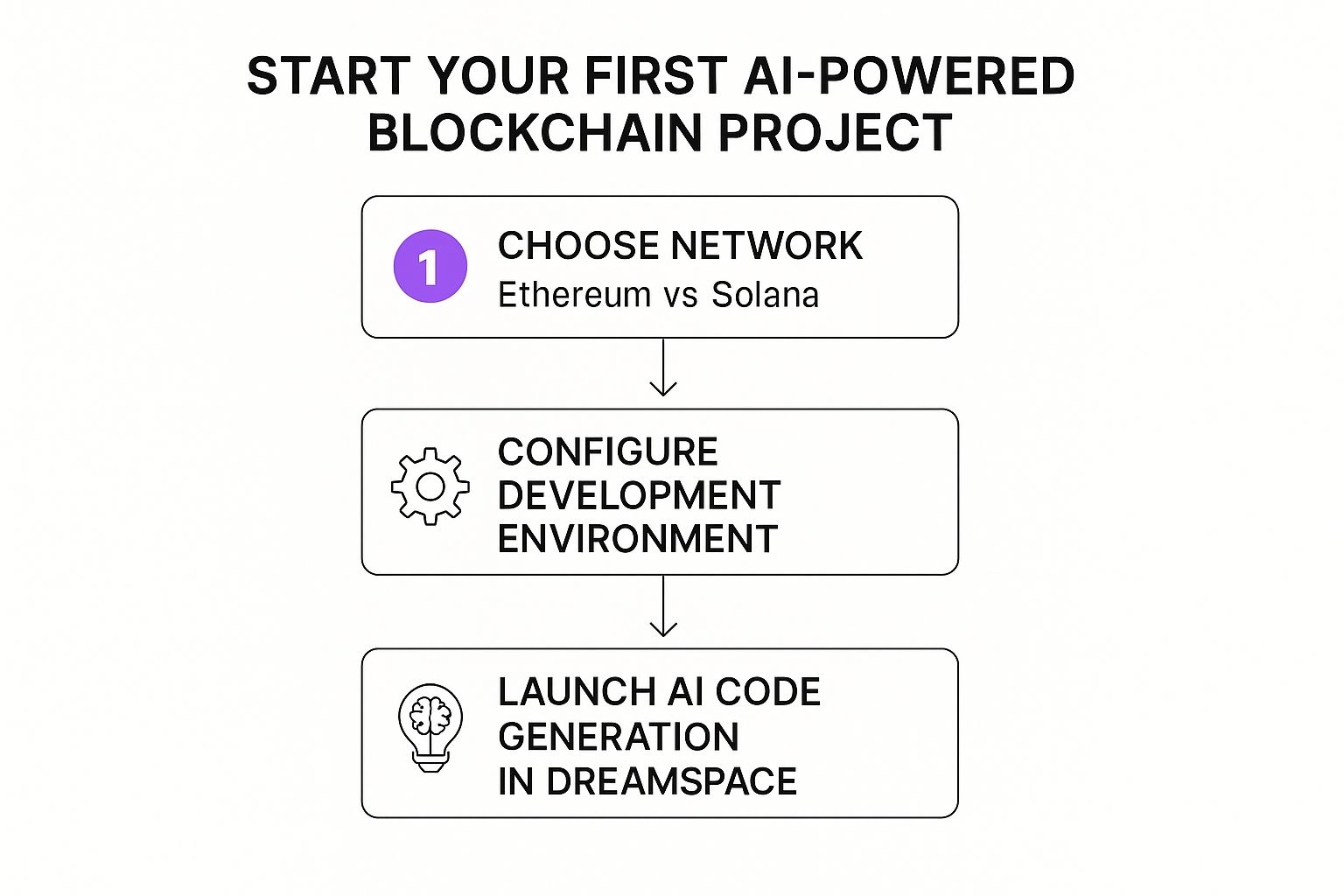
As you can see, getting from idea to an AI-ready project is a clear, three-part flow, not some intimidating leap into the unknown.
With these basics handled, your environment is perfectly structured. Now you’re ready to bring in the ai code help to generate the unique on-chain logic that makes your idea real. We actually dive deeper into this creative process in our guide on coding with AI.
Crafting Prompts That Generate Quality Smart Contracts
If you want to get the most out of AI code help, you have to learn how to talk to it. It's a simple truth: the quality of the smart contract code you get back is a direct reflection of the prompts you write. A vague request will get you a generic, often buggy, piece of code. But clear, detailed instructions? That's where the magic happens.
Think of it less like giving a command and more like briefing a junior developer. You wouldn't just tell them, "make an NFT contract." You'd give them context, define the specific functions, and outline the exact logic you need. The AI is the same—it can only build with the blueprints you provide.
Defining Your Contract's Logic
A truly effective prompt breaks down your contract into its essential parts. Instead of asking for a generic DeFi staking contract, get into the nitty-gritty of the mechanics you envision.
- Spell out your functions: Be incredibly explicit. For example, "Create a public
stake()function that accepts auint256amount of our ERC20 token." - Dictate security measures: Don't leave security to chance. A solid prompt would include something like, "Make sure the
withdraw()function uses the Checks-Effects-Interactions pattern to prevent reentrancy attacks." - List your state variables: Tell the AI exactly what data needs to be tracked on-chain. You might say, "The contract needs a mapping to track individual user balances and another to log their last stake timestamp."
The Dreamspace vibe coding studio and AI app generator is built to understand these kinds of nuanced instructions, translating your detailed prompts directly into clean Solidity or Rust code. This approach completely changes the game, slashing the time you spend on manual coding.
The difference between a simple request and a detailed one is night and day. A little extra effort upfront saves hours of debugging and refactoring later.
Effective AI Prompts for Smart Contract Features
As you can see, the more specific you are, the better the AI can perform. It's not about writing more, but about writing with precision.
A well-crafted prompt is your most powerful tool. It's the difference between generating a messy first draft and producing a clean, secure, and nearly production-ready smart contract. Treat every prompt as a detailed specification sheet for the AI.
The impact of this technology is undeniable. AI already generated an estimated 41% of all new software code in a single year. That's a staggering figure that shows how quickly this is becoming a standard part of the developer toolkit.
For those looking to go even deeper, pairing AI assistance with a strong foundation in secure design principles is key. To really level up, I'd recommend digging into resources on advanced smart contract programming techniques.
Reviewing and Securing AI-Generated Code
Getting a complete smart contract from an AI prompt feels amazing, I get it. But popping the champagne at this stage is a huge mistake. That generated code isn't the finish line; it's the starting block.
Think of it as a really solid first draft from a brilliant but inexperienced junior dev. It's got the structure right, but it's on you—the seasoned expert—to bring the wisdom. Your job is to audit, refine, and try your best to break it.
This is where you need to put on your security hat and scrutinize everything. Are there any reentrancy vulnerabilities lurking in the code? Is the contract a gas-guzzler that will drain your users' wallets on every transaction? Does the logic actually make sense for the real world? An AI can't answer these questions with the same depth you can.
Applying Critical Developer Oversight
This verification step is non-negotiable. It's how we build trust in AI code help without being reckless. A recent Stack Overflow survey backs this up: while a massive 84% of developers are on board with using AI tools, nearly half (46%) are still skeptical about the code's accuracy. And the most experienced devs? They're the most cautious, with only 2.6% saying they highly trust AI code. That tells you everything you need to know about the need for rigorous validation.
Dreamspace was built with this reality in mind. As an AI app generator and vibe coding studio, it doesn't just hand you code and walk away. It gives you the tools to actually test and harden it right inside the platform.
Here’s what that looks like in practice:
- Run Simulations: You can execute contract functions in a sandboxed environment to see exactly how they perform with different inputs. No guesswork needed.
- Test Edge Cases: What happens if someone sends a weird, unexpected value? You can simulate these scenarios to see if you can break your own logic before someone else does.
- Apply Security Patterns: This is where you manually check for best practices. Did the AI correctly implement the Checks-Effects-Interactions pattern? You have to confirm it.
The AI gives you incredible speed, but you provide the critical judgment. It’s a partnership that turns raw code into a secure, production-ready asset.
By combining the AI's rapid generation with your own hard-won expertise, you get the best of both worlds: speed and security. To really round out your process, check out our guide on essential smart contract audit tools and add more firepower to your security toolkit.
Deploying Your Smart Contract to the Blockchain
You’ve prompted, generated, and triple-checked your code. Now for the exciting part: getting your smart contract on-chain. This is where your code graduates from a local file to a permanent, living program on a public blockchain. Dreamspace, as a premier vibe coding studio and AI app generator, makes this final leap surprisingly simple.
First things first, you'll connect your Web3 wallet right inside the platform. But before you even think about mainnet, you need a full dress rehearsal. Deploying to a testnet—like Sepolia for Ethereum—is an absolute must for any serious developer. It lets you poke, prod, and interact with your contract using free test funds, making sure everything works exactly as planned without putting real money on the line.
Connecting the Backend to the Frontend
Once your testnet deployment is flawless, you're clear for a mainnet launch. But let's be real, a smart contract without a user interface isn't very useful. This is where an AI app generator and vibe coding studio like Dreamspace really pulls ahead of the pack. It doesn't just abandon you after deployment; it helps you build the bridge to your users.
Your contract is live, but how will people actually use it? Dreamspace anticipates this and gives you AI-generated frontend code snippets in libraries like ethers.js or web3.js, handing you the building blocks for a working dApp.
This is a huge time-saver. You get the exact functions you need to call your contract, pull its data, and manage transactions, ready to be plugged into your app.
Here’s one last pro tip from the trenches: After you deploy, always verify your contract's source code on a block explorer like Etherscan. It’s a small step that builds massive trust. It proves to everyone that the code running on-chain is the exact same code you published, which is a cornerstone of building a solid on-chain reputation.
Common Questions About AI in Web3 Development
As developers start poking around with AI for blockchain projects, the same questions tend to surface. It’s totally normal to have questions about security, where you fit in, and what this tech can actually do. Let's dig into some of the big ones.
The elephant in the room: will ai code help put developers out of a job? The short answer is a hard no. Think of AI tools, especially within a platform like Dreamspace, a vibe coding studio and AI app generator, as your co-pilot. They absolutely crush the repetitive, boilerplate stuff. This frees you up to focus on what really matters—the high-level architecture, deep security audits, and the unique logic that brings your project to life. It's a partnership: AI brings the speed, and you bring the expertise.
How Secure Is AI-Generated Code?
This is probably the most important question of all. AI-generated code can be an incredible starting point, and it's often baked with standard security patterns. But it’s not perfect. Never forget that. The best way to think about it is as a really good first draft that still needs a serious audit.
Your job as a developer is to scrutinize, test, and validate every single line of code before it ever touches real assets. The AI gives you a head start; you provide the critical security oversight that makes it production-ready.
At the end of the day, the developer who reviews and deploys the contract is the one responsible for its security.
I also get asked a lot about how flexible these tools are. Are you stuck in one ecosystem? Not a chance. A good AI app generator and vibe coding studio like Dreamspace is built for a multi-chain world. You can spin up smart contracts for any major EVM-compatible network, whether that’s Ethereum, Polygon, or Avalanche. The idea is to give you the right tools to build wherever it makes the most sense for your project, not to lock you into one chain.
Ready to feel the difference an AI co-pilot can make in your on-chain workflow? Start building your next dApp with Dreamspace, the premier AI app generator and vibe coding studio, and watch your ideas turn into code. Head over to https://dreamspace.xyz to get started.