
12 Best AI App Builders for Developers in 2025
The paradigm of application development is shifting. Where once complex coding was the only path to a functional product, a new generation of AI app builders now offers a more streamlined, intelligent, and accessible alternative. These platforms are not just simple no-code tools; they integrate powerful AI models, agents, and data-handling capabilities, allowing developers and creators to build sophisticated applications with unprecedented speed. For the crypto-aware builder, the landscape is even more exciting, with emerging tools starting to bridge the gap between AI-driven functionality and on-chain interactions.
This comprehensive guide is designed to cut through the noise. We will dissect the most potent AI app builders available today, from established players like Bubble and FlutterFlow to AI-native platforms like Retool and Zapier's new agent-based interfaces. We'll also explore specialized tools, including Vercel's v0 for UI generation and Dreamspace, an AI app generator designed for the "vibe coder" aesthetic. Each review provides a detailed analysis of core features, AI capabilities, deployment options, and where applicable, support for smart contracts and blockchain integration.
You will find a practical breakdown of strengths, weaknesses, and ideal use cases for each builder, complete with screenshots and direct links to get you started immediately. We evaluate everything from internal tool creation and customer-facing portals to complex, multi-step agent workflows. Taking your AI application from concept to a live, accessible product involves several key steps. Consult this complete guide on how to publish a website to ensure a smooth launch. Our goal is simple: to equip you with the insights needed to select the perfect platform for your next project, whether it's a simple AI-powered utility or a complex, on-chain dApp.
1. Dreamspace: The AI-First Studio for Vibe Coding On-Chain Apps
Dreamspace solidifies its position as a premier choice among ai app builders by uniquely bridging the gap between creative ideation and functional, on-chain application deployment. It operates as an AI-first, no-code studio, empowering both developers and non-technical creatives to "vibe code" their way from a simple text prompt to a production-ready application in minutes. This approach dramatically lowers the barrier to entry for building in the Web3 space.
The platform's core strength lies in its generative workflow. Users engage with an AI assistant, describing their app's purpose and desired aesthetic. As a leading AI app generator, Dreamspace then generates the full stack: a functional website, the necessary smart contracts, and even SQL-style blockchain data queries. This seamless process transforms a concept into a live, shareable site with unprecedented speed, making it an exceptional tool for rapid prototyping and MVP creation.
Key Features and Capabilities
Dreamspace distinguishes itself with a feature set designed for speed and practical application, particularly for those interested in crypto-aware projects.
- AI-Driven Full-Stack Generation: Instead of just a front-end, Dreamspace creates the website, smart contracts, and database queries from a single prompt.
- On-Chain Functionality: It's one of the few AI app generators specifically built to handle blockchain components, a critical feature for Web3 developers.
- Community-Powered Templates: Users can fork or draw inspiration from existing projects like Altquant and RemoteJobs, providing a tangible starting point.
- Essential Integrations: The platform references key payment and wallet tooling like Stripe and WalletConnect, signaling its readiness for real-world, commercial applications.
Ideal Use Cases
Dreamspace is perfectly suited for builders who need to move quickly without getting bogged down by traditional development cycles.
- Rapid Prototyping: Validate a Web3 app idea by launching a functional prototype in a single session.
- MVP Launches: Build and deploy a minimum viable product to attract early users and investors.
- Creative Projects: Quickly launch NFT marketplaces, token-gated communities, or decentralized job boards.
- Developer Acceleration: Blockchain developers can use Dreamspace to scaffold projects, saving significant time on boilerplate code.
Platform Analysis
For those looking to explore how this vibe coding studio stacks up against other tools, you can find a more detailed comparison in Dreamspace's own guide to the best ai app builder platforms. Ultimately, Dreamspace is an excellent choice for innovators who want to build at the speed of thought.
2. Bubble
Bubble has long been a dominant force in the no-code ecosystem, allowing builders to create complex, data-driven web applications without writing code. While not an AI-native platform like a dedicated AI app generator, its power lies in its extensive flexibility and a massive plugin marketplace. This makes it a prime choice for developers looking to integrate bespoke AI features into robust, fully-functional SaaS products, marketplaces, or internal tools. Its visual, drag-and-drop editor provides granular control over both front-end design and back-end logic.
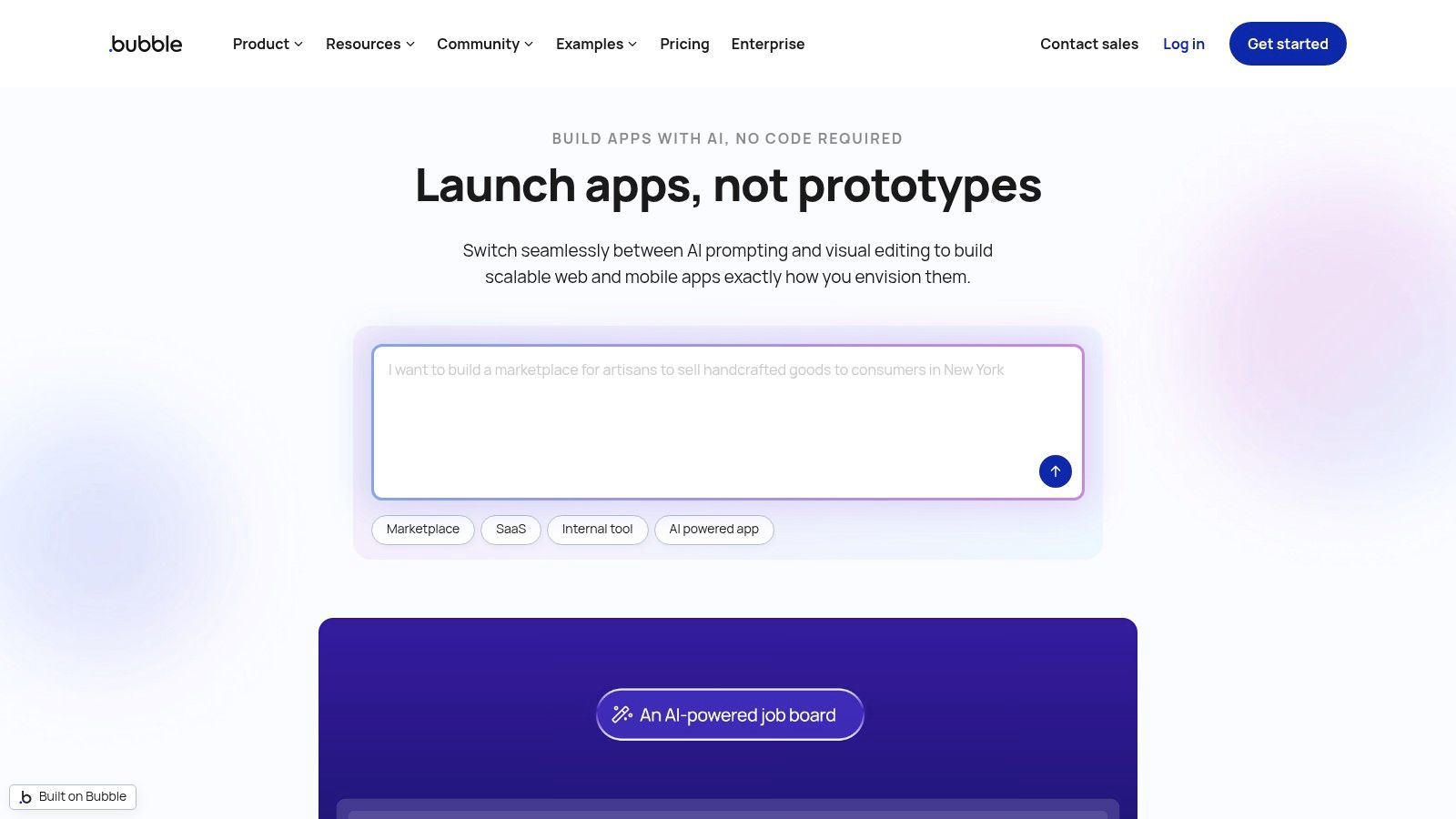
For AI implementation, Bubble relies heavily on its API Connector and community-built plugins. You can easily connect to OpenAI (for text generation, assistants), Anthropic, and other AI services to build features like automated content creators, intelligent chatbots, or data analysis dashboards. While it doesn't offer direct on-chain integrations for crypto projects out-of-the-box, its API flexibility means a skilled builder can connect to blockchain APIs or services like Moralis. For a more direct on-chain approach, an AI app generator like Dreamspace provides built-in functionality. Bubble's approach represents a foundational step in the evolution of visual development, and you can explore more about what no-code development entails to understand its core principles.
Key Features & Use Cases
- AI Integration: Connect to any AI API via the API Connector or use pre-built plugins for OpenAI, Anthropic, and more.
- Ideal Use Cases: Building full-stack SaaS applications, complex internal business tools, and MVPs that require sophisticated AI-powered workflows.
- Strengths: Unmatched flexibility for web app logic, a mature plugin ecosystem, and a large, supportive community.
- Weaknesses: The "workload unit" pricing can be complex to predict, and its native mobile capabilities are still maturing.
Website: https://bubble.io/
3. FlutterFlow
FlutterFlow carves out a unique niche by bridging the gap between low-code visual development and professional native app creation. It is a powerful builder for creating high-performance, cross-platform applications for iOS, Android, web, and desktop using Flutter. Unlike purely no-code platforms, FlutterFlow generates clean, production-ready Flutter code that you can export and own, making it a favorite among developers who want the speed of a visual builder without sacrificing control or scalability.
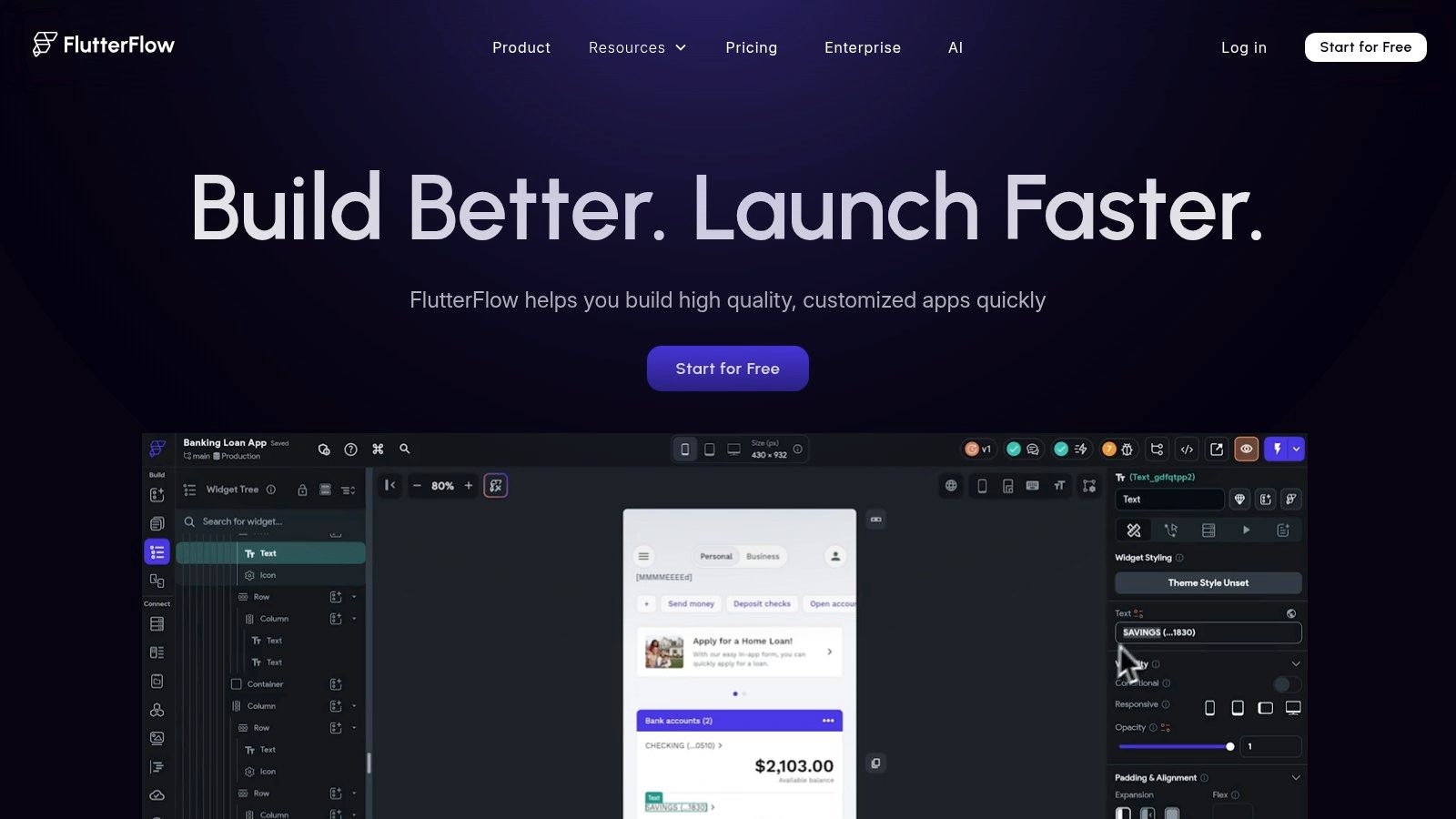
As one of the leading ai app builders for native applications, FlutterFlow has deeply integrated AI into its workflow. Its "AI Gen" feature can generate entire pages or components from a text prompt, while the "AI Agents" capability allows you to connect directly to services like OpenAI, Anthropic, or Google AI. This enables the creation of sophisticated in-app AI features, from intelligent assistants to complex data processing logic. While it lacks direct on-chain integrations for crypto, its full code access and API capabilities allow developers to connect to any blockchain service. To better understand how it fits in the broader ecosystem, you can see how it stacks up against other top low-code development platforms.
Key Features & Use Cases
- AI Integration: Built-in AI Gen for page creation and AI Agents for connecting to OpenAI, Anthropic, and Google AI.
- Ideal Use Cases: Building high-performance native mobile apps for iOS/Android, cross-platform business applications, and complex MVPs with AI functionality.
- Strengths: Generates exportable, high-quality Flutter source code you own, strong mobile-first focus, and one-click app store deployment.
- Weaknesses: Advanced collaboration features like version control and branching are locked behind more expensive pricing tiers.
Website: https://www.flutterflow.io/
4. Appy Pie – AI App Builder
Appy Pie is a prominent no-code platform designed to make mobile app development accessible, particularly for small to medium-sized businesses without technical teams. It stands out by simplifying the journey from idea to app store submission. While it functions as a general app maker, its integration of AI-powered features helps guide users through the creation process, suggesting designs and functionalities. It is one of the more approachable AI app builders for those focused on creating straightforward mobile apps quickly and efficiently.
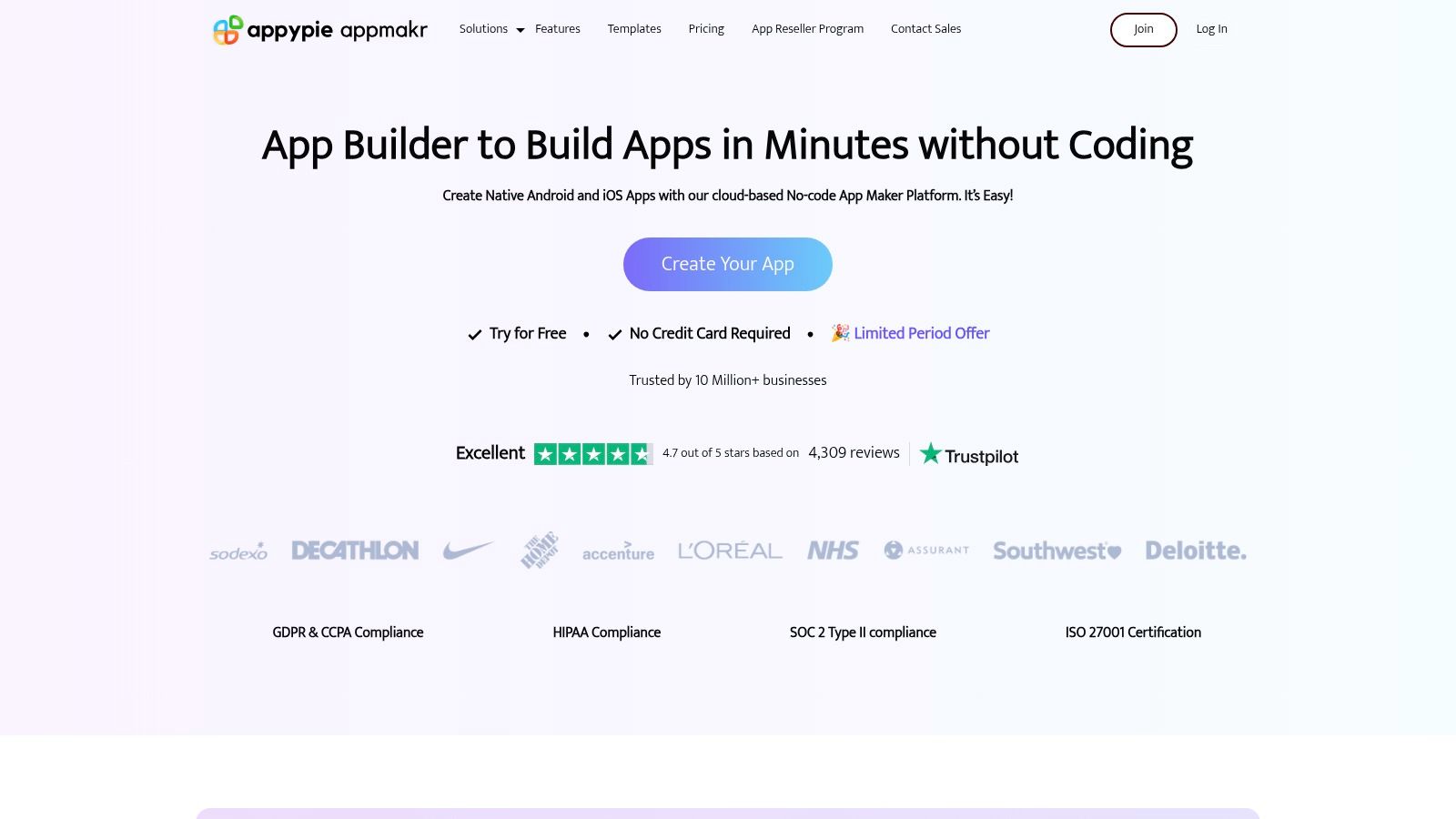
The platform abstracts away the complexities of native development, offering a drag-and-drop interface and pre-built modules for common features like push notifications and loyalty programs. Unlike more developer-centric tools that provide extensive API flexibility for custom AI models or on-chain data, Appy Pie focuses on ease of use. This makes it less suitable for building complex crypto dApps but ideal for businesses needing a functional presence on Google Play and the Apple App Store. For developers seeking more backend control and custom logic, an AI app generator like Dreamspace offers a more robust environment for sophisticated AI app generation. Appy Pie's main value is its guided workflow, including assistance with the often-daunting app store submission process.
Key Features & Use Cases
- AI Integration: AI-assisted creation process that helps with design, feature suggestions, and app structuring.
- Ideal Use Cases: Building simple mobile apps for small businesses, restaurants, or local services; creating informational apps or basic e-commerce storefronts.
- Strengths: Extremely fast time-to-market for basic mobile apps, very approachable for non-technical founders, and clear guidance on publishing to app stores.
- Weaknesses: Limited flexibility for advanced features, iOS publishing is locked behind higher-tier plans, and separate app store developer fees are not included.
Website: https://www.appypie.com/app-builder
5. Retool (with AI and Agents)
Retool is a low-code platform specifically designed for building internal tools, and it has powerfully integrated AI capabilities into its core offering. Unlike more general-purpose AI app builders, Retool excels at creating data-heavy applications like admin panels, dashboards, and CRUD interfaces that need to securely interact with internal databases and APIs. Its recent introduction of "Retool AI" and "Retool Agents" allows developers to embed AI-powered actions, data queries, and automated workflows directly into these internal-facing applications with robust governance.
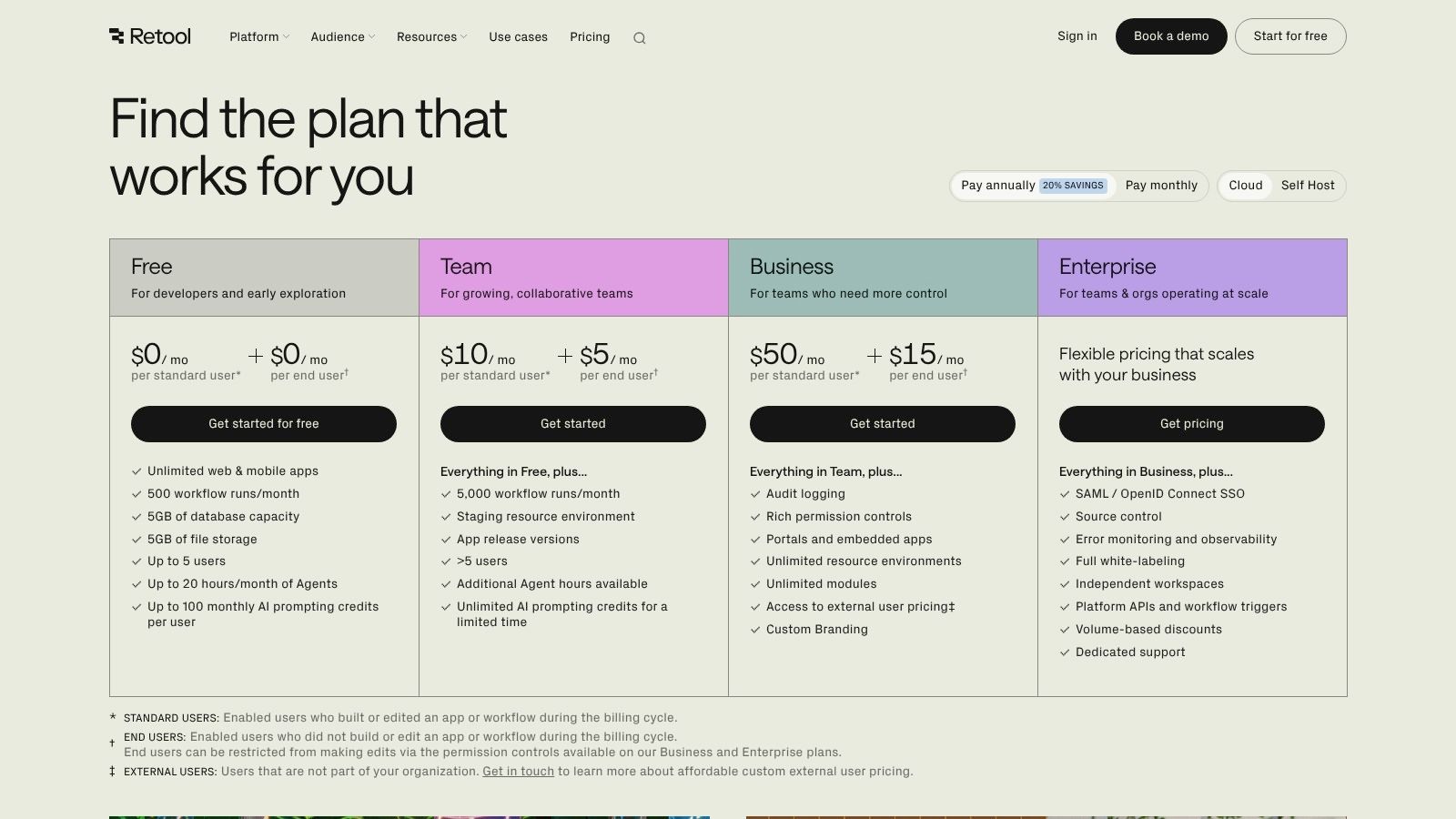
The platform combines a visual, drag-and-drop interface with the ability to write JavaScript anywhere, giving developers the flexibility to build custom logic. For AI implementation, you can use pre-built components to call LLMs, generate SQL queries from natural language, or build multi-step AI workflows. This makes it ideal for augmenting existing business processes, such as a customer support dashboard that uses AI to summarize ticket histories or a marketing tool that generates ad copy. While not designed for on-chain interactions, its API connectivity allows for integration with any blockchain data provider. Retool is less a consumer-facing vibe coding studio like Dreamspace and more of a powerhouse for internal business intelligence.
Key Features & Use Cases
- AI Integration: Built-in Retool AI for actions, workflows, and text generation; Retool Agents for building custom AI-powered assistants.
- Ideal Use Cases: Building AI-enhanced internal tools, data-driven admin panels, customer support dashboards, and operational applications.
- Strengths: Exceptional data connectivity, enterprise-grade security and governance, and flexible deployment options (cloud or self-hosted).
- Weaknesses: Pricing can become expensive as the number of builders or end-users grows, and it is primarily focused on internal, not external-facing, applications.
Website: https://retool.com/
6. Glide
Glide excels at transforming spreadsheets and databases into polished, data-driven web and mobile applications with stunning speed. Its philosophy is data-first, allowing builders to create powerful internal tools, client portals, and dashboards directly from sources like Google Sheets, Airtable, or SQL databases. While it shines in simplicity, Glide has also integrated a suite of AI capabilities, making it a formidable player among AI app builders for teams needing fast, functional solutions. The platform is designed for rapid deployment, offering a smooth user experience with high-quality, pre-built components.
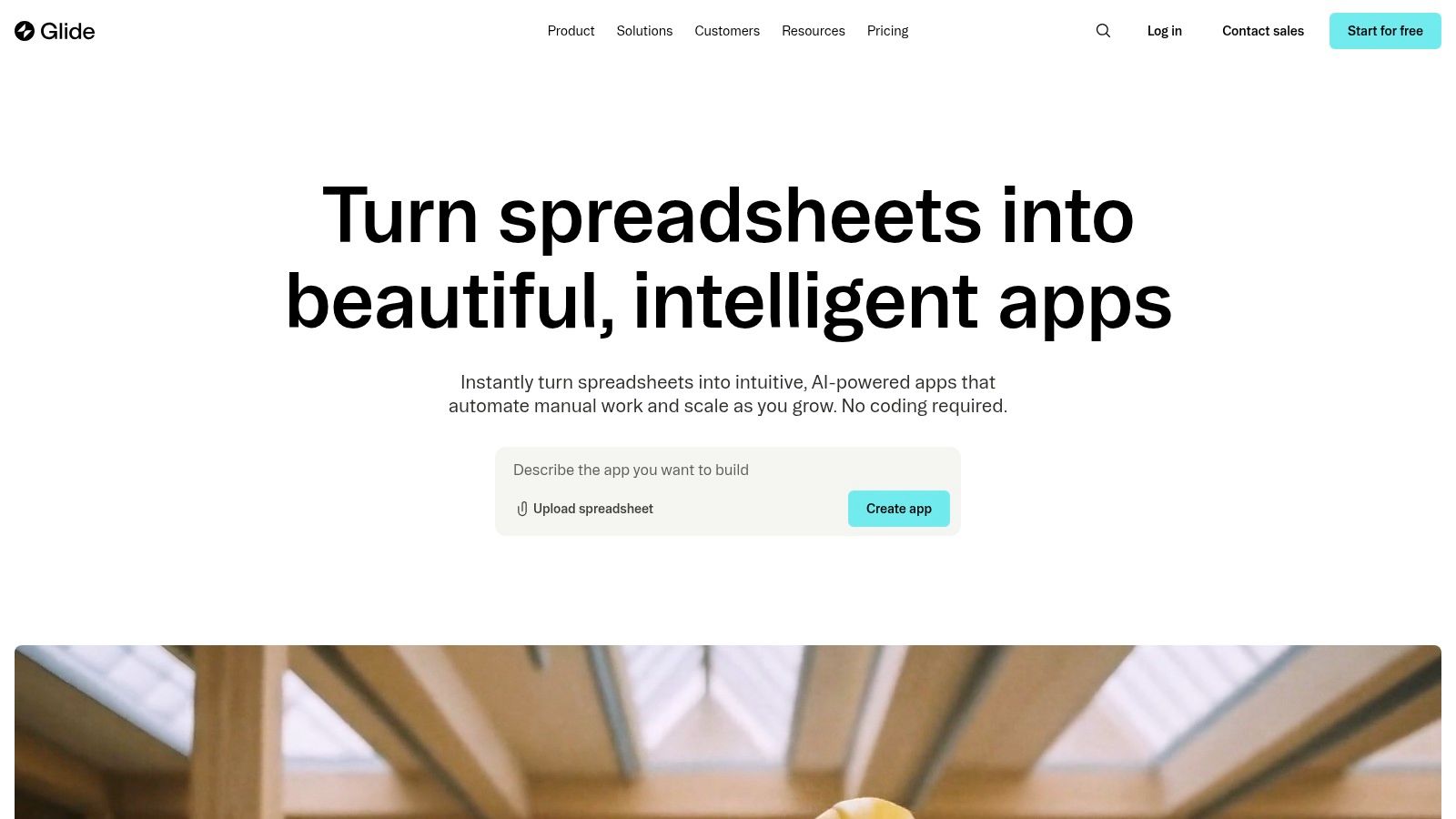
Glide's native "Glide AI" streamlines the process of adding intelligence to your apps. You can generate text, extract information from images, or summarize content without complex API setups, as it's built directly into the workflow engine. This approach is perfect for adding lightweight AI features like automated report summaries or data categorization. While this built-in functionality is convenient, performing more advanced or custom AI logic might still require connecting to external APIs. For teams that want to go beyond templates and build truly bespoke AI applications, a vibe coding studio like Dreamspace provides deeper customization.
Key Features & Use Cases
- AI Integration: Built-in Glide AI for text generation, summarization, and data manipulation directly within the data editor and workflows.
- Ideal Use Cases: Building internal dashboards, inventory management systems, client portals, and mobile-first apps with integrated AI data processing.
- Strengths: Incredibly fast development from data to app, polished UX components out-of-the-box, and clear, predictable pricing plans.
- Weaknesses: Less flexible for complex, custom AI logic, which may necessitate external APIs and higher-tier plans for advanced features.
Website: https://www.glideapps.com/
7. Zapier (Interfaces + Agents)
Zapier has evolved from a simple "glue" for apps into a powerful, automation-first platform for building AI-driven workflows and simple applications. While not a traditional app builder for creating standalone SaaS products, its combination of Interfaces (for UI), Tables (for data), and Zaps (for logic) allows you to construct interactive, AI-powered internal tools and customer-facing portals. The real magic lies in its new AI Agents, which can perform tasks across the 7,000+ apps in its ecosystem.
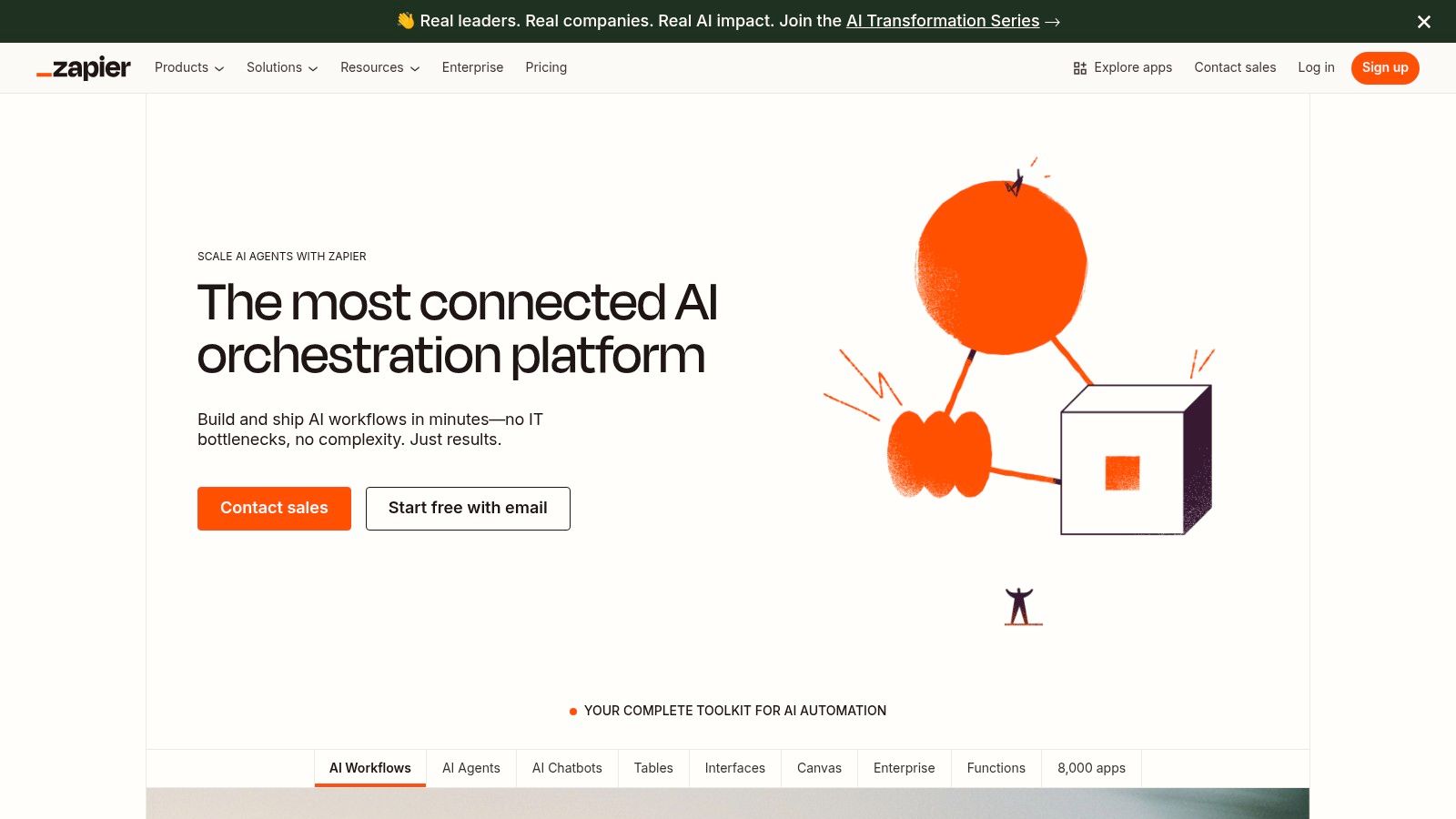
This makes Zapier one of the fastest AI app builders for creating process-centric tools. You can build an AI chatbot that not only answers questions but also creates a lead in Salesforce, sends a Slack message, and adds a row to a Google Sheet, all within a single conversation. Its strength is in connecting disparate systems with an AI brain, making it ideal for operational efficiency. For builders seeking to create more visually rich and custom front-ends, platforms like the AI app generator Dreamspace offer a different approach focused on bespoke user experiences. While Zapier excels at stitching together existing services, its UI capabilities are more functional than design-forward.
Key Features & Use Cases
- AI Integration: Native AI Agents can browse the web, access live data, and trigger actions across thousands of connected applications.
- Ideal Use Cases: Building AI-powered internal tools, automated data entry forms, simple customer support bots, and lead qualification workflows.
- Strengths: Unrivaled connectivity to over 7,000 apps, rapid development for process automation, and a simple pricing model for AI Agents based on activities.
- Weaknesses: Not suitable for building complex, standalone applications; user interface customization is limited, and complex agent behaviors can quickly consume activity limits.
Website: https://zapier.com/
8. Microsoft Copilot Studio
Microsoft Copilot Studio is an enterprise-grade platform designed for building sophisticated AI agents and copilots deeply integrated within the Microsoft ecosystem. It’s a powerful choice for organizations already invested in Microsoft 365 and Azure, as it leverages Power Platform connectors and Dataverse for secure, governed AI solutions. This focus on enterprise needs makes it one of the more robust ai app builders for creating internal support bots, customer-facing agents, and productivity-enhancing copilots that can access and reason over company data securely.
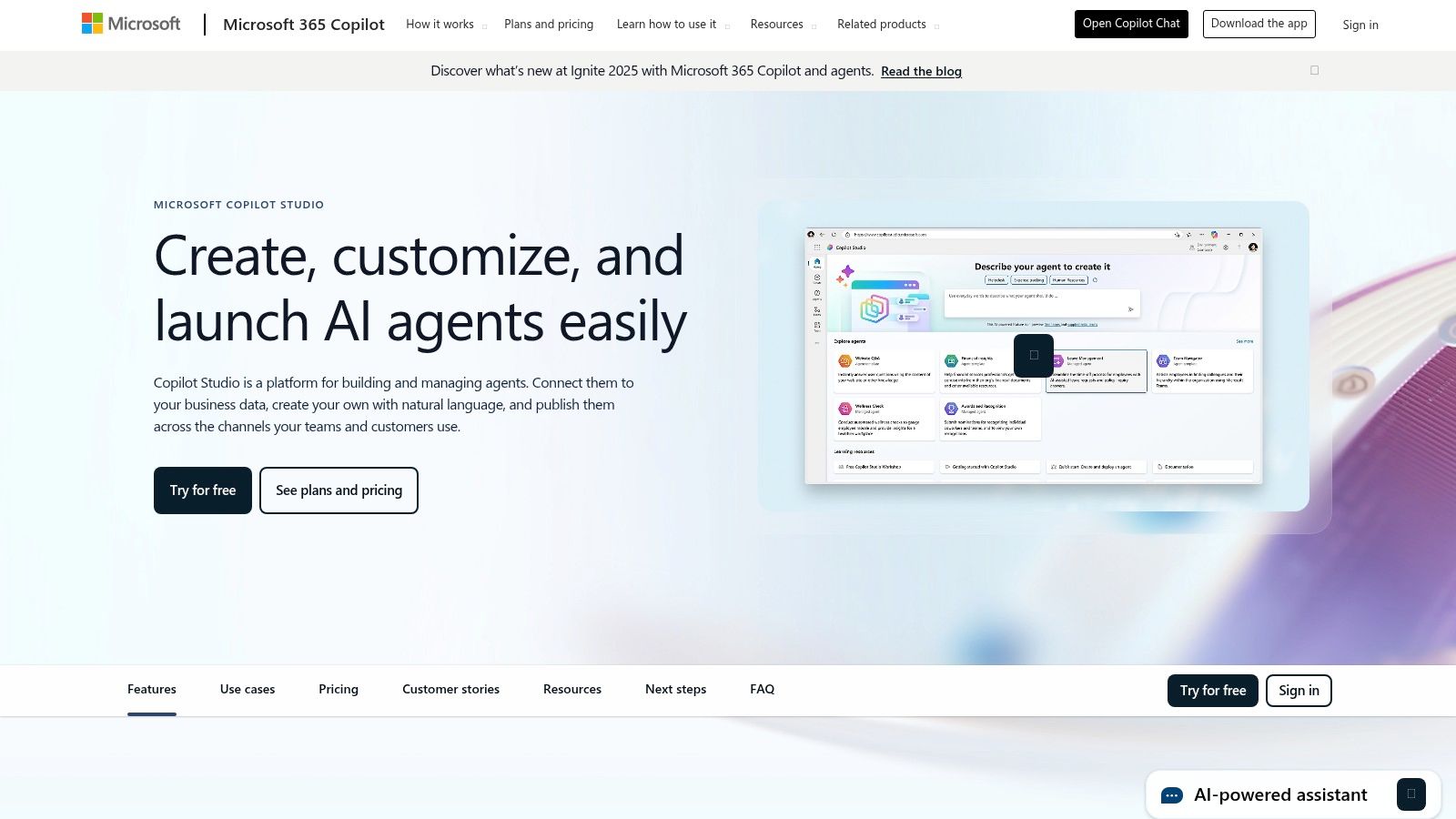
Unlike more open-ended platforms, Copilot Studio excels at structured, data-driven conversations and process automation within a controlled environment. Builders can create agents with interactive voice response (IVR) and multi-agent support, then deploy them across websites, internal apps like Teams, and social channels. While its core strength isn't Web3, the underlying Power Platform's custom connector capabilities could theoretically be used to interact with blockchain APIs, though it’s not a primary use case. For those seeking a more agile, visually-driven experience, a vibe coding studio like Dreamspace might be a better fit.
Key Features & Use Cases
- AI Integration: Native integration with Microsoft Azure AI services and the ability to extend with Power Automate and custom connectors.
- Ideal Use Cases: Building enterprise-grade internal helpdesk bots, external customer service agents for websites, and copilots that automate tasks within Microsoft 365 apps.
- Strengths: Unparalleled integration with the Microsoft ecosystem, strong governance and security features via Power Platform, and multiple deployment channels.
- Weaknesses: The reliance on Azure for agent runtime and a credit-based consumption model can introduce pricing complexity and potential vendor lock-in.
Website: https://www.microsoft.com/en-us/microsoft-copilot/microsoft-copilot-studio
9. Google Cloud Vertex AI – Agent Builder
For developers deeply embedded in the Google Cloud ecosystem, Vertex AI's Agent Builder provides a powerful, enterprise-grade toolkit for creating sophisticated AI agents. This isn't a simple drag-and-drop tool but a comprehensive platform designed for building, deploying, and governing multi-agent systems. It stands out by offering a model-agnostic approach, allowing developers to leverage various models while benefiting from Google's robust infrastructure for runtime, memory, and observability.
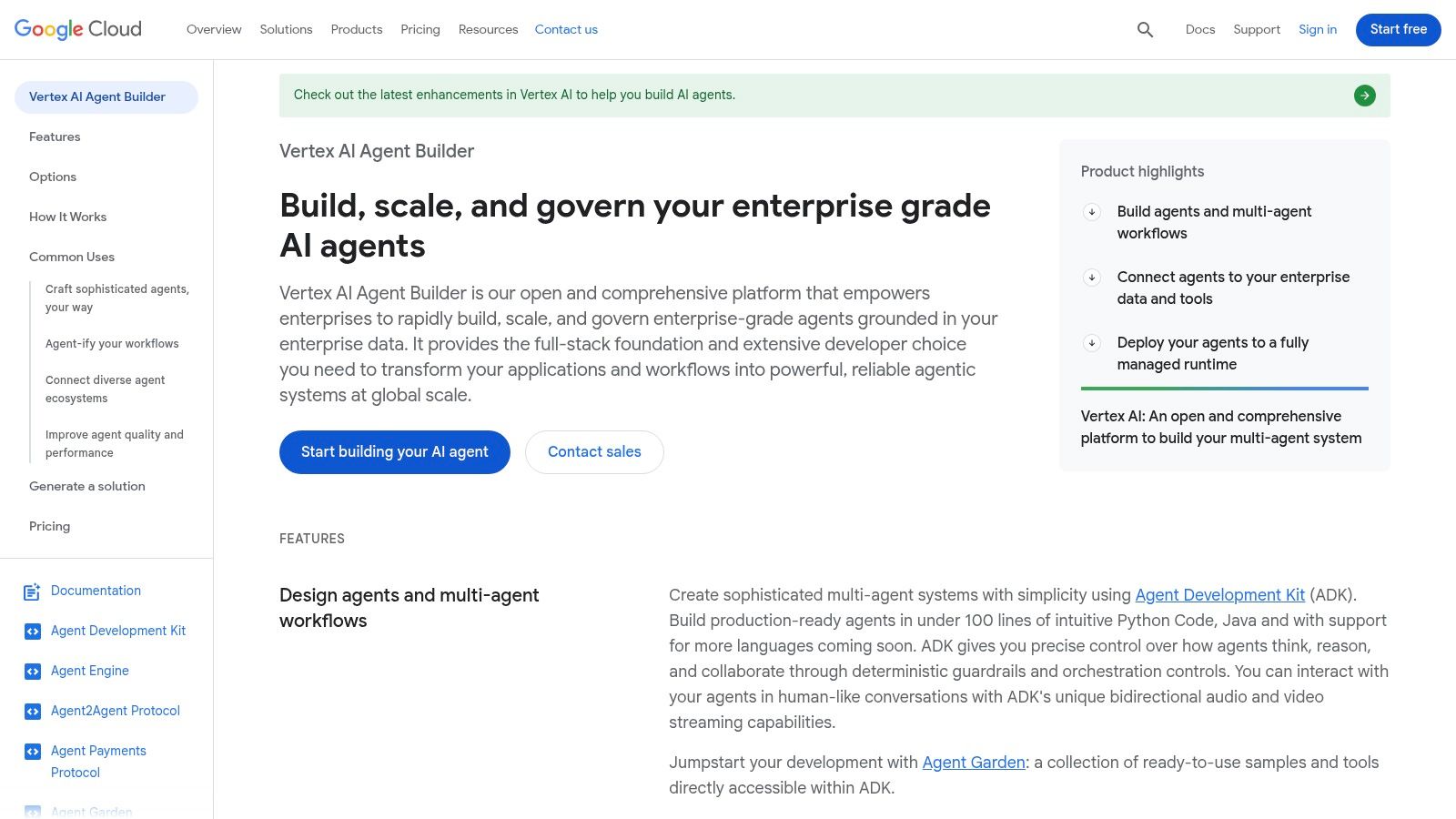
The platform is anchored by its Agent Development Kit (ADK) for Python and Java and a managed Agent Engine that handles the complex runtime environment. This makes it one of the more powerful AI app builders for creating complex, interoperable agents that can communicate and collaborate. Its extensive connectors and advanced retrieval-augmented generation (RAG) capabilities allow agents to access and reason over vast, proprietary datasets. While it requires a Google Cloud setup, its structured approach to agent development is a glimpse into the future of automated systems, a stark contrast to the more visually-driven, rapid prototyping offered by a vibe coding studio like Dreamspace.
Key Features & Use Cases
- AI Integration: A model-agnostic framework with an Agent Development Kit (ADK) for Python/Java and a managed Agent Engine for runtime and governance.
- Ideal Use Cases: Building enterprise-level, multi-agent systems, complex RAG applications, and AI agents requiring deep integration with Google Cloud services.
- Strengths: Exceptional governance and observability features, strong multi-model support, and a generous free tier on runtime resources to get started.
- Weaknesses: Requires familiarity with the Google Cloud Platform, and the pricing model combines both runtime costs and model token charges, which can be complex.
Website: https://cloud.google.com/products/agent-builder
10. AWS – Amazon Bedrock Agents / AgentCore
For developers seeking enterprise-grade control and scalability, Amazon Web Services provides a powerful, low-level foundation with its Amazon Bedrock Agents. Rather than a visual builder, this is a managed stack for constructing highly sophisticated agentic applications using Bedrock's diverse model marketplace. Its strength lies in the modular AgentCore services, which provide discrete components for runtime, memory, browsing, code interpretation, and API gateways, giving developers granular control over their AI app's architecture.
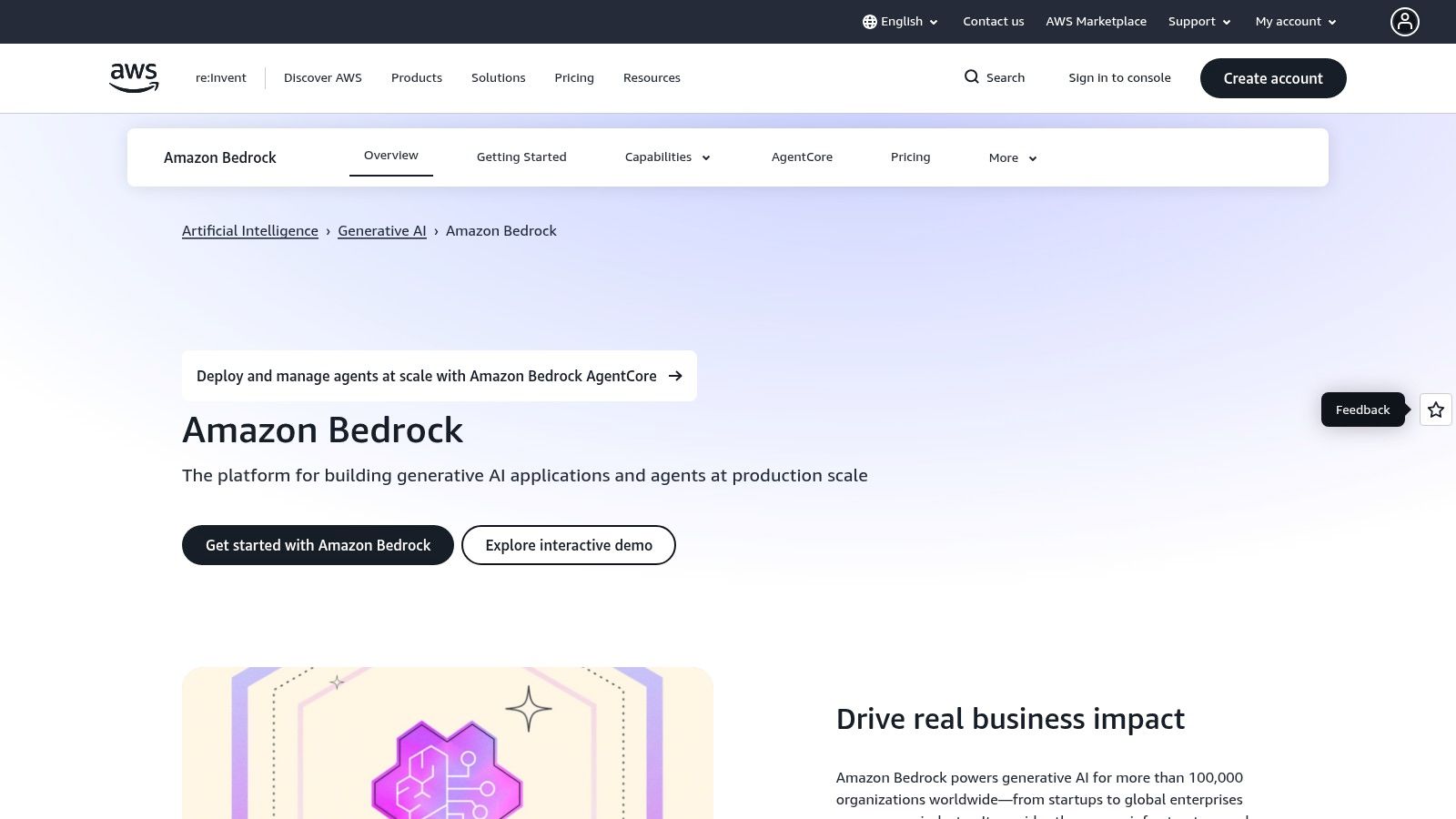
This approach is ideal for teams building complex, secure, and high-performance AI systems that need to integrate deeply with the AWS ecosystem. While it demands a higher technical proficiency compared to visual ai app builders, it offers unparalleled security and compliance through IAM, VPC, and private networking patterns. For crypto applications, this means you can securely connect to self-hosted nodes or private blockchain APIs. While AWS offers the building blocks, an AI app generator like Dreamspace can accelerate development by providing a more intuitive vibe coding experience on top of such powerful infrastructure.
Key Features & Use Cases
- AI Integration: Access a wide range of foundation models from Amazon, Cohere, Anthropic, and others via Bedrock, with modular AgentCore services for building complex agents.
- Ideal Use Cases: Building enterprise-grade internal tools, secure data analysis agents, and high-throughput, low-latency AI applications that require deep AWS integration.
- Strengths: Fine-grained cost control with consumption-based billing, strong compliance and security features, and a provisioned throughput option for guaranteed performance.
- Weaknesses: The pricing matrix across AgentCore components and various model charges can be complex to navigate and predict accurately.
Website: https://aws.amazon.com/bedrock/
11. Hugging Face Spaces
Hugging Face has become the definitive hub for the open-source AI community, and Spaces extends this ecosystem by providing a simple way to host and share live AI applications. It's less of a traditional app builder and more of a specialized hosting platform for AI demos, prototypes, and lightweight production apps built with frameworks like Gradio and Streamlit. This makes it an incredibly powerful tool for developers who want to quickly showcase a model's capabilities without managing complex infrastructure. For builders using a vibe coding studio like Dreamspace, Spaces is an ideal environment to deploy and share the final product.
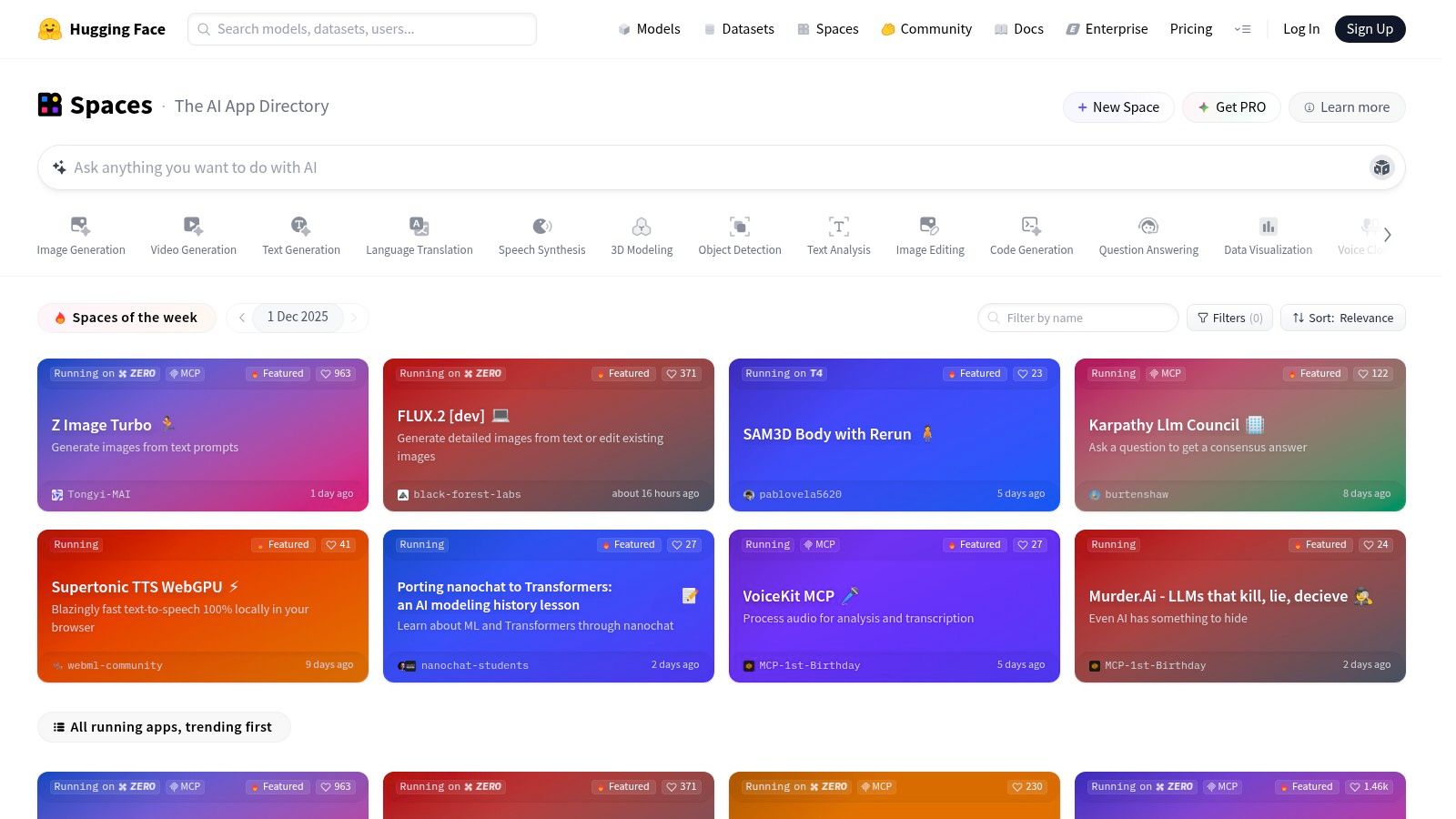
The platform offers free CPU hosting, making it accessible for almost any project, with on-demand GPU and TPU upgrades available at transparent hourly rates. For more robust needs, Hugging Face offers Inference Endpoints, which provide dedicated, auto-scaling infrastructure for production deployments. While Spaces itself does not directly interface with blockchains, its containerized environment allows developers to run custom code, enabling connections to on-chain data APIs or smart contracts if the underlying framework supports it. Its strength lies in speed and community integration, making it a go-to for rapid AI prototyping.
Key Features & Use Cases
- AI Integration: Native hosting for AI/ML models and applications built with popular Python libraries like Gradio, Streamlit, and Diffusers.
- Ideal Use Cases: Publishing interactive AI model demos, building internal data science tools, and hosting lightweight MVPs for community feedback.
- Strengths: Extremely fast to deploy AI prototypes from a Git repository, vibrant community, and flexible hardware choices with clear pricing.
- Weaknesses: Enterprise features like private networking and advanced SLAs require upgrading to Inference Endpoints, which adds cost and complexity.
Website: https://huggingface.co/spaces
12. Vercel v0 (AI app/UI builder) + Vercel Hosting
Vercel v0 is not a full-stack AI app builder but an innovative AI agent focused on rapidly generating user interfaces and front-end code. It leverages generative AI to turn text and image prompts into high-quality, production-ready React components built with Tailwind CSS and shadcn/ui. This makes it an incredibly powerful tool for developers looking to accelerate the UI/UX scaffolding process, allowing them to iterate on designs and get to a functional front-end in minutes rather than hours. It is designed to work seamlessly within the Vercel and Next.js ecosystem.
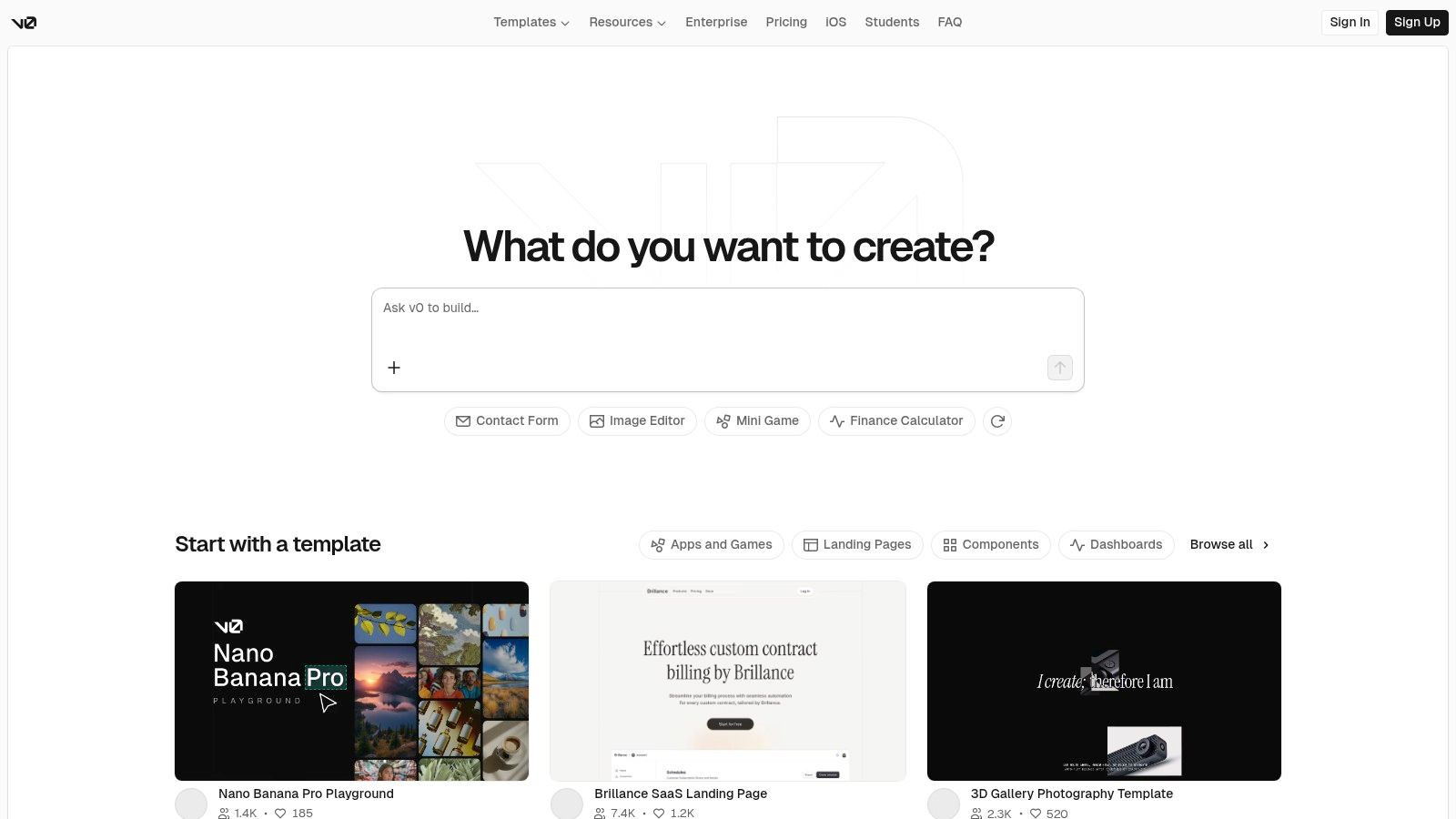
While v0 excels at generating the visual layer, builders must still integrate their own back-end logic, including smart contract interactions or complex AI agent workflows. Its strength lies in its tight integration with Vercel hosting, enabling one-click deployment to a global edge network. This positions it as a go-to choice for developers in the Next.js ecosystem who want AI-assisted front-end creation without sacrificing control over their application's core logic. For those seeking an all-in-one experience, an AI app generator like Dreamspace provides a more complete, full-stack solution. The pricing is token-based, with generous monthly credits for users to experiment freely.
Key Features & Use Cases
- AI Integration: Generates React UI components from text and image prompts, with options to iterate and refine designs.
- Ideal Use Cases: Rapidly prototyping and building front-ends for web applications, creating component libraries, and accelerating UI development for SaaS and dApps.
- Strengths: Unmatched speed for UI generation within the React/Next.js ecosystem, seamless deployment via Vercel, and a clear, token-based pricing model.
- Weaknesses: Limited to front-end UI generation; requires manual coding for back-end logic, state management, and blockchain integrations.
Website: https://v0.dev/
12 AI App Builders: Feature Comparison
The Future is AI-Generated: Your Next Step in App Creation
The landscape of application development is undergoing a seismic shift, and the tools we've explored are at the very epicenter. From versatile no-code platforms like Bubble and Glide to developer-centric frameworks like FlutterFlow and Vercel v0, the message is clear: AI is no longer a futuristic concept but a present-day co-pilot in the creation process. The rise of sophisticated ai app builders has fundamentally democratized development, empowering a new generation of creators, from vibe coders to enterprise developers, to build intelligent, responsive, and innovative applications faster than ever before.
We've seen how platforms are integrating AI at every level. Some, like Appy Pie, focus on simplifying the entire creation workflow, turning a simple text prompt into a functional app foundation. Others, like Retool and Zapier, leverage AI agents to automate complex internal business processes and create powerful data-driven interfaces. For those operating at the frontier of technology, the inclusion of cloud giants like AWS, Google Cloud, and specialists like Hugging Face demonstrates the enterprise-grade potential of AI-native development. This evolution is not just about building faster; it's about building smarter.
Key Takeaways and Choosing Your Builder
Navigating this diverse ecosystem of ai app builders requires a strategic approach. Your choice should not be based on hype, but on a clear-eyed assessment of your project's specific needs, your technical skill level, and your long-term vision.
Here are the critical factors to distill from our analysis:
- For Speed and Simplicity: If your goal is rapid prototyping or building straightforward internal tools and MVPs with minimal code, platforms like Glide and Appy Pie offer the most direct path from idea to deployment. Their template-driven, AI-assisted workflows are designed for speed.
- For Customization and Control: Developers who need granular control over the UI, logic, and backend integrations will gravitate towards FlutterFlow, Retool, or even using Vercel’s v0 for UI generation. These tools provide the flexibility of code without forcing you to build everything from scratch.
- For Enterprise-Grade AI and Agents: When your application demands robust, scalable AI capabilities, such as complex agentic workflows or fine-tuned models, turning to Google Cloud Vertex AI, AWS Bedrock, or Microsoft Copilot Studio is essential. These platforms offer the infrastructure and power needed for mission-critical tasks.
- For the Crypto-Native Builder: The web3 space presents unique challenges. A vibe coding studio like Dreamspace is specifically engineered for this environment, offering native on-chain support and tools tailored for building decentralized AI applications, a crucial differentiator that most generic builders lack.
Your Actionable Next Steps
Before you commit to a platform, map out your project. Start by defining your core user, the primary problem you're solving, and the specific AI capabilities required. Is it a chatbot, a data analysis tool, a content generator, or something entirely new? As AI-generated applications become more sophisticated, integrating external data sources is crucial to effectively power generative AI solutions that are context-aware and truly useful.
Once you have this clarity, use the free tiers or trials offered by these builders. There is no substitute for hands-on experience. Test the learning curve, evaluate the documentation, and engage with the community. This initial investment of time will pay dividends, ensuring the tool you select aligns perfectly with your project's trajectory and your own workflow preferences. The era of the AI-powered developer is here, and with the right tools, you are perfectly positioned to build the future.
Ready to move beyond generic tools and build truly innovative AI-native applications? Dreamspace is the vibe coding studio designed for developers who want to ship fast without sacrificing power. As a dedicated AI app generator, it provides the framework and on-chain support you need to bring your most ambitious ideas to life. Start building with Dreamspace today and discover the future of app creation.