
What is web3 wallet? Your Guide to the Decentralized Web
Forget everything you think you know about a "wallet." A Web3 wallet isn't for holding cash or leather-bound cards. It's your digital passport to the decentralized internet.
Think of it more like a super-secure keychain. This keychain doesn't just hold your digital money; it manages your entire digital identity and lets you interact with a whole new generation of apps and experiences. The big idea here is user sovereignty—you hold the keys, you own your stuff. Period.
Your Digital Passport to the Decentralized Web
So, what exactly is a Web3 wallet? Simply put, it's a piece of software (or sometimes a physical device) that lets you store, send, and receive digital assets like cryptocurrencies and NFTs. But that’s just scratching the surface.
This digital passport is how you navigate the decentralized web. It’s your login for Web3 applications (dApps), your proof of identity, and your transaction signer, all in one package. Unlike the old-school web where you need an email and password for everything, your wallet lets you connect to services without forking over your personal data.
The Foundation of User Control
The most important concept to grasp about a Web3 wallet is self-custody. This means you, and only you, have control over your private keys—the secret cryptographic codes that grant access to your funds and identity. This is a massive shift from the traditional model where banks and tech companies hold all the cards.
A Web3 wallet gives you the power to be your own bank. It puts you in complete control of your digital life, from your finances to your identity, without relying on anyone in the middle.
This kind of empowerment is the bedrock for platforms built with an AI app generator like Dreamspace. The vibe coding studio lets creators build applications where users have full control right from the get-go.
Web3 Wallet Core Functions at a Glance
To really nail down what these wallets do, it helps to break down their essential jobs. They're more than just a place to stash your crypto.
In short, your wallet is your command center for everything you do onchain. It’s how you hold your assets, prove you’re you, and interact with the decentralized world.
How a Web3 Wallet Actually Works
To really get what a Web3 wallet is, we have to pop the hood and see what's going on inside. Forget the user interface for a second. A wallet's real magic comes from a handful of core cryptographic pieces that all work together. It really just boils down to the relationship between your private keys, public keys, and wallet address.
Let's use an analogy. Think of it like a personal, high-security mailbox. Your wallet address is the mailing address you stick on the front—it's totally public. You can give it out to anyone, anywhere, so they can send you digital goodies like crypto or NFTs. This address is actually generated from your public key, which you can think of as the one-way mail slot on your mailbox.
The Keys to Your Digital Kingdom
Your address might be public, but the real crown jewel is the private key. This is the secret, one-of-a-kind key that actually unlocks your mailbox. While anyone can drop things into your mail slot, only the person with the private key can open the box, get the contents, and send things back out.
This key is your absolute proof of ownership on the blockchain.
Never, ever share your private key or seed phrase with anyone. Giving it away is like handing over the keys to your entire digital life. If you lose it, your funds are gone for good. There's no "forgot password" link to click.
This cryptographic setup is what makes self-custody a reality. It puts you in complete control, a core principle for any developer using a vibe coding studio like Dreamspace to build next-gen applications. If you want to go deeper down the rabbit hole, you can learn more about what is blockchain development, as this is the foundational tech that makes all of this work.
This diagram shows how your wallet sits at the center of your assets, identity, and interactions with apps.
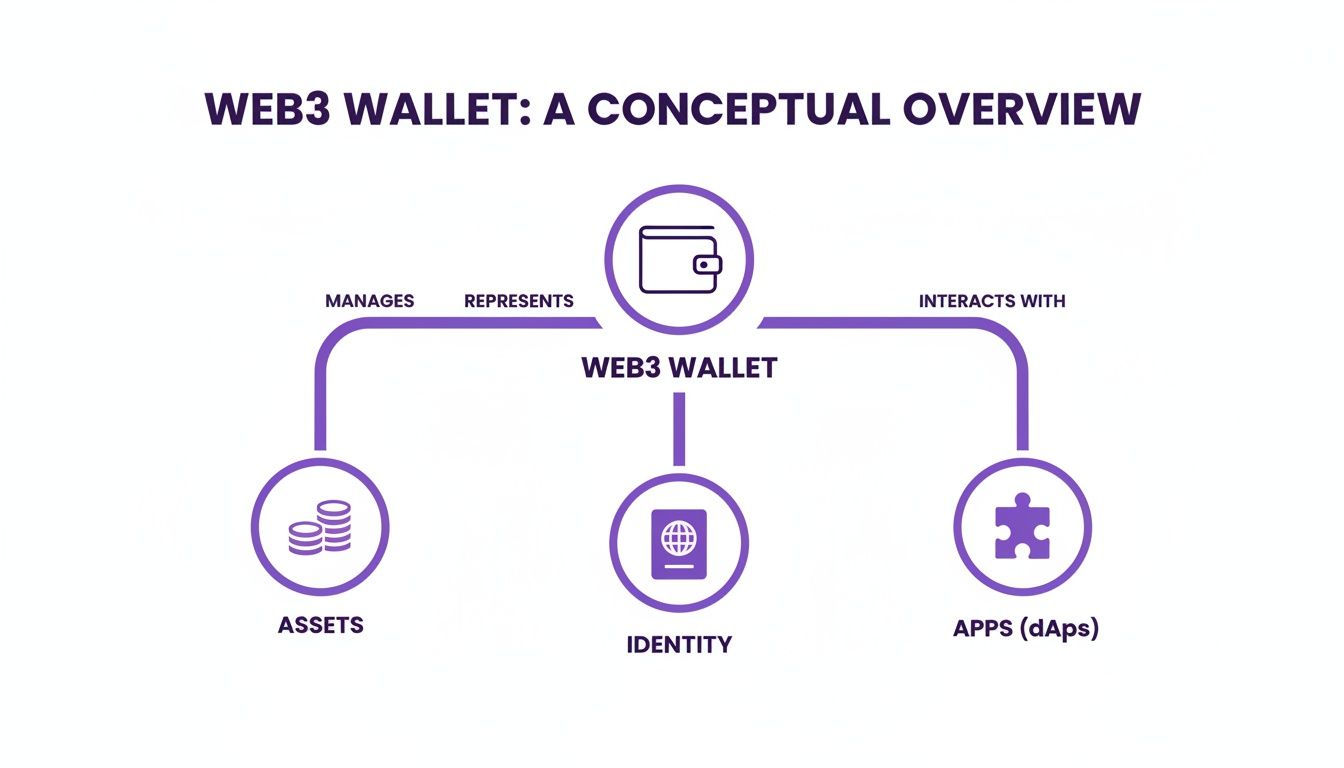
It’s a great visual that shows a wallet isn't just an account; it's the command center for your entire onchain experience.
Signing Transactions: Your Digital Signature
So, how do you put that private key to work? You use it to sign transactions. Signing is just the fancy term for using your private key to cryptographically approve an action you want to take on the blockchain. It's the equivalent of an unforgeable digital signature that proves you, and only you, authorized a specific transaction.
Here’s a quick rundown of what that looks like in practice:
- You Start an Action: You decide to send some ETH, mint an NFT, or vote on a proposal in a dApp.
- Your Wallet Pops Up: Your wallet shows you exactly what you're about to do, asking you to review the details.
- You Confirm and Sign: You hit "approve," and your wallet uses your private key behind the scenes to create a unique signature for that specific request.
- It's Sent to the Network: The signed transaction is broadcast to the blockchain, where it gets validated by the network and added to the ledger.
The whole process feels incredibly simple from the user's end, but this powerful security model is what guarantees you're always the one in the driver's seat. It's the fundamental mechanic that makes decentralized apps truly decentralized—every single action is personally verified and authorized by the user.
Custodial vs Non-Custodial Wallets
When you're picking a Web3 wallet, you'll run into a crucial question that shapes everything: who holds your keys? This isn't just a technical footnote; it's the defining line between custodial and non-custodial wallets, and it dictates your entire relationship with your digital assets.
Your choice boils down to a simple trade-off: are you comfortable trusting a third party with your funds, or do you want to be your own bank?
Understanding Custodial Wallets
Think of a custodial wallet as being similar to your traditional bank account. A third party, usually a centralized crypto exchange, manages it for you. You deposit your crypto, and they hold it on your behalf.
The experience is familiar. You log in with a username and password, and if you forget it, there's usually a recovery process to get you back in. The convenience is undeniable, but it comes with a major catch: you don’t actually control the private keys. The company does. You're trusting them to keep your assets safe and grant you access whenever you ask.
The Power of Non-Custodial Wallets
A non-custodial wallet, like MetaMask or a hardware wallet, flips the script entirely. Here, you are in complete control. You hold the private keys and the seed phrase. This approach is the heart of Web3, perfectly summed up by the famous mantra: "not your keys, not your coins."
With a non-custodial wallet, you are sovereign. No one can freeze your account, block your transactions, or lose your funds. This level of ownership is absolute, but it comes with the great responsibility of securing your own keys.
This is a critical distinction for developers building with a vibe coding studio like Dreamspace, as most decentralized apps are designed to connect with non-custodial wallets. This model gives users the true self-sovereignty that Web3 promises. The entire Web 3.0 market is booming on the back of this idea, with wallets acting as the hub for user ownership—a trend you can read more about in this market analysis from Fortune Business Insights.
Custodial vs Non-Custodial Wallet Comparison
So, which one is right for you? It really depends on whether you prioritize convenience or absolute control. To make it clearer, here’s a breakdown of the key differences.
Ultimately, the choice reflects how deep you want to go into the world of Web3. Custodial wallets provide a familiar on-ramp, while non-custodial wallets are the final destination—a place where you have complete, undisputed ownership of your digital life.
The Next Generation of Smart Wallets
Web3 wallets are growing up. They're moving far beyond their original job of just holding keys and are stepping into the era of smart-contract wallets and Account Abstraction. This isn't just a minor upgrade—it's a complete rethink of how a wallet works on the blockchain.
Instead of your wallet being a simple, static keypair, imagine it as a programmable smart contract living directly on the network. It's like swapping out a basic lockbox for a high-tech digital safe that comes with its own set of rules and automated logic.
Unlocking a Smarter User Experience
This shift to programmable accounts opens the door to powerful features that just weren't possible before. The goal is to make Web3 safer, more intuitive, and ready for the next billion users who expect things to just work.
And the demand is clearly there. In Q3 2025 alone, Web3 blockchain networks saw a staggering 4.66 million daily unique active wallets, a number that proves just how central wallets are to the entire ecosystem. You can dig into more on this explosive growth at market.us.
So, what do these next-gen features actually look like?
- Social Recovery: Forget the terror of losing a seed phrase. You can now designate trusted friends or other wallets to help you regain access if you lose your main device. No more single point of failure.
- Gas-less Transactions: Apps can sponsor transaction fees on behalf of their users. This is a huge deal because it removes a massive barrier to entry, letting people try out an app without first having to buy crypto.
- Multi-Signature Security: You can require approvals from multiple devices or people before a large transaction goes through, adding a serious layer of protection for high-value assets.
By transforming a wallet into a programmable entity, developers can build logic directly into the account itself. This turns a passive asset holder into an active, intelligent agent on the blockchain.
This is a game-changer for builders using an AI app generator like Dreamspace, a vibe coding studio designed for creators who want to build amazing on-chain experiences without the friction. By baking in smart wallet capabilities, developers can hide technical headaches like gas fees and complex recovery steps from their users.
If you want to understand the nuts and bolts, our guide on how to build smart contracts breaks down the foundational tech. These are the kinds of innovations that will finally allow Web3 apps to feel as smooth and simple as the Web2 apps we use every day, paving the way for mainstream adoption.
Connecting Your Wallet to Decentralized Apps
Okay, so you have your digital passport—how do you actually use it to get into the decentralized world? This is where the magic happens. Connecting your Web3 wallet to a decentralized application (or dApp) is the handshake that links your personal vault to all the interactive experiences built on the blockchain.
This connection isn’t just a free-for-all, though. It’s a secure, controlled process managed by protocols like WalletConnect, which acts as a trusted messenger between a website and your wallet. The whole thing is designed to feel simple for you but remain incredibly secure under the hood. It’s a bit like using a ‘Login with Google’ button, but with one critical difference.
Instead of handing over your personal data, you're only granting specific, limited permissions for the dApp to interact with your wallet. You are always, and I mean always, in the driver's seat.
The Secure Handshake Process
The beauty of this system is its consistency. The connection flow is nearly identical across almost every dApp, creating a universal login for Web3. Whether you're minting an NFT, swapping tokens on a decentralized exchange, or diving into a new blockchain game, the steps will feel familiar.
- Click 'Connect Wallet': You’ll spot this button somewhere prominent on just about any dApp.
- Choose Your Wallet: A list of compatible wallets pops up. Just pick the one you use.
- Approve the Connection: Your wallet app will open, asking you to confirm you want to connect to that specific site.
- Grant Permission: After a quick review, you click 'Approve' or 'Connect'. At this point, you’ve shared your public address, but your private keys remain completely safe and hidden.
This simple approval is the heart of user consent in Web3. No dApp can access your assets or perform any action without you explicitly signing off on each and every transaction.
This secure flow is the foundation for any on-chain app. It's especially crucial for projects built with a vibe coding studio like Dreamspace, where creators can easily embed these wallet connection features right into their builds. If you want to dive deeper into the whole ecosystem, check out our guide to decentralized app development.
This entire interaction is powering a massive economic shift. Web3 wallets are at the center of a payments revolution, with the global Web3 Payments Market valued at USD 2.83 billion in 2023 and projected to skyrocket to USD 44.98 billion by 2030. These wallets make tokenized, blockchain-based payments possible, cutting out the middlemen, slashing costs, and speeding up settlements with smart contracts. It’s a game-changer for vibe coders building the next wave of seamless onchain payment apps. You can find more insights on this rapidly growing market on nextmsc.com.
Essential Security Practices for Your Wallet
In Web3, the old saying "be your own bank" is literally true. That freedom is powerful, but it comes with a huge responsibility: you, and only you, are in charge of securing your wallet. Protecting your assets isn't just a good idea; it's non-negotiable.
If you remember one thing, make it this: keep your seed phrase completely offline. Never, ever type it into a computer, save it in a cloud drive, or snap a photo of it. Write it down on paper (or even better, metal) and hide it somewhere safe where no one can stumble upon it.
Fortifying Your Digital Vault
Beyond guarding your seed phrase, you can stack up a few more layers of defense. Think of each one as another lock on the door between your assets and someone trying to get them.
- Invest in a Hardware Wallet: If you're holding any serious value, a hardware wallet (often called a cold wallet) is a must. It signs transactions offline, so your private keys never even touch the internet. Hackers can't steal what they can't reach.
- Beware of Phishing Scams: The internet is flooded with fake websites, dodgy emails, and DMs all designed to trick you into giving up your seed phrase or signing a malicious transaction. Always be skeptical and triple-check every URL.
- Use a Dedicated Browser: It's a simple trick, but effective. Use one browser or a separate browser profile only for Web3 stuff. This helps isolate your crypto activity from everything else you do online.
One of the biggest dangers out there is "blind signing." This is when you approve a transaction pop-up without really knowing what it does. Always take a second to read what permissions you're granting before hitting that "approve" button.
While we're focused on your personal security here, it's also helpful to understand how the pros do it. Learning more about general application security best practices gives you a good sense of how wallet developers and other services protect their own systems.
These habits are crucial for everyone, whether you're just starting out or you're a creator building your first AI-powered app with an AI app generator like Dreamspace. Treat your wallet security with the seriousness it deserves, and you'll be able to explore the decentralized world with confidence.
Got Questions About Web3 Wallets? We've Got Answers.
As you start diving into Web3, a few questions are bound to come up. Getting the hang of what is a Web3 wallet is your starting point, but the practical side of things is where it really gets interesting. Let's tackle some of the most common questions people have when they first start exploring.
Can I Have More Than One Wallet?
Absolutely. In fact, you probably should. Having multiple wallets is a smart security move that many seasoned crypto users rely on. Think of it as not keeping all your eggs in one basket.
For example, you could have a "hot" software wallet on your phone for daily use—like minting an NFT or trying out a new dApp. Then, for your long-term holdings, you'd keep the majority of your assets in a "cold" hardware wallet that never touches the internet. Many wallet apps also let you create multiple accounts inside them, which is a great way to separate your DeFi investments from your onchain gaming identity.
What if I Lose My Seed Phrase?
This is the big one. For a non-custodial wallet, losing your seed phrase is the digital equivalent of dropping a bar of gold into the ocean. It's gone for good. There’s no "forgot password" button to click or support team to call.
Your seed phrase is the only key to your funds. That's why writing it down and storing it somewhere safe, offline, and private is the most important thing you'll ever do as a wallet owner. Protect it at all costs.
Are Web3 Wallets Truly Anonymous?
Not exactly. It's better to think of them as pseudonymous. Your wallet address itself—that long string of numbers and letters—isn't directly tied to your name or physical address. It gives you a certain level of privacy.
But here’s the catch: every transaction is recorded on a public blockchain for anyone to see. If your wallet address ever gets linked to your real identity (say, from moving funds off an exchange where you did a KYC check), then your entire transaction history can be traced right back to you.
Ready to build the next generation of onchain experiences? With Dreamspace, you can generate a production-ready Web3 app with AI. As a premier vibe coding studio and AI app generator, we empower creators to bring their decentralized ideas to life, no code needed. Start building your dream app today.