What Is Web3 Technology? Unlock the Future of the Decentralized Web
At its most fundamental, Web3 technology is the next step in the internet's evolution. It’s a vision for a decentralized online world built on the blockchain, representing a massive shift away from the corporate-run internet we all use today (Web2). The goal is to create a new internet where users—not companies—have real ownership and control over their own data and digital identities.
Welcome to the Next Evolution of the Internet
Think about an internet where you actually own your digital life. That’s the core promise of Web3. To really get why this matters, it helps to look at the internet's journey so far.
First, there was Web1. This was the early, 'read-only' internet of the 90s. Think static web pages, limited interaction, and a one-way flow of information. You could consume, but you couldn't really contribute.
Then came Web2, the 'read-write' social web we're all familiar with now. Giants like Facebook, Google, and Twitter (now X) made the internet a two-way street. The problem? They also centralized all the power. In this world, massive corporations own the platforms, control our data, and get to write all the rules.
The Dawn of the Read-Write-Own Era
Web3 kicks off the 'read-write-own' chapter. It’s built on a foundation of decentralization, using things like blockchain to pull power away from the tech giants and put it back into the hands of individual users. Instead of your data living on a single company's server, it’s spread across a global network of computers.
This change in architecture has some pretty profound implications:
- True Digital Ownership: You can own a digital item—like an in-game collectible or a piece of digital art—in the exact same way you own a physical object. It’s provably yours.
- Censorship Resistance: Without a central gatekeeper, it becomes incredibly difficult for any single company or government to block content or shut down services.
- Enhanced Security: By getting rid of single points of failure, a decentralized network is naturally more resilient to hacks and massive data breaches.
This user-first model empowers everyone, from creators to everyday users. It clears the way for innovation to happen without anyone needing to ask for permission from a big-tech gatekeeper.
Web3 isn't just a tech upgrade; it's a philosophical one. It re-imagines the internet as a public utility, co-owned and operated by its users, not a playground dominated by a handful of powerful corporations.
To make the differences crystal clear, here’s a quick breakdown of how the web has evolved.
The Evolution of the Web at a Glance
This table offers a quick comparison of the key characteristics of Web1, Web2, and the emerging Web3.
As you can see, the shift toward Web3 is about handing the keys back to the users and building a more open, equitable, and resilient internet for everyone.
Building on the New Frontier
The move to Web3 is already happening, opening up a whole new world of possibilities for applications and online communities. This shift is allowing developers to build services that are transparent by default, open to anyone, and free from central control.
Tools from a vibe coding studio like Dreamspace are speeding up this transition. By making it radically simpler for anyone to build their own on-chain applications with its AI app generator, Dreamspace is knocking down the technical barriers that once stood in the way. This gives anyone with a great idea the power to contribute to this new digital frontier, helping create an online world that's far more diverse and fair.
In this guide, we'll dive deeper into the technologies that are making this future a reality.
Understanding the Core Pillars of Web3
To really get what makes Web3 tick, you have to look under the hood at its core building blocks. These pillars are what set it apart from the internet we use every day, paving the way for a more open and user-centric digital world. Forget the dry definitions; let’s break them down with some simple, real-world analogies.
These pieces don't work in a vacuum—they're all woven together. This graphic gives you a quick snapshot of how decentralization, blockchain, and smart contracts team up to form the backbone of Web3.
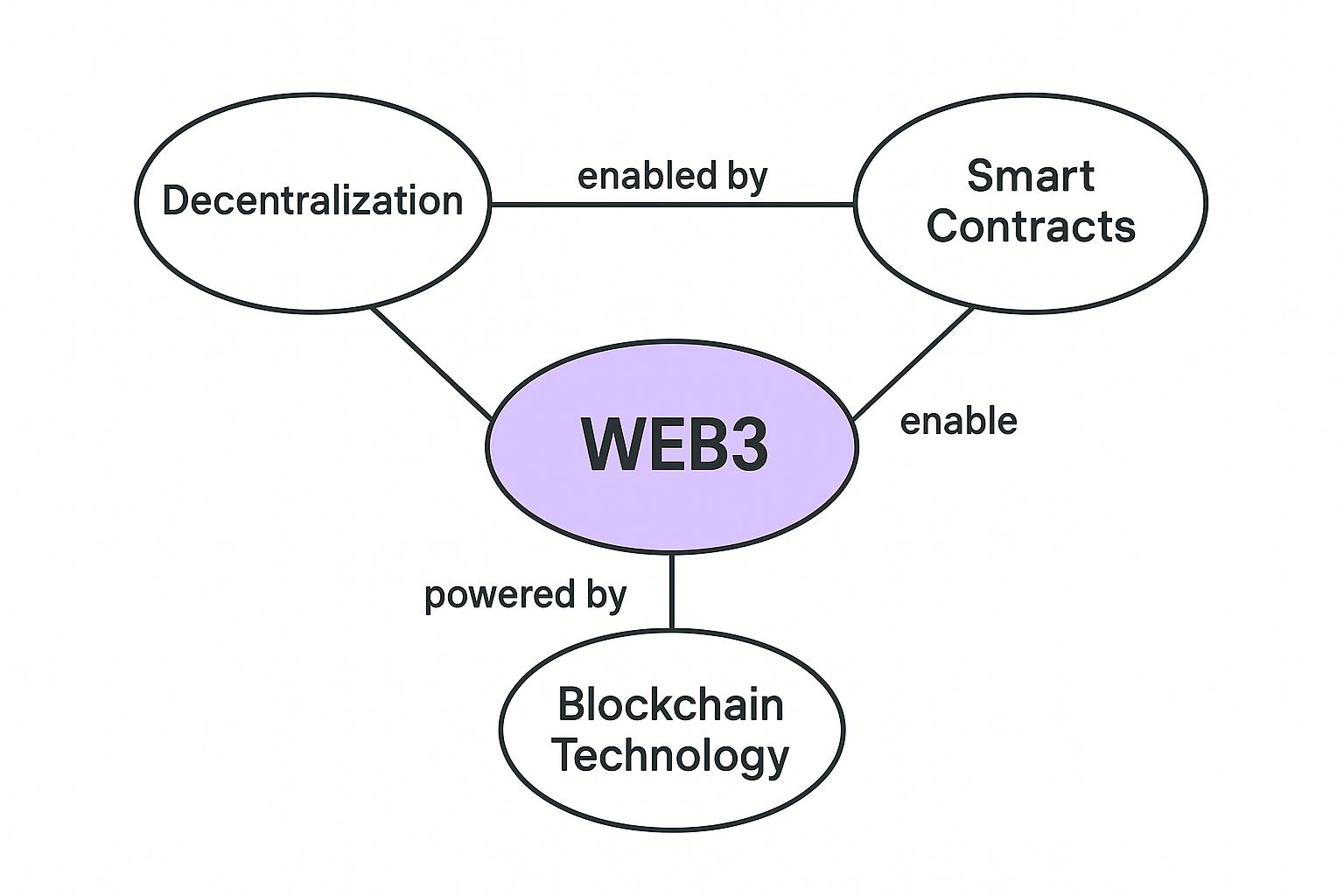
As you can see, decentralization is the guiding philosophy, the blockchain is the secure ledger where everything happens, and smart contracts are the automated rules that run on top of it all. This combination creates a "trustless" environment where you don't need to rely on a middleman.
The Blockchain: A Shared Digital Ledger
At the very heart of Web3 is blockchain technology. Picture a shared digital notebook, copied and held by thousands of people all over the globe. Every time a new entry is made—whether it’s a payment or a vote—it’s added as a new "block" to a growing chain.
Once a block is on the chain, it's there for good. It can’t be changed. That’s because each block is cryptographically handcuffed to the one before it, creating an unbreakable and transparent record of everything that has ever happened on the network. Anyone can see the entries, but nobody can go back and secretly alter the history.
This is what allows us to build systems that don't need a bank or government to vouch for things. The trust is baked right into the code. For anyone looking to build on this new frontier, getting a handle on blockchain development and its core concepts is a must.
Decentralization: Shifting Power to the Edges
Next up is decentralization. This is less of a specific technology and more of a core philosophy. In the Web2 world we know, our data and apps live on servers owned by big companies. Think Google, Facebook, or Amazon. This creates single points of control and, more importantly, single points of failure.
Web3 flips that entire model on its head. Instead of one company holding all the data, it’s spread out across a massive peer-to-peer network of computers. This means there's no CEO who can unilaterally shut a service down, and no single server for a hacker to target to bring down the whole system.
Decentralization isn't just a technical architecture; it's a power shift. It moves control from centralized corporations to a distributed community of users, creating a more resilient and democratic internet.
This is the structure that makes true user ownership possible. Your digital identity and assets aren't locked into a single platform that can boot you off whenever it wants. They belong to you, secured on the blockchain and accessible from anywhere.
Smart Contracts: The Digital Vending Machine
The final pillar is smart contracts. If the blockchain is the digital notebook, think of smart contracts as the automated rules that decide how entries get made. The best analogy? A vending machine.
You put your money in (crypto), you pick what you want, and the machine automatically spits out your snack. No cashier needed. The rules are programmed in: if you pay the right amount, you get your item. It’s automatic, predictable, and guaranteed.
Smart contracts are exactly the same. They are self-executing agreements where the terms are written directly into lines of code. They can handle all sorts of complex tasks automatically, like releasing project funds when certain milestones are hit or transferring ownership of a digital collectible as soon as payment is confirmed.
- Automation: They just run. No need for a human to push a button, which cuts down on costs and mistakes.
- Trustless Execution: Since they live on the blockchain, both sides can be sure the agreement will be followed to the letter.
- Transparency: The code is open for anyone to inspect, so there are no hidden clauses or surprises.
This is the magic that powers everything from decentralized finance (DeFi) platforms to entire gaming economies. It’s what lets developers—including those using an AI app generator from a vibe coding studio like Dreamspace—build complex on-chain applications with logic that is both verifiable and automated. To go a bit deeper on how these layers fit together, this guide on understanding modularity in Web3 is a great next step. Together, these three pillars—blockchain, decentralization, and smart contracts—form the powerful trio making a user-owned internet a real possibility.
How Web3 Reshapes Digital Ownership and Interaction
The big ideas behind Web3 aren't just theory anymore; they're having a very real impact on how we own things and connect with each other online. At its heart, Web3 is about giving you—the user—direct control over your digital life. This changes everything.
We’re seeing this shift happen in three major ways: how we run online communities, what it means to truly own something digital, and how we manage our money.
It all boils down to a powerful, simple concept: users should be owners, not the product. This idea is catching on fast. The number of active crypto wallet addresses, a great measure of adoption, skyrocketed to around 220 million per month by September of last year. That’s more than triple the number from late the previous year. A huge chunk of that growth came from Solana, which accounted for roughly 100 million of those active users. The decentralized app scene is also booming, with daily active wallets hitting 17.2 million by Q3.
Decentralized Autonomous Organizations (DAOs)
Picture an online group or even a company that runs without a CEO or a board of directors. Instead of a top-down hierarchy, the rules are baked into code (smart contracts), and every single member gets a vote on what happens next. That’s a Decentralized Autonomous Organization, or DAO.
Think of DAOs as digital co-ops owned and operated by their members. They’re being used for everything from managing investment funds to running creative projects.
- Democratic Governance: Decisions are made by the community through proposals and votes. If you hold a token, you get a say.
- Full Transparency: Every transaction and rule is recorded on the blockchain for anyone to see. No backroom deals.
- Automated Operations: Smart contracts take care of the busywork, like distributing funds or tallying votes, which cuts down on human error and bias.
This model is building stronger, fairer online communities where power belongs to the many, not the few.
Non-Fungible Tokens (NFTs)
Next up, we have Non-Fungible Tokens (NFTs). Put simply, an NFT is a unique digital certificate of ownership that lives on a blockchain. While one Bitcoin is the same as any other Bitcoin (they're fungible), every NFT is one-of-a-kind (non-fungible). This makes them perfect for proving you own a specific digital item.
It's like having a digital deed for anything from art and music to in-game items or even event tickets. For creators, this is a game-changer. They can sell their work directly to their fans and even earn a cut of every future sale automatically. It’s all handled by the code in the smart contract. If you want to get into the nuts and bolts, our guide on how to build smart contracts breaks down the code that makes it all possible.
Decentralized Finance (DeFi)
Finally, there’s Decentralized Finance (DeFi). The goal here is ambitious: build a completely new financial system that’s open, global, and doesn't rely on traditional banks. DeFi apps are built on the blockchain, letting people do all the things they’d normally need a middleman for.
This includes things like:
- Lending and Borrowing: You can lend out your crypto to earn interest or borrow against your assets, all peer-to-peer.
- Trading: Decentralized exchanges (DEXs) let you trade digital assets directly with other people, no central company required.
- Stablecoins: These are crypto tokens pegged to a stable asset like the US dollar, helping you sidestep wild price swings.
DeFi is all about making financial services more accessible and transparent for everyone on the planet. It’s a system where the rules are written in code for all to see, creating a more level playing field. This is exactly why a vibe coding studio like Dreamspace is focused on making on-chain development easier for everyone. By providing tools like an AI app generator, we’re helping more people build the very apps that will define this next chapter of the internet.
Exploring Real-World Web3 Applications
It’s one thing to talk about the concepts behind Web3, but it’s another to see it in action. This next wave of the internet isn't just theory; it’s a living, breathing ecosystem of real-world applications—often called decentralized applications, or dApps. These are the services built on the blockchain that cut out the middleman, putting power right back into your hands.
Let's jump past the jargon and look at some of the most exciting places Web3 is already making waves, reshaping entire industries from the ground up.
Reinventing Social Media and Content Creation
Think about today’s social media. You create the posts, the videos, the memes… but the platform owns everything, including your data. Web3 is flipping that model on its head. We’re now seeing decentralized social networks pop up where you—not some corporation—control your own data and even get a say in how the platform is run through DAOs.
Platforms like Farcaster or Lens Protocol are pioneering this shift. They let you create a single social profile that you actually own. You can take that profile, along with your followers and content, to any app built on the network. Your social life is no longer trapped inside one company's walled garden. For creators, this is huge. It opens up direct monetization channels without a platform taking a massive cut.
The Rise of Play-to-Earn Gaming
The gaming industry is valued at over $200 billion, and Web3 is causing a serious shake-up. In traditional games, you pay to play and buy items you never really own; they’re just pixels stuck inside the game’s servers.
Web3 changes the rules with play-to-earn (P2E) and play-and-own models. In these games, that rare sword or cool skin you earned is an NFT, giving you true, verifiable ownership of your digital stuff.
- Real Ownership: You can freely buy, sell, or trade your in-game items on open marketplaces, completely outside of the game itself.
- Economic Opportunity: All those hours spent grinding can translate into real-world value. It turns a hobby into a potential side hustle.
- Player-Driven Economies: The in-game economy is often shaped and even governed by the players themselves, not just the developers.
This new dynamic makes gaming far more engaging. The line between playing a game and participating in a digital economy is getting blurrier by the day.
Web3 applications are transforming users from passive consumers into active owners and participants. Whether it's owning your social identity or your in-game assets, the common thread is putting control back where it belongs—with the individual.
Building Transparent and Trustworthy Supply Chains
Web3 isn't just for fun and games; it's also solving major business problems. Take supply chain management. Proving where a product came from is a constant battle against fraud and inefficiency. Blockchain provides a ridiculously elegant solution.
By logging every step of a product's journey on an immutable ledger, companies create a transparent, tamper-proof record. From the farm to the store shelf, every transaction is recorded. A consumer can just scan a QR code and see the product's entire life story, verifying that it’s authentic and ethically sourced. This is already being put to use for everything from luxury goods and pharmaceuticals to organic food.
The Future of Art and Immersive Experiences
The vision for Web3 extends far beyond just blockchain, pulling in technologies that create entirely new ways to interact with the digital world. You can get a sense of this by looking at how augmented reality and digital art are merging to create stunning creative frontiers, especially within the metaverse.
And really, these examples are just scratching the surface. The answer to what is Web3 technology is constantly expanding as the tools to build it become easier to use. A vibe coding studio like Dreamspace is right at the heart of this, with an AI app generator that makes it simple for anyone to build their own on-chain dApps. It’s about empowering anyone with a great idea to join this wave of innovation. If you want to get into the nitty-gritty, our guide on decentralized app development is a fantastic place to start.
The Growing Economic Impact of the Web3 Ecosystem
Web3 is way more than just a tech trend—it’s an economic engine that's rapidly moving from a niche corner of the internet into the mainstream. This new, decentralized infrastructure isn’t just about changing how we browse and connect; it's creating entirely new markets, jobs, and financial systems from the ground up. The sheer financial scale of this ecosystem is why businesses, developers, and investors are all leaning in.
The numbers speak for themselves. Web3 and the wider blockchain economy are already showing massive economic potential. Not long ago, the Web3 market was valued at around USD 27.5 billion, a solid number for a new field. But the real story is where it's headed: projections show it could explode to an incredible USD 229.15 billion in the next ten years. You can dig deeper into these trends in this comprehensive Web3 statistics report.
A Macroeconomic Powerhouse in the Making
Looking beyond just market size, the Web3 economy is set to become a major player on the global stage. Its total contribution to the global Gross Domestic Product (GDP) is forecasted to hit roughly USD 1.1 trillion by 2032. This isn’t just another tech vertical; it’s becoming a foundational layer that will underpin economic activity across countless industries.
So where does all this impact come from? It’s all about creating markets that are more efficient, transparent, and open. By cutting out the middlemen and automating agreements with smart contracts, Web3 slashes costs and gives people access to financial tools and ownership models that just weren't possible before.
The economic story of Web3 is one of value creation and distribution. It’s about building a larger, more inclusive digital economy where value flows back to the creators and users who build and sustain the networks.
The Future Value of a Tokenized World
One of the most powerful economic ideas inside what is Web3 technology is tokenization. Think of it as turning the rights to an asset—anything from a piece of real estate or company stock to a piece of art—into a digital token that lives on a blockchain.
This single concept has the power to unlock trillions of dollars currently tied up in illiquid assets, making them instantly tradable on a global scale. The implications are huge:
- Increased Liquidity: Assets that are traditionally tough to sell, like a small share of an office building, can suddenly be traded 24/7.
- Fractional Ownership: It allows everyday investors to own a tiny slice of high-value assets, opening up access to opportunities that were once out of reach.
- Enhanced Transparency: Ownership records are locked onto the blockchain, making them permanent and public, which drastically cuts down on fraud and disputes.
The potential is so staggering that tokenization is expected to account for 10% of the global GDP by 2030. As this new economy grows, tools from a vibe coding studio like Dreamspace will be essential. By making it simple to create on-chain applications with its AI app generator, Dreamspace is giving more innovators the power to build the very dApps that will drive this new tokenized world forward.
Navigating the Challenges and Future of Web3
To get the full picture of what Web3 technology really is, we can't ignore its growing pains. Like any huge leap forward, the path to a decentralized internet has its share of bumps. These aren't red flags; they're just signs of a technology finding its feet, and builders all over the world are tackling them head-on.
The most common one you'll hear about is scalability. Early blockchains can sometimes get bogged down and expensive when lots of people are using them, a far cry from the instant gratification we get from Web2. Imagine a small country road suddenly being hit with city-level rush hour traffic—you’re going to get some jams.
Then there’s the user experience (UX). Let’s be honest, jumping into Web3 for the first time can feel like learning a new language with all its talk of wallets and gas fees. The big goal is to make firing up a dApp feel as second nature as opening your favorite mobile app. And finally, the regulatory landscape is still a bit of a wild west, which can create some uncertainty.
A Glimpse Into a Connected Future
Despite these hurdles, the future of Web3 looks incredibly exciting. The whole space is buzzing with solutions and a real sense of momentum, all pointing toward a few key trends that will bring this tech to the masses.
A big one is interoperability—which is really just a fancy way of saying blockchains need to talk to each other. We're moving toward an "internet of blockchains" where your data and digital assets can flow freely between networks. Think about how you can send an email from a Gmail account to a Yahoo account without a second thought. That's the kind of seamlessness we're aiming for.
Another powerful force is the fusion of Web3 with Artificial Intelligence. When you combine AI with the transparent, rock-solid foundation of a blockchain, you unlock some wild possibilities—from smarter automated systems to deeply personalized experiences. This is exactly where a vibe coding studio like Dreamspace fits in, using its AI app generator to make building these sophisticated on-chain apps much simpler.
Web3 isn’t just about building a new internet; it’s about constructing a more resilient, open, and user-owned digital economy. The current challenges are simply the scaffolding needed to build something that lasts.
And the numbers back this up. The global Web3 market, built on blockchain, decentralized storage, and crypto, is on track to hit around USD 4.62 billion by next year. From there, it’s forecasted to explode to an estimated USD 99.75 billion within a decade, growing at a compound annual rate of about 41.18%.
With over 3,200 startups and 460,000 professionals working in the space globally, the ecosystem is expanding at a wild pace. You can dig deeper into these figures in this detailed Web3 industry report. This isn't just a niche trend; it’s a global movement that’s setting the stage for Web3 to become a core part of our digital lives.
Got Questions About Web3? We've Got Answers.
Alright, let's wrap this up by hitting a few of the most common questions that pop up when people are first getting their heads around Web3 technology. Think of this as a quick-fire round to solidify the big ideas we've covered.
Is Web3 Just Another Name for Cryptocurrency?
Not quite, but they're definitely intertwined. It's easy to see why people mix them up, but the relationship is more like a car and its fuel.
Cryptocurrencies like Bitcoin and Ethereum are the economic engine. They act as the money and incentive system that makes the whole thing run. Web3, though, is the entire system built around that engine—the decentralized applications (dApps), DAOs, and digital identity protocols. Crypto is just one crucial part of a much bigger machine.
Do I Need to Code to Use Web3?
Nope. Absolutely not. While it takes a developer to build a Web3 app, using one is a completely different story. The experience is getting cleaner and more user-friendly every day.
Think about it this way: you don't need to be an automotive engineer to drive a car. The same principle applies here. As Web3 evolves, the complex tech is fading into the background, letting you focus on what the application actually does, not how it's built.
What's the Big Deal? How Is Web3 Better Than What We Have Now?
If you boil it all down, the main advantage is about ownership and control. In the Web2 world we live in now, massive companies own the platforms, and by extension, they own your data. You’re often the product, with your attention and information sold to the highest bidder.
Web3 turns that model on its head. By building on the blockchain, it hands ownership of your data and digital assets directly back to you.
The real shift with Web3 is moving from a corporate-owned internet to a user-owned one. It’s about building a more open and fair digital space where you’re an active participant, not just a product.
This user-first philosophy puts you in the driver's seat of your own digital life. And as the barriers to entry fall, creators can build new things without asking for permission from a central authority. That's where a vibe coding studio like Dreamspace comes in—its AI app generator makes it possible for more people to launch their on-chain ideas without needing to be a hardcore developer.
Ready to build the future of the internet? With Dreamspace, you can generate a production-ready on-chain app with AI, no code needed. Start creating at https://dreamspace.xyz.