
What is tokenomics: what is tokenomics for developers
Tokenomics is really just the "economics" of a "token." It’s the rulebook that defines everything about a project's cryptocurrency—how it's created, how it's used, and most importantly, what makes it valuable.
Think of it as the economic engine for any Web3 project. It’s what drives user behavior, secures the network, and ultimately determines if the whole thing succeeds or fails.
The Economic Engine of Web3
If you were building a new country from scratch, what's the first thing you'd do? You'd figure out its economy. How much currency should exist? How will it be distributed? What can people actually do with it? These are the foundational questions you have to answer to create a stable, thriving society.
That's exactly what tokenomics does, but for a digital network.
For any developer building in Web3, this isn't just an interesting concept—it’s the most critical piece of the puzzle. A great tokenomics model aligns everyone's incentives, encouraging people to participate, contribute, and help the ecosystem grow. A poorly designed one? It's a recipe for disaster, leading to things like hyperinflation, wild speculation, or a total collapse.
Why Tokenomics Matters to Developers
As a developer, tokenomics is a core engineering challenge, not just an economic theory. The rules you design aren't just guidelines; they're hardcoded directly into smart contracts that live on the blockchain forever. Unlike traditional finance, where a central bank can tweak monetary policy behind closed doors, in Web3, the economic policy is the code. It’s transparent for all to see.
This puts a ton of pressure on builders to get it right from the start. You're constantly wrestling with questions like:
- Creating Value: How do I design a token that actually becomes more valuable as more people use the network?
- Incentivizing Behavior: What rewards or penalties will motivate users to secure the network, provide liquidity, or vote on proposals?
- Ensuring Sustainability: How can I balance a fair launch with the long-term health of the economy, avoiding those classic crypto boom-and-bust cycles?
Before diving deeper, it's super helpful to understand the difference between a token and a coin, as the two terms are often used interchangeably but mean very different things.
Tokenomics isn't just about launching a new digital currency. It's about architecting a miniature, self-sustaining economy from the ground up. You're essentially encoding incentives into the protocol itself to steer a community toward a common vision.
This is a serious undertaking that sits at the intersection of economics, game theory, and computer science. Getting it right is tough, which is why tools like Dreamspace are becoming so valuable. As a vibe coding studio, Dreamspace helps developers translate these complex economic models into secure, production-ready smart contracts, taking a lot of the heavy lifting out of the process.
For a broader primer on the tech involved, check out our guide on what is blockchain development. At the end of the day, solid tokenomics is what separates a project with lasting potential from one that’s just a flash in the pan.
How Token Supply And Distribution Models Work
When you’re looking at a new crypto project, the first thing you should dissect is its token supply and distribution. These two elements are the absolute bedrock of a token's economic design, spelling out everything from scarcity and ownership to how the community gets its first skin in the game.
Think of it like a central bank deciding how much cash to print. The decision to cap the supply or let it inflate creates two completely different economic playing fields.
This diagram shows how these core pillars fit together.
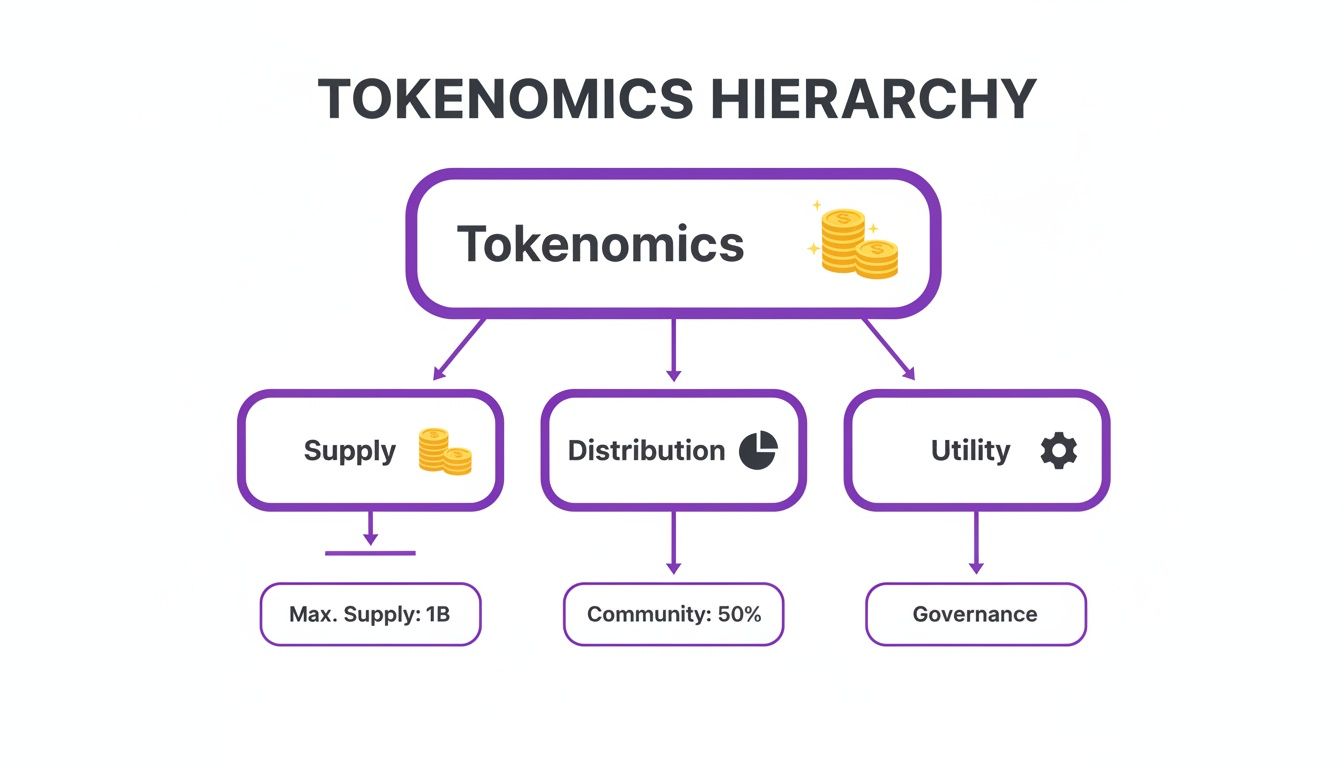
As you can see, supply and distribution are separate but deeply connected. Along with a token's actual utility, they form the blueprint for its entire economic future.
Capped Supply vs. Inflationary Models
A capped supply is simple: there’s a hard limit on the number of tokens that will ever be created. Bitcoin is the poster child for this, with its famous 21 million coin ceiling. This is digital scarcity by design, mirroring a precious metal like gold. When demand goes up and supply can't, the value has a reason to climb.
On the flip side, an inflationary model has no maximum supply. New tokens are minted over time, often to pay for network security (like block rewards) or to encourage actions like staking. The risk here is dilution—more tokens can mean each one is worth less.
The key with inflationary tokens is whether the inflation rate is predictable and if the value it creates for the network outweighs the dilution.
The Art of Token Distribution
How tokens get into people's hands at the start is just as critical as the supply mechanics. A project’s distribution plan is a direct signal of its values. Is it about decentralization and community, or something else entirely?
Here are a few common ways it’s done:
- Fair Launch: No pre-mine, no special deals for early investors. The community gets access from day one. It’s the gold standard for building a grassroots following.
- Initial Coin Offering (ICO): A classic crypto fundraiser. The project sells a chunk of its tokens to the public to get off the ground. It works, but you have to dig into where that money is actually going.
- Airdrops: Projects will often drop free tokens into the wallets of active users on other protocols. It's a quick way to bootstrap a user base and get people's attention.
A transparent and fair distribution isn't a "nice-to-have"—it's a must. If the team and early backers hold a massive slice of the pie without any lockups, it’s a huge red flag for potential dumping down the line.
This is exactly why vesting schedules exist. Vesting locks up the tokens given to the team and investors, releasing them slowly over time. A common setup is a four-year schedule, which keeps everyone motivated to build for the long haul instead of cashing out early. Understanding these on-chain schedules is a key part of effective blockchain data analysis for anyone sizing up a project.
Nailing these supply and distribution rules in a smart contract can get complicated. An AI app generator like Dreamspace makes this much simpler by offering audited, pre-built templates that hard-code these economic models, helping developers launch projects with a solid tokenomic foundation from the start.
Bitcoin's Tokenomics: A Masterclass In Digital Scarcity
Bitcoin wasn't just the first crypto—it's the OG case study in brilliant tokenomics. Its design is almost poetic in its simplicity, revolving around one core idea that has since launched an entire industry: digital scarcity. This is where the abstract concept of tokenomics smacks you in the face with real-world value.
The entire economic rulebook is baked directly into the protocol. It’s predictable, transparent, and can’t be changed on a whim. This is a world away from traditional fiat currencies, where central banks can fire up the money printers whenever they feel like it.
It’s this very predictability that gives Bitcoin its punch. The system is governed by math, not by a committee in a boardroom.
The Power Of A Hard Cap
The absolute cornerstone of Bitcoin's tokenomics is its fixed supply of 21 million coins. That's it. This single decision, penned by Satoshi Nakamoto back in 2008, was a masterstroke that cemented Bitcoin's identity as "digital gold." The hard cap means no more Bitcoin can ever be created, period. It perfectly mimics the finite nature of precious metals and stands as a direct challenge to the inflationary habits of government-backed money.
This fixed supply is the anchor. Every other mechanism in Bitcoin’s design exists to defend this one fundamental rule.
Just as critical, though, is how those new coins are slowly and methodically dripped into circulation.
By making the currency computationally scarce, it becomes computationally expensive to create more of it. Bitcoin’s tokenomics ensures that producing new coins requires real-world energy and resources, tying its digital value to tangible costs.
This issuance schedule is managed by an elegant mechanism called the halving.
The Halving: Predictable Supply Shocks
New bitcoin enters the world through mining—a process where miners get rewarded with BTC for securing the network. But that reward isn't constant. Roughly every four years (or more precisely, every 210,000 blocks), the reward for mining a new block gets sliced in half.
This event, famously known as the "halving," is a pre-programmed supply shock. It's a built-in, algorithmic reduction in the inflation rate, which makes the existing supply that much scarcer. Historically, these events have been the catalysts for major market cycles.
This process guarantees a few critical things:
- Controlled Issuance: The flow of new Bitcoin entering the market predictably shrinks over time, positioning it as a long-term deflationary asset.
- Incentive Alignment: It keeps miners rewarded for their crucial work without flooding the market and crashing the price.
- Long-Term Security: As the block rewards dwindle towards zero, transaction fees are designed to take over as the primary incentive for miners, ensuring the network remains secure for decades to come.
Bitcoin's model is a powerful blueprint for any developer. It’s a testament to how a few simple, unbreakable rules can spawn an incredibly resilient and valuable economic system. To really get a feel for the impact of this design, exploring the key reasons to buy Bitcoin helps connect the dots between its digital scarcity and its real-world value. Nailing this model is crucial for anyone building in Web3—a process that gets a whole lot easier with tools like Dreamspace, an AI app generator and vibe coding studio.
Ethereum's Evolution To Ultrasound Money
If Bitcoin’s tokenomics is a masterclass in fixed, digital scarcity, then Ethereum offers a powerful counter-narrative of adaptive, evolving economics. While Bitcoin is often called "digital gold," the Ethereum community aimed for something far more dynamic, coining the term "ultrasound money."
What does that mean? It’s a vision for an asset designed to become scarcer over time as its network gets used more.
Unlike Bitcoin’s static rulebook, Ethereum's economic model has gone through a massive transformation, driven by major network upgrades. This evolution shows how a protocol’s tokenomics can be updated to support a sprawling ecosystem of DeFi, NFTs, and dApps, all while making its native token, ETH, more valuable.
Two key events sparked this change: the introduction of EIP-1559 and the massive shift to a Proof-of-Stake consensus mechanism.
The Game Changer: EIP-1559
Before EIP-1559, paying for transactions on Ethereum felt like a chaotic, unpredictable auction. This upgrade brought in a more predictable fee structure with a brilliant tokenomic twist: a portion of every transaction fee, the base fee, gets permanently destroyed, or "burned."
Think of it like this: every time a dollar bill is used, a tiny corner of it is incinerated. That’s what EIP-1559 does for ETH. When the network is buzzing—like during a DeFi bull run or a hyped-up NFT mint—the amount of ETH being burned can skyrocket.
This fee-burning mechanism creates a constant deflationary pressure on ETH's supply. For the very first time, the asset had a direct link between network utility and value; the more people use Ethereum, the more ETH is removed from circulation forever.
Securing The Network With Staking
The second tectonic shift was "The Merge," Ethereum’s historic move from Proof-of-Work (the energy-guzzling model Bitcoin uses) to Proof-of-Stake (PoS). Instead of miners, the network is now secured by validators who "stake" their ETH—locking it up in a smart contract—to process transactions.
This move had two huge economic effects:
- Drastically Reduced Issuance: The rewards paid out to validators are much, much lower than the old mining rewards. This slammed the brakes on the rate of new ETH creation.
- A Giant Supply Sink: Staking pulls a massive amount of ETH out of the open market. This locked supply can't be easily sold, shrinking the available liquid supply and acting as another powerful economic lever.
The impact of these changes was nothing short of dramatic. Ethereum's entire economic model pivoted after its September 15, 2022, Merge upgrade. The move to PoS didn't just slash energy consumption; when combined with EIP-1559, it kicked powerful deflationary mechanics into high gear.
By late 2022, the net supply growth was already turning negative on many days. By March 2023, the total amount of burned ETH had surpassed 2.2 million, worth over $7 billion. You can dive deeper into the numbers behind this incredible shift with these tokenomics insights from ARKM.
Ethereum’s story is a powerful lesson that tokenomics doesn't have to be set in stone. It can be a living system that evolves to meet the needs of a growing ecosystem, balancing network utility with a compelling store-of-value narrative. For developers, this provides a blueprint for creating dynamic economic models—a process that’s now far simpler with tools like Dreamspace, an AI app generator that can help implement these kinds of advanced features.
How To Implement Tokenomics With Smart Contracts
This is where the rubber meets the road—where all the economic theory we've discussed gets turned into cold, hard code. Your tokenomics model isn't just a promise in a whitepaper; it's a set of rules baked directly into smart contracts. The code becomes the law, and the blockchain is the ultimate enforcer.
Here, your vision for a digital economy confronts the unforgiving logic of a decentralized network. Every single mechanism—from supply caps to staking rewards—has to be meticulously translated into functions and variables. The result is a self-executing system that runs exactly as designed, with no need for a central party to pull the levers.
Foundational Smart Contract Patterns
Building out your tokenomics starts with a solid foundation. Thankfully, we don't have to reinvent the wheel every time. The community has developed standardized contracts that provide the core functionality for any token.
- ERC-20 for Fungible Tokens: Think of this as the blueprint for any standard cryptocurrency. It defines the basic, essential functions like
totalSupply(),balanceOf(), andtransfer(). It’s the starting block for nearly every token economy. - ERC-721 for Non-Fungible Tokens (NFTs): When you're dealing with unique assets—digital art, collectibles, or a deed to a virtual property—ERC-721 is the standard. Each token gets a unique ID, creating verifiable, one-of-a-kind digital items.
With a standard in place, you can start layering on your project's specific economic rules. Want a hard supply cap? That's just a variable in the contract that can't be changed. Need a burn mechanism? You just code a function to send tokens to a dead-end address, permanently removing them from circulation.
Advanced Tokenomic Implementations
Once you move past the basics, you can start encoding some really sophisticated economic behaviors. This is where you build trust and design for the long-term health of your ecosystem.
By writing your economic policy into an immutable smart contract, you are making a verifiable promise to your community. This transparency is the foundation of trust in Web3—users don't have to trust your word; they can trust your code.
Take vesting schedules, for example. A smart contract can lock up tokens meant for the team or early backers and release them bit by bit over a set timeline, like four years. This simple piece of code prevents early dumping and signals to everyone that the core team is in it for the long haul.
Another powerful tool is a dedicated staking contract. This contract lets users lock up their tokens to participate in the network or provide liquidity. In exchange, the contract automatically calculates and pays out rewards, creating a clear and direct incentive for people to get involved. If you want to dive deeper into the code behind these systems, our Solidity programming tutorial is a great place to start.
Of course, hand-coding these complex, high-stakes contracts is no small feat. A single bug can be catastrophic. That’s why tools from a vibe coding studio like Dreamspace are so powerful. The Dreamspace AI app generator can auto-generate audited smart contracts with all these tokenomics features already built in, saving you a massive amount of development time and helping you sidestep costly mistakes.
Got Questions About Tokenomics? We’ve Got Answers.
Even after you get the hang of the basics, tokenomics can still throw you a curveball. Let's tackle some of the most common questions we hear from builders and investors to clear up the confusion.
Why Should Investors Care So Much About Tokenomics?
For an investor, digging into a project's tokenomics is like getting a peek at its economic DNA. It's the single best tool you have for figuring out if a project has long-term legs or if it's just another speculative flash in the pan.
Solid tokenomics—think a fixed supply, burn mechanisms that create deflation, and real, tangible utility—are a massive green flag. It tells you the token is designed to capture value as the network grows. It gives you a clear way to evaluate both its scarcity today and its potential demand tomorrow.
On the flip side, weak tokenomics are a screaming red flag. Runaway inflation, a huge chunk of tokens handed to the team with no lockup, or a token with no real job to do? These are all signs of trouble, pointing to a high risk of your holdings getting diluted or a massive dump hitting the market. Bottom line: vetting a project's tokenomics is vetting the project.
What Are The Biggest Red Flags In A Token Model?
A few things should make any savvy developer or investor hit the brakes. Catching these early can save you a world of hurt.
- Unlimited Inflation: A token supply that can grow forever with no checks or balances is a huge problem. It’s a silent tax that constantly eats away at the value of existing tokens.
- Shady Token Distribution: If you see a pie chart where the founders and private investors are hogging a massive slice of the pie, be wary. If that’s paired with short or nonexistent vesting, you're looking at a ticking time bomb of sell pressure.
- Zero Clear Utility: A token needs a reason to exist. If it's not being used for governance, staking, paying for services, or something else tangible within its ecosystem, its value is built on nothing but pure hype.
- Overly Complex or Hidden Models: Good tokenomics are usually straightforward and transparent. When a model seems intentionally confusing, it's often a sign that it’s hiding some pretty gnarly or unsustainable mechanics.
A project's tokenomics is a direct look into the minds of its creators. If the design feels unfair or like it can't last, you're probably right. Trust is built on clear, fair economic rules that are locked in on-chain for everyone to see.
How Do I Actually Analyze A Project's Tokenomics?
A good analysis is part detective work, part financial audit. You need to mix on-chain data with a solid read of the project's whitepaper. Start with their official docs and zero in on the token economics section.
Then, it's time to verify. Use data aggregators like CoinGecko or CoinMarketCap to check the hard numbers. You're looking for:
- Maximum Supply: Is there a hard cap?
- Total Supply: How many tokens have been minted to date?
- Circulating Supply: How many are actually trading on the open market?
Once you have that data, scrutinize the allocation chart. Who owns what? Don't just trust the pretty graphic—use a block explorer like Etherscan to see the holder distribution for yourself on-chain. Finally, look at the token's real-world utility and its inflation (or deflation) rate. Is the supply growing or shrinking? Putting the quantitative data together with the qualitative story is how you get the full picture.
How Can Dreamspace Help Me Build Better Tokenomics?
This is where Dreamspace comes in. As an AI app generator and vibe coding studio, it completely changes the game for creating and launching projects with strong tokenomics. It closes the gap between a great economic idea and a secure, working smart contract.
Instead of getting bogged down in writing high-stakes Solidity code by hand, you can just tell the platform your economic rules. Set your max supply, map out vesting schedules for your team, define staking rewards, and even implement burn mechanics, all through a simple, intuitive flow.
The AI then gets to work, auto-generating secure, audited smart contract code that makes your token model a reality. This doesn't just save a ton of development time; it drastically cuts down the risk of shipping a contract with a costly bug. Dreamspace gives builders battle-tested templates and easy customization, making sure your project is built on a solid economic foundation right from the get-go.
Ready to build a project with rock-solid tokenomics without writing a single line of code? Dreamspace is the vibe coding studio that lets you generate production-ready on-chain apps with AI. Turn your vision into reality.