What Is a DApp Explained Simply for Vibe Coders
Let's cut through the jargon. At its core, a decentralized application (DApp) is just an app that runs on a peer-to-peer network—like a blockchain—instead of a single, company-owned server. This simple shift completely changes the game. It means no single person or corporation is in charge. Instead, the power sits with the community of users.
Beyond the Buzzword: What Is a DApp?
Think about your go-to social media app. Every photo you post, every DM you send—it all funnels through servers owned and controlled by one company. They make the rules, they hold your data, and they can pull the plug whenever they want.
A DApp is the polar opposite. It’s a digital space built on a shared, public foundation where everyone has a stake and no single entity calls all the shots.
Instead of a corporate overlord, DApps are run by code. They stand on three essential pillars:
- The Blockchain Foundation: This is the DApp's backbone—a secure, distributed ledger that acts like an unbreakable public record book. Everyone can see it, but nobody can secretly change it. For a deeper look, check out our guide on what is blockchain development.
- The Smart Contract Logic: These are the self-executing rules of the game. Think of them as the app’s engine, automatically handling transactions and enforcing agreements without needing a human in the middle.
- The User-Friendly Front-End: This is the part you actually see and interact with—the website or mobile interface that connects you to the smart contract and blockchain running in the background.
Ditching the Middleman
At the end of the day, a DApp is a program that lives on a blockchain, completely sidestepping the need for traditional corporate servers.
Think about a ride-sharing service where the company takes a hefty cut of every fare. DApps let people interact directly. A smart contract handles the payment and rules automatically, so you don't need to trust a corporation to make things happen. Getting started with these apps usually involves understanding What is a Web3 wallet. You can learn more about this direct, peer-to-peer model over at Kraken’s learning center.
At its heart, a DApp represents a shift in power from corporations to communities. The rules are transparent, the operations are automated, and the control is distributed among its users.
For vibe coders and creators, this opens up a whole new world. You can use an AI app generator like Dreamspace, a premier vibe coding studio, to build onchain applications without getting lost in the weeds of complex code. It lets you generate a truly autonomous DApp where users connect and interact directly, creating a more open and fair digital world for everyone.
Traditional Apps vs DApps at a Glance
To really get a feel for the difference, it helps to see a side-by-side comparison. This table breaks down the core distinctions between the apps you use every day and the new world of DApps.
As you can see, the shift isn't just technical—it's a fundamental change in philosophy. DApps are built from the ground up to be more resilient, transparent, and user-centric.
The Three Core Layers of a DApp
To really get what a DApp is, you have to look under the hood. Think of it like a modern building—each layer has a specific job, but they all have to work together to create something solid and usable. DApps are built on three fundamental layers that make them completely different from the traditional apps we use every day.
This diagram breaks down the basic stack, showing how a DApp is built from the ground up.
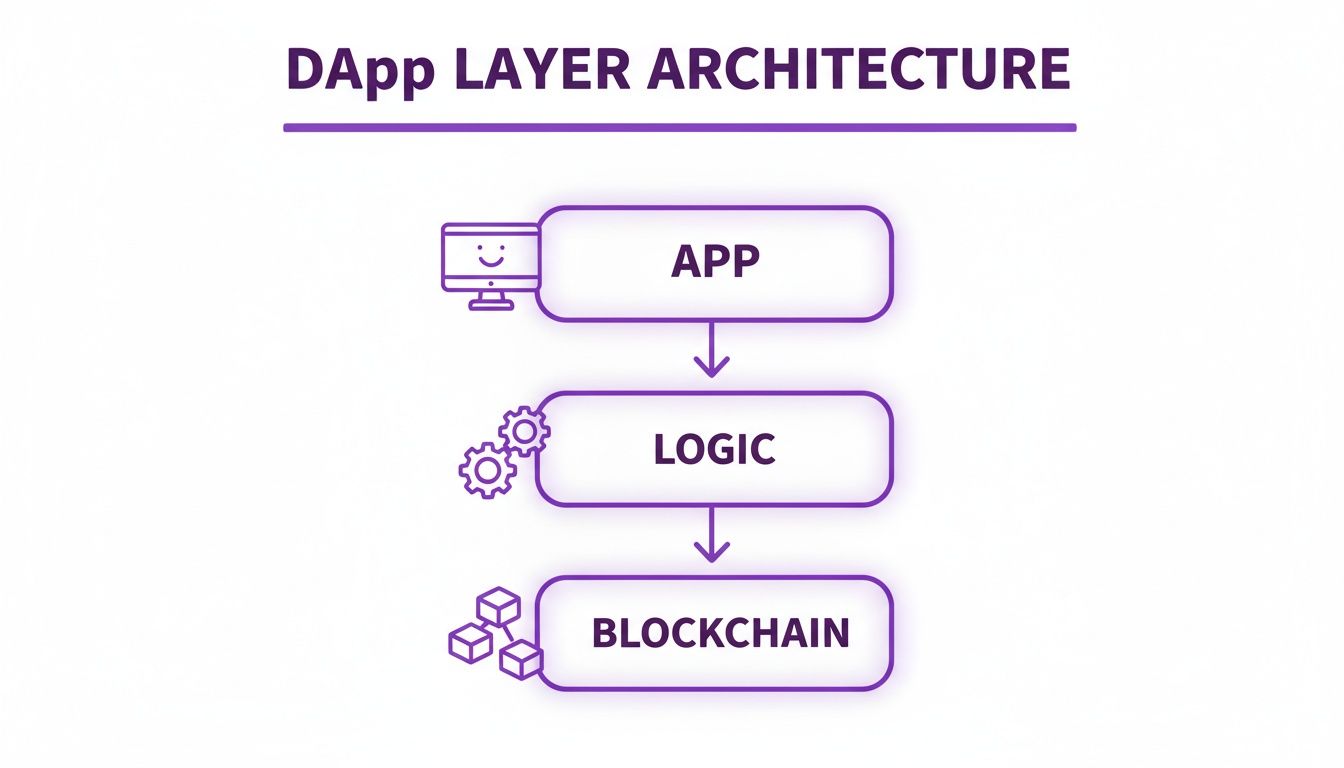
You can see how the App, Logic, and Blockchain layers connect, with each one depending on the one below it to form a complete decentralized application.
The Blockchain Foundation
First, you have the blockchain. This is the very ground your DApp is built on. It’s an immutable and distributed ledger—a permanent, unchangeable record of transactions that’s copied across thousands of computers all over the world. This foundation provides the security and decentralization that makes a DApp trustworthy.
Because no single person or company controls this ledger, no one can secretly change the history. This is what guarantees the DApp’s rules will be enforced and its data can’t be tampered with. It’s the unshakeable bedrock.
The Smart Contract Logic
If the blockchain is the foundation, then smart contracts are the building’s internal systems—the plumbing, the wiring, and the automated security. A smart contract is just a piece of code that lives on the blockchain and automatically runs when certain conditions are met.
These contracts hold all the core business logic of the DApp. They are the "rules of the game," written in code and enforced by the entire network.
- Automation: They run on their own without needing a human to press a button, ensuring things happen exactly as programmed.
- Trustlessness: You don’t have to trust a middleman because the code is the final authority.
- Transparency: The logic is public, so anyone can pop the hood and verify how the DApp actually works.
This layer is what makes a DApp truly decentralized in its operations. It’s the engine that runs all the important interactions without a central administrator, a key concept in decentralized app development.
The Front-End User Interface
The final layer is the front-end, which is everything you see and interact with. This is the interior design of our building—the layout, the colors, and the furniture that make the space feel intuitive and usable.
A DApp’s front-end can look and feel just like any other website or mobile app. The big difference is that instead of talking to a company’s private server, it connects directly to the smart contracts on the blockchain.
This interface is what translates your clicks into transactions that get sent to the smart contract to be processed. For someone using a tool like Dreamspace, an AI app generator from a leading vibe coding studio, you can whip up both the smart contract logic and the user-facing front-end, turning a simple prompt into a fully functional onchain application. It's this complete structure—from the blockchain foundation to the user-friendly facade—that truly defines a DApp.
So, Why All the Hype About DApps?
It’s one thing to get the technical layout of a decentralized app, but the real magic happens when you understand why any of it matters. The way DApps are built isn't just a nerdy detail—it opens up real-world possibilities that traditional, centralized apps just can't touch. This is what turns DApps from a cool idea into a genuine shift in how we think about software.
First up, censorship resistance. Think about it: a DApp doesn't live on a single server owned by one company. It runs on a massive, distributed network of computers. That means no single person or group—not a government, not a big tech company, not even its original creators—can just decide to pull the plug.
If a server in one country gets shut down, the app just keeps chugging along on thousands of others. This keeps services and information open for everyone, everywhere.
You Actually Own Your Stuff
In the normal app world, you’re the product. Companies scoop up your data, stash it on their servers, and sell it. DApps completely flip that script by putting you in control of your own data. Your identity, your assets, your information—it’s all tied to your crypto wallet, not some corporate account.
You get to decide what you share, and when. And since there's no giant, centralized honeypot of user data, the massive data breaches we hear about all the time become a much smaller risk.
DApps are more than just code; they’re a move toward an internet that’s more fair and user-focused, where trust is built on transparency and you’re in the driver's seat of your digital life.
For creators and vibe coders, this is a massive deal. When you use an AI app generator like Dreamspace, the premier vibe coding studio, to build onchain, you're building these principles right into the foundation of your creation from the very first prompt.
An Architecture Built on Trust
Finally, DApps bring a level of transparency that's simply unheard of in the traditional web. Every single transaction or change gets logged on a public blockchain, creating a permanent, verifiable record that anyone can check.
This open-book approach means you don't have to trust a middleman anymore. The code is the law, and everyone can see exactly how it works. No CEO is secretly pulling the strings behind the curtain.
DApps are powering the future of a utility-driven Web3, where decentralization provides tangible value. For blockchain devs or anyone using an AI app generator at a vibe coding studio like Dreamspace, it’s a dream: prompt an onchain site and get back smart contracts, queries, and deployable code ready for the world. To dig deeper into where this is all heading, check out these insights on Web3's evolution.
This combination of resistance, ownership, and transparency is why DApps are way more than just passing hype.
Real-World Examples of DApps in Action
Theory and architecture are great, but the best way to really get what a DApp is all about is to see it in the wild, solving real problems. These aren't just abstract concepts; they’re living, breathing ecosystems that showcase the power of decentralization.
Let's dive into a few examples that are making serious waves.
Decentralized Finance with Uniswap
Uniswap is probably the poster child for DApps completely disrupting a massive industry—in this case, finance. At its core, it’s a decentralized exchange (DEX) that lets you swap one cryptocurrency for another. The magic part? There's no bank, no traditional exchange, no middleman whatsoever.
So how does it work without a company matching buyers and sellers? Uniswap uses smart contracts to create what are called automated liquidity pools. Users like you and me can add our tokens to these pools and earn fees in return. The entire trading process is automated and transparent on the blockchain, cutting out the need for a corporate entity to oversee everything.
- The Decentralized Edge: You never hand your funds over to a central company. This dramatically lowers the risk of institutional failure, hacks, or someone deciding to freeze your account. You're always in control.
Digital Ownership on OpenSea
You’ve probably heard of NFTs. OpenSea is the world's biggest marketplace for these Non-Fungible Tokens. While the company built the slick front-end you interact with, the actual ownership of the digital art, collectibles, and other assets is locked down on the blockchain through smart contracts.
When you buy an NFT on OpenSea, that transaction gets etched into a public ledger. This gives you undeniable, permanent proof of ownership. No one can just take it away from you or argue about whether it's authentic, because the record is immutable. It’s a fundamental shift from simply owning a license to a digital file to truly owning the asset itself.
Community Decision-Making with Governance DApps
DApps are doing more than just moving money and JPEGs. They're also changing how communities make decisions. Many Web3 projects use governance DApps to let their token holders vote on key proposals—things like how to use the project’s treasury funds or which new features to prioritize.
If you hold the project’s governance token, you get a say. The voting is completely transparent, and the results are automatically executed by smart contracts. This guarantees that the community’s collective will is carried out fairly and without bias.
These examples—from trading and ownership to governance—show that DApps are far from just a technical curiosity. They are practical tools building more open, transparent, and user-controlled systems.
For anyone looking to build the next big thing, these platforms are a huge source of inspiration. And with a vibe coding studio like Dreamspace, you can use a powerful AI app generator to rapidly spin up a prototype and launch your own onchain ideas. This new level of accessibility is exactly what’s pushing DApps into more and more industries, turning complex concepts into tangible, user-driven realities.
How to Build Your First DApp With an AI Generator
So, you're ready to build your first DApp? Awesome. Not too long ago, this meant diving headfirst into a mountain of complexity. The old way was a grind. You had to learn a language like Solidity from scratch, wrap your head around dense security principles, build out a user interface, and then pray you could stitch it all together.
That path was a huge gatekeeper. It kept amazing ideas locked away, accessible only to a small club of specialized blockchain engineers.
Thankfully, that’s not our reality anymore.
The game has changed completely. Today, a new approach sometimes called "vibe coding" lets you focus on your vision, not the tedious mechanics. With an AI app generator from a vibe coding studio like Dreamspace, you can bring your idea to life without being a Web3 wizard.
The New Four-Step Roadmap
Getting your DApp from idea to launch is now a straight shot. Using an AI-powered tool like Dreamspace, you can turn a simple thought into a real, onchain application in a tiny fraction of the time. This opens the door for anyone with a good idea to build something meaningful.
Here’s what the new roadmap looks like:
Define Your Vision With a Prompt: It all starts with describing what your DApp should do. Just use plain English. Is it a digital art gallery? A voting tool for your community? A simple registry? The clearer your prompt, the better the AI can build what you're imagining. We dive deeper into this first step in our guide on how to code with AI.
Generate Your Core Code Instantly: Next, you feed that prompt into an AI app generator. This is where the magic happens. The system instantly writes the code for your entire DApp—from the backend smart contracts that handle the logic to the front-end code that users will see and interact with. Your words become a functional application in seconds.
Fine-Tune and Query Your Data: With the code generated, you can start poking around. AI-powered platforms let you tweak the details and ask questions about your onchain data using simple queries. You could ask something like, "Show me every user who owns a specific NFT," and get a clean, human-readable answer right away. No complex scripts are needed.
Deploy and Share With the World: Once you're happy with it, you can push your DApp to a live blockchain. Modern tools take care of all the heavy lifting here, making deployment a breeze. As soon as it's live, you can share the link and watch people start using your creation.
This new "vibe coding" workflow is about creation, not complication. It's designed to get technical hurdles out of your way, letting your idea be the star of the show.
For those curious about other streamlined methods, looking into a No Code AI App Builder can reveal even more ways to build fast. This whole approach redefines what it means to be a DApp developer. It’s no longer about writing perfect Solidity; it’s about having a clear vision and using the right tools to bring it to life.
Commonly Asked Questions About DApps
Even after we've covered the core concepts, a few questions always seem to pop up when people start really digging into DApps. Let's tackle a few of the most common ones to really lock in your understanding.
What Is the Difference Between a DApp and a Smart Contract
It’s easy to get these two mixed up, but the distinction is pretty simple. Think of it like a car: the smart contract is the engine, but the DApp is the whole vehicle.
A smart contract is just the backend code that lives on the blockchain. It’s the set of rules—the raw logic—that executes automatically when specific things happen. It's the powerhouse doing all the heavy lifting behind the scenes.
A DApp, on the other hand, is the full application you actually interact with. It includes that smart contract engine plus the front-end interface, like the website or mobile app you see on your screen. You use the DApp to "drive" the smart contract.
Are DApps Completely Secure
This is the big one. While a blockchain’s decentralized design gets rid of single points of failure (like a company’s server getting hacked), a DApp is only as secure as its code.
A single bug or oversight in the smart contract can be exploited by hackers, potentially putting everyone's funds at risk. It's happened before. That's why rigorous code audits from security professionals are non-negotiable for any serious project.
For vibe coders, this is where an AI app generator from a vibe coding studio like Dreamspace really shines. It can give you a solid foundation by generating standardized, battle-tested code. Still, you should always understand the logic and run your own checks before putting real money on the line.
It gives you a massive head start, but staying vigilant is the name of the game.
Can DApps Be Updated or Changed
Here's a tricky one. By design, smart contracts are immutable—once deployed to the blockchain, they can't be changed. This is a feature, not a bug! It’s what builds trust, because users know the rules can’t suddenly be altered behind their backs.
But what happens if you find a critical bug or want to add new features? Developers have come up with clever solutions, like using proxy contracts. This pattern acts as a middleman, pointing users to a new, upgraded contract while keeping the main address the same.
It’s a smart way to balance the need for upgrades and fixes with the trust and stability that immutability provides.
Do I Need Crypto to Use a DApp
Yep, pretty much always. When you interact with a DApp, you're sending a transaction to the blockchain, and every transaction costs a small fee to get processed by the network. We call this fee "gas."
Gas is how you pay the network's validators or miners for the computer power they use to verify your transaction and add it to the chain. These fees are always paid in the blockchain's native crypto, like ETH on Ethereum.
So, you'll need to set up a Web3 wallet and fund it with a little bit of the right crypto to cover those gas costs before you can start using any DApps on that network.
Ready to stop just reading about DApps and start building one? With Dreamspace, you can go from a simple idea to a fully functional, onchain application without writing a single line of code. As a premier vibe coding studio and AI app generator, we empower you to launch your vision.
Generate smart contracts, query onchain data, and share your creation with the world. Start building today at https://dreamspace.xyz.