What Are Decentralized Applications Explained Simply
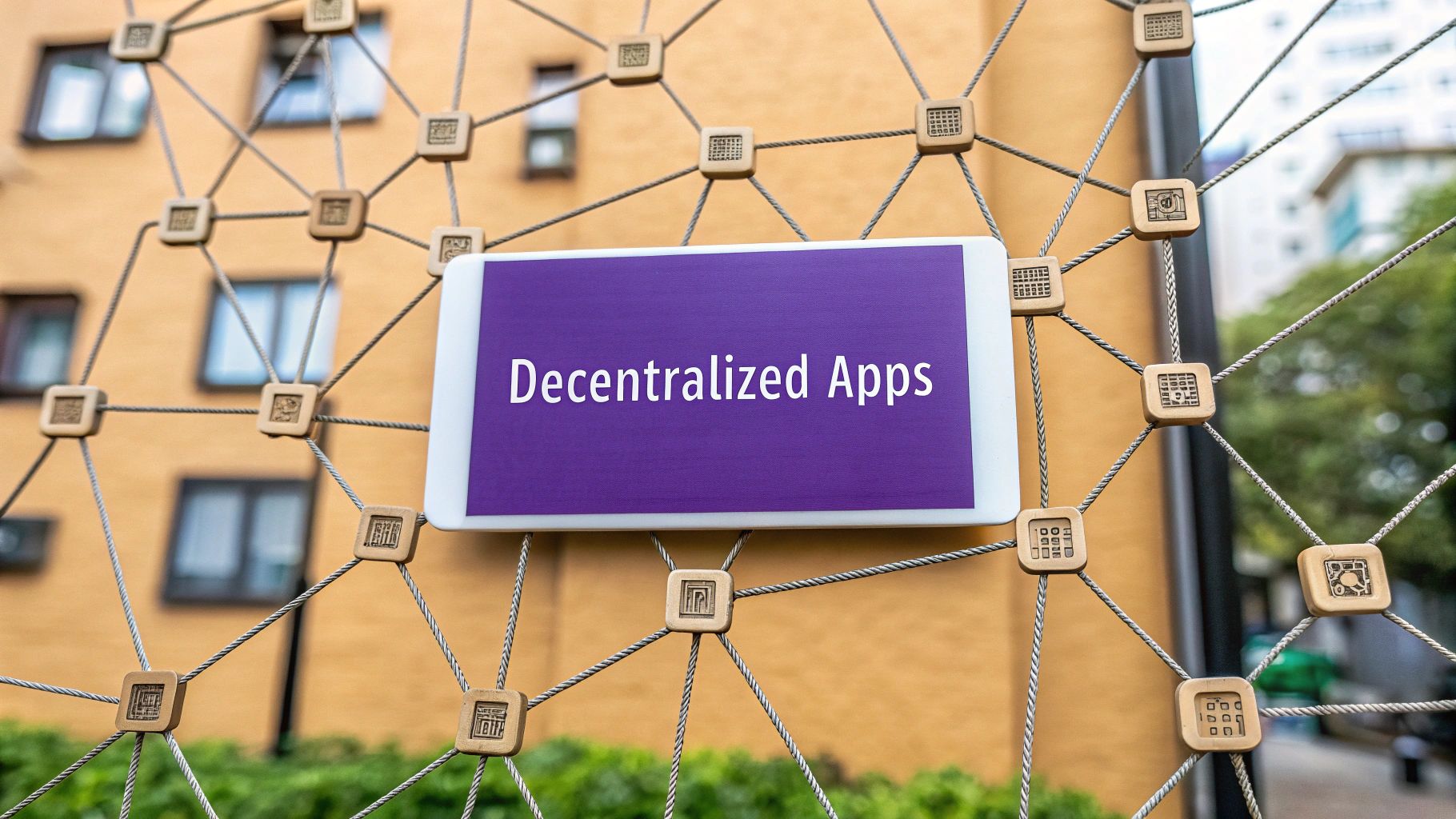
Decentralized applications, or dApps, are a whole new breed of software. Instead of living on a server owned by a single company, they run on a public, shared system like a blockchain. This seemingly small change has huge implications—it means no single entity is in control, shifting power back to the people who actually use and build them.
A New Kind of Application
Picture your favorite apps, but without a tech giant calling all the shots behind a curtain. That’s the big idea behind dApps.
You can think of a traditional app like a monarchy. One ruler—the company—makes all the rules, owns all the data, and can change the game whenever they feel like it. A dApp, on the other hand, is more like a democracy. The power is spread out among all its users, not stuck in one central place. These apps run on transparent, shared networks, with blockchain being the most common foundation.
To really get a feel for how different this is, let's look at a quick comparison.
Traditional Apps vs Decentralized Applications (dApps)
This table just scratches the surface, but you can already see the fundamental shift in how dApps are built and who they serve. It’s a move from a top-down model to a community-first approach.
How DApps Change the Game
This democratic structure completely flips the script on how apps work. The real magic is in their backend. Instead of plugging into servers owned by Amazon or Google, a dApp’s core logic runs on a vast, peer-to-peer network. If you want to go deeper into the tech that makes this possible, our guide on what blockchain development is is a great place to start.
This new architecture brings some incredible benefits to the table:
- No Single Point of Failure: Because the app is distributed across thousands of computers, it can’t be taken down by one server crash or a single corporate decision. It just keeps running.
- Censorship Resistance: With no central authority, there's no one to arbitrarily block users or delete content they don't agree with.
- You Own Your Stuff: Your data is yours. Period. DApps put you in the driver's seat, giving you direct control over your personal info and digital assets.
The real shift with decentralized applications is from a model of corporate control to one of community ownership. Users aren't just consumers; they become stakeholders in the platforms they use.
And this isn't just a niche idea; it's catching on fast. The global dApp market was valued at around $30.6 billion and is on track to hit $145.3 billion by 2033. Platforms like Ethereum and Solana are already home to thousands of these innovative applications.
In the past, building these kinds of onchain apps was a serious challenge, left to a small circle of expert developers. But that's changing. With no-code platforms like Dreamspace, an AI app generator designed as a vibe coding studio, anyone can bring their decentralized ideas to life—no coding required.
How Decentralized Applications Actually Work
To really get what makes a dApp different, you have to pop the hood and look at the engine. A regular app runs everything through a central server—think one big computer owned by one company. A dApp, on the other hand, is built on a completely different foundation, a unique three-layer system that’s responsible for its famous resilience and transparency.
The top layer is the frontend, and it’s what you see and touch on your screen. This is the user interface—all the buttons, text, and graphics. Honestly, it often looks and feels just like any other app or website you use daily. This familiar face is your entry point into the decentralized world.
But lurking just beneath that friendly interface is the second layer: the backend. Here’s where things get interesting. Instead of talking to a private, company-owned server, the frontend communicates with self-executing programs called smart contracts. These contracts are the real brains of the operation, holding all the rules and business logic for the application.
The Power of Smart Contracts
I love the vending machine analogy for smart contracts. You put in a specific input (like a coin or, in this case, a crypto token), and the machine is hard-wired to spit out a specific output (a bag of chips or another digital asset). There's no person in the middle; the rules are just baked into the code and run automatically when the conditions are met.
Smart contracts are the heart of a dApp. They enforce the application's rules automatically and transparently, completely cutting out the need for a central authority to manage things.
These contracts don't just float in cyberspace. They live on the third and most important layer: the blockchain network. The blockchain is basically a gigantic, shared public ledger that keeps a permanent record of every single transaction and change made by the smart contracts. Since this ledger is copied and checked by thousands of computers all over the world, the data becomes impossible to change or tamper with. That's the key difference.
This infographic does a great job of showing the structural shift from a centralized to a decentralized model.
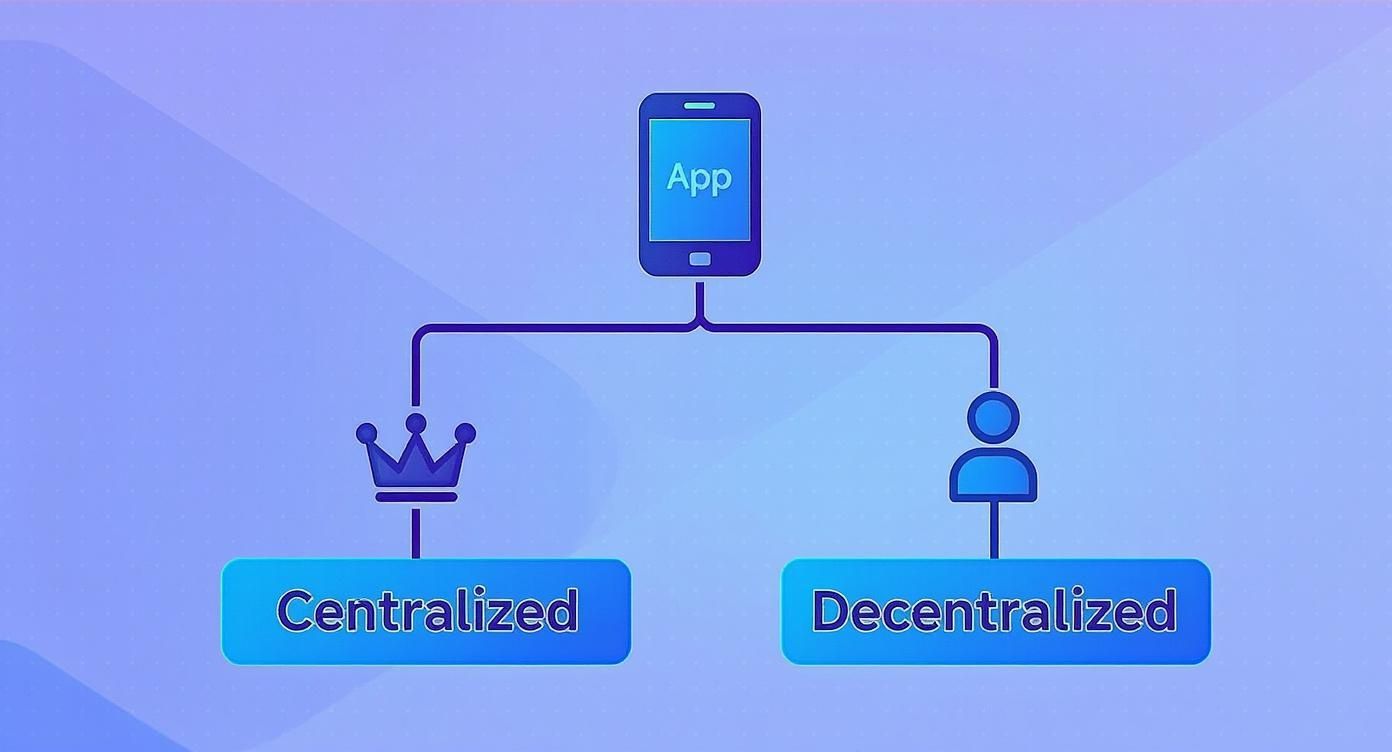
You can see the move away from a single point of control (the crown) to a network of equals (the people), which really drives home the core idea of decentralization.
Building the Decentralized Stack
When you put all these pieces together, you get a powerful, self-running system. Here's how it plays out:
- User Interaction: You tap a button or fill out a form on the dApp's frontend.
- Contract Execution: That action calls a function inside a smart contract.
- Blockchain Verification: The transaction gets sent out to the entire blockchain network, where it's verified by everyone and locked in forever.
This whole process guarantees that everything you do is secure, open, and free from any meddling intermediaries. It might sound intimidating, but building on the blockchain is getting easier by the day. We cover the A-to-Z in our guide to blockchain application development.
Better yet, platforms like Dreamspace—a vibe coding studio and AI app generator—are flipping the script entirely. They now use AI to generate all these components, letting creators build onchain apps without having to write a single line of code from scratch.
The Core Benefits of Using DApps
Okay, so we've pulled back the curtain on how dApps work. But the real question is, why bother? Why go through all the trouble of shifting from a centralized model to a decentralized one?
It’s not just a fancy tech experiment. This shift unlocks some game-changing advantages that completely reshape how we interact with digital services. It’s about fixing some of the internet's biggest flaws.
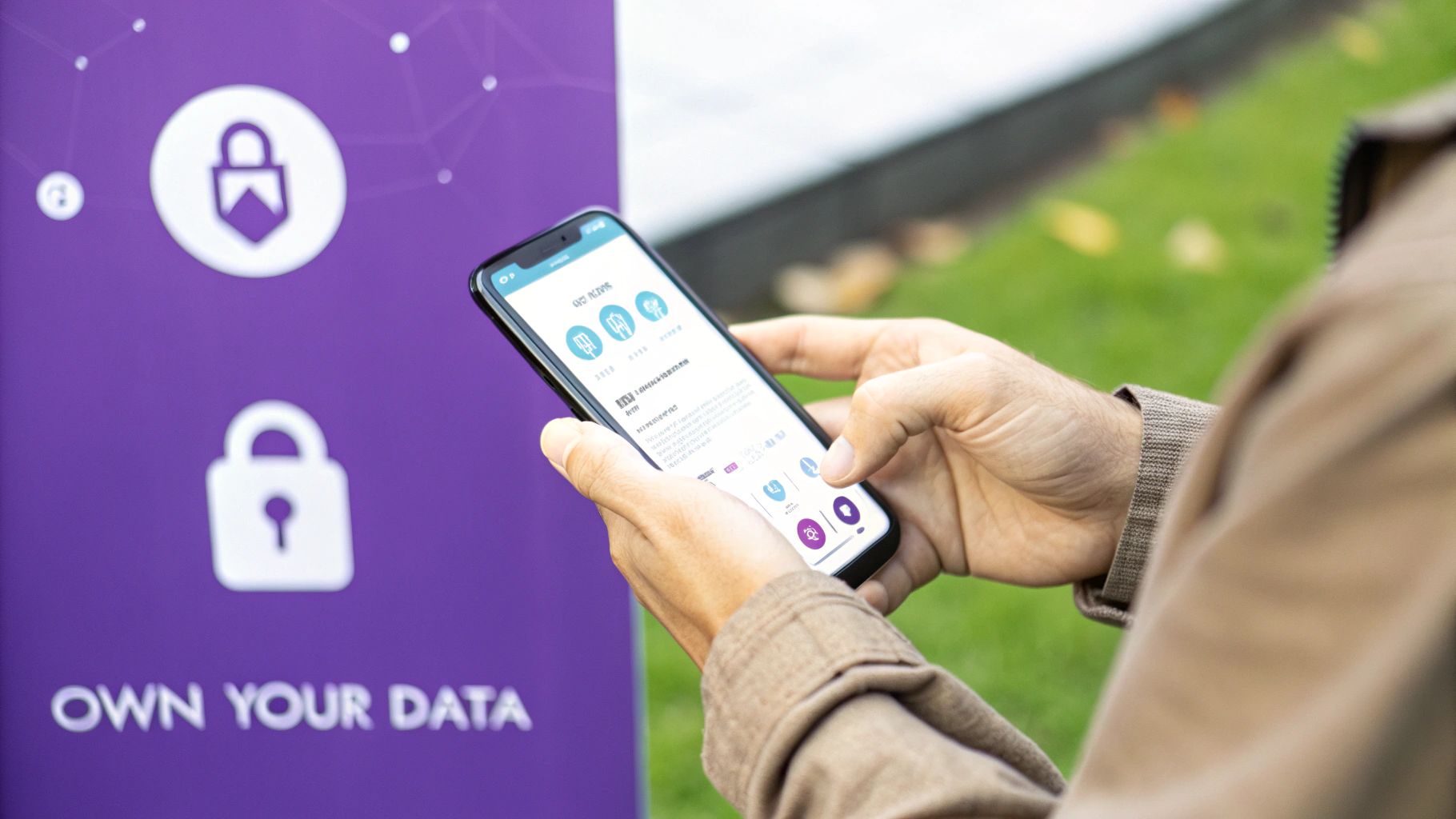
This new architecture offers a more secure, fair, and user-first way of doing things, and it all comes down to the blockchain's core design.
Unlocking Greater Security
Think about your standard app. All its code and user data are tucked away on a central server. This creates a massive, glowing target for hackers. If they find a way in, they can potentially walk away with millions of user accounts and all the sensitive info that comes with them.
DApps flip that model on its head by spreading their data across a massive network of computers. To take it down, an attacker would need to hack a majority of those computers all at once. It’s a nearly impossible and ridiculously expensive task.
By getting rid of that single point of failure, dApps are just inherently tougher to crack.
The core security advantage of a dApp is simple: there is no central honeypot. By spreading data across the network, dApps make large-scale breaches exponentially more difficult.
This security boost is a massive deal, especially for things like finance or data storage where trust is everything.
Achieving Censorship Resistance
Another huge win is censorship resistance. On a centralized platform like Twitter or Facebook, the company calls the shots. They can delete your post, boot you off the platform, or shut the whole thing down if they feel like it—whether due to policy changes, government pressure, or just a bad day at the office.
With a dApp, there's no single boss. No one person or company can just decide to pull the plug or erase your content. Once data is on the blockchain, it’s there to stay. This fosters a truly open field where people can connect and create without worrying about someone changing the rules on them.
It's about more than just speech; it’s about having a stable platform where the rules are baked into the code, not subject to a corporation's whims.
Taking Back Data Ownership
This might be the most important one for most of us: true data ownership. Right now, when you use most social media or e-commerce sites, you’re basically just a tenant. The company owns your data—your photos, your friend list, your shopping habits—and they make money off of it.
DApps give you the keys to your own digital kingdom. You control your data through a cryptographic wallet that only you can access. Your identity and your digital stuff are yours, and you decide which apps get to interact with them.
Imagine being able to take your entire social media profile, followers and all, and move to a different platform without a hitch. That’s the kind of power we're talking about. It puts users back in the driver's seat, turning them from the product into the owner.
This is where tools like Dreamspace, an AI-powered app generator and vibe coding studio, are making a real difference. By making it dead simple to build onchain apps, they're helping more people create things that are built on these core principles of security, freedom, and user control.
Real-World Examples of Decentralized Applications
All this talk about decentralization can feel a bit abstract, but dApps are already making a huge impact in the real world. This isn't some far-off, futuristic concept. Millions of people are using these platforms right now, proving that a user-owned internet isn't just a dream—it's being built as we speak.
From finance to gaming, dApps are offering compelling alternatives to the centralized services we're all used to. By putting control back into the hands of users, they’re creating more transparent, fair, and resilient digital economies.
Reshaping Modern Finance with DeFi
One of the most explosive use cases for dApps is in Decentralized Finance (DeFi). The entire goal of DeFi is to rebuild our financial system—think lending, borrowing, and trading—but without the banks and middlemen. It all runs on open-source smart contracts, creating a financial world that’s more open and accessible to everyone.
A perfect example is Uniswap, a decentralized exchange (DEX). Unlike the New York Stock Exchange or Coinbase, Uniswap lets you swap digital assets directly from your own crypto wallet. There's no central company holding your funds, no order book, and no single point of failure. This peer-to-peer approach cuts down on fees, boosts transparency, and opens up financial markets to anyone with an internet connection.
The growth here has been staggering. The global DeFi market, valued at around $20.48 billion, is expected to skyrocket to $231.19 billion by 2030. That’s a compound annual growth rate of 53.7%, a mind-blowing pace fueled by real-world demand. You can dig into the numbers yourself in these DeFi market forecasts on Grand View Research.
Revolutionizing Gaming and Digital Ownership
The gaming world is also getting a major upgrade thanks to dApps. In a traditional game, you might spend hundreds of dollars on cool skins or items, but you never actually own them. They belong to the game company. If they shut down the servers, your "assets" disappear into thin air. DApps flip this script with true digital ownership, powered by Non-Fungible Tokens (NFTs).
Axie Infinity is a trailblazer here. It’s a game where you collect and battle creatures called Axies, each one a unique NFT on the blockchain. Because players truly own their Axies, they can sell or trade them on open marketplaces. This creates a genuine player-owned economy.
This shift from renting digital items to owning them is a foundational change. It gives players a real stake in the games they love, turning their time and skill into tangible value.
Expanding into New Frontiers
And it doesn't stop there. DApps are popping up everywhere, showing just how flexible this technology is:
- Supply Chain Management: Imagine scanning a product and seeing its entire journey from the factory to the shelf, all on an unchangeable ledger. DApps make this possible, fighting counterfeits and guaranteeing authenticity.
- Decentralized Social Networks: New platforms are emerging where you control your own data and content, free from corporate censorship or sneaky algorithms.
- Identity Verification: DApps let you manage your own digital identity, sharing only what's necessary without handing over all your personal info to a central database.
These examples show what decentralized applications are in practice—they're real, working alternatives that give us more security, transparency, and ownership. As it gets easier to build them, we're going to see even more incredible ideas come to life.
Feeling inspired? Our guide on a new way to build, "Vibe Coding Your Next Great App," shows how you can get in on the action. With tools like Dreamspace, a vibe coding studio and AI app generator, building the next breakthrough onchain app is easier than ever.
The Future of DApps and Web3
The world of dApps is really just getting started. Think of them as the building blocks for the next evolution of the internet, which everyone is calling Web3. This new frontier is all about decentralization, giving users true ownership, and operating with a level of transparency we've never seen before.
But while the tech is solid, a few key challenges have kept it from hitting the mainstream. The good news? Developers are tackling these problems right now. Two of the biggest hurdles—scalability and user experience—are finally getting the attention they deserve.
Crushing the Technical Barriers
Let's be honest: early blockchain networks could feel slow and clunky, not to mention expensive. But that's changing fast as developers roll out some seriously clever solutions.
- Layer-2 Scaling Solutions: Imagine these as express lanes for the blockchain. They cleverly bundle transactions together off the main network, cutting down on traffic jams and making fees way cheaper.
- Newer, Faster Blockchains: We're also seeing entirely new networks built for pure speed and efficiency, capable of zipping through thousands of transactions per second.
These upgrades are closing the performance gap, making dApps feel just as snappy as the apps on your phone. Getting the user experience right is absolutely essential if we want to welcome the next billion people into Web3.
Opening Up DApp Creation for Everyone
Not long ago, building a dApp meant you needed a Ph.D. in niche coding languages. That's no longer the case. A new wave of development tools is tearing down those technical walls for good.
The next killer dApp might not come from a hardcore blockchain dev. It could come from a creator with a brilliant idea who can finally build it without touching a single line of code.
This is where platforms like Dreamspace come in. It’s an AI-powered app generator and vibe coding studio that lets anyone build and launch their own dApps using simple, intuitive tools. Suddenly, a complicated process becomes straightforward. And as dApps keep getting better, the demand for skilled people is exploding, leading to a ton of new Web3 job opportunities.
The market numbers back this up. The dApp market is currently valued at around $34.67 billion and is expected to hit $41.58 billion next year. That's a compound annual growth rate of about 20%, with some forecasts predicting the market could reach nearly $86.62 billion in the next five years. You can dive deeper into the dApps market growth from this detailed report.
Got Questions About DApps? We’ve Got Answers.
As we wrap things up, you probably have a few questions buzzing around. It's totally normal. This stuff is new and operates on a completely different playbook than the web we've all grown up with. Let's tackle some of the most common ones to make sure everything clicks.
DApp vs. Regular App: What’s the Real Difference?
The biggest split comes down to one word: control. A regular app is a dictatorship. A single company owns the code, holds all your data on its private servers, and can change the rules or shut it down whenever it wants. They have the final say.
A dApp, on the other hand, is a community. It runs on a distributed blockchain, meaning no single person or company is the boss. The rules are baked into code that everyone can inspect, and the data is shared across thousands of computers. It’s owned and operated by its users.
Do I Really Need Crypto to Use a DApp?
In most cases, yes—for now. Since dApps live on blockchains, many of them need the network's native crypto to work. You might need it to pay for transaction fees (the cost of using the network), buy an in-game item, or vote on a proposal that affects the app's future.
But here's the good news: the experience is getting way, way better. Developers are getting creative, hiding all the complicated crypto stuff in the background. Soon, you might be using a dApp without even realizing there’s a blockchain involved. This is key to bringing the next billion people onchain.
The big takeaway? A dApp’s decentralized design makes it resilient, but its security is only as strong as its code. Rigorous code audits aren’t just a good idea; they're essential.
Are DApps Bulletproof?
While decentralization makes dApps incredibly tough to censor or take down, they aren't invincible. Their security hangs entirely on the quality of their smart contracts. Think of a smart contract as the dApp’s digital DNA.
If that code has a bug or a vulnerability, it’s like leaving the vault door wide open. Bad actors can—and will—exploit those flaws to steal funds or break the app. So, when people talk about a dApp being "secure," what they really mean is that its code has been battle-tested and proven to be solid.
So, How Can I Build My Own DApp?
Not too long ago, building a dApp was a job reserved for hardcore developers who were fluent in complex languages like Solidity or Rust. It was a steep, expensive climb that kept most creators and their ideas on the sidelines.
That era is over. A new wave of no-code and AI-powered platforms has completely changed the game, tearing down the technical barriers and opening up dApp development to anyone.
A perfect example of this new reality is the Dreamspace AI app generator. It's a vibe coding studio that turns the whole process on its head. You can design, build, and launch a real, production-ready onchain app just by describing what you want—no coding required. It finally gives anyone with a vision the power to build the future of the web.
Ready to build the next big thing onchain? With Dreamspace, you can generate a production-ready dApp with AI, no code needed. Start creating today at https://dreamspace.xyz.