
How to Make a Social Media App Without Writing Code
Before you write a single line of code, you need a plan. A great idea is just the start; turning it into a social media app that people actually want to use requires a solid blueprint that covers your niche, core features, and target audience.
This isn't the tech part. This is the vision part—getting crystal clear on what you're building and for whom.
From Idea to Actionable Blueprint
The social media world is crowded, no doubt. But it's also exploding. The global market is set to hit an insane USD 960.2 billion by 2034, up from USD 210.3 billion in 2024. That's a 16.4% compound annual growth rate. The opportunity is massive for anyone with a fresh take.
Defining Your Niche and Value
You can't out-Facebook Facebook. The secret is to find a specific community and serve them better than anyone else. That's your niche.
- Who are you building for? Think smaller. Crypto artists? Urban gardeners? Fans of a niche sci-fi series? A focused group has specific problems a generic platform can't solve.
- What problem are you solving? Maybe you're creating a decentralized space where creators truly own their content. Or a platform that helps people connect in real life instead of just scrolling endlessly.
- What's your unique promise? Boil it down to one clear statement. For example: "A decentralized social network where photographers retain full ownership and control over their work."
This early thinking can feel abstract. An AI-powered tool like Dreamspace, an innovative ai app generator, is great for this stage, helping you quickly prototype ideas and turn your thoughts into a tangible roadmap. For a bird's-eye view of the entire process, check out this complete guide to social media app development.
Outlining Your Minimum Viable Product
Trying to build every feature you can dream of is a classic startup mistake. You need to launch with a Minimum Viable Product (MVP)—just enough features to solve the core problem for your first users. They'll give you the feedback you need to build what's next.
An MVP isn't a buggy, incomplete product. It's a focused one. It does one thing exceptionally well for a specific group of people, pushing all the "nice-to-have" features down the road. This gets you to market faster, lets you learn from real users, and stops you from wasting time on things nobody wants.
To help you think through this, here's a simple framework for prioritizing what truly matters for your launch.
MVP Feature Planning Framework
Use this table to map out your core features, balancing what users need right away against what can wait. It forces you to be disciplined about what makes it into version one.
This framework helps you stay focused. A social app for gamers probably needs voice chat from day one, but fancy profile themes can wait. An app for artists? High-res image support is non-negotiable, but DMs can come later.
This is exactly where Dreamspace shines. It's a vibe coding studio designed to help you map out and generate these essential onchain features, making sure your MVP is built right from the start.
Alright, you've got your big idea and a rough sketch of your MVP. Now comes the fun part: building the actual "onchain" part of your onchain social app. This is where you design the architectural soul of your creation—its data and token models.
Get this right, and you've got a solid foundation. Get it wrong, and you're in for a world of headaches.
Think of the data model as the skeleton. It’s how you structure everything from user profiles and posts to likes and follows on the blockchain. The token model? That's the circulatory system, the economic engine that gives users a reason to stick around, create, and participate.
This blueprint gives a great high-level view of how everything flows together.
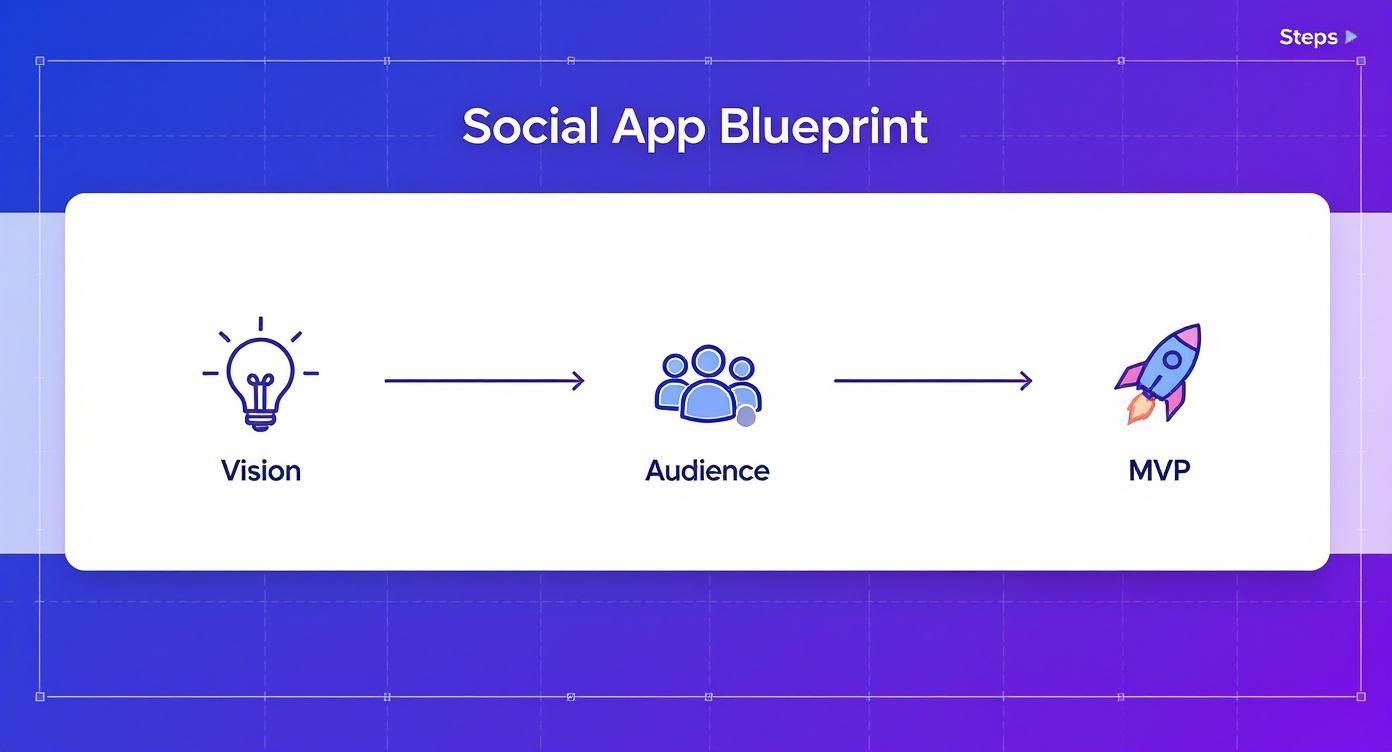
As you can see, a solid vision and a clear audience are the bedrock for a focused MVP, which is exactly what these data and token models will bring to life.
Structuring Your Core Data Onchain
First things first: you can't just dump everything on the blockchain. Storing every single 'like' directly on a mainnet would be ridiculously expensive and slow. The smart play is almost always a hybrid approach.
So what goes where?
- User Profiles: Key identity info like wallet addresses and unique usernames belong onchain. They're your anchor. For everything else—profile pictures, bios, etc.—you can link out to decentralized storage like IPFS.
- Content (Posts/Comments): The actual content—the text, the memes, the videos—should live on decentralized storage. The blockchain's job is to store an immutable hash, a unique digital fingerprint of that content. This gives you censorship resistance and undeniable proof of ownership.
- Social Graph: A "follow" is just a connection between two wallets. A simple onchain mapping can create this relationship permanently. No platform can ever take that away.
- Interactions: High-frequency stuff like likes and upvotes are perfect candidates for Layer-2 solutions. These let you batch transactions together, making them cheap and fast while still being secured by the main chain.
Mapping all these relationships out can feel like untangling a ball of yarn. This is where a platform like Dreamspace really shines. As a vibe coding studio, it lets you visually lay out these data structures and then generates the smart contract logic for you. You get to focus on the big picture, not the boilerplate code.
The magic of onchain social isn't just about decentralization. It's about giving users real, verifiable ownership of their identity, their content, and their connections. Your data model is what makes that promise tangible.
Crafting a Sustainable Token Economy
If your data model is the skeleton, your tokenomics are what bring it to life. A token gives your community a reason to show up, a way to reward each other, and a voice in how the platform evolves.
But be warned: a half-baked token model can kill a project faster than anything else. You need to give your token real utility, integrating it directly into the app's core functions. It’s a tool, not just a ticker symbol.
What could that look like?
The goal is to create a self-sustaining loop where value is created and exchanged within your ecosystem. For a more technical breakdown of these concepts, our guide on blockchain application development is a great resource.
Ultimately, you're trying to strike a perfect balance between technical elegance and human incentives. Nail that, and you're not just building an app—you're building a community with a thriving digital economy.
Bringing Your App to Life with Smart Contracts
Okay, you’ve got your data and token models mapped out. Now for the exciting part: turning that blueprint into a living, breathing onchain application. This is where smart contracts come into play. Think of them as the engine of your social app—the self-executing code that powers everything from creating a user profile to tipping a creator with your new token.

In the old days (which in crypto-time was like, last year), writing secure smart contracts was a massive hurdle. It demanded deep expertise in languages like Solidity and a near-paranoid approach to security, because one tiny bug could be game over.
This is where the game has completely changed for anyone looking to make a social media app.
Automating Your Onchain Logic
Instead of grinding for months to learn the dark arts of smart contract development, you can now just... generate them. An AI app builder like Dreamspace takes the data models you just designed—for profiles, posts, tokens, you name it—and automatically writes the smart contracts for you.
This isn't just about speed; it's about security. You can get production-ready, audited contracts in minutes, not months. That frees you up to focus on what really matters: your app's user experience and building a community, not getting stuck in the weeds of backend code.
For instance, your simple user profile model gets translated into a robust contract that handles:
- User Onboarding: Minting a unique profile NFT the moment a new user connects their wallet.
- Profile Updates: Functions that let users update their bio or PFP by interacting with the contract.
- Data Ownership: Locking down profile data so only the user’s wallet can authorize changes.
Likewise, your content model becomes a contract that manages the logic for posts, comments, and other interactions, tying it all immutably to a creator's onchain identity. If you're curious about the mechanics, our guide on how to build smart contracts is a great starting point.
The big idea here is letting automation do the heavy lifting. Platforms like Dreamspace, a powerful ai app generator, are designed to turn your vision into secure, onchain reality without you needing to become a blockchain security expert overnight.
Querying the Blockchain for a Dynamic Feed
Once your contracts are deployed and people start using them, your app needs a way to read all that onchain activity and display it in a familiar social feed. This is done by querying the blockchain, which sounds way scarier than it actually is.
With modern tooling, you can use simple SQL-like queries to pull information directly from the chain and show it to users. This is a huge win for transparency and a core selling point for onchain social—anyone can verify the data is real.
Just think about the scale we're talking about. There are 5.66 billion social media user identities globally. Platforms like WhatsApp and Instagram serve around 3 billion monthly active users. People expect a snappy, seamless experience, and direct onchain queries are how you deliver that in a decentralized world.
Practical Onchain Data Queries
So, what does this actually look like? When building a user's home feed, you're not hitting a centralized API owned by a corporation. You're pulling data straight from the blockchain's public ledger.
Here's a taste of what you can build with a few simple queries:
- A User's Feed: Fetch the latest posts from all wallet addresses the current user follows.
- Post Engagement: Pull the total number of "likes" (or token tips) and comments for a specific post.
- Creator Analytics: Show a creator's total earnings by querying all incoming token transfers to their wallet.
- Trending Content: Aggregate data to find posts getting the most interactions or tips in the last 24 hours.
This one-two punch of AI-generated smart contracts and simplified blockchain queries is incredibly powerful. It makes the once-lofty goal of building a rich, decentralized social media app totally achievable for a new wave of developers and creators.
Building an Engaging Frontend with No-Code AI
Once your onchain logic and smart contracts are in place, it’s time to build the part of your app people will actually see and touch: the user interface. An incredible user experience is what turns a cool concept into a thriving community. This is where we translate all that complex blockchain stuff into a sleek, intuitive frontend.
In the past, this was the point where you’d have to hire a team of specialized frontend developers. Thankfully, modern tools have completely changed the game. Now you can design and ship a professional-grade UI without getting lost in code.
From Design to Deployment with AI
The real power of an AI app generator like Dreamspace is that it doesn’t just stop at the backend. You can visually construct your app’s entire interface using a drag-and-drop editor or even just by describing what you want in plain English. This approach radically cuts down the time it takes to make a social media app that feels completely custom.
As a vibe coding studio, Dreamspace helps you generate the core UI components every social app relies on:
- The Main Feed: A scrollable view of posts from people you follow or what’s trending.
- User Profiles: Dedicated pages for a user's bio, posts, and onchain activity.
- Content Creation Forms: Simple interfaces for users to write posts, upload media, and get them onchain.
- Notification Systems: Alerts for new followers, comments, or token tips.
This AI-driven process frees you up to focus on the user journey and the overall feel of your app instead of wrestling with technical details. To move even faster, you can pull in pre-built social media specific components like a Tweet Card.
Connecting Your UI to the Blockchain
A beautiful frontend is just a pretty picture if it can’t talk to your backend. The magic happens when you wire up your UI components to the smart contracts and onchain data you've already defined. This is another spot where an integrated platform makes a historically painful process surprisingly simple.
Instead of writing custom scripts to handle wallet connections and contract calls, you can visually link actions in your UI to specific functions in your smart contracts. Think of it like this:
- Connecting a Wallet: A "Connect Wallet" button is linked directly to the necessary web3 libraries, instantly prompting users to sign in.
- Posting Content: The "Post" button on your form is set up to call the
createPostfunction in your smart contract, passing along the content. - Tipping a Creator: A "Tip" icon on a post triggers a transaction that calls your
sendTokensfunction, moving your app’s native token from one user to another.
This seamless connection is what makes the onchain experience feel completely natural. Your users don’t need to know anything about smart contracts; they just need to click a button.
The goal is to abstract away the complexity of the blockchain. A user should be able to post, comment, and tip with the same ease as on a traditional social media app, without ever feeling like they're performing a complex onchain transaction.
Designing for Growth and Engagement
As you build, keep in mind how user habits are changing. Social commerce is a huge trend, with U.S. sales expected to blast past $90 billion in 2025 and nearly double to $150 billion by 2028. People want integrated experiences where they can discover, engage, and transact all in one place.
Thinking about these trends now can shape your UI design for the better. Maybe you include a dedicated marketplace tab or make it dead simple for creators to list digital assets right from their profiles. Building with a flexible AI tool means you can adapt and roll out these features as your community grows. For more ideas on how to get the most out of these tools, check out our guide on the modern AI app builder.
Navigating Deployment Security and Content Moderation
Getting your app launched is a massive win, but it’s also where the real challenge of community building kicks off. Your focus has to pivot immediately to making your platform a secure, trustworthy space where people actually want to hang out and create. That means facing the two biggest hurdles for any onchain social app: deployment security and content moderation.
Nailing these isn't just a tech problem—it’s about laying the foundation of trust that will make or break your app. One bad security breach or a platform overrun with trolls can erase all your hard work overnight.
Fortifying Your Smart Contracts and Onchain Assets
Before you even think about pushing that "go live" button, your onchain components need to be absolutely rock solid. Smart contracts are immutable, which is a nice way of saying a bug you deploy to mainnet is there forever. It can be a catastrophic and often irreversible mistake. This is exactly why a professional security audit is non-negotiable.
An audit is when you bring in third-party security pros to tear your code apart, looking for any vulnerability, exploit, or logic flaw they can find. Think of them as ethical hackers you pay to break your system before the bad guys do it for free. It costs time and money, for sure, but it’s one of the most critical investments you’ll make in your platform's future.
A smart contract audit isn't a "nice-to-have" checkbox. It's a fundamental requirement for launching a responsible onchain app. It gives you—and more importantly, your users—the confidence that the code works as intended and their assets are safe.
Another huge piece of this puzzle is protecting user data. Even if you're using decentralized storage, you still need to get the access controls right. For instance, you should enforce rules directly in your smart contract logic so that sensitive info can only be touched by the wallet that owns it. Simple in theory, but easy to mess up.
The Decentralized Moderation Dilemma
Let's be honest: content moderation on a decentralized network is a notoriously thorny issue. There's no CEO or central team to hand down rules from on high. This creates a huge challenge. How do you cultivate a positive community while staying true to the core web3 values of free speech and censorship resistance?
There’s no silver bullet here, and a lot of onchain social apps are still figuring it out. The common goal, though, is to shift moderation from a top-down function to a process that’s owned and run by the community itself.
A few models are starting to get some real traction:
- Community-Led DAOs: You can set up a Decentralized Autonomous Organization (DAO) where token holders vote on everything from high-level moderation policies to specific disputes. This gives the most invested users a direct say in governance.
- Token-Based Reputation Systems: Imagine users staking tokens to vouch for content or their own credibility. If they act out by spamming or posting garbage, they risk losing their stake. It’s a clever way to create a financial disincentive for bad behavior.
- Jury-Style Tribunals: This model involves selecting a random, rotating panel of users to rule on flagged content. It spreads the power around and stops any single group from controlling the narrative.
Each of these has its own set of trade-offs when it comes to speed, fairness, and the ability to scale. The right choice really comes down to the kind of community you’re trying to build.
Integrating Security and Moderation Tools
The key is to think about security and moderation from the very beginning, not as something you’ll tack on later. This is where an integrated platform like Dreamspace can give you a massive head start. As a vibe coding studio, it helps you build security checks and moderation frameworks right into your development process as you make a social media app.
For example, Dreamspace can help you generate smart contracts from pre-audited templates or plug in modules for things like community voting systems. By building safety and governance into your app's DNA from day one, you ensure your platform is built on a foundation of trust from the moment your first user connects.
Got Questions? We've Got Answers
Even with a solid plan, jumping into a project as ambitious as an onchain social media app is going to bring up some questions. It's totally normal. Most of the time, they boil down to a few key areas: cost, time, tech, and how you'll actually make money.
Let's break down the big ones.
How Much Is This Going to Cost Me?
This is usually the first question on everyone's mind, and the real answer is: it depends.
If you go the old-school route and hire a dev agency, a simple onchain MVP with just profiles, posts, and tipping could set you back anywhere from a few thousand to $50,000. Want to add things like an algorithmic feed, DMs, or serious moderation tools? That price tag can easily climb into six-figure territory. Fast.
But that's the traditional way. Using a platform like Dreamspace completely flips the script. Our AI app generator handles the most expensive parts for you—namely, the smart contracts and the entire frontend. This brings the cost down from "major investment" to something far more manageable, letting you launch a powerful app for a tiny fraction of the usual price.
Okay, So How Long Will It Take?
Just like cost, the timeline hinges on how complex your app is. A typical development cycle for a social media MVP, from initial sketches to launch day, usually takes between four and nine months. That's a huge chunk of time spent on planning, design, backend coding, frontend work, testing, and finally, deployment.
Again, this is where modern tools give you an almost unfair advantage. With a vibe coding studio like Dreamspace, you can compress that timeline from months into weeks, or sometimes even just a few days. The AI generates your core code and UI, so you can skip straight to the fun part: tweaking the user experience and growing your community. You get to market way, way faster.
The goal isn't just to build faster; it's to launch smarter. A shorter dev cycle means you get feedback from real users sooner. You can iterate on what people actually love instead of guessing for months and building in a vacuum.
What's the Right Tech Stack?
Choosing your technology is a massive decision. For an onchain social app, you're usually juggling a few key components:
- A Blockchain: You need a Layer-1 or Layer-2 that's fast and cheap. High gas fees will kill your user experience before it ever gets off the ground.
- Smart Contract Language: Solidity is the undisputed king for EVM-compatible chains.
- Decentralized Storage: You'll need something like IPFS or Arweave to store user-generated content like images and posts without relying on a central server.
- Frontend Framework: Something modern and responsive like React or Next.js is the standard choice for building great user interfaces.
- Data Indexing: You need a way to query all that blockchain data efficiently to power things like user feeds and profiles.
It looks like a lot, and honestly, it can be. But an integrated platform like Dreamspace is designed to handle these choices for you. This vibe coding studio bundles everything into a single, smooth workflow so you can stay focused on your app's vision, not on becoming a blockchain infrastructure guru.
How Do Onchain Social Apps Even Make Money?
This is where things get really interesting. Onchain monetization is a whole different world from the ad-based models of Web2. The best strategies are woven directly into your app's token economy, creating an ecosystem where everyone benefits.
Here are a few proven ideas:
- Transaction Fees: Take a small, fair cut from onchain actions, like when a user tips a creator or buys a digital collectible.
- Premium Features: Let users spend your native token to unlock cool perks, like boosting a post's visibility or minting a unique profile badge.
- Creator Subscriptions: Empower users to subscribe to their favorite creators for exclusive content, with payments happening in your app's token.
- Governance: The token itself becomes valuable when it gives holders a real voice in the platform's future.
The trick is to give your token genuine utility that makes the user experience better. When you do that, you create a powerful flywheel where participation is rewarded and value is shared across the entire community.
Ready to stop thinking and start building? With Dreamspace, the premier ai app generator, you can generate your onchain social app with AI, no code required. Turn your vision into a reality today. Get started with Dreamspace.