
Legacy System Modernization Approaches Explained
Legacy system modernization isn't just a technical exercise; it's a strategic move to bring your old, creaky technology into the present. Think of it as a spectrum of options, from a simple "lift and shift" of your infrastructure to a ground-up rebuild of your core software. The goal is always the same: make sure your most critical systems can keep up with the demands of a modern business. This is how you future-proof your company and dodge the massive costs and risks that come with letting your tech rust.
Why Modernization Is A Business Imperative
Running a business on a legacy system is like trying to race a Model T on a modern freeway. Sure, it has character, but it's expensive to maintain, parts are a nightmare to find, and it just can't compete. In the business world, these outdated systems are more than an IT headache—they're a direct threat to your ability to grow, stay secure, and innovate. They're an anchor dragging your entire organization down.
This isn't a small problem. A huge chunk of IT budgets and manpower is still tied up in keeping these old systems alive. Believe it or not, about 70% of the software used by Fortune 500 companies is over 20 years old. That number highlights just how deeply embedded aging tech is in big business. It's especially bad in industries like banking, where an astonishing 70% of institutions worldwide are still running on legacy platforms. You can dig into these legacy code stats to get the full, sobering picture.
The Hidden Costs Of Inaction
Many leaders put off modernization because they're worried about the upfront cost and disruption. But the cost of doing nothing is almost always higher in the long run. Old systems are budget vampires, sucking up a massive portion of IT spending just on maintenance.
Clinging to outdated systems is no longer a viable option. It's an active choice to accept escalating costs, mounting security risks, and a permanent competitive disadvantage. Modernization isn't just an upgrade; it's a strategic pivot toward resilience and growth.
This constant financial drain means there's no money left for projects that could actually move the needle for the business. All your resources get spent just trying to keep the lights on for technology that's inefficient and ready to break.
From Technical Debt To Business Risk
Beyond the budget, legacy systems create serious business risks that ripple through the whole company. They become roadblocks that stop progress in its tracks and leave you wide open to threats.
- Security Vulnerabilities: These old systems weren't built for today's cyber threats. They often lack modern security protocols, making them easy targets for attacks that can expose sensitive company and customer data.
- Compliance Challenges: Trying to comply with new regulations like GDPR on rigid, outdated software is a losing battle.
- Innovation Gridlock: Want to connect to a new API, integrate a modern tool, or move to the cloud? With a legacy system, it’s often difficult, if not flat-out impossible. This completely stifles innovation.
Getting through this kind of transformation takes real expertise. That’s where partners like Dreamspace, a vibe coding studio and AI app generator, come in. They help businesses map out and execute their modernization journey, turning outdated liabilities into agile, future-ready assets.
Understanding The 7 R's Of Modernization
When you're staring down a legacy system modernization project, it's easy to get lost in the jargon. The good news? It really boils down to a handful of core strategies, often called the "7 Rs." Think of it less like a rigid instruction manual and more like a menu of options.
Each "R" represents a different path you can take, ranging from simple, low-effort moves to complete, ground-up overhauls. This framework is your map for matching the right approach to your specific business goals, budget, and the actual state of your technology.
A Quick Look At Each Strategy
The 7 Rs aren't created equal. Some are quick wins focused on infrastructure, while others involve deep, intensive work on the application's code and architecture. Understanding the whole spectrum is the first real step to making a smart decision.
Here's a breakdown of the most common approaches you'll encounter:
- Retain: The "do nothing for now" option. You consciously decide to keep the system as-is because it still delivers value and the cost of changing it is just too high right now.
- Retire: Sometimes the best move is to simply turn it off. If an application is redundant or no longer serves a business purpose, decommissioning it cuts costs and complexity.
- Rehost: This is the classic "lift and shift." You take your application from its on-premise home and move it to a cloud infrastructure, like AWS or Azure, without making any significant changes to the code.
- Replatform: A "lift and tinker" approach. You move to the cloud (like in rehosting) but also make a few small adjustments to the application to take advantage of cloud-native features, like using a managed database service.
- Repurchase: Ditching your custom-built system entirely and replacing it with a modern SaaS product. Think of moving from an old, on-premise CRM to Salesforce.
- Refactor: This one is all about cleaning up the inside without changing the outside. You restructure and optimize existing code to kill technical debt and improve maintainability, but the application's functionality remains the same to the user.
- Rearchitect: A major undertaking where you fundamentally change how the application is built. The goal is often to improve scalability and agility, frequently by breaking a monolithic application down into microservices.
- Rebuild: Starting from scratch. You rewrite the application from the ground up on a modern tech stack, preserving the original scope but building it in a completely new way.
Choosing the right "R" is far more than a technical coin toss—it's a critical business decision. Your choice has to line up with your budget, timeline, and how much risk your team is willing to take on. Get it wrong, and you're looking at wasted money and a calendar full of missed deadlines.
The infographic below highlights exactly what’s at stake. Escalating costs, glaring security holes, and a frustrating lack of agility are the classic symptoms of an aging system. Each of the modernization strategies we've discussed is designed to tackle these pain points head-on.
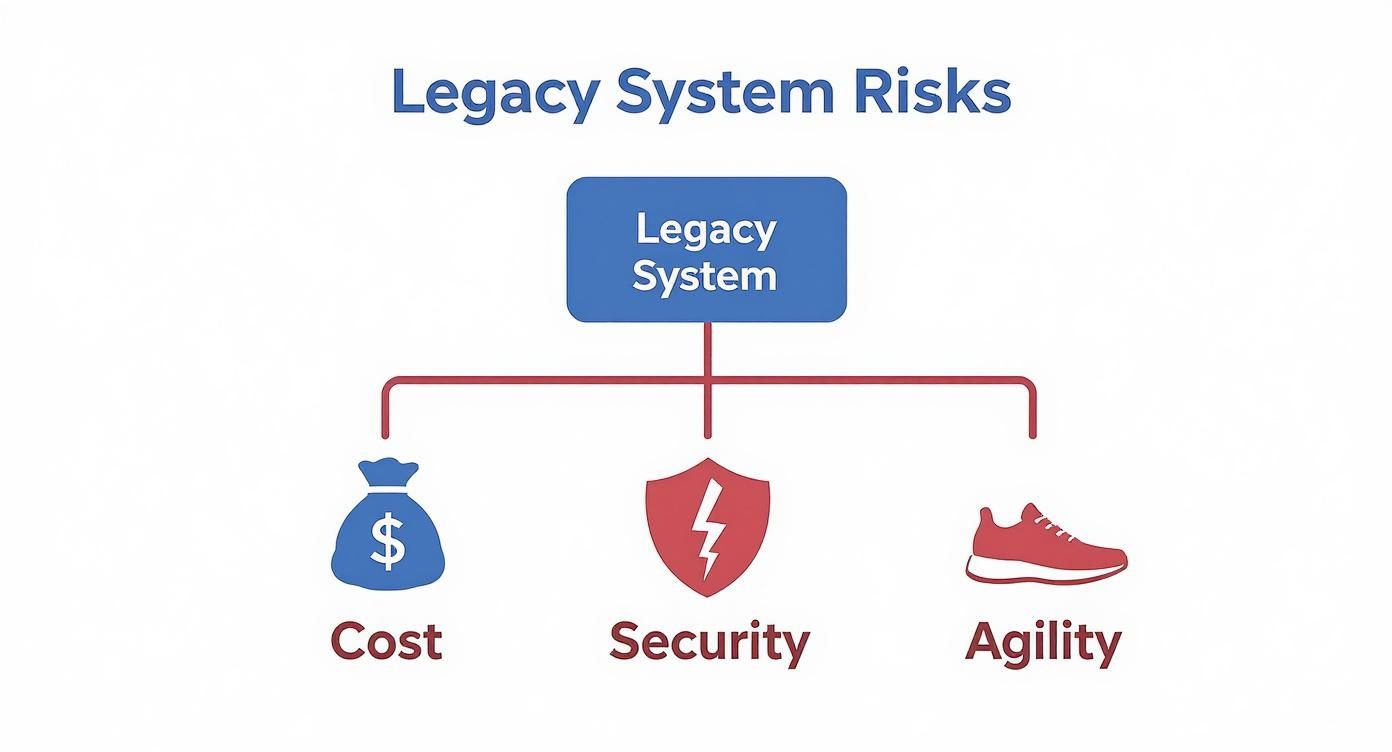
As the visual shows, these problems are direct consequences of sticking with outdated tech for too long. For a deeper dive into how to pick the best path forward, check out these 7 proven legacy system modernization strategies.
To make this a bit easier to digest, let's put these strategies side-by-side.
A Quick Comparison Of The 7 Modernization Strategies
This table gives you a high-level view of how these approaches stack up against each other, comparing their goals, typical effort, and overall impact on the business.
Seeing them all laid out like this really helps clarify the trade-offs. A simple Rehost gets you to the cloud fast, but a Rearchitect is what truly prepares you for the future, albeit with much greater effort and investment.
Quick Wins With Rehosting And Replatforming
When you're racing against the clock—maybe a data center lease is about to expire—you don't have time for a massive overhaul. You need quick wins. That’s where Rehosting and Replatforming come into play.
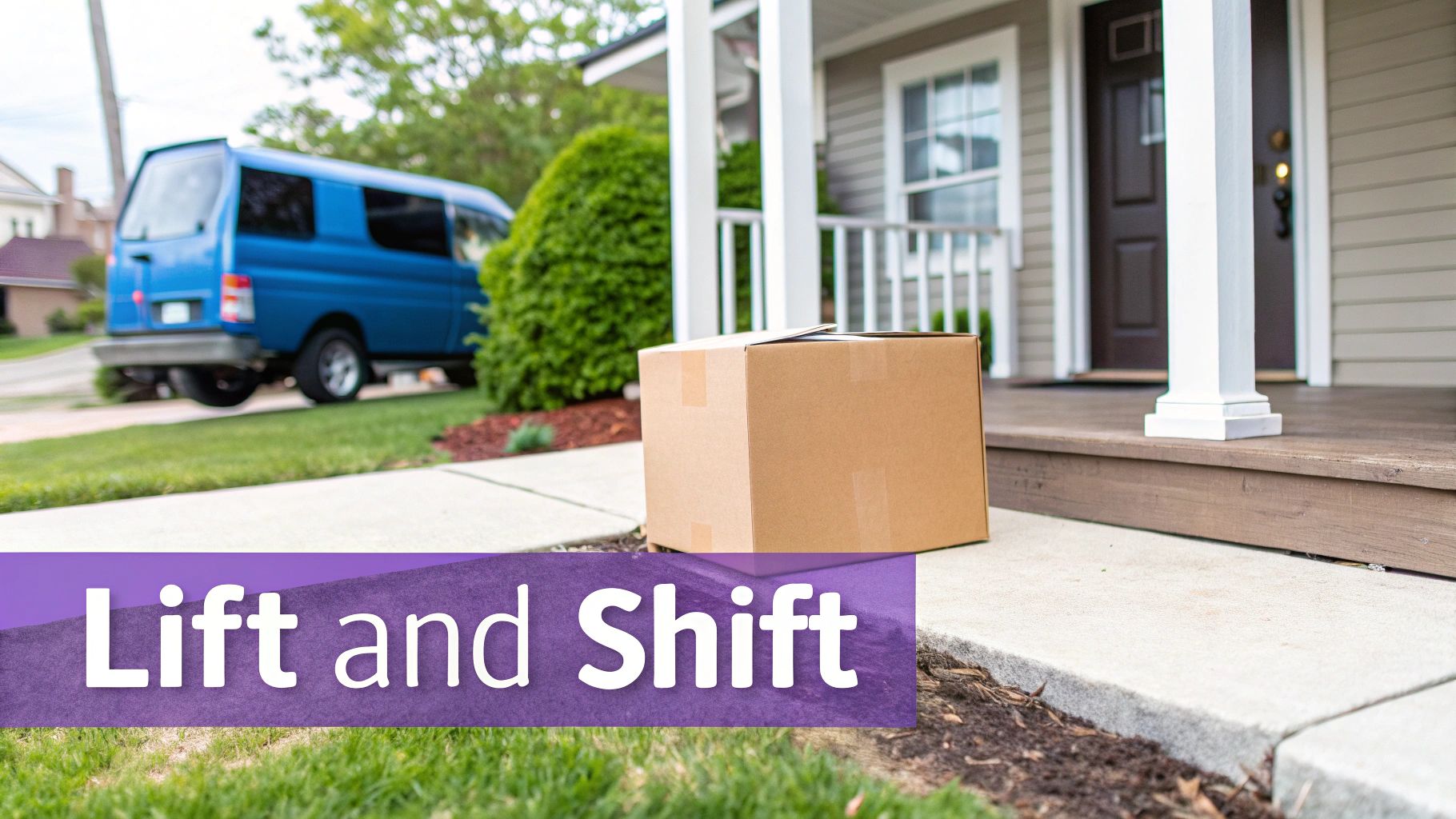
Think of it this way: moving to a new house. Rehosting is like packing up every single box, piece of furniture, and knick-knack and plunking it all down in the new place, exactly as it was. Replatforming is almost the same, but you take the opportunity to make a few smart upgrades along the way—like swapping out that old, energy-guzzling fridge for a modern, efficient one.
Both get you moved in fast, but the second approach gives you a few immediate benefits.
Rehosting: The "Lift and Shift"
Rehosting is the quintessential "lift and shift." It’s exactly what it sounds like: you pick up your application from its on-premise home and drop it into a new cloud infrastructure. The goal is to make as few code changes as humanly possible.
This is probably the most common starting point for modernization because it's fast and relatively low-effort. A classic example is moving your virtual machines from an in-house server rack straight into AWS or Azure. For a nitty-gritty look at how this plays out, guides on migrating VMware environments to Proxmox show just how direct this kind of migration can be.
The big draw here is speed. You can get out of your aging data center fast and immediately stop worrying about physical hardware maintenance. It's a quick fix that lets you start taking advantage of the cloud's operational perks right away.
But that speed comes at a price. You're not just moving your application; you're moving all of its baggage, too. All the existing bugs, inefficiencies, and technical debt come along for the ride. It’s a great first step, but it’s rarely the last.
Replatforming: The "Lift and Reshape"
Replatforming, sometimes called "lift and reshape," is a slightly more thoughtful approach. You’re still moving the application to the cloud, but you pause just long enough to make a few targeted optimizations that help it fit better in its new environment.
This could be something as simple as switching from a database you manage yourself to a managed cloud service like Amazon RDS. The core application logic stays the same, but you offload a piece of the operational burden.
This strategy strikes a nice balance between speed and tangible rewards. You get some genuine cloud-native benefits without committing to the time and cost of a full rearchitecture. If you’re looking to add new features around the modernized app, checking out the best low-code development platforms can be a great way to build them quickly.
While some technical debt still tags along, replatforming offers a much better ROI than a simple rehost. You get real improvements in performance and scalability without a massive project, making it a very popular middle-ground. This is also where an AI app generator like Dreamspace could step in, helping your team rapidly build small, cloud-native services that integrate with your newly replatformed application.
Strategic Upgrades: Repurchasing and Refactoring
Once you move past the quick wins of rehosting and replatforming, you get into the more strategic modernization approaches. This is where Repurchasing and Refactoring come in.
These two strategies are the middle ground between a simple move and a complete ground-up rebuild. They definitely require more planning and a bigger budget, but the payoff is huge—they solve core application problems instead of just changing where the application lives.
Let's say your team is stuck using a clunky, custom-built accounting tool. It gets the job done, but it’s painfully slow and nobody knows how to update it anymore. Repurchasing is the decision to finally ditch it and switch to a modern, cloud-based platform like QuickBooks or Xero. You’re trading a known headache for a ready-made solution that just works.
Adopting New Solutions With Repurchasing
The Repurchasing strategy is all about replacing a legacy application with a commercial off-the-shelf (COTS) or SaaS product. This is a super common move when an old system handles a standard business function—think CRM, HR, or finance—where there’s already a competitive market full of great, modern tools.
The biggest upside? You get instant access to new features, ongoing support from the vendor, and a predictable monthly or yearly cost. The trade-off, however, is that you often lose the custom functionality that was built specifically for your business over the years. This means you have to adapt your old workflows to the new software, which can be a real cultural shift for the team.
When you're looking at repurchasing, you have to ask a simple question: Is the convenience and power of a new tool worth giving up our unique, custom-built features? It’s a choice that bets on market-standard efficiency over homegrown perfection.
Cleaning The Codebase With Refactoring
If repurchasing is like trading in your old car for a new one, Refactoring is like giving your current car a complete engine overhaul. From the outside, it looks and drives exactly the same. But under the hood, it’s a brand-new machine—cleaner, more efficient, and way easier for a mechanic to work on down the road.
This strategy is all about restructuring and cleaning up an application's internal code without changing what it actually does. The real goal here is to crush technical debt, which is just a fancy term for all the messy, outdated code that makes software fragile and a nightmare to update.
Putting off modernization is a huge risk, but getting it right can slash operational costs by up to 65%. You can learn more about how AI-driven platforms are transforming modernization.
The tricky part about refactoring is that it delivers zero new features to your users, which can make it a tough sell to business leaders. Its value is purely technical: better performance, stronger security, and making future development work faster and cheaper.
This is where tools from a vibe coding studio like Dreamspace can be a game-changer. An AI app generator, for instance, can automate a ton of the manual work. It can scan your code, pinpoint the worst spots of technical debt, and even suggest optimized code snippets to speed up the whole refactoring process. To see this in action, check out the benefits of an AI-powered coding assistant.
Total Transformation With Rearchitecting and Rebuilding
Alright, now we're getting into the deep end. Rearchitecting and Rebuilding aren't just tune-ups; they are the full-scale overhauls that set your business up for the long haul.
These are the strategies you turn to when quick fixes just won't cut it anymore. They're big, strategic moves designed to give you a serious competitive edge by fundamentally changing how your technology works from the inside out.
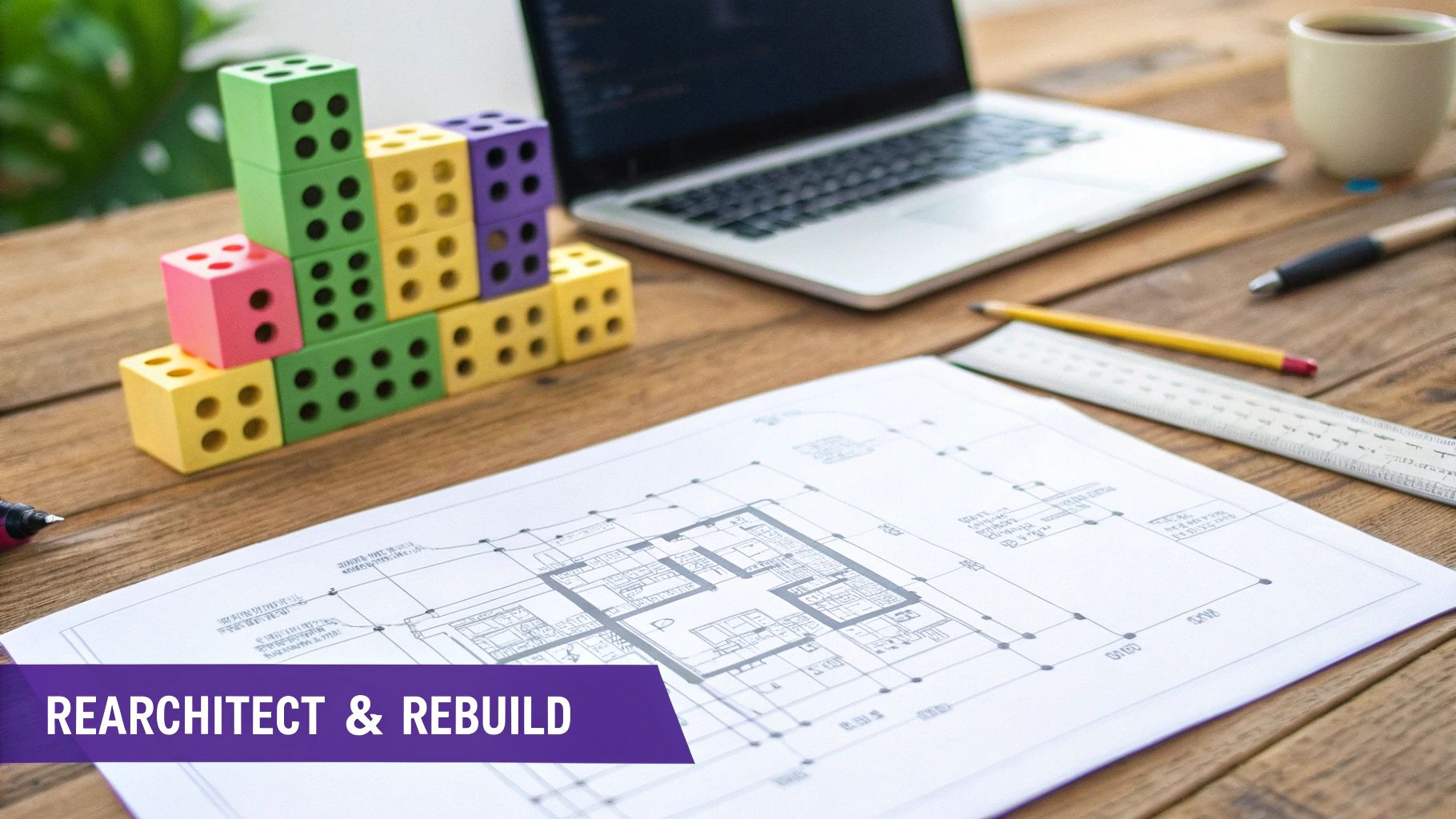
Think of it like this: rearchitecting is like taking an old warehouse and gutting it to create modern, modular loft apartments. You’re not just painting the walls; you're changing the entire blueprint. This shift gives you incredible flexibility and the ability to scale up without tearing everything down again.
Rearchitecting For Agility and Scale
At its core, rearchitecting is all about breaking apart a clunky, monolithic application into smaller, independent pieces—what we often call microservices.
Each microservice is built to do one thing and do it well. They all talk to each other through APIs, which means you can update, fix, or replace one part of the system without breaking everything else. The result? You can get new features out the door so much faster.
This is why rearchitecting is quickly becoming the go-to over simple "lift-and-shift" migrations. It delivers genuine, lasting agility. As more companies adopt microservices, the trend toward more resilient and adaptable systems is clear—you can get a better sense of the legacy modernization market to see how big this shift really is.
Rearchitecting is a bet on the future. It’s a conscious choice to trade short-term convenience for long-term agility, building a system that can evolve as fast as your business does.
Rebuilding From The Ground Up
Then there's rebuilding. This is the most radical option of all.
Imagine bulldozing that old warehouse and constructing a brand-new, cutting-edge skyscraper in its place. You're rewriting the entire application from scratch using the latest and greatest tools, frameworks, and architectural designs.
It's a massive undertaking, but it gives you a completely clean slate.
- Wipe Out Technical Debt: Every single line of clunky, outdated code is gone. Your team gets to build on a clean, modern foundation.
- Embrace Modern Tech: You can finally use the newest programming languages and cloud-native services, unlocking a world of new capabilities.
- Build for Tomorrow: The new system is designed from day one to be scalable, secure, and a breeze to maintain for years to come.
This approach makes the most sense for those mission-critical apps that are so tangled and broken that trying to patch them up is just throwing good money after bad. For projects of this scale, working with a partner like Dreamspace, a vibe coding studio, can be a game-changer. Their knack for using AI app generators to create modern, on-chain applications can dramatically speed up the rebuilding process and ensure you get a product that’s truly built for the future.
How To Choose The Right Modernization Path
With all the different modernization strategies out there, picking one can feel like a shot in the dark. But here’s the secret: there’s no single “best” answer. The real key is matching your technical game plan to what your business actually needs to accomplish.
It all starts by asking the right questions. Getting honest answers to these questions builds a solid framework for your decision, steering you clear of a path that’s too expensive, takes too long, or just plain misses the mark. This turns a daunting technical choice into a focused business conversation.
Assess Your Current State
First things first, you need to get a clear-eyed view of where you stand right now. This means taking a hard, honest look at the health of your current system, what your team can realistically handle, and the budget you’re working with.
- Business Problem: What specific pain are you trying to eliminate? Are you bleeding money on maintenance costs? Are security holes keeping you up at night? Or is your inability to ship new features frustrating customers?
- System Health: Just how much technical debt are you dragging around? Is the code a tangled mess of spaghetti, or is it reasonably well-organized? An application that’s one bad day away from collapsing might need a more dramatic intervention.
- Budget and Risk: What’s your budget and timeline? A full rebuild gives you a fresh start but requires a serious investment of time and money. On the other hand, a simple rehost is faster and cheaper but doesn't fix any of the underlying problems.
Think of your budget and risk tolerance as the guardrails on this journey. A strategy that looks perfect on a whiteboard is worthless if you run out of cash halfway through or if a single misstep could tank the business.
Aligning Strategy With Business Goals
At the end of the day, the technology has to serve the business. If your main goal is just to escape an expensive data center lease—fast—then rehosting is a perfectly logical move. But if you’re trying to set your company up for a decade of rapid innovation, you really need to be thinking about rearchitecting for the long haul.
Don't forget you can mix and match. You don’t have to lock yourself into a single strategy for your entire software portfolio.
You might decide to retire an old, redundant app, rehost a stable internal tool that just works, and go all-in on rebuilding your main customer-facing platform. For teams looking to spin up new front-ends or internal tools quickly, it’s also worth exploring what no-code development is as a way to supplement the main effort.
This kind of flexible thinking lets you put your resources where they’ll make the biggest splash. More often than not, this balanced approach is the smartest way forward.
Frequently Asked Questions
Modernizing a legacy system is a big undertaking, and it's natural to have questions. Here are a few of the most common ones we hear from organizations just starting their journey.
What Is The First Step In A Legacy Modernization Project?
Before you write a single line of new code, you have to start with a deep-dive assessment. This is the non-negotiable first step.
You need a complete picture of your current system—its architecture, all its weird dependencies, its actual business value, and the mountain of technical debt it's carrying. This discovery phase is what keeps you from making a hugely expensive mistake down the road and ensures your modernization plan is grounded in reality.
How Do I Get Stakeholder Buy-In For Modernization?
You have to speak their language. Forget the technical jargon and build a business case that focuses on what they care about: money and strategy.
Frame the conversation around the real-world costs of doing nothing—skyrocketing maintenance fees, glaring security holes, or losing ground to competitors. Then, show them the return on investment. Talk about lower operational costs, getting new features to market faster, and future-proofing the business.
A successful pitch frames modernization not as an IT expense but as a strategic investment in the company's future. It’s about enabling growth, mitigating risk, and staying competitive.
Can A System Be Modernized While Still In Use?
Absolutely. In fact, it's pretty much the only way it's done. A "big bang" switchover is just too risky for most businesses.
Modernization is almost always an iterative process designed to cause as little disruption as possible. We use techniques like the Strangler Fig Pattern, where you slowly and carefully replace bits and pieces of the old system with new services. This phased approach lets you deliver value incrementally and keeps the business running smoothly throughout the entire transition.
Ready to transform your legacy systems into modern, on-chain applications? Dreamspace is a vibe coding studio and AI app generator that helps you build for the future. Generate smart contracts, query blockchain data, and launch your project with AI.