
How to Become a Blockchain Developer: A Quick Guide to Skills and Jobs
So, what does it actually take to become a blockchain developer? It's more than just learning a new programming language. It's a journey that starts with the fundamentals, moves into the mind-bending concepts of decentralization, and ends with you building real, portfolio-worthy projects.
Let's break down the roadmap.
Your Path to Becoming a Blockchain Developer
Jumping into blockchain development is a huge move, and for good reason. The demand for developers who can navigate this space is exploding. From DeFi to Web3 gaming, companies are scrambling for talent that can build, secure, and deploy decentralized systems.
But here’s the reality: you don’t just wake up one day and start shipping complex smart contracts. There’s a deliberate path you have to follow. It starts with the same stuff every great software engineer knows—the computer science essentials—before layering on the unique challenges and concepts of blockchain.
This approach is crucial. It ensures you’re not just copy-pasting code, but truly understanding why things work the way they do in a world without central servers.
The Core Learning Milestones
I like to think of this journey in three distinct phases: getting the basics down, going deep on blockchain, and then, finally, building things. Trying to jump ahead is a recipe for getting completely overwhelmed.
This roadmap breaks it down visually, showing how each stage builds on the last.
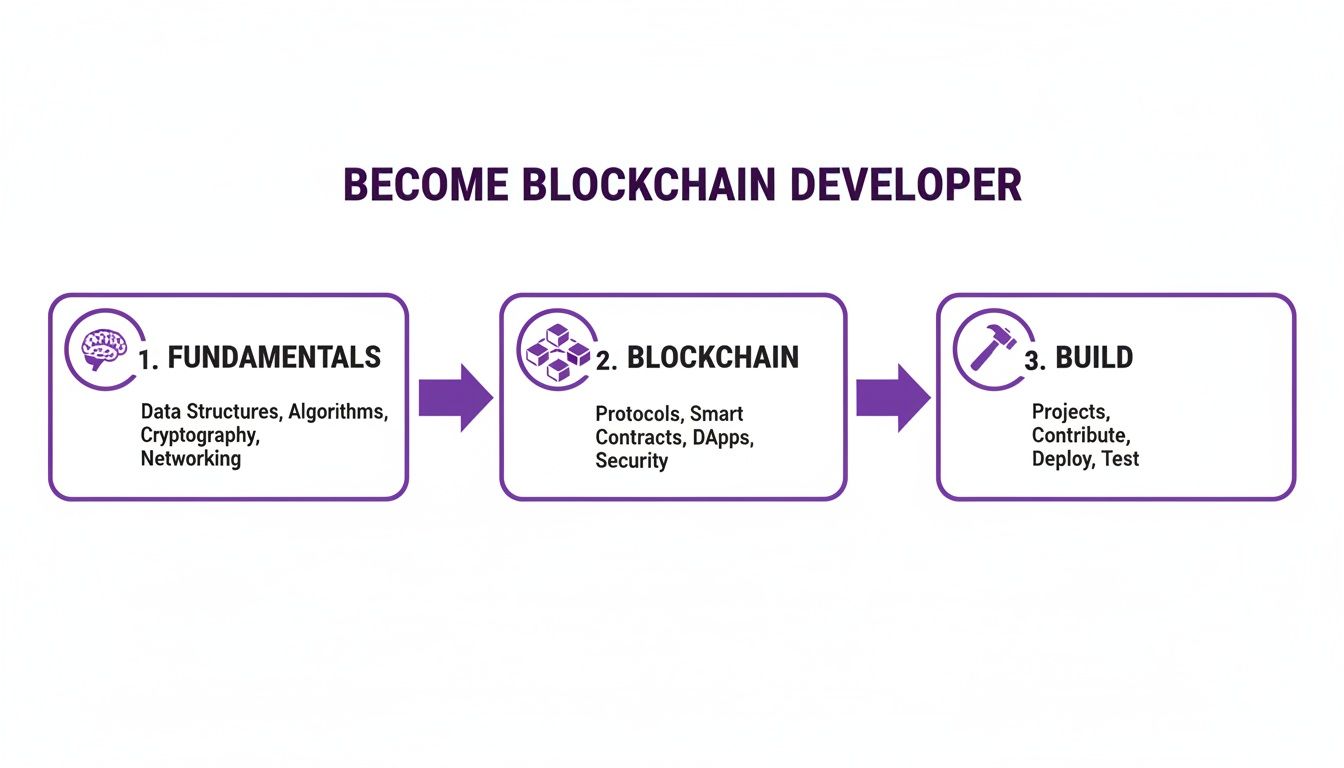
As you can see, building is the final—and most important—step. It all starts with a solid foundation. If you need a refresher on the absolute core concepts, our guide on what is blockchain development is the perfect place to start.
Core Skill Areas and Estimated Learning Timelines
To give you a clearer picture of the commitment, here's a realistic breakdown of the key skill areas and how long you should expect to spend on each. This isn't a race; it's about building a solid foundation.
Remember, these timelines are just estimates. The key is consistent, focused effort. The most successful developers I know didn't just learn a language; they learned a new way of thinking about security, trust, and how data flows.
Ultimately, your portfolio is your resume. It’s the tangible proof that you can solve real problems using this technology. Whether you're coding a dApp from the ground up or using a tool like Dreamspace to accelerate the process, your projects are what will get you noticed. An AI app generator can be a massive help here, letting you generate on-chain apps in minutes so you can focus on the unique logic and user experience.
Building a Rock-Solid Technical Foundation

Before you write a single line of Solidity, you need to get the groundwork right. I’ve seen so many aspiring developers try to skip this part, jumping straight into smart contracts only to hit a wall. Trust me, a solid grasp of the fundamentals is what separates a developer who just copies tutorials from one who can actually engineer secure and efficient decentralized systems.
Think of it like building a skyscraper. You don’t start with the penthouse; you pour a deep, strong foundation. For a blockchain developer, that foundation is built on computer science principles, networking know-how, and the basics of cryptography. These aren't just academic exercises—they're the tools you'll use every single day.
Why Computer Science Fundamentals Matter
At its core, a blockchain is just a special kind of distributed database. To work with it effectively, you really need to understand how data is organized and moved around. This is where classic CS concepts become your secret weapon for writing code that doesn't just work, but works well.
Three areas are absolutely critical:
- Data Structures: You have to know how data is stored. Concepts like linked lists are a perfect analogy for how blocks are chained together. And you'll use hash tables (or "mappings" in Solidity) constantly for pulling data efficiently.
- Algorithms: Writing smart contracts is all about logic and efficiency. A good handle on algorithms helps you write gas-efficient code that won't cost users a fortune in transaction fees. It's a huge deal.
- Object-Oriented Programming (OOP): Languages like Solidity are heavily influenced by OOP. Understanding principles like inheritance and encapsulation will make your smart contract code more modular, reusable, and way easier to manage down the line.
The most common—and most expensive—bugs in smart contracts often come from a weak grasp of these fundamentals, not from a misunderstanding of blockchain itself. Secure code is efficient, logical code.
Understanding the Network You're Building On
Blockchains are peer-to-peer (P2P) networks. This is a totally different world from traditional web apps that rely on a central server. Your dApps will communicate across a distributed web of nodes, which makes a basic understanding of networking non-negotiable.
You don't need to be a network engineer, but you should get comfortable with the TCP/IP model. Knowing how data packets travel across the internet gives you a mental model for how blockchain nodes communicate, sync up, and reach consensus. This becomes vital when you're trying to debug why your dApp can't connect to a node.
Cryptography: The Bedrock of Blockchain Security
Cryptography is the magic that makes all of this possible. It’s what gives us the security, immutability, and trust that define the entire system. Without it, there’s no blockchain.
Again, you don’t need a Ph.D. in math, but you absolutely must understand two core concepts:
- Public-Key Cryptography: This is the foundation of digital identity on-chain. You need to know how public and private key pairs create digital signatures to authorize transactions and prove ownership.
- Hash Functions: These are the engines of immutability. Understanding how hashing creates a unique, fixed-size fingerprint for any piece of data is essential. It’s how blocks are linked and how the ledger’s integrity is maintained.
Putting in the work to master these pillars gives you the confidence to build real-world applications. This dedication also pays off. In the U.S., typical full-time blockchain developer compensation ranges from $120,000–$190,000 per year, with senior roles often clearing $200,000. On top of that, Web3 compensation frequently includes token allocations, which can significantly boost your total earnings. You can dive into more detailed salary info and the job outlook on Algorand's blog.
Alright, with your tech fundamentals squared away, it’s time to get into the good stuff—the core ideas that make blockchain tick. This isn't just academic theory; it's the stuff you'll be wrestling with every single day as a developer. Getting these concepts down is what separates someone who just copies tutorials from someone who can actually build something new.
The whole show starts with the distributed ledger. Forget about a traditional database sitting on one company's server. A blockchain's ledger is copied and shared across a huge network of computers. This is the magic of decentralization—it makes the network tough, censorship-resistant, and free from a single point of failure.
Every transaction gets bundled into a "block," which is then cryptographically chained to the one before it. This creates a permanent, unchangeable record of everything that’s ever happened.
But how do all those computers agree on what’s true without a boss? That's where consensus mechanisms come in.
Understanding How Blockchains Agree
Think of consensus mechanisms as the rulebook everyone on the network agrees to play by. They ensure the ledger stays honest and secure. There are a bunch of them out there, but you absolutely need to know these two from the get-go.
- Proof-of-Work (PoW): This is the OG, the one that powers Bitcoin and (historically) Ethereum. In this system, "miners" use powerful computers to race to solve a complex math puzzle. The winner gets to add the next block to the chain and earns a reward. It's incredibly secure but notoriously power-hungry.
- Proof-of-Stake (PoS): This is the more energy-efficient heir to the throne. Instead of miners, you have "validators" who lock up (or "stake") their own crypto as collateral to vouch for the network's integrity. Validators are chosen to create new blocks, and if they try to cheat, they lose their staked coins.
Understanding the tradeoffs between PoW and PoS—security versus energy use, speed versus decentralization—is key to understanding why different blockchains are designed the way they are.
Choosing Your First Smart Contract Language
Once you’ve got the “how” down, you need to learn the language to actually build things. Smart contracts are the heart of it all. They're just programs that run automatically when certain conditions are met, with the rules of the agreement baked directly into the code. They are the foundation for every decentralized application (dApp).
Two languages pretty much run the show, and your choice will steer you toward a specific ecosystem. If you want to go deeper, we've got a full breakdown in our guide to popular blockchain programming languages.
For now, let's look at the two big players.
Choosing your first language is a huge decision. Solidity is the established giant with a massive ecosystem, making it a great starting point. Rust is the powerful newcomer, offering top-tier performance for the next wave of dApps.
Solidity was purpose-built for the Ethereum Virtual Machine (EVM), the runtime environment for Ethereum smart contracts. It's an object-oriented language that will feel pretty familiar if you've ever touched JavaScript or C++. The overwhelming majority of today's DeFi and NFT projects are built with Solidity, which means the community support, tutorials, and open-source code are absolutely massive.
Rust, on the other hand, is a systems-level language prized for its raw performance and memory safety. It's the language of choice for high-speed chains like Solana and Polkadot. It definitely has a steeper learning curve, but its strict compiler helps you avoid entire categories of common bugs—a lifesaver when you're coding contracts that handle real money.
To help you see the differences at a glance, here’s a quick comparison.
Solidity vs Rust: A Comparison for Smart Contract Developers
Choosing between Solidity and Rust often comes down to what ecosystem you're targeting and what you're trying to build. Solidity gets you into the largest existing market, while Rust positions you on the cutting edge of performance.
Ultimately, your first choice isn't forever, but it will set your initial path. Starting with Solidity opens the door to the biggest ecosystem right now. Mastering Rust puts you at the forefront of what's next in high-performance blockchain.
The great news is that no matter which you pick, you can always build faster. Using an AI app generator like Dreamspace, a vibe coding studio designed to generate on-chain apps and boilerplate smart contracts, lets you skip the tedious setup and focus on your app's unique logic.
The Modern Blockchain Developer Toolkit
Alright, you've got the core blockchain concepts down and you've picked a language to focus on. Now for the fun part: assembling your toolkit. Knowing the theory is one thing, but having the right software and frameworks is what turns ideas into actual, running applications.
Think of these tools as your personal workshop. Each one has a specific job, and understanding how they all click together is the key to a smooth, headache-free workflow. You'll need an environment to write and compile your contracts, a way to test them without burning real crypto, libraries to talk to the blockchain, and of course, a wallet to act as your digital identity.
Core Development Frameworks
Frameworks are your command center. They bundle everything you need to compile, test, and deploy smart contracts, saving you from a world of manual configuration pain. In the Ethereum world, two giants dominate the scene.
- Hardhat: This is a super flexible, JavaScript-based environment. Its killer feature is the Hardhat Network, a local Ethereum simulation that lets you build and test on your own machine. Plus, its massive plugin ecosystem means you can customize it for almost any need.
- Foundry: Built in Rust, Foundry is all about speed and modularity. Its big selling point? You write your tests directly in Solidity. For many developers, this is a game-changer, as it avoids the context-switching that comes with writing tests in JavaScript.
Honestly, choosing between them often comes down to personal taste. Hardhat is the established veteran with a huge community, while Foundry is the newer kid on the block, beloved for its raw speed and Solidity-native testing. Try both.
Interacting with the Blockchain
Once your smart contract is live, your app's frontend needs a way to communicate with it. This is where JavaScript libraries come in, acting as the critical bridge between your user interface and the blockchain's backend.
The two main players here are Ethers.js and Web3.js. They give you a straightforward API to send transactions, read contract data, and listen for on-chain events. For instance, you'd use Ethers.js in your React app to let a user click a button and trigger a function in your smart contract.
Of course, to sign those transactions, you need a wallet. MetaMask is the undisputed king. It’s a browser extension that serves as your secure gateway to the decentralized web, letting you manage your keys and approve transactions with a click.
Your day-to-day development loop will almost always involve this trio: a framework like Hardhat for local work, a library like Ethers.js to connect your dApp, and a wallet like MetaMask to interact with the network.
Handling Data On-Chain and Off-Chain
Here’s a pro-tip: not all data should live on the blockchain. Storing large files like images or videos on-chain is incredibly expensive. This is where decentralized storage comes into play. The InterPlanetary File System (IPFS) is the go-to solution—a peer-to-peer network for storing data in a distributed way. It's perfect for things like NFT metadata or hosting your dApp's frontend.
Querying historical data from the chain can also be a slow, clunky process. To fix this, developers rely on indexing protocols like The Graph. It lets you build custom APIs (called "subgraphs") to pull blockchain data efficiently, making your applications feel way faster and more responsive.
As you get started, remember you can seriously speed up the process. A tool like Dreamspace, an AI app generator built for this space, can scaffold out the initial smart contract and dApp structure for you. This lets you focus on the unique logic while the AI handles the boilerplate, helping you learn and ship much faster.
4. From Theory to Practice: Building Your First dApp
You can read all the theory in the world, but nothing solidifies the concepts like actually building something. The moment you write, test, and deploy your first decentralized application (dApp) is when it all finally clicks. This is where you convert abstract ideas into real, tangible skills.
Your first project doesn't have to be the next Uniswap. In fact, it shouldn't be. The goal is to get a win under your belt by navigating the full development lifecycle—from writing a smart contract to interacting with it through a simple web interface.
Keep it simple. Think of a basic voting system, a "tip jar" contract that can receive crypto, or a bare-bones NFT minting dApp. These projects are perfect because they touch on all the critical components without getting you bogged down in complexity.
Writing Your First Smart Contract
Let's stick with the voting dApp idea. The heart of this application is its smart contract, which we'll assume is written in Solidity for an EVM-compatible chain. This contract needs to handle a few key jobs.
- State Variables: You'll need variables to keep a list of candidates and a mapping to track the vote count for each one.
- Functions: You’ll need a public function that lets users cast their vote and another
viewfunction so anyone can check the current results. - Security: Even here, security is crucial. You have to build in a check to make sure each address can only vote once. This is a non-negotiable.
This simple exercise forces you to think about logic, data management, and the fundamentals of on-chain security right from the start.
Your first dApp is your sandbox. It's the place to make mistakes, learn from them, and truly understand the consequences of immutable code. Prioritize security and gas optimization from line one, as these habits will define your career.
Connecting a Frontend and Deploying to a Testnet
A smart contract is just code sitting on the blockchain; it’s not exactly user-friendly. To fix that, you'll need a basic frontend, typically built with a library like React. This is where tools like Ethers.js or Viem come in—they act as the communication bridge between your website and the blockchain.
You'll build a dead-simple interface with buttons that call your smart contract's functions. For instance, a "Vote for Candidate A" button would trigger a transaction that calls your vote() function, which the user then signs using their MetaMask wallet.
Of course, you’re not going to spend real money to test this. You’ll deploy and test your dApp on a testnet first. Testnets are clones of a main blockchain that use valueless "test" Ether, letting you debug and experiment without any financial risk. This is a critical step. Mastering this testnet workflow is a non-negotiable skill for any serious blockchain developer.
For a deeper dive into the full stack, our guide to blockchain application development covers the entire process in more detail.
A Quicker Way to Build: Using AI
Building your first dApp from the ground up is an amazing learning experience, but let's be honest—it can be a slog. Writing boilerplate code, setting up the environment, and configuring the frontend connection all take time away from focusing on your app's unique logic.
This is where you can work smarter, not just harder. Tools like Dreamspace, a vibe coding studio, can act as an AI app generator to create the foundational code for your on-chain apps and smart contracts with no-code. You just describe your dApp idea in plain English, and it can generate the initial Solidity contract and React components in minutes.
Using a tool like Dreamspace can drastically cut down your prototyping time. It lets you focus on customizing the core features and learning the underlying patterns instead of getting stuck on repetitive setup tasks. It's a powerful way to build faster and bring your ideas to life much more quickly.
Creating a Portfolio That Lands You a Job
In the Web3 world, your GitHub is your resume. Seriously. While your on-paper skills matter, nothing gets you noticed like a portfolio packed with real, working projects. This is your proof-of-work, showing everyone you can actually build, secure, and ship decentralized applications.
Your portfolio needs to tell the story of your growth as a developer. Forget about quantity—two polished, production-ready projects will always impress more than ten half-baked experiments. The key is to build dApps that solve a genuine, even if small, problem.
Showcasing Your Skills Through Projects
Recruiters and hiring managers are looking for more than just tutorial-followers. They want to see developers with a diverse skill set who can tackle different corners of the Web3 ecosystem.
Here are a few project ideas to get the gears turning:
- A DeFi Protocol: Try building a simple staking or yield farming contract. This immediately signals you understand financial primitives and take security seriously.
- An NFT Marketplace: Put together a basic platform for minting and trading NFTs. This shows you're comfortable with ERC-721/1155 standards and can manage off-chain metadata.
- A Decentralized Identity App: Develop a system for users to control their own on-chain identity. It proves you can think creatively beyond the world of finance.
For every single project, aim for 100% test coverage and a clean, well-documented codebase. A detailed README is non-negotiable. Explain what the project does, how to set it up, and what tech you used. This is what separates amateurs from professionals.
If you want to get these ideas off the ground quickly, a tool like Dreamspace can be a massive help. It's a powerful vibe coding studio and AI app generator that can handle the initial boilerplate, freeing you up to focus on building out the unique features that will make your project shine.
Beyond Code Contributions
Projects are the heart of your portfolio, but contributing to the wider ecosystem shows you're a real team player. Merging a simple bug fix into an open-source library like OpenZeppelin or improving the documentation for a tool like Hardhat can be incredibly valuable. These are the kinds of contributions that really stand out in interviews.
A strong portfolio isn’t just a collection of code; it's proof of your problem-solving ability, your commitment to security, and your passion for the decentralized space. Make it easy for people to see what you can do.
Once your projects are ready, you need to package your experience the right way. For a great guide to writing a software engineer resume that actually gets you in the door, it's worth checking out expert resources.
Finally, get out there and build in public on platforms like GitHub and Twitter. Share your progress, write about your learnings, and engage with other devs. That visibility is your direct path from learning to earning.
Burning Questions for Aspiring Blockchain Devs
The path to becoming a blockchain developer is definitely a grind, full of technical challenges and some big choices. As you get deeper into it, a few questions tend to pop up for just about everyone. Let's clear the air on some of the most common ones.
So, Do I Actually Need a Computer Science Degree?
Straight answer? No, a formal degree isn't a hard requirement. Plenty of incredible blockchain developers are self-taught or came out of coding bootcamps.
What really gets you noticed is a killer portfolio, a rock-solid grasp of CS fundamentals, and proof you can write secure smart contracts. In the Web3 world, what you can do and build almost always speaks louder than a diploma.
Which Blockchain Should I Learn First?
If you're just starting out, Ethereum is hands-down the best place to begin. It's been around the block, which means you'll find a mountain of documentation, endless tutorials, and a huge community of developers to help you when you get stuck. That support system makes a massive difference.
That said, if you're eyeing high-speed dApps, you might want to look at learning Rust for a chain like Solana. But honestly, starting with Ethereum gives you a foundation that makes picking up any other chain way easier down the road.
The fastest way to land a job is to build things. As soon as your portfolio starts looking solid, hit the ground running. Check out dedicated blockchain developer job listings to see exactly which skills companies are hiring for right now.
How Can I Build and Learn Faster?
Want to put your learning on the fast track? Stop watching tutorials and start building your own projects. The sooner you jump into creating unique dApps, the better.
This is where tools like Dreamspace can be a game-changer. It’s an AI app generator that lets you skip the tedious boilerplate code for dApps and smart contracts. By using a vibe coding studio like this, you can focus on the unique logic of your app and see how the underlying pieces fit together, way faster than if you wrote every single line from scratch. It's an awesome way to build out your portfolio in record time.
Ready to bring your on-chain ideas to life faster? With Dreamspace, you can generate production-ready dApps and smart contracts using AI, no code needed. Skip the boilerplate and start building what matters.