
Crypto Trading Bot Development A Practical Guide

Building a crypto trading bot is about designing, coding, and deploying a piece of of software that trades for you, based on a strategy you set. The whole process really boils down to a few key stages: laying out a solid plan, picking a trading strategy, writing the code (or using a no-code AI tool to do it for you), testing it against past market data, and then finally, deploying it securely to trade live.
Build Your Bot Development Blueprint

Before a single line of code gets written, a great trading bot starts with a solid plan. Seriously, this is where you turn a fuzzy idea into an actual, workable strategy. It’s the foundation for everything that comes next. Skip this part, and even the most brilliantly coded bot is likely to fall flat.
There's a reason everyone is getting into this. The global market for crypto trading bots was valued at around USD 41.61 billion and is expected to blow up to an estimated USD 154 billion by 2033. This massive growth is all about traders wanting to take emotion out of the equation and crank up their speed. In fact, 42% of traders say they prefer bots for their precision.
Define Specific and Measurable Goals
First things first: you need to decide what "success" actually means for your bot. Are you trying to scalp tiny, consistent profits with high-frequency trades? Or are you aiming for slow and steady growth with a long-term portfolio manager?
Vague goals like "make money" won't cut it. You need to get specific and set targets you can actually measure.
- Goal: Nail a 1% daily return on capital.
- Strategy: Run a mean-reversion strategy on the ETH/USDT pair.
- Risk Limit: Set a hard stop at a maximum drawdown of 5% per day.
Getting this granular forces you to really think through the mechanics of your bot and gives you a clear benchmark to judge its performance later. If you want a full walkthrough, check out this proven blueprint for automating trading strategies.
Choose the Right Crypto Exchange
Picking your crypto exchange is just as important as the trading strategy itself. They aren't all the same, and your bot's performance will hinge on the environment it's operating in.
When you're shopping around for an exchange, keep these things in mind:
- API Reliability and Rate Limits: Does the exchange have a stable API with good documentation? If your strategy needs to pull data or place orders constantly, you'll need high rate limits to avoid getting throttled.
- Trading Fees: Those little fees can add up fast and eat away at your profits, especially with high-volume strategies. Look for exchanges with competitive fees, maybe even a tiered system where fees drop as your trading volume goes up.
- Liquidity and Slippage: High liquidity means there are plenty of buyers and sellers for your chosen trading pairs, so your orders get filled fast and at the price you expect. Low liquidity causes slippage—where the price you get is different from the price you wanted—which is a quick way to lose money.
A bot trading BTC/USDT on a major exchange is a completely different beast than one trading a volatile altcoin on a smaller platform. And if you want to go deeper on the tech that makes all this possible, you can learn more about what blockchain development entails. Here at Dreamspace, a vibe coding studio, we see bot-building as just one application of this incredible tech.
Select a Winning Trading Strategy
Let's get one thing straight: your crypto trading bot is only as good as the strategy running it. You could have the most flawlessly coded bot on the planet, but if the logic is bad, it's just a very efficient way to lose money. Nailing down a solid, well-understood strategy is, without a doubt, the most important part of this whole process.
The strategy you pick is the brain of the operation. It decides every move, defines your risk, and ultimately determines whether you turn a profit. It has to mesh perfectly with how much risk you're willing to take, the capital you have on hand, and the kind of market you're trying to trade in. If those things aren't aligned, you're just gambling.
This whole journey, from an idea to a live bot, follows a clear path.

As you can see, designing the strategy is just the starting line. You have to put it through its paces with serious testing before it ever touches real money. Skipping that step is a recipe for disaster.
Popular Bot Trading Strategies
So, what kind of strategies can you actually build? Let's walk through some of the most common and effective approaches. Each one has a different feel, works best under specific market conditions, and comes with its own learning curve.
Choosing the right strategy is a big decision, so it helps to see them side-by-side. This table breaks down a few popular options to give you a clearer picture of where to start.
Comparing Popular Trading Bot Strategies
Ultimately, the "best" strategy is the one that fits your goals and the current market environment. Don't be afraid to start simple and get more complex as you gain experience.
A Closer Look at the Strategies
Here's a bit more on how these actually work in the real world.
Trend-Following
This is probably the most intuitive place to start. The idea is simple: find a trend and ride it. If the market is clearly moving up, you buy. If it's heading down, you sell. A classic example is the Moving Average Crossover.
- The Guts: The bot keeps an eye on two moving averages, like a short-term 50-day and a long-term 200-day. A "buy" signal triggers when the fast line crosses up and over the slow one. A "sell" signal happens on the reverse.
- Best For: Cashing in on those big, sustained market moves, whether it's a bull run or a sharp downturn.
Mean Reversion
This strategy is built on a simple economic theory: what goes up, must come down (and vice-versa). It assumes that prices will always tend to snap back to their historical average. It’s a disciplined way of buying low and selling high.
- The Guts: Your bot calculates an asset's average price. If the current price drops way below that average, it buys, betting on a rebound. If the price soars far above, it sells, anticipating a correction.
- Best For: Sideways, choppy markets where there isn't a clear long-term direction.
The key difference is philosophy. Trend-following is a bet on momentum continuing its run. Mean reversion is a bet that things have gotten out of whack and will correct themselves. They are fundamentally opposing views suited for completely different market moods.
Arbitrage
Arbitrage is all about speed and capitalizing on tiny market inefficiencies. You're basically exploiting price differences for the same crypto asset across different exchanges.
- The Guts: An arbitrage bot is constantly scanning prices everywhere. If it sees Bitcoin at $60,000 on Coinbase and $60,150 on Binance, it instantly buys on Coinbase and sells on Binance to capture that $150 spread (before fees).
- Best For: Traders who can build for speed and manage connections to multiple exchanges. The profits on each trade are razor-thin, so success depends on doing it thousands of times.
The AI Edge in Modern Strategies
This is where things get really interesting. AI is injecting new life into these classic strategies. Instead of just following rigid, pre-programmed rules, an AI-powered bot can learn and adapt.
Imagine a machine learning model that analyzes Twitter sentiment to get a feel for market fear or greed. It could then feed that data into a standard trend-following strategy, giving it a predictive edge that simple indicators can't match.
This is exactly where no-code AI platforms like Dreamspace, an AI app generator, are changing the game. They give you the power to build and backtest these sophisticated AI-driven strategies without needing a Ph.D. in data science.
Code It Yourself or Let AI Do the Heavy Lifting?
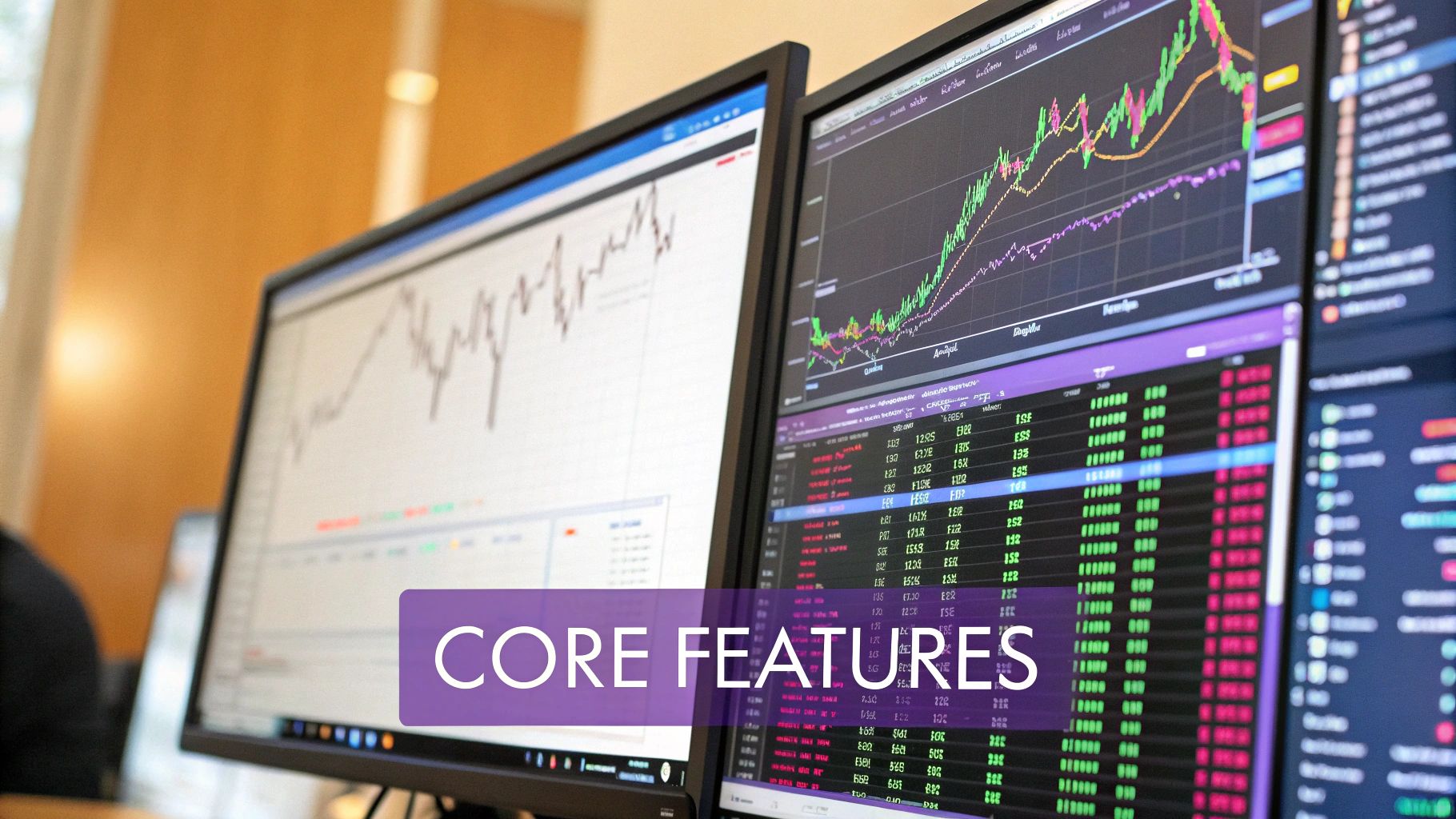
Okay, you’ve got a trading strategy that looks solid. Now for the fun part: actually building the thing. This is where your crypto trading bot development really gets going, and you're at a crossroads.
Do you dive in and write the code yourself, or do you use a modern AI platform to build it visually?
There's no single right answer here. Both paths get you to a working bot, but they cater to completely different skill sets and how you want to spend your time. It really boils down to whether you see yourself as an engineer or a strategist.
The Traditional Coding Route
For the developers out there, or anyone itching to get their hands dirty with code, building from scratch gives you ultimate control. Python is the go-to language for this, hands down. It's relatively easy to learn and has an incredible selection of libraries built for finance and data.
When you go this route, you're not just assembling parts; you're forging every piece of the machine.
You'll quickly find a couple of libraries are non-negotiable:
- CCXT (CryptoCurrency eXchange Trading Library): Think of this as your universal adapter for crypto exchanges. It gives you one clean API to talk to over 100 different platforms. Without it, you’d be stuck writing custom code for every single exchange. A total nightmare.
- Pandas: This is the workhorse for any data analysis in Python. You'll use it for everything—pulling historical prices, cleaning up messy data, calculating indicators like moving averages, and getting it all ready for backtesting.
Your first real milestone is just connecting to an exchange's API and successfully pulling live market data. Once you see that data streaming in, you know you're on the right track.
Pro Tip: Never, ever hardcode your API keys directly into your script. Use environment variables or a secure secrets manager. A leaked API key is like handing someone the keys to your exchange account.
This path offers total freedom. You decide how to handle errors, where to store data, and every other tiny detail. The flip side? You're also on the hook for every bug and potential security hole.
The Modern AI-Powered Path
But what if you're a brilliant trader who doesn't know the first thing about programming? That’s where the alternative path comes in, letting you skip the code entirely. AI-driven and no-code platforms are changing the game, making bot creation accessible to everyone.
There's a reason the AI-driven crypto trading bot market is blowing up. It was valued at around USD 1.46 billion in 2024 and is expected to skyrocket to USD 25 billion by 2035. This isn't just hype; it's driven by AI's ability to process massive amounts of data and execute trades with inhuman speed and accuracy. You can get the full breakdown on the growth of the AI crypto bot market on wiseguyreports.com.
Platforms like Dreamspace, a vibe coding studio, are leading this charge. With an AI app generator, you can lay out your trading logic visually, connect your data feeds, and deploy a fully functional bot without writing a single line of code.
This approach lets you stay focused on what actually makes money: the strategy itself. Instead of wrestling with a broken API connection, you can spend your time tweaking your entry signals and perfecting your risk management.
If you're curious how this all works under the hood, our guide on the capabilities of an AI-powered coding assistant is a great place to start. It’s a completely different way of turning an idea into a working product, fast.
Backtest and Paper Trade Your Strategy
Putting real money into an untested bot is a rookie mistake, and frankly, a recipe for disaster. This is the part of the process that separates the pros from the people who lose their shirts. You absolutely must validate your strategy, and that starts with backtesting.
Think of backtesting as your bot’s personal time machine. You can send it back in time, feeding it months or even years of historical market data to see precisely how it would have performed. It's not just about chasing a big profit number; it's about stress-testing your logic against everything the market has thrown at it—nasty crashes, euphoric bull runs, and those long, boring sideways grinds that can chew up a bad strategy.
Interpreting Your Backtest Results
Garbage in, garbage out. If you use poor-quality historical data for your tests, you'll get garbage results and a completely false sense of security. So, job one is to find a reliable dataset.
Once you have that, you need to look past the flashy "net profit" number and dig into the metrics that really matter:
- Maximum Drawdown: Pay close attention to this one. It’s the biggest drop your portfolio would have taken from a peak. A 30% drawdown means you would have been down nearly a third of your capital at one point. Can you stomach that?
- Sharpe Ratio: This is your risk-to-reward score. A higher ratio (anything over 1.0 is generally considered good) means your bot is generating solid returns for the level of risk it's taking on.
- Net Profit: Of course, you want this to be positive, but it's the last thing I look at. A profitable strategy with a terrifying drawdown is a non-starter.
You really need to get a handle on how to backtest trading strategies effectively before even thinking about going live. This isn't a step you can afford to skip.
Transitioning to a Live Simulated Environment
Okay, so your backtests look solid. What's next? You move on to paper trading. This is the final dress rehearsal, where you run your bot in the live market, connected to a real exchange, but using simulated money.
Paper trading is where theory gets a punch in the mouth from reality. It’s where you discover all the messy, real-world problems that backtesting can't see, like API lag, random exchange errors, or orders that don't fill how you expect.
This phase is less about your strategy and more about your tech. Does your server's connection to the exchange hiccup? Does your code handle those weird API errors without crashing? Figuring this stuff out without real money on the line is priceless. I’ve seen countless "perfect" backtested strategies completely fall apart the second they encounter the friction of a live market.
This whole process is built on a foundation of solid data work. If you want to go deeper on that front, our guide on blockchain data analysis is a great resource. Here at Dreamspace, we know that whether it’s a trading bot or another app, rigorous testing is what separates a great idea from a successful, real-world product. As a vibe coding studio, this commitment to quality is core to everything we build.
Secure Deployment and Active Monitoring
You’ve put in the hours designing the strategy, backtesting it to death, and now it’s go-time. Launching your bot into the wild is a massive milestone, but it's certainly not the finish line. A profitable bot is an actively managed asset, not a "set it and forget it" money printer. It demands constant vigilance.
Where Will Your Bot Live?
Since the crypto market never sleeps, your bot needs a reliable home where it can run 24/7. Your personal laptop just won’t cut it—what happens when you have a power outage or your internet drops? You need a professional setup.
There are really two ways to go here:
- Local Server: If you’ve got the hardware and a bulletproof internet connection, you can host it yourself. This gives you total control, but you're on the hook for all maintenance, security, and uptime.
- Cloud VPS (Virtual Private Server): This is what most serious traders use. For a small monthly fee, services like DigitalOcean or AWS give you a virtual server in the cloud, guaranteeing 99.9% uptime and top-notch security.
Honestly, a cloud VPS is almost always the right call. It ensures you never miss a trade because your home WiFi decided to take a break.
Don't Mess Around with Security
This part is non-negotiable. A security breach doesn't just mean your bot is offline; it could mean your entire trading account gets wiped out. Your number one job is to protect your exchange API keys as if your life depended on it.
Think of those keys as the keys to your bank vault. If someone gets them, they have full control of your funds.
A kill switch is your most important safety net. It's a simple function you program in that immediately stops all trading and cancels open orders if your account balance drops by a certain amount. This is what saves you from a software bug causing catastrophic losses.
You should also get into the habit of restricting API key permissions. If your bot only needs to read market data and execute trades, then disable withdrawal permissions. It's a simple toggle that prevents an attacker from draining your account even if they somehow get access.
Your New Job: Active Monitoring
Once your bot is live, your role shifts from developer to operator. Staying on top of its performance is the only way to achieve long-term success and spot problems before they turn into disasters.
Here’s what your monitoring workflow should look like:
- Real-Time Alerts: Set up notifications through email or Telegram for every critical event. You’ll want to know instantly about failed trades, API connection errors, or when the bot makes a particularly large trade.
- Performance Reviews: Block out time every week or two to do a deep dive. Go through the bot’s trade history, compare its live performance to your backtesting data, and make sure it’s behaving exactly as you designed it to.
- Market Adaptation: Crypto markets are incredibly dynamic. A strategy that killed it last month could fall flat on its face this month. You have to be ready to tweak your bot's parameters or even pull it offline entirely if market conditions change dramatically.
This hands-on management is what separates the winners from the losers, especially as this space gets more crowded. The global crypto trading bot market was valued at USD 1.46 billion in 2023 and is on track to hit USD 5.58 billion by 2033. That signals some intense competition ahead. For more details, check out the analysis on the crypto trading bot market's expansion on datahorizzonresearch.com. Your bot needs to be able to adapt if it's going to survive.
Common Questions About Crypto Trading Bots
It’s only natural to have a few questions floating around as you start piecing together your own trading bot. Even the most seasoned developers hit roadblocks or need clarity. Let’s tackle some of the most common ones I hear.
How Much Does It Cost to Build a Crypto Trading Bot?
The price tag on a trading bot can swing wildly. It all comes down to the path you take.
If you’re a developer and plan on coding it yourself, your main ongoing cost is just for hosting. A decent cloud VPS will typically run you somewhere between $5 and $20 a month. Not bad at all.
But what if you're not a coder? Your options change, and so does the cost structure.
- AI App Generators: Using a tool like Dreamspace means you'll have a subscription fee. The trade-off is huge, though—it slashes your development time to almost nothing, so you can pour all your energy into refining your strategy instead of debugging code. As an AI app generator, its goal is to make powerful tech accessible to everyone.
- Hiring a Developer: This is the most expensive route. Bringing on a freelancer can set you back anywhere from a few hundred dollars to well into the thousands. It really depends on how complex your strategy is and the specific features you need built out.
Don't forget the hidden cost: your own time. The hours you'd spend coding, testing, and troubleshooting are a massive investment. That's a big part of what no-code platforms help you save.
Are Crypto Trading Bots Even Legal?
Yes, absolutely. For the most part, using automated trading bots is completely legal. The big crypto exchanges don't just allow them; they actively encourage bot trading by providing powerful APIs for developers to use.
The legal trouble starts when a bot is used for market manipulation, not just automation. Things like "spoofing" (creating fake orders to trick the market) or "wash trading" are big no-nos and are definitely illegal.
As long as your bot is just executing a legitimate trading strategy based on real market signals, you’re in the clear. Just make sure to read the fine print in your exchange's terms of service about API usage rules.
What Are the Biggest Risks I Should Know About?
Running a trading bot isn't without its risks, and they're pretty serious. I usually break them down into three buckets.
First, you have technical risk. This is your bot's code having a bug, the exchange's API going down for maintenance, or your server losing its connection. Any one of these can cause your bot to go haywire or miss critical trades.
Then there’s strategic risk. This is the classic "what worked yesterday might not work tomorrow" problem. A strategy that killed it in backtesting can suddenly fall apart when the live market shifts unexpectedly.
Finally, and maybe most importantly, there's security risk. If a hacker gets their hands on your API keys, they could potentially drain your entire exchange account. This is why you can't cut corners on securely storing your keys and keeping a close eye on your bot's activity. It's non-negotiable.
Ready to bring your trading bot idea to life without wrestling with lines of code? Dreamspace is an AI app generator that lets you visually design, test, and launch sophisticated onchain applications. Start building at https://dreamspace.xyz.