
A Guide to Creating a Dating App Without Code
So, you want to build a dating app. The process really boils down to a few key stages: nailing down your unique idea, planning the must-have features, and picking the smartest way to build it. The biggest game-changer? No-code platforms. They've completely flipped the script, turning what was once a $50,000+ coding nightmare into something a single founder can actually pull off.
The New Way to Build a Dating App
Jumping into the dating app world can feel like you're about to wrestle with giants like Tinder and Bumble. But honestly, the playbook for launching a successful app has totally changed. You no longer need a huge dev team or a pocketful of venture capital just to get your idea off the ground.
The playing field is more level than ever, thanks to powerful tools that are now widely available. Smart creators are ditching the old, expensive, code-heavy routes for faster, more agile methods. The secret to success now isn't about building another generic swiping app—it's about finding your unique corner of the market.
Finding Your Niche
Before you write a single line of code (or even a prompt), you need a strategy. The new dating apps that are actually succeeding aren't trying to be the next Tinder. They're hyper-focused on a specific community or a shared passion. Think about it: an app for board game geeks, one for dedicated marathon runners, or maybe one just for traveling nurses.
- Look for underserved groups: Who are the big players ignoring? This could be based on demographics, specific hobbies, or different life stages.
- Solve a real problem: Are people in a certain community frustrated with the one-size-fits-all platforms? Your app can give them features that feel like they were made just for them.
- Build a community, not just a utility: A niche app wins by creating a sense of belonging that the massive apps simply can't.
When you lock in a clear niche, you instantly stand out. Your marketing gets easier and your users feel understood. If you're looking for inspiration on how to build those tight-knit community features, checking out a dedicated Appy Friends service can spark some great ideas.
Mapping Out Core Features and Budget
Once you know who you're building for, you can decide what to build. Of course, you’ll need the basics like user profiles, a matching mechanism, and a chat function. But your real value comes from the specialized features. Maybe it's a shared event calendar for your community, or profile prompts that only they would understand.
This is also where we get real about the money. The dating app market is enormous and still growing. It was valued at around $11-13 billion in 2025 and is on track to hit nearly $21 billion by 2033. There's definitely room for new players who do things differently.
Here's the key: a huge budget is no longer a prerequisite. An AI app generator like the Dreamspace vibe coding studio make this possible by handling all the complicated backend and database stuff for you. This frees you up to focus on what really matters—the user experience.
You don't need a six-figure budget anymore. Modern tools handle the heavy lifting, letting you focus on creating an app people will love.
This shift has massively lowered the barrier to entry. If you want to get a better handle on this approach, our guide on what no-code development is is the perfect place to start. It’s all about going from a simple idea to a concrete plan with a clear roadmap and a budget that won’t make your eyes water.
To help you get started, here's a checklist to brainstorm the features your app will need.
Core Feature Planning Checklist
Use this table to map out the essentials for your app and brainstorm some unique ideas that will make your platform stand out from the crowd.
Think of this as your starting point. The "Essential Features" are your table stakes, but the "Innovative Ideas" are where you'll really win over your niche audience.
Building Your App's Foundation with AI
You’ve got your killer idea and a specific niche. Now, how do you actually build the thing? This is usually where the dream hits a wall of technical complexity—backend architecture, database schemas, and all the stuff that makes projects drag on for months.
But we're not doing it the old way. This is where the magic of AI comes in.
Instead of writing endless lines of code or hiring an expensive engineering team, you can use an AI app generator like Dreamspace to build the entire foundation. It’s like having a senior engineer on your team, ready to translate your ideas into a fully working, secure backend just by describing what you want. This completely changes the game, saving you a ton of time and money.
This concept map breaks it down. You start with a core idea, narrow it down to a specific niche, and then define the features that bring it to life.
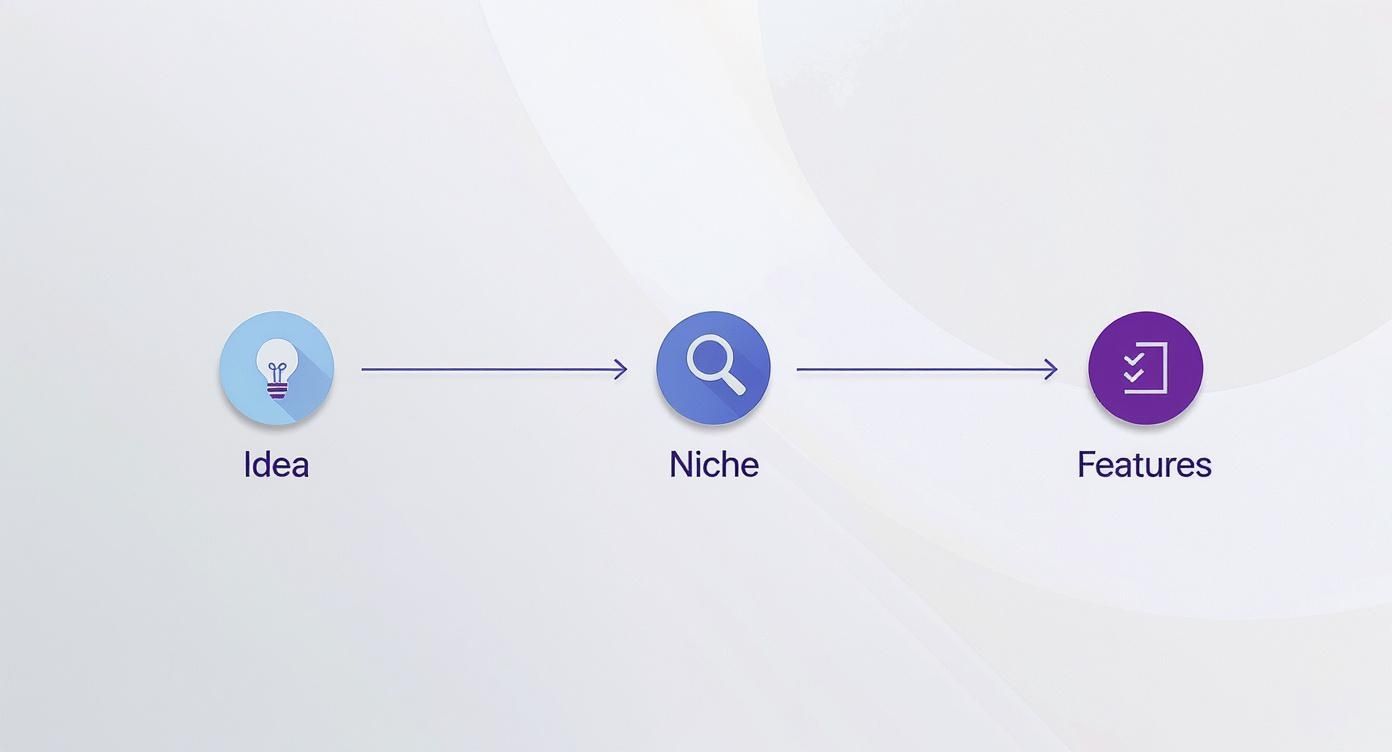
It’s a simple, linear path from an abstract concept to a concrete plan.
Prompting Your Database into Existence
The heart of any dating app is its database. It’s the vault that holds every user profile, every swipe, and every late-night chat. With Dreamspace, a powerful AI app generator, you literally speak this database into existence using simple prompts, just like you’d talk to an AI assistant.
For example, to set up your user profiles, you could just tell it:
- "Generate a 'users' table with fields for email, password, username, date of birth, location, bio, and a list of photo URLs."
And just like that, the AI builds the database table for you. No SQL, no complicated setup. You can then build on this foundation, adding more layers of complexity as you go.
Defining Your App's Core Logic with AI
Beyond just storing data, you need to define how your app works. This is the logic that makes it fun and engaging, and you can build it all with prompts.
Let’s tackle the key mechanics of any dating app:
- Swipe and Like Logic: You can prompt the AI to create a 'swipes' table that tracks interactions between users. It just needs to know who did the swiping (
swiper_id), who got swiped on (swiped_id), and the outcome (statuslike 'liked' or 'passed'). This simple table is the engine behind your entire matching system. - Matching System: Now, to create a match, you’d simply prompt: "When two users have a 'liked' status for each other in the 'swipes' table, create a new entry in a 'matches' table linking both
user_ids." The AI gets it and creates the necessary logic. - Chat Functionality: For messaging, you'll need a 'messages' table. A good prompt would be: "Create a 'messages' table linked to a 'matches' ID, with a
sender_id,receiver_id, message content, and a timestamp."
Security isn't an afterthought; it's the first thing you build. By using an AI generator, you ensure that fundamentals like user authentication and data encryption are baked into your app’s foundation from the very beginning, protecting your users' sensitive information.
This approach lets you build a secure, scalable foundation without touching a single line of code. If you want to see more about how this works under the hood, we wrote a post on how an AI app builder translates prompts into code. With this solid ground built, you're ready to start designing the user interface and adding your own unique flair.
Crafting an Irresistible User Experience
Alright, you've got the technical bones of your app sorted out. Now comes the part that really matters: what your users will actually see, touch, and feel.
Let's be honest, in the world of dating apps, a clunky interface is a death sentence. People have zero patience for confusion. If it feels like work, they'll delete your app in minutes. Your success literally depends on creating a user experience (UX) that’s intuitive, fun, and makes people want to stick around.
The goal here isn't just functionality; it's about designing an experience that feels personal and exciting. This is where AI tools really shine, letting you spin up prototypes and visualize user flows without needing to hire a full design team from day one. It all starts by turning that feature list into actual screens.
Designing the Core Experience
Your app's entire experience boils down to three critical areas: the user profile, the swiping (or discovery) screen, and the chat. Get these right, and you're golden. Each one needs to be clean, sharp, and dead simple to navigate.
User Profiles: A profile should do more than show a face; it needs to tell a story. While a great photo gets the first look, the layout has to pull people in. A study I saw recently found that while 65% of women are looking for serious relationships, they put way more weight on a profile's content than men do. Use your design to highlight interesting prompts, shared interests, and bios that are practically begging for a conversation to start.
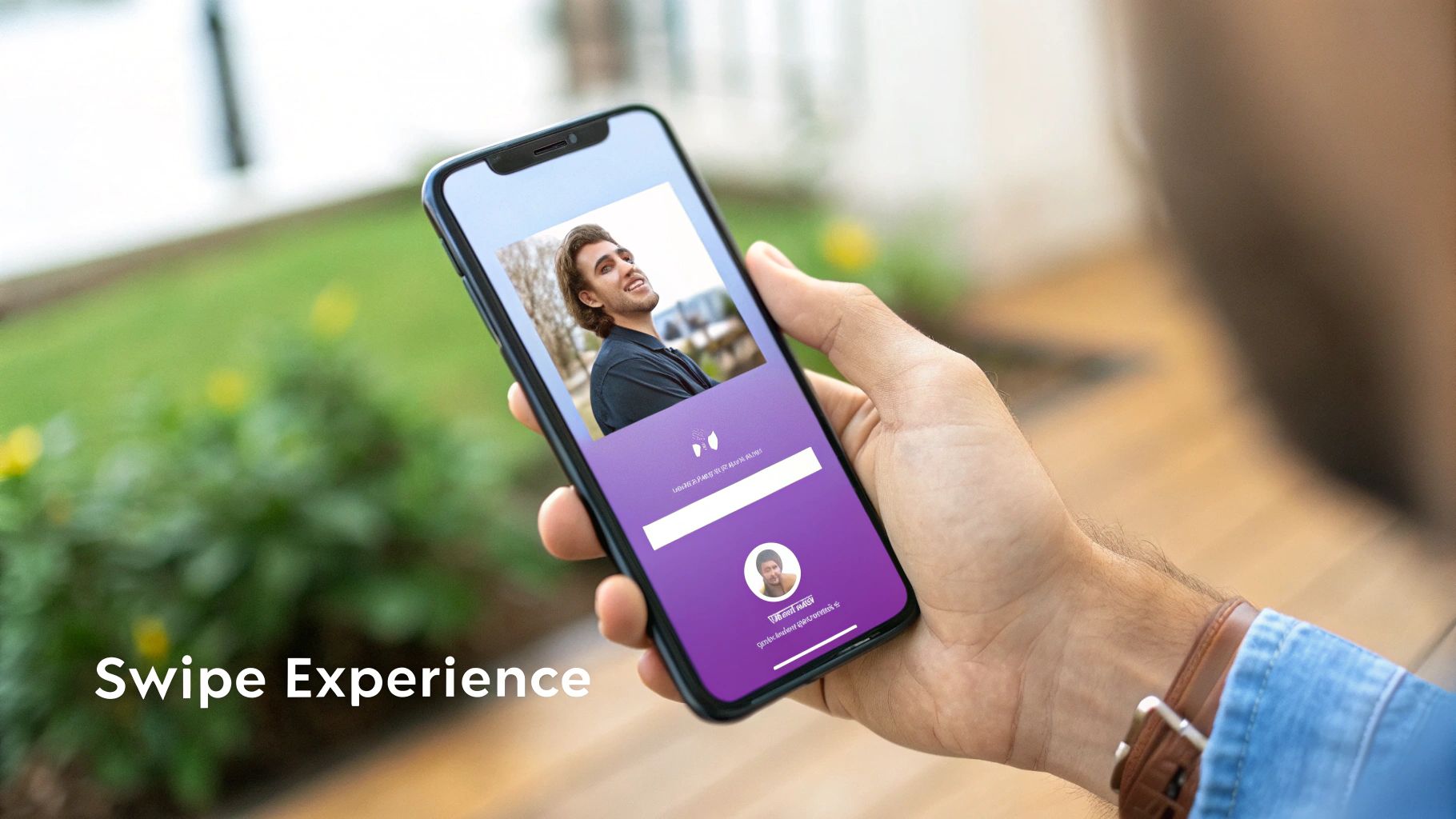
The Swiping Mechanic: This is the addictive engine of your app. That swipe action needs to feel buttery smooth and responsive. Adding little touches like subtle animations or a bit of haptic feedback—what designers call micro-interactions—can make the experience feel incredibly tactile and satisfying. It keeps people hooked.
This is where a vibe coding studio like Dreamspace becomes your secret weapon. You can literally just prompt the AI to generate a UI for a profile screen that perfectly balances photos with those personality-rich text fields. You get a design that’s both beautiful and effective right out of the gate.
The Psychology Behind a "Sticky" App
A killer UX is more than just pretty screens. It’s about tapping into user psychology. Your app is in a constant battle for attention, and tiny details can make all the difference in whether someone opens it once or ten times a day.
Think about notifications. A generic "Check out who's new" is easy to ignore. But a notification that says, "You have a new match!" creates a jolt of excitement and anticipation. It’s a powerful dose of social validation that makes people want to come back for more.
A great dating app doesn't just connect people; it creates moments of delight and anticipation. The user experience should feel less like a utility and more like a fun, rewarding game that leads to genuine connections.
By focusing on these psychological triggers and using an AI app generator like Dreamspace to build out the visuals, you create a seamless journey. The path from seeing a profile to swiping right and starting a conversation should feel completely natural. The less friction, the more time users will happily invest in your platform.
Implementing Smart Matching and Monetization

Okay, you've got a sharp-looking UI. Now for the fun part: building the engine that actually forges connections and, just as importantly, brings in revenue. In today's market, a simple filter for age and location just won't cut it. People expect apps to get them, and your business needs a real plan to stay afloat.
This is where AI goes from being a buzzword to your most valuable player. Modern AI looks way beyond what a user puts in their bio. It can learn from swiping habits, notice which profiles someone lingers on, and even get a feel for the vibe of their chats. This creates a much smarter, more intuitive matching experience.
AI-Powered Matching Algorithms
A truly intelligent matching system digs into multiple layers of data to suggest people who are genuinely compatible. You don't need a Ph.D. in data science to pull this off; an AI app generator like Dreamspace can help you piece together the logic.
Here’s how AI can seriously upgrade your matching game:
- Behavioral Analysis: The AI learns from real-world actions. It sees who a user likes, messages, and unmatches, then refines future suggestions based on those patterns.
- Interest Clustering: It can spot shared interests from bios or connected social accounts, essentially building little communities right inside your app.
- Communication Style Matching: This is a cool one. By analyzing chat data (anonymously, of course), the AI can even pair up people who have similar ways of talking, which can be a huge predictor of a good first conversation.
With these tools, your app stops being a static catalog of profiles and starts acting like a personal matchmaker. That's what keeps users coming back.
Choosing Your Monetization Model
Once your app is delivering real value, it's time to think about monetization. The dating app world has already proven people will pay for a better experience. The trick is to make your paid features feel like a worthy upgrade, not a roadblock.
A successful monetization strategy enhances the user experience for paying customers rather than punishing free users. The goal is to make the upgrade feel like a desirable power-up, not a mandatory toll.
Here are a few popular ways to go about it:
- Freemium with Subscriptions: This is the classic model. The core app is free, but a subscription unlocks perks like unlimited swipes, seeing who liked you, or advanced search filters.
- In-App Purchases: These are one-off buys for specific advantages. Think "Super Likes" to get noticed or a "Profile Boost" to show up in more searches for a short time.
- Niche-Specific Features: If you're building for a specific community, you can monetize exclusive features, like access to special events or curated content relevant to that niche.
The big players show there's more than one way to win. Tinder has a massive 9.6 million paying subscribers, playing a numbers game. Meanwhile, Hinge pulled in around $550 million in 2024 by focusing on a premium, relationship-oriented crowd. It proves that whether you're going for mass appeal or a tight-knit community, a smart monetization plan is everything. It's worth digging into more insights about the competitive landscape of dating apps to find your angle.
Your Go-to-Market Launch Strategy
Building a stunning app is an incredible achievement, but honestly, it’s only half the battle. The real test starts the moment you decide to launch. A solid go-to-market strategy is what separates an app that withers on the vine from one that becomes a viral hit.
This is where you shift gears from developer to founder. It’s all about meticulous testing, a smooth deployment to the app stores, and a smart marketing plan to reel in those crucial first users.
The Beta Testing Phase
Before you even think about a public launch, you absolutely must put your app through its paces with a small, trusted group of beta testers. This phase is pure gold for squashing bugs, getting brutally honest feedback, and fine-tuning the user experience.
- Recruit Your Testers: Start with your inner circle—friends, family, or people from online communities in your target niche. You want a diverse group that actually looks like your ideal user.
- Focus on Feedback: Don't just hunt for crashes. Ask them pointed questions. Was the sign-up a breeze or a pain? Does the matching algorithm feel right? What’s the one feature they wish it had?
- Iterate and Improve: Take that feedback and put it to work. This cycle of testing and improving ensures that when you do go live, your app is polished, stable, and genuinely fun to use.
Navigating the App Stores
Getting your app onto the Apple App Store and Google Play Store can feel like navigating a maze of rules. But with a little prep, you can make it painless. Each store has its own thick rulebook covering everything from privacy to the exact dimensions of your screenshots.
Remember, your app store listing is your storefront. Your app's name, icon, and description are the first things anyone will see. Make them count. Your goal is to instantly communicate what makes your dating app special.
A successful launch isn't about flipping a switch. It's about building momentum through rigorous testing and a strategic rollout that creates buzz and attracts the right users from day one.
Acquiring Your First 1,000 Users
Okay, your app is live. Now for the real challenge: getting people to actually use it. Your first major milestone is hitting 1,000 users. This initial group is critical for seeding your community and creating the social proof you need to grow.
You need to build buzz before you launch. Get on social media, create profiles for your app, and start talking to your target audience weeks—or even months—ahead of time. Share behind-the-scenes glimpses, tease upcoming features, and set up a waitlist to capture that early interest. The fundamentals of building an engaged user base are pretty universal, whether you're building a dating app or trying to develop a social media app from scratch.
To help organize your efforts, here’s a quick checklist to follow.
Pre-Launch Marketing Checklist
This table provides a simple roadmap, but remember to adapt it to your specific app and audience.
Paid advertising can also be a massive growth lever, but only if you know what you’re doing. For instance, running ads on platforms like Meta requires a specific skill set to get right. If you plan to go down that route, this ultimate guide to scaling your Facebook and Instagram ad campaigns is packed with great advice. A smart launch combines paid tactics with organic efforts like content and influencer outreach for a powerful one-two punch.
A Few Common Questions About Creating a Dating App
Jumping into the world of dating apps always kicks up a lot of questions. I get it. From the sticker shock of development costs to the genuinely scary parts like user safety, knowing what you're up against makes the whole process feel less daunting. Let's tackle some of the big ones.
So, What's This Going to Cost Me?
The price tag on a dating app isn't what it used to be. Not even close. If you go the traditional route and hire a team of developers, you're easily looking at a bill between $50,000 to $150,000, and honestly, it can go much higher.
But that's the old way.
Using a no-code AI app generator like Dreamspace completely changes the game. Your main costs shift from unpredictable developer salaries to a simple, manageable platform subscription. This means you can get a real, working app into the hands of users for a tiny fraction of what it used to cost. It makes the idea possible for a solo founder or a small, scrappy team.
What Are the Big Legal and Safety Hurdles?
This is the serious stuff. User safety isn't just another feature on your roadmap—it's the foundation of your entire app. You're dealing with people's personal data and helping them meet in the real world, so you have to get this right from day one.
Here’s what you’ll be up against:
- Keeping the Bad Guys Out: You need solid systems to fight off scammers, catfishing, and harassment. That means having user verification options, super-obvious reporting tools, and a one-click block button.
- Moderating Content: A clear, non-negotiable content moderation policy is crucial. It’s what keeps your community from turning into a toxic mess.
- Handling Data Privacy: You are legally on the hook for this. A rock-solid Terms of Service and a clear Privacy Policy are mandatory. These documents need to explain exactly how you collect, use, and protect user data to comply with rules like GDPR and CCPA.
How Does a New App Even Compete?
Let's be real: trying to take on giants like Tinder or Hinge head-on is a suicide mission. They have marketing budgets bigger than most startups' entire valuations. The secret isn’t to be bigger; it’s to be better for a specific group of people.
The winning strategy is to find a niche. Don't build for everyone; build for someone. When you focus on a community that's being ignored, you can build something that feels like it was made just for them. That’s how you get the kind of loyalty the big guys can only dream of.
Think about it. An app for people who love CrossFit, or board games, or are over 50. You can build in features those communities would actually want and create a real sense of belonging. This focus makes your marketing a hundred times more effective and helps you build a core group of passionate users from the start. That’s how you carve out your own successful corner in a very crowded market.
Ready to stop just thinking about your dating app idea and actually build it? With Dreamspace, a vibe coding studio, you can use AI to generate your entire on-chain app—from the smart contracts to the UI—without the insane cost and headache of traditional development. Start bringing your vision to life today. Check out https://dreamspace.xyz to get started.