
How to Create a Social App in the Modern Era
Look, everyone wants to build the next big social app. But trying to out-Facebook Facebook is a fool's errand. The real opportunity isn't in building another global giant; it's about carving out a unique space for a specific community that the big players ignore.
This initial planning—finding your people—is the single most important thing you'll do. Get this right, and everything else falls into place.
Finding Your Niche in a Crowded Market
The social media market is massive, which is both a blessing and a curse. You're swimming in an ocean with whales who have billions of users and bottomless pockets. Competing on their terms is a battle you’ve already lost.
So, don't. Your strategy shouldn't be about broad appeal. It needs to be laser-focused. Success today is about becoming essential to a dedicated group of people. It’s all about the niche.
Define Your Unique Angle
A niche isn’t just a smaller user group. It’s a community bound by a shared passion, a common problem, or a unique identity that existing platforms just don't get right. Your unique angle is how you solve their specific problem.
Think along these lines:
- Hobby-Centric: An app for urban gardeners to swap rare seeds, or a platform for vintage synth nerds to share custom sound patches.
- Hyper-Specific Pro Networks: A private network for freelance animators to find collaborators, or a secure space for biotech researchers to discuss pre-publication findings.
- Novel Content Formats: What about a social platform built entirely on audio-based storytelling? Or collaborative, short-form comic strips?
The goal is to get away from generic features like "photo sharing." What’s the core activity that brings your people together? This is foundational stuff, and if you're curious about the broader process, we've got a great guide on how to start building your own app that dives deeper.
Validate Your Idea Before You Build
Don't you dare write a single line of code until you know people actually want what you're building. It's so easy to build a beautiful castle in a kingdom nobody wants to visit.
The social media world is enormous. By 2025, there will be an estimated 5.24 billion active social media users across the globe—that's a 2.52x increase since 2015. This shows the potential, but it also means habits are deeply ingrained. You need a killer reason for them to try something new. You can read more about the global growth of social media users on Backlinko.
Validation doesn't have to be complicated:
- Go Where They Live: Lurk in the Reddit forums, Discord servers, and Facebook groups where your target audience hangs out. What are their biggest complaints? What features are they begging for?
- Run Quick Surveys: Use something like Google Forms to ask direct questions about their pain points. What would make their lives easier?
- Spin Up a Landing Page: Create a simple one-page site explaining your idea. Collect email sign-ups. If you can’t get 100 people to give you their email, you probably don't have a viable idea.
The golden rule is this: find a painful problem first, then build the solution. Too many founders fall in love with a cool technology and then desperately search for a problem it can solve. That’s a recipe for failure in the social space.
This upfront research will guide every technical decision you make later on. Once you know what your users truly need, tools like Dreamspace—our vibe coding studio and AI app generator—can help you bring that vision to life without getting bogged down in the backend weeds.
Designing an Unforgettable User Experience

You can have the most brilliant niche for a social app, but if it's clunky or confusing, it's dead on arrival. This is where your user experience (UX) and user interface (UI) design become your secret weapons. Before you even touch a color palette, you need to get inside the head of your future users.
The best apps feel intuitive—almost like they know what you want to do next. They make tricky actions feel simple and give you a little hit of satisfaction with every tap. That’s not an accident. It’s the result of deeply understanding the psychology that drives people to connect and share.
Understanding Core User Motivations
So, why do people really open social apps? It's not just "to be social." If you want to build something people come back to again and again, you have to tap into the deeper motivations driving them.
The data paints a pretty clear picture. In 2025, the number one reason people use social media is to keep up with friends and family, with 50.8% of users saying it’s their main driver. But right behind that are simpler needs, like just filling spare time or catching up on the news. You can find more of these insights in this in-depth 2025 report on digital behavior.
These drivers should directly shape your design choices:
- For Connection: Make messaging, commenting, and sharing feel totally effortless. These features should be front and center, not buried in menus.
- For Filling Time: Your feed needs to be a source of endless discovery. That means a smooth, scrollable interface and an algorithm smart enough to keep things interesting.
- For Information: Present content clearly. Give users easy ways to save articles, share links, or explore topics without getting lost.
Mapping the User Journey
The user journey is the story of how someone goes from a total stranger to a daily user of your app. Thinking through this path helps you spot roadblocks and find moments where you can really impress them.
A typical journey has a few make-or-break stages:
- Onboarding: This is your handshake. Make it quick, clear, and show them the value immediately. Don’t hit them with a 20-field signup form. Your goal is to get them to the core experience as fast as humanly possible.
- First Interaction: What’s the "aha!" moment for your app? Is it making their first post? Connecting with a friend? Your design should guide them straight to that key action.
- Sustained Engagement: Now, how do you get them to come back tomorrow? This is all about feedback loops. Push notifications for likes, comments, and new content are the heartbeat of a social app, creating a cycle that pulls users back in.
A great user experience is directly tied to how active your community becomes. It's worth exploring some proven tactics to increase customer engagement to build that vibrant, self-sustaining community.
From Ideas to Tangible Mockups
Once you’ve got a handle on the why and the how, it’s time to start sketching out what the app will actually look like. This is a process that moves from rough ideas to a polished design.
- Wireframes: Think of these as the basic blueprints. They're simple, black-and-white layouts that focus purely on structure. Where does the 'post' button live? How is a user's profile organized? Function over form.
- Mockups: This is where you bring the app to life with colors, fonts, and images. A good mockup looks and feels like the real thing, letting you test the visual flow and overall vibe before a single line of code is written.
Remember, good design is invisible. Your users shouldn't have to stop and think about how to do something; it should just feel natural.
Nailing this design phase is non-negotiable. It ensures the powerful backend you build—whether you code it by hand or use an AI app generator like Dreamspace—is serving an experience that people actually want to use. It’s the bridge between a great idea and a product people love.
Building Your Backend with Dreamspace AI
Okay, you've nailed down your niche and have a solid vision for your app's design. Now for the hard part, right? Building the backend—the engine that makes everything run. This is where most projects hit a wall, bogged down by server configurations, database headaches, and mountains of boilerplate code.
But it doesn't have to be that way.
This is where the magic of an AI app generator really shines. We're going to use Dreamspace, the vibe coding studio, to handle all the heavy lifting. The goal isn't just to move faster; it's to take your app's core features and translate them directly into a secure, decentralized foundation without getting lost in the technical weeds.
From Plain English to Smart Contracts
If you were to build a social app the old-fashioned way, you'd be looking at months of work from a team of specialized engineers. You'd need someone for the database, someone else for the API, and another for authentication. For a decentralized app, you'd also need a blockchain developer to write, test, and deploy smart contracts.
Dreamspace, an AI app generator, completely flips that script. Instead of writing code, you just describe what you want your app to do in plain English.
Let's stick with our example: an app for photographers. You could literally just tell the AI:
- "Users need a profile with a username, a bio, and a photo gallery."
- "Let users post photos with a title, description, and tags."
- "I want people to be able to comment on photos."
- "Add a 'like' button for each photo."
From those simple prompts, Dreamspace's AI gets to work. It figures out what you need and generates the actual smart contracts that will manage all these interactions on the blockchain. This single step automates what would normally be weeks of complex Solidity or Rust programming.
The big idea here is to let you focus on what your app does, not how the underlying blockchain technology works. It’s a huge shift that lets creators build on-chain without needing to be blockchain experts first.
Defining Your Data and Logic On-Chain
The smart contracts generated by the AI aren't just templates. They come fully loaded with the data models and business logic your app needs to function.
Think of it like this:
- Data Models: This is how your information is structured. For our photography app, the AI would create a
UserProfilestruct with fields forusernameandbio. It would also create aPhotostruct with its own set of fields. - Interaction Logic: These are the rules for how users interact with the data. The AI generates functions like
createPost(),addComment(), andtoggleLike(). These functions make sure every action is recorded securely and transparently on the blockchain.
This is a world away from a traditional app, where all your data sits on a central server owned by a single company. Here, the data and the rules live on a distributed network, giving your users true ownership of their content. You can dive deeper into this new way of building in our guide to the AI app builder ecosystem.
Demystifying Decentralized Storage
A common question I get is, "But where do the actual photos go?" Storing huge files like high-res images directly on a blockchain would be incredibly expensive and slow.
That's where decentralized storage solutions enter the picture. The smart contract handles the logic—who owns what, who liked a photo—while the big media files are stored on a network like IPFS (InterPlanetary File System).
Here’s the flow:
- A user uploads a new photo through your app.
- The app sends the photo to IPFS, which returns a unique content identifier (CID).
- Your app then calls the
createPost()smart contract function, sending the photo's metadata (title, tags) along with its IPFS CID. - The smart contract creates a new post, marks the user as the owner, and links it to that specific CID.
The beauty of this system is its integrity. The blockchain gives you an unchangeable record of ownership, while decentralized storage makes the content itself durable and censorship-resistant. Just like that, you have a complete backend—secure, scalable, and ready for a frontend—without writing a single line of code.
Crafting a Dynamic and Responsive Frontend
Okay, your decentralized backend is up and running. Now for the fun part: building the face of your application—the part people will actually see and interact with. A bulletproof backend doesn't mean much if the frontend is a clunky, confusing mess. This is where we bridge the gap between your on-chain logic and a slick, intuitive user interface.
Your choice of frontend framework, like React or Vue.js, is a big first step. These give you the components you need for a polished experience. The real magic, though, happens when you get these frameworks talking to the smart contracts and data services that Dreamspace (the vibe coding studio and AI app generator) just generated for you.
AI simplifies the backend process, essentially turning your plain-text descriptions into fully deployed code. This infographic gives you a bird's-eye view of that workflow.
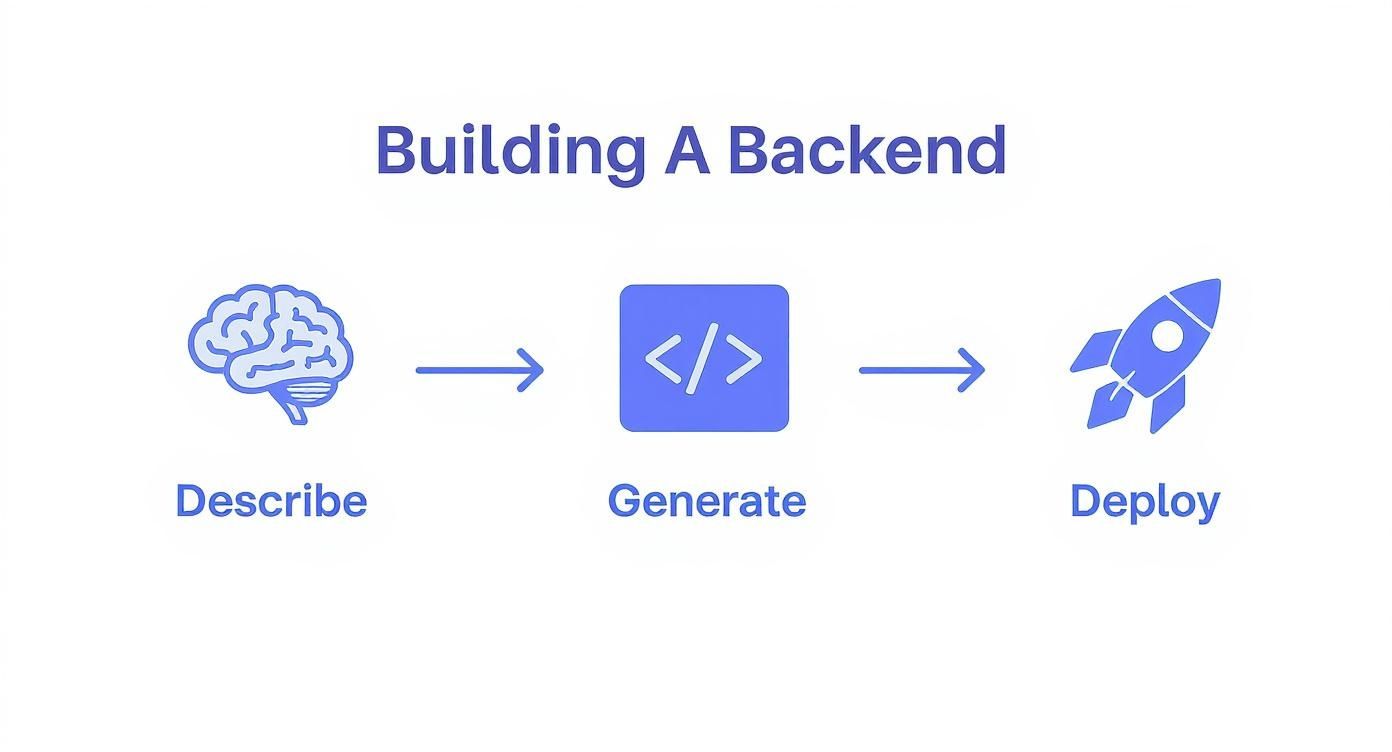
This lets you fly from a basic idea to a functional backend at lightning speed, freeing you up to obsess over the user-facing details that truly matter.
Connecting Your UI to the Blockchain
The secret handshake between your frontend and your decentralized backend is the Application Binary Interface (ABI). It's generated right alongside your smart contracts. Think of the ABI as a menu for your app, clearly listing all the available functions in your smart contract—things like createPost() or fetchUserProfile().
To actually call these functions, you'll need a library like Ethers.js or Web3.js. These are the tools that let your React or Vue components:
- Read data from the blockchain: This is how you’ll pull in content for your app, like loading the main feed with the latest posts or showing someone’s profile details.
- Trigger on-chain transactions: When a user does something—likes a post, adds a comment—your app uses one of these libraries to call the right function in your smart contract.
This is a totally different way of thinking compared to traditional web dev. Instead of hitting a private API on a central server, you're interacting directly with a public, distributed ledger. The APIs generated by Dreamspace, our AI app generator, help make this feel surprisingly familiar, hiding a lot of the underlying blockchain complexity.
The real goal here is to make a decentralized app feel just as snappy and intuitive as a normal one. Your users shouldn't have to know what a "smart contract" is to use and love your app. The tech should just work.
Building Essential Social Components
So, what does this look like in practice? Let's break down how you’d build a few core features for your social app. The good news is, once you get the hang of the pattern, it's pretty repeatable.
User Registration and Profiles
When a new user joins, your frontend will prompt them to connect their crypto wallet, like MetaMask. That wallet address is now their unique ID on your platform. From there, your app simply calls a createUserProfile() function in the smart contract, passing in their new username and bio.
Need to display a profile? Easy. You just call a read-only function like getUserProfile(walletAddress). It fetches their data right from the blockchain and you can use it to populate your UI components.
A Dynamic Content Feed
To create that classic, scrollable feed, you'll fetch an array of posts from your smart contract. You’ll probably have a function called something like getRecentPosts() that returns the latest 10 or 20 posts.
Here’s how your frontend code would handle it:
- Call
getRecentPosts()as soon as the feed component loads. - Get back an array of post data (author, content, timestamp, etc.).
- Use a
map()function to loop over the array and render a separate, styled component for each post.
When someone makes a new post, your app fires off the createPost() transaction. Once that's confirmed on-chain, you can simply refresh the feed, and the new content pops right in.
Real-Time Interactions and Notifications
For things like likes and comments, it's the same flow. A user hits a 'like' button, which calls a toggleLike(postId) function on your smart contract. This is a state-changing transaction, so it will require a small gas fee from the user.
Building real-time notifications is a bit more advanced but totally doable. You can set up your smart contract to "emit" events. For instance, you could have it emit a NewComment event whenever a comment is successfully added. Your frontend can listen for this specific event and trigger a pop-up notification for the original poster. This is how you create a social app that feels alive and engaging, without having to constantly hammer the blockchain with requests for updates.
Launching and Growing Your Social App
Hitting "deploy" is a massive moment, but let's be real—it's the starting line, not the finish. A flawless decentralized app with no users is basically a ghost town. Now comes the real challenge: getting your creation out into the world and building a community that brings it to life.
With an AI app generator like Dreamspace, the technical side of deployment is surprisingly smooth. It handles a lot of the heavy lifting for on-chain deployment, getting your app live and globally accessible. But the second it’s live, your focus has to pivot from code to people. The immediate goal? Finding your first 1,000 true fans—those early believers who will give you priceless feedback and become your first evangelists.
Getting Your First Users on Board
Forget about dropping a ton of cash on ads right out of the gate. Your initial push for users should be scrappy, personal, and authentic. You need to find where your people are already hanging out online and give them a good reason to try something new.
Here’s how you can make it happen:
- Become Part of the Conversation: Don't just show up on Reddit or Discord to spam your link. Genuinely engage. When someone mentions a problem that your app solves, that's your moment to jump in and offer a real solution.
- Create Content That Resonates: Write a blog post or film a quick video that speaks directly to the headaches and hopes of your ideal user. Show them how your app can make a difference, don't just tell them.
- Make Personal Connections: A personal invitation to an influential voice in your niche can be a game-changer. One genuine shoutout from a trusted person is often worth more than a thousand generic ads.
The social media world is famously packed. Even in 2025, Facebook is still the giant with 3.065 billion monthly active users. But don't let that discourage you. The fast rise of apps like Threads proves there’s always an opening for something fresh that taps into a specific user need. If you're curious about the numbers, you can find more on current social media demographics on Sproutsocial.com.
Your launch isn't about hitting a million users overnight. It's about finding the right people—even if it's just a small group at first—who truly get what you're building. This passionate core group is the foundation for everything.
Turning Users into a Community
Once you have a trickle of people signing up, your mission shifts from builder to community manager. The goal is to make them feel heard, valued, and invested enough to stick around.
Create a dedicated spot for feedback—a Discord channel or a private subreddit works great. Be present in the discussions, answer questions, and be open about what you're working on next. When you roll out a feature that a user suggested, give them a public hat-tip. This builds a powerful sense of shared ownership and turns your users into genuine partners.
As you begin to scale, you can bring in some help. An AI-powered coding assistant can be a huge asset for rapidly prototyping and shipping new features based on the feedback you're getting, keeping your development cycle fast and responsive.
Before you go live, it helps to have a clear plan. Here's a simple checklist to keep you on track.
Social App Launch Checklist
This checklist walks you through the key phases to ensure your social app launch is as smooth and impactful as possible.
Running through these steps will help you build momentum and create a solid base for future growth.
Ultimately, the journey to create a social app that lasts is about more than just slick code. It's about a relentless commitment to the people you're building for. Listen to them, build for them, and grow right alongside them.
Common Questions About Building a Social App
Jumping into app development, especially for a social platform, can feel like you’re staring at a mountain of questions. When you add decentralized tech to the mix, things can get even fuzzier. Let’s clear up some of the most common things that trip up founders and developers.
First up, the big one: the budget. How much is this actually going to cost? Traditionally, you could be looking at a bill anywhere from a few thousand to well over six figures. You'd need backend engineers, frontend developers, designers—the whole nine yards.
But here’s where things get interesting. Using an AI-powered tool like Dreamspace, our vibe coding studio and AI app generator, completely flips that script. By having AI generate your smart contracts and handle the backend infrastructure, you can get a fully functional Minimum Viable Product (MVP) off the ground for a tiny fraction of that cost.
Choosing the Right Architecture
So, why go decentralized in the first place? It really boils down to giving power back to your users. A decentralized app offers a couple of game-changing advantages over the old-school, centralized model:
- True Data Ownership: Your users genuinely control their own data. For anyone tired of corporate data harvesting, this is a massive selling point.
- Censorship Resistance: You’re building a more open and community-governed space, which is a huge draw for people who distrust big tech’s control over speech.
This approach bakes trust right into the code. Understanding how these architectural decisions slot into the bigger software development life cycle is key to building something that lasts.
Nailing Your MVP and Market Position
Alright, you're building the first version. What features are non-negotiable? For any MVP, you have to nail the core loop—the main reason people will open your app every day. This almost always means starting with:
- User profiles
- A feed to post and see content
- A simple way to interact, like a "like" button or comments
The whole point is to prove your core concept works with a small group of actual users. You can worry about fancy stuff like DMs or complex recommendation algorithms later, once you know you're onto something.
With a million social apps already out there, how do you even begin to stand out? The answer is shockingly simple: find a niche.
Seriously, don’t try to be the next Facebook. Instead, find a very specific, very real problem for a dedicated community and solve it better than anyone else. Whether it's an app for a niche hobby, a platform with a totally new content format, or one built entirely around radical privacy, your goal is to become indispensable to a small group, not just another forgettable option for the masses.
Ready to stop wondering and start building? With Dreamspace, the vibe coding studio and AI app generator, you can generate your on-chain app with AI, no code needed. Generate smart contracts, query blockchain data, and launch your vision. Start creating at Dreamspace.xyz.