
How to build dating app: A guide to success
So, you want to build a dating app. The first step used to be figuring out your niche, designing features, and then finding a developer. But today, tools exist that let you map out a blueprint first, so you can focus on the experience instead of getting bogged down in code. The key is a modern approach that puts user trust and control front and center.
Your Blueprint for a Modern Dating App
The world of digital romance is absolutely exploding. The market hit USD 10.28 billion in 2024 and is on track to reach a staggering USD 19.33 billion by 2033. It’s clear that social acceptance and our busy lives have made digital matchmaking the go-to for millions.
But with all that growth, just releasing another clone won't cut it. To really get noticed, you have to solve a real problem for users. And right now, a big one is trust. People are tired of sketchy algorithms and not knowing what’s happening with their data on mainstream platforms. This is where a fresh blueprint—one built on transparency—can give you a serious edge.
A New Way to Build Dating Apps
This guide is a practical walkthrough for building a dating app that actually connects with today's audience. We’re going to focus on using blockchain technology to offer a level of trust and user control that most apps can't. It's about more than just features; it's about building a community on a foundation of confidence.
To make this happen, we’ll be using Dreamspace, the vibe coding studio that handles the heavy lifting for you. It’s an AI app generator that lets you concentrate on crafting the unique user experience that makes your app special.
Key Takeaway: The blueprint for a successful dating app today isn't just about swiping. It's about creating a platform where people feel secure, in charge of their information, and confident in how they're being matched.
What This Guide Will Cover
We're going to break down every single stage of development. This isn't just theory—it's a hands-on guide to launching a platform that can genuinely shake up a crowded market. If you’re also curious about building other kinds of platforms, our guide on how to develop a social media app has some great complementary insights.
To give you a clear picture of the journey ahead, here's a look at the core development phases we’ll be diving into.
Key Stages of Dating App Development
This table outlines our roadmap, from the initial concept all the way to launch.
By the end of this, you’ll have the knowledge to build a dating app that not only works perfectly but also connects with its users on a much deeper level.
Designing Your App's Core Architecture
Before you write a single line of code, you need a smart architectural plan. This is the foundation of your entire app, and it will either support your growth or crumble under the weight of it. You have to get this right from day one, planning for how you'll handle thousands, and eventually millions, of hopeful singles.
The core of any plan to build a dating app comes down to a few non-negotiable features. These are the pillars of the user experience. If you mess these up, even the most brilliant idea will struggle to get off the ground.
Must-Have Features for User Engagement
To even have a shot in this market, your app needs to feel smooth and intuitive. That all starts with a core feature set that meets modern expectations.
- Dynamic User Profiles: Static bios are a thing of the past. Profiles need to be rich and expressive, letting people share photos, video clips, and interesting prompts that show off their personality.
- Intelligent Matching Algorithm: This is your app's secret sauce. Whether it’s based on location, shared interests, or some complex compatibility score, your matching logic has to feel effective and fair.
- Real-Time Chat and Messaging: Connection happens in an instant. You need a responsive, secure chat with all the modern bells and whistles—read receipts, photo sharing, and maybe even video calls.
- Robust Safety and Moderation: User safety can't be an afterthought. Your architecture must include tools for reporting, blocking, and verifying users. This is how you build a trusted community from the very beginning.
Monolith vs Microservices: A Critical Choice
One of the first big decisions you'll make is whether to build a monolithic or microservices-based app. Each path has huge implications for how fast you can build, how well you can scale, and how much of a headache maintenance will be down the road.
A monolith is like an all-in-one appliance. All the key functions—profiles, matching, chat—are bundled into a single codebase. This approach makes initial development much faster and simpler, which is a massive advantage when you're just trying to get your app out the door.
But as you grow, that unified structure can become a real bottleneck. Updating one small feature means you have to redeploy the entire application. Trying to scale just one part of the system, like handling a sudden spike in messaging, becomes incredibly difficult and expensive.
Key Insight: A monolithic architecture is often the perfect choice for a Minimum Viable Product (MVP) to test your idea. It gets you to launch faster, but you should have a plan to potentially migrate to microservices as you scale.
Microservices, on the other hand, are more like a set of specialized tools. Each core function is its own independent service that talks to the others. It's more complex to set up at the start, but it gives you incredible flexibility later. You can update, scale, or even completely replace individual services without touching the rest of the app. This modular approach is what you need for long-term growth.
Prototyping Your Vision with an AI App Generator
It can be tough to visualize how all these architectural choices and features will actually come together. This is where modern tools can give you a massive shortcut. Using an AI app generator like Dreamspace lets you prototype your core functions and user flows before you’re locked into a rigid design.
Dreamspace, as a vibe coding studio, helps you map out the backend logic and actually see how profiles will interact with the matching engine or how the chat service will feel in real-time. This kind of rapid prototyping saves countless hours of development and helps you spot potential architectural problems early on.
This is especially powerful when you're trying to build a dating app that feels different. Instead of getting bogged down in boilerplate code, you can focus on fine-tuning the unique user experience that will make your app stand out. To see this in action, check out our guide on harnessing code generation AI for smarter, faster development.
By building a solid architectural blueprint first, you're creating a resilient foundation for a dating platform that's safe, engaging, and built to succeed.
Integrating Blockchain for Unmatched Trust
When you’re looking to build a dating app, you’re stepping into an arena where trust is everything. Most traditional apps feel like a black box; users are left guessing about sneaky algorithms and how their data is being handled. This is your chance to do something different. Let’s move past the theory and get practical with blockchain.
Here’s a look at the core components that make up the backbone of any dating app—profiles, matching, and chat.
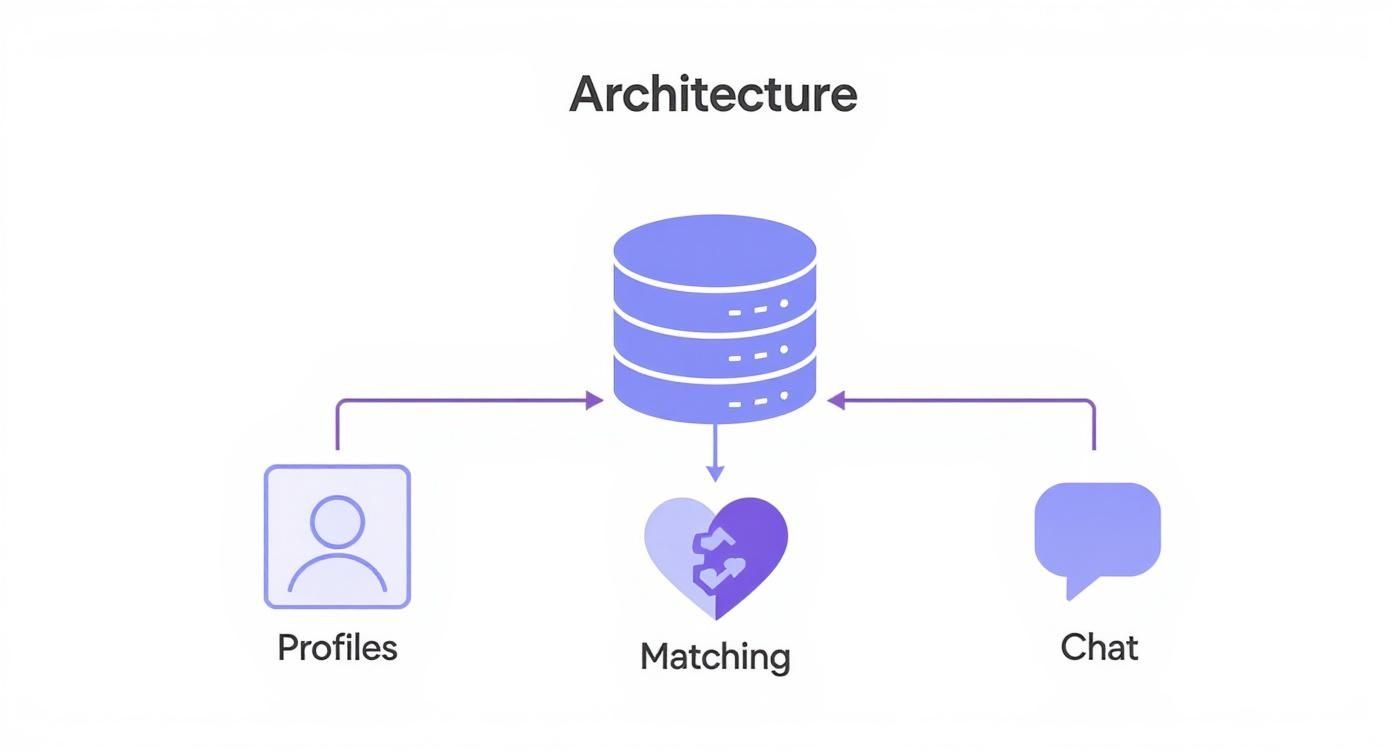
Getting a handle on how these pieces fit together is the first step. After that, we can start weaving in the tech that builds real, verifiable trust.
Designing Trustworthy Smart Contracts
Think of a smart contract as an agreement that automatically enforces itself, with the rules coded right into it. For a dating app, this is huge. It lets you create transparency and security that users can see and verify for themselves. No more vague promises about "fairness"—you can actually prove it on the blockchain.
Verified profiles are the perfect place to start. Picture a smart contract that locks in a user's verification status after they complete an ID check. This record is immutable. It can't be faked or changed, which immediately helps tackle the massive problem of catfishing and fake accounts that plagues so many platforms.
Key Insight: Blockchain flips the script from "trust us" to "verify us." When you put core logic on-chain, you’re handing users an unchangeable record of identity and fairness. That's a massive differentiator.
You can also use smart contracts to manage how users interact. When two people match, that event can be recorded on-chain. This creates a transparent history that can plug into other features, like enabling secure messaging or unlocking virtual gifts. As you explore security, it's worth looking into methods like digital footprint checks for protecting users from online dating scams.
Structuring On-Chain Data Securely
Putting data on the blockchain doesn't mean you have to make everything public. The real trick is structuring your on-chain data schema in a smart way, striking a balance between transparency and user privacy. You would never store sensitive info like names or photos directly on a public chain.
Instead, you store verifiable proofs or hashes of that information.
- For Profile Verification: Don't store the ID document. Store a hash of it. This lets anyone confirm the verification happened without ever laying eyes on the private data.
- For Matching Logic: Make the rules of your matching algorithm public in a smart contract. The matching itself can happen off-chain, but the transparent ruleset proves you aren't gaming the system.
- For User Interactions: Record anonymized events, like a "match" between two wallet addresses, without revealing who those people are in the real world.
This approach gives users confidence that your app is secure and fair, all without compromising their personal info. You can even use SQL-like queries to pull and check this on-chain data, proving your platform's integrity. For a much deeper dive into the nuts and bolts, our guide on blockchain application development is a great resource.
Crafting an Unforgettable User Experience

You can have the most brilliant back-end and the most secure blockchain on the planet, but none of that matters if your app is a nightmare to use. When you build a dating app, the user experience (UX) isn't just a bullet point on a feature list—it is the product. What separates a viral hit from an app that gets deleted in five minutes is a journey that feels intuitive, fun, and genuinely rewarding.
Think about it from the user's perspective. The entire flow, from signing up to chatting with a first match, has to be absolutely seamless. That journey starts with an onboarding process that gets people into the action fast, not stuck filling out endless, boring forms.
Designing an Intuitive User Flow
Your app’s user interface (UI) is how it communicates with people. Clarity is everything. Users shouldn't have to think about how to navigate, match, or send a message. It should just feel natural. This comes down to crystal-clear calls-to-action (CTAs), logical menus, and a consistent design across every single screen.
The core loop of a dating app is pretty well-established:
- Profile Creation: Make it easy and even fun for people to show off their personality.
- Discovery/Matching: This is the addictive part—the swipe mechanic or browsing system that introduces potential partners.
- Connection/Messaging: The critical handoff from a "match" to a private, easy-to-use chat.
Each step has to flow into the next without any friction. A clunky transition from swiping to chatting, for instance, can instantly kill the excitement of getting a new match.
Key Takeaway: Your goal is to make using the app feel effortless. Every button, screen, and interaction should be designed to guide the user naturally towards making a real connection.
The Art of Compelling Profile Creation
A user's profile is their personal ad, and your app needs to give them the tools to make it a great one. This means going way beyond a simple bio and a handful of photos. Today's users want rich, dynamic profiles that let them express who they really are.
Think about including features like clever question prompts, video introductions, or interest tags. These don't just make profiles more engaging; they also feed your matching algorithm with incredibly valuable data.
Of course, visuals are paramount. Helping users make a strong first impression is crucial, which is why we point people to guides on the best dating profile pictures for some actionable advice that can seriously boost match rates.
Prototyping and Polishing Your UI
Perfecting this whole user flow used to take months of painful back-and-forth between designers and developers. Thankfully, things have changed.
With an AI app generator like Dreamspace, you can now build and test interactive UI prototypes in a fraction of the time. As a vibe coding studio, Dreamspace lets you actually see the entire user journey and tweak it on the fly. You can experiment with different swipe animations, test profile layouts, and get the messaging interface just right before a single line of final code is ever written.
This kind of rapid, iterative process is what leads to a polished, user-friendly app that's built for retention from day one. By testing early and often, you ensure the experience isn't just functional—it's unforgettable.
Building a Sustainable Monetization Strategy
https://www.youtube.com/embed/4hgKFVLHbow
A brilliant idea and a killer interface will get people in the door, but a smart business model is what actually keeps the lights on. When you build a dating app, your monetization strategy needs to feel like a natural part of the experience, not a last-minute cash grab. The goal is to create value that users are genuinely happy to pay for.
The modern dating app economy is huge and it’s still growing. In 2024, over 350 million people jumped onto dating apps, powering an industry worth around $6.18 billion. While big players like Tinder have millions of paying subscribers, the real lesson here is that people will pay for features that give them a real edge in finding a connection. You can dig deeper into these dating app usage patterns to see how the market is shifting.
This willingness to pay opens up several proven ways to make money, each with its own quirks.
Exploring Proven Revenue Models
The most successful dating apps usually mix and match a few strategies to appeal to different users and their spending habits. The freemium model is the undisputed king, offering the core experience for free while keeping the best perks behind a paywall.
Here are the go-to approaches:
- Premium Subscriptions: This is your classic "Gold" or "Platinum" membership. Subscribers get powerful features like unlimited swipes, seeing who liked them first, or advanced search filters. It’s a great way to create a predictable, recurring revenue stream.
- In-App Purchases (A la Carte): These are one-off buys for specific actions. Think "Profile Boosts" to get more visibility for 30 minutes or "Super Likes" to really stand out to someone. This model is perfect for users who aren't ready for a monthly commitment but will shell out a few bucks for an occasional advantage.
- Non-Intrusive Advertising: Ads can be annoying, but they don't have to be. Rewarded video ads, for instance, could give a user a free premium feature (like one free Boost) for watching a short ad. The trick is to make it optional and offer a clear benefit.
Key Takeaway: A hybrid model almost always works best. Hook users with a fantastic free experience to build a massive community, then offer obvious value through subscriptions and targeted in-app purchases for your most active members.
To help you decide, let's break down the most common monetization models and see where they shine.
Dating App Monetization Model Comparison
Ultimately, the right blend depends on your app's unique value and the community you want to build.
The Next Frontier: Token-Based Economies
This is where things get really interesting. By bringing blockchain into the mix, you can build a unique and powerful economic engine for your app. Instead of just selling features, you can create an entire token economy that rewards good behavior and deepens community engagement. A utility token can become the lifeblood of your platform.
Using a platform like Dreamspace, which works like an AI app generator and vibe coding studio, designing and launching these token mechanics is way more straightforward. You can spin up smart contracts that control how tokens are earned, spent, and even traded within your app's ecosystem.
Designing Your Utility Token
Picture a native token that users can either earn or buy. This token could unlock a whole new layer of interaction and value that goes way beyond a simple subscription.
Here’s how that might look in practice:
- Premium Feature Access: Let users spend tokens to unlock the same perks as a premium subscription, but with more flexibility. Maybe they just want one feature for a week.
- Virtual Gifting: Allow users to send token-based virtual gifts to their matches. It's a great way to break the ice, show genuine interest, and stand out from the crowd.
- Rewarding Positive Behavior: A smart contract could automatically send tokens to users who get consistent positive feedback or help moderate the community by flagging bad actors. This creates a real incentive for good conduct and helps build a safer, healthier environment for everyone.
By creating a token economy, you’re not just monetizing; you’re building a self-sustaining ecosystem where users are truly invested in the platform’s success. This approach turns monetization from a simple transaction into a core part of the experience itself.
Your Go-to-Market Launch Plan
Alright, you’ve put in the work and your app is almost ready for its big debut. But going from a finished product to a successful launch isn't as simple as flipping a switch. You need a solid game plan to make sure everything goes smoothly. Let's walk through the final steps to build a dating app that launches with a bang, not a whimper.
The absolute last thing you want is for your first wave of users to be your beta testers. A buggy, broken first impression can kill an app before it even gets a chance to grow. That’s why a thorough testing strategy is non-negotiable.
A Three-Tiered Testing Approach
You can't just test everything at once. To be effective, you need to think in layers. Each layer catches different kinds of problems, giving you a much more stable and reliable app in the end.
Unit Testing: This is where you get granular. Your developers need to check every tiny piece of code to make sure it does what it’s supposed to do. Does that "like" button actually record a "like" in the database every single time? This is where you find out.
Integration Testing: Once the individual pieces work, you have to see if they play nicely together. This is where you test how different parts of your app interact. For instance, when a user updates their profile, does that information correctly show up in the messaging module?
User Acceptance Testing (UAT): Here's the moment of truth. You put the app in the hands of real people in an environment that mimics the live version. Their feedback is pure gold, telling you if the app actually meets their needs and feels intuitive. This is your last chance to polish up those final details.
Navigating the App Store Deployment
After all that testing, you're finally ready to go live. This means getting your servers ready for action and submitting your app to the major players: the Apple App Store and Google Play Store.
Getting approved can be a bit of a minefield. Both stores have strict guidelines you have to follow to the letter. You'll need everything from compelling marketing screenshots and a killer app description to a crystal-clear privacy policy. Be prepared for the review process itself—it can sometimes take a few days, so don't leave it to the last minute.
Pro Tip: Your marketing should start long before your launch day. Building a community ahead of time is one of the best ways to guarantee a flood of downloads and activity right out of the gate.
Creating Your Pre-Launch Buzz
So, how do you build that early hype? A killer landing page is your secret weapon for snagging those crucial early adopters.
This is where a platform like Dreamspace becomes incredibly valuable. It’s an AI app generator and vibe coding studio that lets you whip up a professional, shareable website in no time. You can use it to build a waitlist, capture emails, share sneak peeks, and build that all-important sense of anticipation. That way, when you finally launch, you'll have an eager audience waiting.
Common Questions About Building a Dating App
So, you want to build a dating app. It's a journey, and along the way, a few big questions always pop up. Getting a handle on things like budget and how you'll find those first crucial users can be the difference between a flop and a runaway success.
Let's talk money first. Everyone asks about the cost, but there's no magic number. A lean, simple MVP might run you anywhere from $15,000 to $40,000. But if you're thinking bigger—with custom matching algorithms and, say, blockchain features—you could easily be looking at over $100,000. Time-wise, you’re probably looking at four to nine months to get that first version out the door.
Then comes the big one: how do you get people to actually use it? The market feels packed, right?
Here's the secret: Don't try to be the next Tinder. It’s a losing game. The real win is finding a niche. Focus on a specific community or a unique hook, like blockchain-verified profiles. A smaller, passionate user base is worth way more than a huge, indifferent crowd.
So, Where Do You Find Those First Users?
Getting that initial group of users on board is all about smart, targeted outreach, not blasting ads into the void.
- Build a Community First: Start talking about your idea on places like Reddit or in Discord servers where your ideal users already hang out. Get them excited before you even have a product.
- Reward the Early Birds: Give your first 1,000 users a real reason to join and stick around. Think lifetime premium access or other perks they can't get later. This turns them into your first evangelists.
- Go Hyper-Local: Don't try to conquer the world on day one. Start with a single city or even a college campus. Building up a dense, active user base in one area makes the app feel alive and way more appealing to newcomers.
Honestly, the best way to handle all these challenges is to start with a rock-solid vision and use the right tools for the job. An AI app generator and vibe coding studio like Dreamspace can dramatically slash your initial development time and costs. It lets you get a prototype out there fast, so you can see if your idea has legs without breaking the bank.
Ready to bring your unique dating app concept to life? Dreamspace is the vibe coding studio for crypto, letting you generate a production-ready onchain app with AI. Generate smart contracts, SQL blockchain data queries, and a shareable website with no code needed. Start building with Dreamspace today.