
How to Build a Website with Members Using AI

Building a website with members isn't just about putting content behind a paywall; it's about forging a genuine, valuable connection with your audience. You're transforming casual visitors into a loyal, dedicated community. This journey involves picking the right membership model, gating your best content, and, most importantly, sparking real engagement. The great news is that modern tools have made this whole process more straightforward than ever, letting you launch a thriving, community-first platform without a massive headache.
Why Membership Models Are Winning
The idea of a "membership" has evolved far beyond old-school fan clubs or magazine subscriptions. It's now a powerhouse strategy for creators, communities, and businesses of all sizes. Instead of constantly battling for visibility on crowded social media feeds, a membership site gives you a private space to deliver exclusive value straight to your most dedicated followers. This shift away from rented platforms creates a far more stable and predictable world for both you and your members.
This guide will walk you through exactly how to build a website with members, but with a modern, Web3-focused twist. We’ll dig into how tools like Dreamspace, a vibe coding studio, completely simplify this. With its AI app generator, you can spin up sophisticated, token-gated experiences without ever touching a line of code.
The Power of Direct Community Value
At its heart, a successful membership website runs on a simple, honest exchange: you give your members exclusive content, special tools, or a private community, and in return, they support you directly. This model cuts out the middlemen, making sure the value you create lands right in the hands of the people who appreciate it most.
Here's why this direct connection is so powerful:
- Recurring Revenue: Memberships create a predictable income stream. This stability is a game-changer for financial planning and sustainable growth.
- Deeper Engagement: A members-only space naturally encourages more meaningful conversations and builds a much stronger sense of belonging.
- Audience Ownership: You’re building a direct line to your audience, one that isn’t at the mercy of some third-party algorithm's latest whim.
Tapping Into the Subscription Economy
This shift toward membership sites is part of a much bigger economic wave. The global subscription economy hit a valuation of $487 billion in 2024 and is on track to explode to over $2.1 trillion by 2025. This isn't just a niche trend; it shows that people are not only comfortable with but are actively looking for subscription-based relationships. In fact, a staggering 78% of adults worldwide already have at least one paid subscription.
To get the most out of this guide, it helps to have a clear understanding of what a membership site is, how it functions, and the core value it provides. Getting this foundation right is crucial before we jump into the technical side of things.
The core idea is simple but powerful: building a website with members allows you to stop renting an audience from social platforms and start owning your community. It’s about creating a space where your biggest supporters can gather, connect, and access the unique value only you can provide.
As we go on, you’ll see firsthand how an AI app generator like Dreamspace can turn this powerful concept into a tangible reality, making it easier than ever to launch your own community hub.
Choosing Your Membership Structure
Before we dive into the code, we need to make a foundational decision about how people will join your site. This isn't just a small technical detail—it shapes the entire experience for your members, defines your security approach, and opens up different ways to monetize your project.
You're essentially choosing between two paths: the familiar email-and-password system (offchain) or a modern, crypto-native approach using digital assets (onchain).
The offchain model is what everyone knows. It’s the standard login for most of the web, making it super accessible for just about any audience. On the flip side, the onchain model uses a crypto wallet as a user's identity, granting access based on tokens or NFTs they hold. This is the heart of Web3, creating a more decentralized and user-owned experience.
So, who are you building for? A mainstream audience that needs zero friction, or a crypto-savvy community that values verifiable ownership?
Onchain vs. Offchain: A Deeper Look
The difference goes way beyond just the login screen. An offchain system means you're storing user data—emails, passwords, profiles—on your own servers. You're in complete control, but that also means you're completely responsible for securing it. If there's a breach, it's on you.
An onchain system flips that script entirely. A member’s "account" is their crypto wallet, and their "membership" is a digital asset they hold inside it. You never store their credentials. Your job is simply to verify that they own the required token or NFT to get in. This massively reduces your security burden around personal data and gives users true ownership of their access.
Dreamspace, as an AI app generator, is designed to handle both approaches, so you can pick the one that fits the vibe of your community.
The core difference is simple: offchain is about granting permission, while onchain is about verifying ownership. One is a key you give someone, and the other is a key they already own.
This is a critical distinction. A traditional login is second nature for most people. A wallet login, while empowering, can be a hurdle for those new to crypto.
Onchain vs Offchain Membership Models: A Strategic Comparison
To make this crucial decision a bit easier, let's put the two models head-to-head. Seeing the trade-offs laid out like this usually makes the right choice for your project jump out.
Thinking through these differences is key. If you're building an exclusive art community, an NFT-gated model is a no-brainer—the membership pass is a collectible itself. But if you're setting up a website for a local book club, an email and password system is almost certainly the more practical, less intimidating choice.
For a deeper dive into how businesses are using these models, you can explore various use cases for building subscription and membership sites to get some real-world inspiration.
Ultimately, your focus should be on the strategic decision that best serves your community. The good news is that with a tool like the Dreamspace vibe coding studio, the technical side of implementing either choice becomes much, much simpler.
Building Your Foundation with an AI App Generator
Alright, you've decided on a membership model. Now for the fun part: actually building the thing. This is usually where the momentum dies. You hit a wall of code, backend configs, and smart contract headaches.
But what if you could just… skip all that?
This is where an AI app generator completely flips the script. We’re going to step away from the theory and build the core of our membership site using a simple text prompt.
Tools like Dreamspace, a vibe coding studio, are built to understand plain English and turn your ideas into a real, working application. You don't have to be a coding wizard to get started. You just need a clear vision for what you want to build. This approach demolishes the old barriers that made building a member site from scratch such a pain.
Think of your first prompt as the blueprint. The AI takes that description and generates the foundational code, sets up the database, and even scaffolds a basic user interface. It’s like having a quick conversation with a senior developer who just gets it instantly.
Prompting the AI for Your Membership Logic
The real magic is in the details. A vague prompt gets you a generic site, but a specific one gets you your site. Let’s walk through two real-world examples based on the membership models we just covered.
Scenario 1: Onchain NFT Gating
If you're going the onchain route, your prompt needs to be crystal clear about the blockchain logic.
- Prompt Example: "Create a members-only website where access is granted to users who hold a 'Cool Cats' NFT on the Ethereum network. Generate a smart contract that allows me to mint new membership NFTs. The site should have a members-only dashboard and a public landing page."
When you give Dreamspace, an AI app generator, a prompt like this, it doesn't just spin up a webpage. It generates the actual Solidity smart contract for your NFT membership, wires up the wallet connection logic, and implements the token-gating to protect your exclusive pages. It handles all the gnarly blockchain interactions so you don't have to.
Scenario 2: Offchain Tiered Access
For a more traditional offchain setup, you can ask for different access levels right from the start.
- Prompt Example: "Build a membership site with three tiers: Gold, Silver, and Bronze. Users sign up with an email and password. Gold members have access to all content, Silver to the blog and videos, and Bronze only to the blog. Integrate Stripe for monthly payments."
In this case, the AI sets up a classic user database, implements the sign-up and login flows, and creates the logic to check a user's membership tier before showing them content. It builds the entire backend system that would normally take a developer weeks to code by hand.
To really see how these two paths differ, check out this flowchart. It visualizes the core distinction between setting up an offchain versus an onchain model.
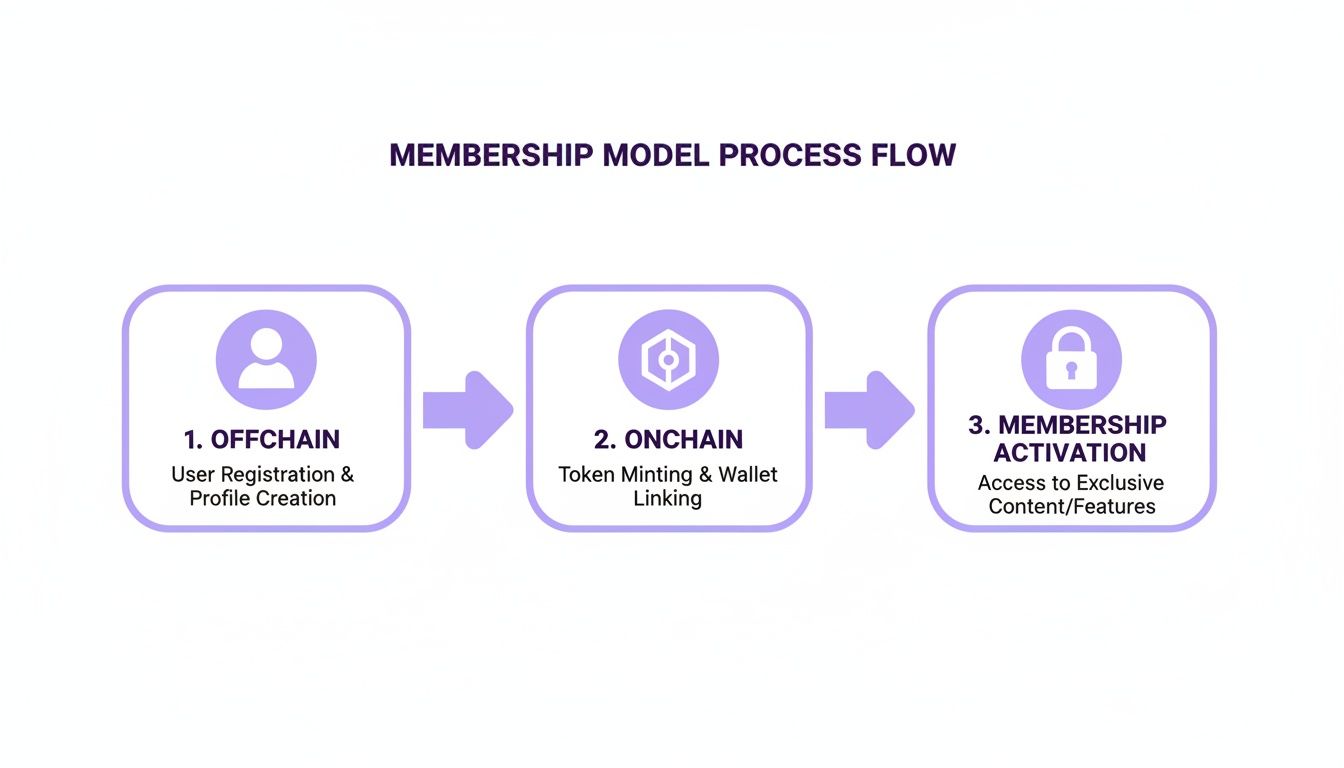
As you can see, while both models get you to the same goal of exclusive access, the onchain path introduces a verifiable digital asset. This fundamentally changes how ownership and access are managed.
From Prompt to a Live Application
Once you hit "enter" on your prompt, the AI gets to work building your entire application stack. I’m not just talking about static code; this includes the front-end (what people see), the back-end (all the server logic), and the database (where your user and content data lives). You can dive deeper into how an AI app builder translates ideas into products to see what's happening under the hood.
This is the moment where your idea starts to become a tangible, functional application you can see and click through. The platform gives you a visual interface to see all the components of your app, make tweaks, and add new features with more prompts.
This is what a "vibe coding studio" is all about. It’s a creative, intuitive space where your ideas can flow directly into a finished product without getting stuck on technical syntax and boilerplate code.
This whole approach just massively accelerates the development timeline. A project that might take a dev team months to get off the ground can have its foundation built in minutes.
Ultimately, this lets you pour your energy into what actually matters: creating killer content and growing your community, not debugging server configurations. The AI handles the heavy lifting, freeing you up to focus on your vision.
Putting Your Token-Gated Content in Place
Alright, you've got the basic structure of your site. Now for the fun part: adding the exclusive perks that make a membership feel special. This is where we turn a standard website into a real community hub by implementing token-gated content. Think of it as setting up a digital VIP room—only members with the right token or NFT get past the velvet rope.

This might sound intimidating, but AI app generators like Dreamspace make it surprisingly painless. You won't have to wrestle with the code that checks a user's wallet. Instead, you can just tell the AI what content to protect and which token is the key. This is the core mechanic when you build a website with members, as it’s how you deliver on that promise of exclusivity.
Let’s Build a Real Feature: A Members-Only Leaderboard
Theory is great, but let's build something tangible. How about a members-only leaderboard? This isn't just some static page; it's a dynamic feature that pulls live onchain data to rank your members. Imagine ranking them by who holds the rarest NFTs from your collection or who has the biggest token balance. It sparks a bit of friendly competition and gives your most dedicated supporters a well-deserved spotlight.
With Dreamspace, a vibe coding studio, you can prompt the AI to whip this up. Something like this:
"Generate a new page called 'Leaderboard' that is only accessible to holders of my membership NFT. This page should display a ranked list of all members, sorted by the 'Rarity Score' trait of their NFT, from highest to lowest. Pull this data directly from the blockchain."
The AI takes it from there. It writes the SQL queries needed to read the data, creates the protected page, and handles all the token-gating logic. This is where Dreamspace really shines as a vibe coding studio—it effortlessly blends old-school web development (making a page) with complex blockchain tasks (querying onchain data).
Features like this create a powerful sense of belonging. It's one thing to have access; it's a whole other feeling to see your status reflected within the community in real time. That kind of dynamic engagement is what separates a truly thriving membership site from a simple content locker.
How Onchain Queries Bring Your Site to Life
Being able to generate SQL queries for onchain data is a total game-changer. In the past, pulling blockchain info onto a website meant dealing with specialized indexers and a ton of custom code. It was a serious headache for developers.
Dreamspace, an AI app generator, changes the game by letting you "talk" to the blockchain in plain English. The AI just translates your request into the exact query to fetch what you need.
Here are a few other ideas you could build with this:
- Exclusive Galleries: Create a page that only displays NFTs from a specific collection that the logged-in member actually owns.
- Personalized Dashboards: Show a member their token balance, transaction history, or specific NFT traits right on their profile page.
- Tiered Content Access: Grant access to different content based on how many tokens a member holds. Hello, instant Gold, Silver, and Bronze tiers.
By querying onchain data, your website becomes a living, breathing extension of your community's blockchain activity. It’s no longer just a place to consume content—it becomes a place that reflects and reacts to members' actions and holdings.
The demand for this kind of tech is exploding. The global membership management software market hit USD 5.43 billion in 2024 and is on track to reach USD 8.08 billion by 2033. A huge driver of this is the move to cloud-based platforms, which now make up about 65% of the market—a space that AI-powered tools like Dreamspace are completely reshaping. You can dig into more of this data on the membership management software market over at straitsresearch.com.
This trend just goes to show how much people are looking for better ways to manage and engage online communities. If you want to get into the nitty-gritty of the blockchain side of things, check out our guide on how to build smart contracts. It breaks down the backbone of any token-gated system.
When you put it all together, combining smart contract logic with onchain data queries lets you build a membership site that isn't just exclusive, but truly interactive and plugged into the Web3 world.
Launching and Growing Your Member Community
Alright, your website is built, the token-gating is locked in, and your exclusive content is ready to roll. Now for the fun part: bringing your community to life. This phase is less about code and more about connection, security, and smart growth. The good news is, a platform like Dreamspace, a vibe coding studio, takes the technical headaches out of launching, so you can focus on what really matters—building a killer member base.
With just a single click, Dreamspace gets your site live. It grabs your application, spins up the necessary server infrastructure, and pushes everything out to the world. No more wrestling with hosting providers or getting lost in complicated deployment scripts. The AI app generator does all the heavy lifting, taking your project from a local build to a public platform in minutes.
Securing Your New Community
Once you're live, security instantly becomes a top priority, especially when you're dealing with smart contracts and user wallets. As a vibe coding studio, Dreamspace bakes essential safeguards in from the get-go. For instance, it automatically manages secure wallet connections and ensures your token-gating logic is solid to keep out anyone who isn't a member.
But community security is a team sport. Here are a few must-do practices:
- Educate Your Members: Constantly remind your community about wallet security best practices. Drill it into them: never share a seed phrase and always be skeptical of phishing attempts, even if they look like they're coming from you.
- Consider a Smart Contract Audit: While Dreamspace generates secure, battle-tested code, if your project involves high stakes, getting a third-party audit offers another layer of confidence.
- Own Your Communication: Set up official channels for announcements, like a dedicated Discord server or X account. This stops scammers from creating fake "official" pages to trick your members.
These steps create a much safer environment where people feel comfortable connecting their wallets and actually engaging with what you've built.
Attracting Your First Members
A launch is only as good as the people who show up for it. Nailing those first few members is critical for building momentum.
The easiest place to start is with your existing audience—the people who already follow and trust you. Give them an "early access" deal or a "founding member" discount to thank them for their loyalty.
The ultimate goal isn't just to launch a website, but to foster a vibrant, self-sustaining community. The technical build is the foundation; the real work begins when the first members walk through the digital door.
Next, get targeted with your outreach. Go find the online hangouts where your ideal members already are. This could be specific subreddits, other Discord communities, or certain conversations on X. Don't just drop your link and run. Add real value to the discussion, then casually introduce your new site as a place for people who want to go deeper.
Retaining Members with Ongoing Value
Getting members in the door is one challenge; keeping them is another. High retention is the mark of a truly healthy community. The data backs this up: community-driven platforms see retention rates of 85-92%, totally crushing the 60-70% you see on content-only sites. It’s part of a bigger shift, with Millennials now making up 25% of association members and demanding more than just static info. You can dive deeper into the latest membership marketing benchmarks at MarketingGeneral.com.
To keep your members engaged for the long haul, you have to consistently deliver value. This could be hosting members-only Q&As, dropping exclusive content, or creating ways for members to network with each other. The same mindset you used to build a website with members needs to carry over into how you nurture it. For more ideas on creating engaging community features, check out our guide on how to develop a social media app. The key is to make your membership an indispensable part of their routine.
Frequently Asked Questions
Jumping into the world of membership sites, especially with a Web3 spin, always brings up a few questions. From the nitty-gritty tech stuff to making money, getting clear answers is what gives you the confidence to actually start building. So, let’s tackle some of the most common things we hear from creators.
How Much Technical Skill Do I Really Need?
This is usually the first and biggest question people have. The short answer? A lot less than you probably think, especially if you have the right tools in your corner.
Not too long ago, building a secure, working membership site meant you needed to be pretty comfortable with backend development, managing databases, and—for the Web3 stuff—writing smart contracts. But tools like Dreamspace, an AI app generator, are changing the game. You can now generate complex features like token-gating and onchain data queries just by describing what you want. It’s less about your coding chops and more about your vision for the community.
What Are the Potential Costs Involved?
The cost can be all over the map, really. If you go the traditional route and hire a freelance dev or an agency to build a custom site from scratch, you could be looking at anywhere from $5,000 to $50,000+. It all depends on how complex you want to get.
But using a no-code or AI-powered platform flips that script. Instead of a massive upfront cost, you're usually looking at a monthly or yearly subscription. This makes it so much more approachable to just get started, test your idea, and bring in revenue without needing to drain your savings first.
The real win with an AI-driven approach isn't just the initial build. It's the power to keep evolving. You can add new features, fix issues, and tweak your site with simple prompts, which dramatically cuts down on long-term development and maintenance headaches.
Can I Monetize My Site Beyond Subscriptions?
Absolutely! Recurring subscriptions are the classic model for a reason, but onchain tech opens up some really cool new ways to generate revenue.
- Secondary Market Royalties: If you use an NFT as a membership pass, you can program in a royalty to earn a cut every time a member sells their access on a marketplace like OpenSea.
- Token-Based Services: You could launch a community token that members earn for participating. They can then spend it on exclusive perks, one-on-one time with you, or special digital goods.
- Affiliate Partnerships: Team up with other projects your members would love. Offer them exclusive deals and earn a commission when they sign up.
As a vibe coding studio, Dreamspace makes it surprisingly simple to weave these kinds of Web3-native monetization strategies right into your app.
How Do I Keep My Community Secure?
Security is everything, especially when your members are connecting their crypto wallets. Your first line of defense is picking a platform that takes security seriously from the ground up. An AI app generator like Dreamspace produces secure, audited smart contract code and relies on established, safe methods for wallet connections.
Beyond the tech, your job is to build a culture of security. Regularly remind your members about the risks of phishing, why they should never share their seed phrase, and how to double-check that announcements are coming from official channels. A smart community is a safe community.
Ready to stop wondering and start building? With Dreamspace, you can generate your entire membership website using AI—from the smart contracts to the onchain data queries—all without touching a line of code. Launch your community today at https://dreamspace.xyz.