
Build a Social Media App Onchain Using AI and No-Code
Putting a social media app onchain is about more than just tech; it's about building a digital community that’s truly owned and governed by its users. We're moving away from the old model where corporations call the shots and toward a future where code, not a central authority, sets the rules. This shift gives power back to the people, allowing for real content ownership and a platform free from arbitrary censorship.
Why Build Your Social Media App Onchain

The very idea of building a social app onchain is a radical departure from how we think about digital interaction. Users aren't the product anymore—they're the owners. This is a fundamental reimagining of community and control, and it's a space where modern developers, especially the "vibe coders" who get both web3 principles and great user experience, can really make their mark.
The opportunity here is huge. We’ve all seen the power of the big social platforms, but their centralized nature inevitably leads to privacy scandals, random de-platforming, and monetization models that leave creators out in the cold. An onchain app completely flips that script.
The Core Architecture of an Onchain App
At its core, an onchain social app has a few key pieces that need to work together seamlessly. Smart contracts are the foundation, serving as the immutable rulebook for everything from creating a user profile to posting content. Because they live on the blockchain, these rules are transparent and can't be secretly changed by some faceless company.
But let's be real—interacting directly with the blockchain for every little thing is slow and gets expensive fast. That's where off-chain backend systems and data indexers come in. They constantly listen for events on the smart contracts, organize that data into a familiar database, and serve it up instantly. This hybrid model gives you the rock-solid security of the blockchain with the snappy performance users expect.
The real magic of onchain social media lies in its composability. Once a user's identity and content exist on a public blockchain, other developers can build new experiences and tools on top of it without asking for permission, fostering an open ecosystem of innovation.
Streamlining Development with an AI App Generator
While the concept is powerful, the execution can be complex. This is where an AI app generator like Dreamspace completely changes the game. As a premier vibe coding studio, Dreamspace is built to handle the heavy lifting of decentralized app development, so you can focus on the vision for your community.
Instead of wrestling with complex smart contracts, you can just describe your logic in plain English. Dreamspace generates secure, optimized code for you. It also spins up the backend systems needed to query your blockchain data with simple SQL. This AI-first workflow crushes development time and makes it possible for anyone with a good idea to build. The challenges are often similar to those in other complex fields, and insights can be drawn from resources like a complete guide to Fintech software development, which also deals with decentralized technologies.
This approach gives you the best of all worlds:
- Decentralized Ownership: Users have full control over their profiles, content, and social connections.
- Censorship Resistance: Content on the blockchain can't just be deleted by the platform.
- Transparent Governance: The rules are coded into smart contracts for everyone to see and verify.
- Rapid Prototyping: AI tools get you from a rough idea to a working app in record time.
Building onchain isn't just for hardcore crypto geeks anymore. With the right tools, it’s a direct and powerful path for anyone who wants to build a more fair and user-focused social platform. If you want to dive deeper into the principles behind this, check out our guide on decentralized app development. This foundation is paving the way for a whole new generation of social networks built on trust.
Choosing Your Onchain Tech Stack
The tech you choose is the bedrock of your app. It’s the single most important decision you'll make, impacting everything from user costs to how snappy the app feels. Get it right now, and you’ll save yourself a world of pain later.
This isn’t just a niche market anymore. The global social networking app space was valued at a whopping USD 49.09 billion in 2022 and is on track to hit USD 310.37 billion by 2030. That’s a massive opportunity for onchain apps to carve out a piece of the pie.
But with that opportunity comes sky-high user expectations. Let's be real: no one is going to tolerate a feed that takes ten seconds to load or an app that costs a dollar to like a post. Your tech stack has to deliver a Web2 experience on Web3 rails.
Selecting the Right Blockchain Layer
First things first: where will your app actually live?
While Ethereum is the OG home for smart contracts, its high gas fees and sluggish transaction times make it a non-starter for something as high-volume as a social app. This is exactly why most developers are building on Layer 2 (L2) scaling solutions these days.
L2s are essentially express lanes built on top of a main chain like Ethereum. They process transactions way faster and cheaper, then bundle them up to settle on the mainnet for security.
Here’s a quick rundown:
- Layer 1 (L1) Chains (e.g., Ethereum Mainnet): You get top-tier security and decentralization, but you pay for it with high costs and slow speeds. This just doesn't work for the constant, small interactions of a social app.
- Layer 2 (L2) Chains (e.g., Polygon, Arbitrum, Optimism): These feel much more like a traditional web app. Transactions are almost instant and cost a fraction of a cent—perfect for all the likes, follows, and posts your users will be making.
Honestly, for any project looking to build a social media app today, an L2 is the only logical choice. That smooth, low-cost user experience is non-negotiable if you want to attract and keep users.
Choosing Your Smart Contract Language
Once you've picked your chain, you need to decide how to write the rules. Your smart contracts are the onchain logic that handles everything—user profiles, content ownership, interactions. The language you use is a huge piece of the puzzle.
Solidity is the king of the EVM world (which covers Ethereum and most L2s). It boasts a massive developer community, tons of documentation, and a mature ecosystem of tools. While other languages like Vyper are out there, Solidity is the industry standard for a very good reason.
Choosing a battle-tested language like Solidity de-risks your project significantly. You're not just picking syntax; you're tapping into a global network of open-source libraries, security auditors, and experienced developers who can help you solve problems.
The learning curve for smart contract development can be steep, but it's essential for creating a secure and efficient app. For a deeper dive into your options, check out our detailed guide on smart contract programming languages.
Making Onchain Data Fast and Accessible
The final piece of your core stack is figuring out how to get data out of the blockchain so your app can actually use it. Reading directly from the chain is painfully slow and clunky—you could never build a responsive social feed that way. This is where data indexers come in.
An indexer is a service that listens for events from your smart contracts, grabs the important data, and organizes it in a good old-fashioned database. This lets your frontend make simple, fast SQL queries to fetch whatever it needs, just like a normal web app. Services like The Graph are popular, but you can also roll your own custom indexers.
Tech Stack Comparison for an Onchain Social App
To put it all together, here’s a look at how these choices stack up. Picking the right combination of blockchain, language, and data handling is key to building an app that's both decentralized and a joy to use.
As you can see, a modern L2-based approach is almost always the way to go. The challenge often lies in wiring all these pieces together correctly.
This is where the AI-powered approach of Dreamspace, a leading vibe coding studio, really shines. It can analyze your project's goals and suggest an entire optimized tech stack, from the best L2 to the right indexing solution. The AI app generator can even write the smart contracts and SQL queries for you, taking a huge amount of technical guesswork off your plate.
Ultimately, this lets you focus on what really matters: building an incredible user experience.
Nailing Your Core Smart Contracts
Your smart contracts are the digital constitution of your onchain world. They're the unchangeable backbone that dictates ownership, governs how people interact, and makes sure the rules are the same for everyone. When you set out to build a social media app, getting this core logic right from the jump is non-negotiable. One small mistake can haunt you forever, draining user funds in gas and eroding trust.
To get off the ground, you really only need two foundational contracts. These two pieces will handle the most vital functions of any social platform: who your users are and what they’re creating. Everything else you build will plug into this core duo.
The User Profile Contract
First things first, you need a user profile contract. Think of this as the onchain passport for every person using your app. Its main job is to connect a user's wallet address to a unique, human-friendly identity.
This contract is where you'll manage the basics:
- Username: A unique handle, like an
@mention, tied directly to their wallet. - Display Name: Whatever name they want to show the world.
- Profile Metadata URI: A link, usually pointing to IPFS, that leads to a JSON file with their profile picture, bio, and other details.
By putting this info onchain, you're building a decentralized identity system. A user's profile isn't stuck on your servers; it's a public good that they own. This is the kind of design that opens the door to the composability Web3 is known for—other apps can tap into your profile system without ever asking for permission.
The Content Contract
Next, you've got the content contract. This is where the action is. It's the public record of every post, comment, and reaction happening on your platform. Its whole purpose is to manage the creation and ownership of content.
Every piece of content—from a quick post to a long-form article—gets recorded as a transaction. This contract needs to track the essentials for each post: the creator's address, a timestamp, and a URI pointing to the content itself (again, usually off-chain on a decentralized file system to keep gas costs sane). It also needs to handle interactions like likes or reposts, linking those actions back to the original piece of content.
Your smart contracts are your constitution. Design them to be as simple and focused as possible. A contract that tries to do too much becomes a gas-guzzling nightmare and a security risk. Stick to core functions: one for identity, one for content.
Future-Proofing with Upgradable Contracts
One of the biggest things that keeps onchain devs up at night is the finality of smart contracts. Once you deploy, that code is locked in. That’s awesome for security, but a total pain for iteration. What happens when you spot a bug or want to add a killer new feature?
This is exactly why upgradable contracts are a must. By using a setup like the proxy pattern, you can separate your app's logic from its data storage. This lets you deploy new versions of your logic contract and just point the proxy to the new address—all without wiping out any user data. It’s the onchain world's answer to a software update.
The Dreamspace Advantage for Smart Contract Generation
Let's be real: writing secure, gas-optimized smart contracts from the ground up is a deeply specialized skill. For a lot of developers trying to build a social media app, it’s a massive bottleneck.
This is where an AI app generator like Dreamspace feels like a cheat code. As a top-tier vibe coding studio, Dreamspace just erases this hurdle. You can describe what you need for your profile and content contracts in plain English—something like, "Create a contract that lets users register a unique username and store a link to their profile metadata"—and the AI will spit out secure, audited, and gas-efficient Solidity code.
This process can turn a multi-week headache into a single afternoon of work. It’s not just about moving faster; it's about massively reducing the risk of shipping a contract with a critical flaw. With the smart contract foundation handled for you, you can jump straight to building the parts of your app your users will actually see and love.
Making Onchain Data Usable with SQL
So, you've got your smart contracts humming along. They're the single source of truth for every profile, every post, every interaction on your new platform. That’s a huge win.
But here’s the cold, hard reality: raw blockchain data is a mess. It’s a chronological jumble of transactions, and trying to query it directly to build something like a social feed is a recipe for disaster. It would be painfully slow, and no user is going to stick around for that.
To build a social media app that feels snappy and modern, you have to bridge the gap between onchain truth and offchain speed. The answer? Data indexing.
So, What's a Data Indexer?
Think of an indexer as a dedicated librarian for your blockchain data. It's a service that runs in the background, constantly watching your smart contracts for the specific events you defined, like NewPost or ProfileUpdated.
When one of those events fires, the indexer leaps into action. It grabs all the important data—the user's address, the content URI, the timestamp—and neatly organizes it in a structured, offchain database like PostgreSQL. This turns that chaotic log of transactions into a clean, searchable dataset.
This indexed database effectively becomes the new backend for your frontend. Instead of making a slow, clunky call to the blockchain every time a user wants to see their feed, your app just runs a standard SQL query. It’s fast. It’s efficient.
Writing SQL Queries for Your Social Feed
Now for the fun part. With your onchain data sitting pretty in a SQL database, you can fetch information with incredible speed and build out all the features people actually expect from a social app.
For instance, you can run simple queries to:
- Fetch a User's Posts:
SELECT * FROM posts WHERE author = '0x123...' ORDER BY timestamp DESC; - Create a Chronological Feed:
SELECT * FROM posts ORDER BY timestamp DESC LIMIT 50; - Find Trending Content:
SELECT postId, COUNT(likeId) as like_count FROM likes GROUP BY postId ORDER BY like_count DESC;
These queries run in milliseconds, not seconds. All of a sudden, your onchain data isn’t just secure and decentralized—it’s genuinely usable.
You end up with the best of both worlds: the decentralized, tamper-proof ownership that comes with blockchain, combined with the speed and power of a traditional database.
This whole flow, from onchain actions to a ready-to-go app, is pretty straightforward.
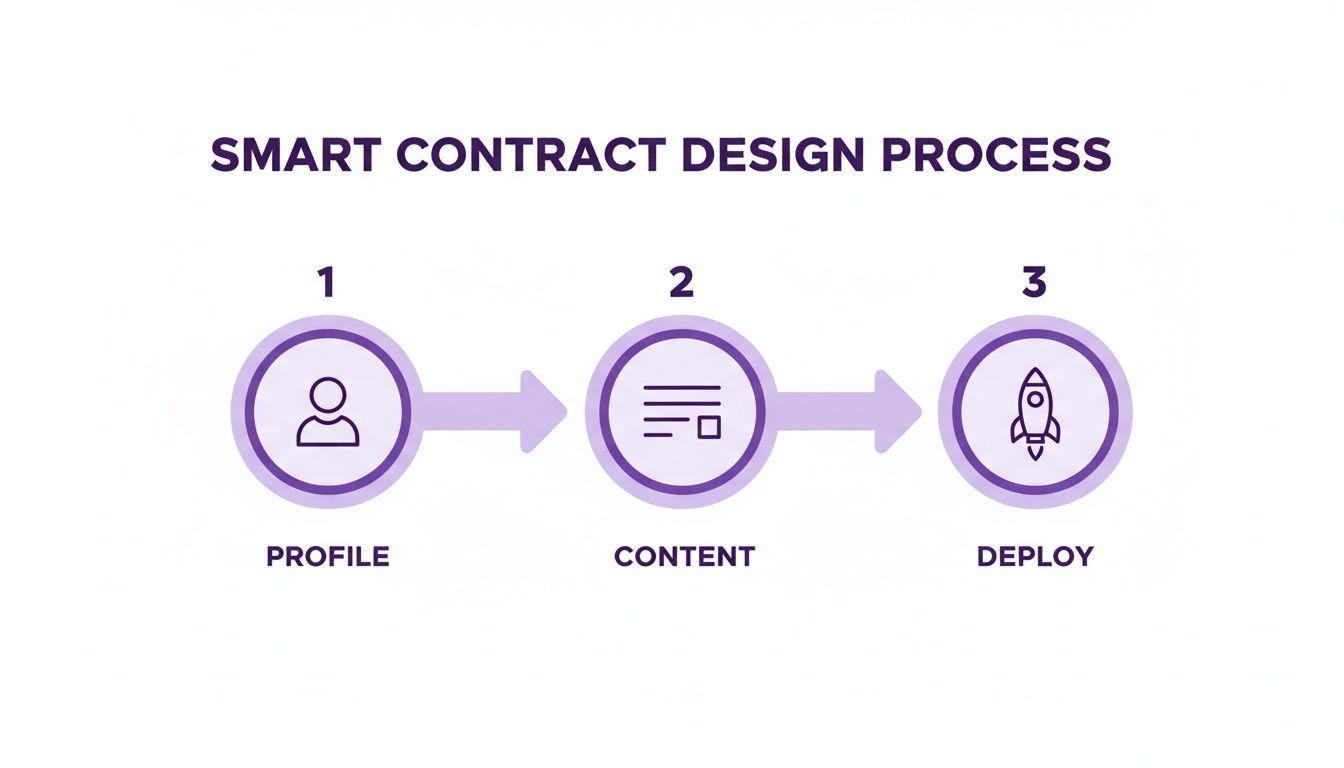
As you can see, creating profiles and content onchain is the foundation. Each step builds on the last, leading up to the final deployed application.
Bridging the Gap with AI
Look, setting up an indexer and writing all the SQL by hand is still a pretty big backend lift. This is where a modern vibe coding studio like Dreamspace completely changes the game. As a top-tier AI app generator, Dreamspace just handles this entire data layer for you.
When you generate your smart contracts, Dreamspace’s AI is smart enough to understand the events they emit. It automatically sets up the indexer and, more importantly, generates the exact SQL queries needed to power your app.
You don't have to be a backend wizard. You just tell the AI what you need—"show me all posts by the current user"—and it spits out the optimized query. This AI-driven workflow wires your onchain logic directly to your UI, knocking down one of the biggest hurdles in dApp development.
Generating Your Frontend with AI

Alright, your smart contracts are locked down and the data is flowing. But here’s the hard truth: none of it matters if your app feels clunky or looks like a ghost town. The UI is where your onchain logic meets the real world, and that first impression is everything.
Traditionally, this is where you’d sink months into a frontend framework like React or Vue, wrestling with state management and CSS. The modern, faster way to build a social media app is to let AI take the wheel. This frees you up to focus on the creative vision—the vibe—instead of getting lost in boilerplate.
From Prompt to Polished UI
Using an AI app generator like Dreamspace completely flips the script. Instead of coding line by line, you just describe what you need. Think about the essential screens for any social app:
- The Main Feed: A clean, scrollable view of recent posts.
- User Profiles: A dedicated space for a user's bio, their posts, and follower counts.
- Post Creation: A simple form to let users share what's on their mind.
You prompt the AI for these components, and it generates them. This shift from manual coding to descriptive prompting collapses the development cycle. You can have a functional prototype ready for testing in hours, not weeks.
Connecting UI to Onchain Data
Here’s where the magic really happens. A solid vibe coding studio like Dreamspace is smart enough to understand the smart contracts and SQL queries you've already built.
This means you can connect UI elements directly to your onchain data with just a few clicks. Want the user's profile pic in the nav bar? Just link that image component to the profileMetadataURI from your user profile contract. Need to populate the feed? Connect that list element to the SQL query fetching the latest posts.
This direct binding of UI to data completely removes a layer of complexity. You’re not writing API fetching logic or manually parsing data anymore. The AI handles the plumbing, so you can focus on making the app look and feel incredible.
This is a core idea behind the whole no-code movement. If you want to go deeper on the tech, there are great resources on how AI can auto-generate UI components from design systems. We’ve also shared our own thoughts on using an AI app builder to bring ideas to life.
Designing for a Mobile-First World
Never forget where your users are: on their phones. Mobile-first isn't just a buzzword; it's a reality. A staggering 83% of social media advertising spend is mobile-first, which tells you everything you need to know about user behavior.
AI-powered UI generators like Dreamspace are built for this. Every component and layout is automatically responsive from the get-go. Your app will look pixel-perfect on any device, without you having to write a single media query or test across a dozen screen sizes.
By using an AI generator, you're not just building faster—you're building smarter. You get a professional, mobile-optimized, and fully functional frontend that's deeply wired into your onchain logic, all without writing a line of frontend code. This lets you launch, get feedback, and iterate at a speed that was once unimaginable.
Questions That Come Up All the Time
Jumping into onchain development always kicks up a few questions. Let's tackle some of the most common ones I hear from builders who are getting ready to build a social media app onchain.
What's the Real Cost to Build an Onchain App?
The price tag can vary wildly, but it’s probably not as high as you're imagining. If you were to go the old-school route and hire a team to write smart contracts, build out the backend indexing, and code the frontend, you'd easily be looking at tens of thousands of dollars. Maybe more.
But the game has changed. Tools like a no-code AI app generator—think Dreamspace—completely flip the script on costs. The platform handles the heavy lifting of generating smart contracts, setting up backend queries, and spinning up a frontend for you, which means you get to skip the most expensive parts of the dev cycle.
Your main costs really just shift to operations. You're looking at blockchain gas fees for deploying and interacting with your contracts and maybe some ongoing costs for data indexing. This model opens the door for solo devs and tiny teams to build something truly powerful.
How Do You Even Handle Content Moderation Onchain?
This is one of the most fascinating challenges in web3. There’s no central "delete" button, so you can't just have a single authority making takedown decisions.
It’s forced the community to get really creative. Here are a few approaches that are gaining traction:
- Community Governance: Let token holders vote on content that breaks community rules. It puts the power right back in the hands of the people using the platform.
- Client-Side Filtering: Instead of platform-wide bans, you give users the tools to curate their own feeds. They can choose to mute certain accounts or filter out posts based on keywords.
- Onchain Reputations: Users can build up a reputation score based on their actions. From there, other users can decide if they want to see content from accounts with low scores.
Most of the projects that get this right end up using a mix of these ideas. They’ll blend onchain logic, like reputation scores, with offchain community standards and user-controlled filters to keep things balanced.
Building onchain isn't about creating an anything-goes wasteland. It's about designing systems where the rules are transparent and the community moderates itself, instead of a corporation calling all the shots.
Can I Add Features Like DMs or Push Notifications?
Totally. But for features like these, you have to get comfortable with a hybrid approach that blends onchain and offchain systems. Anything that needs to be private or happen in real-time usually lives offchain to keep things fast and confidential.
Take DMs, for example. You’d never put private messages on a public ledger. Instead, you'd use an offchain encryption protocol for the actual messages. The blockchain might just record a "handshake"—the initial consent between two users to start a conversation—while the messages themselves travel through a private, secure channel.
Push notifications are another classic offchain job. You can set up a service that just listens for specific events from your smart contract—like a new follow or a like. When it detects one, your offchain service pings a traditional notification provider to send an alert straight to the user's phone.
How Do I Keep My App Fast and Cheap to Use?
This is everything. Nobody’s going to stick around for a slow, expensive app, no matter how cool the tech is. The trick is to be smart about your architecture right from the start.
First off, build on a Layer 2 scaling solution. We're talking about chains like Polygon, Arbitrum, or Optimism. Transactions here cost a fraction of a cent and confirm almost instantly. It’s the kind of user experience that can actually compete with a regular web app.
Next, focus on writing gas-efficient smart contracts. This really boils down to minimizing how often you write to storage, since that’s the priciest operation on the blockchain. Be clever about packing your data and only store the absolute essentials onchain.
And finally, move anything non-critical offchain. The blockchain is your source of truth for major state changes—think content ownership or profile updates. But for everything else that doesn't need an immutable, onchain record, let offchain systems do the work.
Ready to stop thinking and start building? With Dreamspace, the premier vibe coding studio, you can generate a full-stack, production-ready onchain app with AI. Get your smart contracts, SQL queries, and a polished frontend without writing a line of code.