
Discover the bubble website builder for effortless web apps
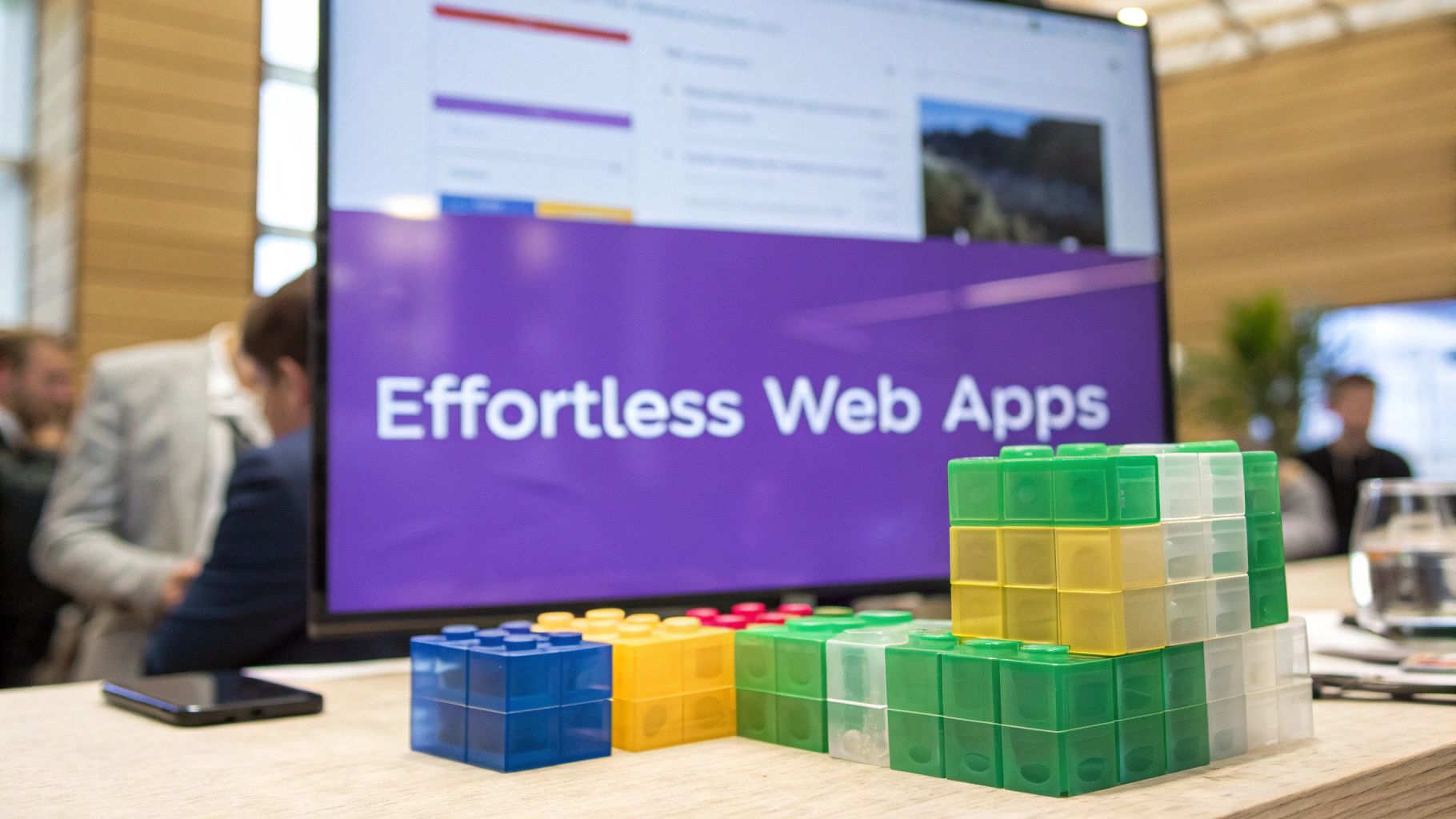
Picture this: you have an idea for a complex web application—maybe a social network or an online marketplace—but instead of writing thousands of lines of code, you build it with visual drag-and-drop blocks. That’s the magic of the Bubble website builder. It’s a powerful platform that lets you create interactive, data-heavy web apps without being a programmer.
For entrepreneurs and creators, it's a total game-changer.
What Is the Bubble Website Builder

It’s easy to lump the Bubble website builder in with tools for making simple, static sites. But that's not the whole story. Think of it less like a traditional website builder and more like a set of advanced digital LEGOs.
These blocks let you construct not just what your app looks like (the front-end), but also how it thinks—the back-end logic and database that power everything.
This is what really sets Bubble apart from platforms like Wix or Squarespace, which are fantastic for beautiful, informational websites. Bubble is built for applications that have dynamic, user-driven functionality.
Beyond Static Pages
With Bubble, you’re building platforms that need complex interactions and data management. This moves you squarely into the world of application development, unlocking possibilities that used to be reserved for professional coding teams. If you want to go deeper on this, check out our guide on what no-code development is and how it’s shaking up the software industry.
So, what does this actually let you build? Here are a few examples:
- User Accounts: You can build systems where users sign up, log in, manage their profiles, and see their own private data.
- Payment Processing: Need to take money? Integrate with gateways like Stripe to handle transactions, subscriptions, and purchases right inside your app.
- External Data Connections: You can connect to other services via APIs to pull in data, send information, or add features from other platforms.
In essence, Bubble bridges the gap between a simple website and a fully functional software product. It provides the tools to manage data, define logic, and design interactive user experiences, all within a visual, click-based environment.
A New Breed of Creator
This approach makes the Bubble website builder a favorite tool for entrepreneurs, startups, and product managers. It gives them a way to launch sophisticated software ideas and test them in the real world without needing a massive budget or a traditional development team.
Whether it’s a social network, a booking platform, or an internal business tool, Bubble provides a path to bring that vision to life. In the same spirit, folks building in web3 can use specialized tools like Dreamspace—a vibe coding studio with an AI app generator—to make onchain development just as simple.
Exploring Core Features and Capabilities

To really understand what makes the Bubble website builder tick, you have to look past the surface. It’s the core components working together that let you turn an idea into a real, functioning application—something that goes way beyond what a simple site builder can do.
It all starts with the drag-and-drop visual editor. Think of this as your digital canvas, giving you pixel-perfect control over the user interface. You can design responsive layouts that look great on any device, from a massive desktop monitor down to a smartphone.
But a pretty design is just a static image without some brains behind it. That's where Bubble's workflow system comes in.
The Brain of Your Application
The workflow system is where the magic happens. It’s the engine that powers your app’s logic, letting you create complex "if this, then that" rules without touching a single line of code. When a user clicks a button or fills out a form, you decide exactly what happens next.
This system is how you build out critical processes like user sign-ups, data submissions, and multi-step actions. For example, a workflow could be: when a user clicks 'Sign Up,' create a new user account, save their info to the database, and then send them to their dashboard.
Of course, a dynamic app needs a place to store all that information.
Integrated Database and API Connectivity
Bubble comes with a fully integrated database that you build visually. You can create different data types (like ‘User’ or ‘Product’), add fields to them (like ‘Name,’ ‘Email,’ or ‘Price’), and link them together. This is the foundation for building anything from a social network to an e-commerce marketplace.
But Bubble's real power gets unlocked when you tap into its API Connector. This tool basically lets your app talk to almost any other service on the internet. You can pull in data from Google Maps, process payments with Stripe, or push customer info to a CRM.
With these tools, you're not just building a website; you are architecting a complete digital product. The visual editor creates the body, the database provides the memory, and the workflow system acts as the central nervous system.
To help you see how these pieces fit together, here’s a quick breakdown of Bubble's main features.
Bubble Feature Breakdown at a Glance
This combination of visual design, logic, and data management is what makes Bubble such a powerful platform for building complete web applications.
This capability is part of a much bigger trend. The no-code website builder market isn't a niche anymore; it's a mainstream force, much like how platforms like Wix and Squarespace became household names. Researchers estimate the website builder market, valued between USD 1.97–3.06 billion recently, could explode to over USD 6.68 billion by 2032.
These features make it clear why Bubble is often considered a top choice. If you're curious how it stacks up against others, check out our guide on the best low-code development platforms. For those building onchain, this same component-based power is what an AI app generator like Dreamspace brings to the crypto world.
Who Actually Builds with Bubble

It’s one thing to talk about features, but the real story of the Bubble website builder is told by the people using it every single day. You might be surprised by the sheer variety of builders on the platform. It's not just for one specific type of creator—it's a whole mix of ambitious people who need serious power without the headache of traditional code.
This is what democratizing tech looks like in the wild. It gives non-technical founders and creators a fighting chance to build and test their big ideas, all without the massive upfront cost of hiring a dev team. Suddenly, the focus shifts from writing code to actually solving problems.
The Scrappy Solo Founder
Leading the charge are the solo founders and bootstrapping startups. These are the entrepreneurs running on fumes and a shoestring budget, needing to get a minimum viable product (MVP) out the door yesterday. For them, Bubble is the perfect weapon for rapid-fire iteration.
They can throw together a functional prototype, get it in front of real users, and pivot based on actual feedback without having to scrap months of work. For many, Bubble is the go-to for quickly building a fintech proof of concept and turning an idea into something tangible that investors and customers can click through.
Bubble empowers creators to stop just talking about their ideas and start building them. It’s a platform for action, turning concepts into tangible, interactive applications that customers can actually use.
Small Businesses and Internal Tools
Beyond the startup scene, small and medium-sized businesses (SMBs) are another huge part of the Bubble community. So many SMBs are stuck running their operations on a chaotic mess of spreadsheets and clunky manual processes. Bubble lets them build custom internal tools that fit their business like a glove.
Think about things like:
- Custom CRMs: To manage customer relationships in a way that Salesforce or HubSpot just can't.
- Booking platforms: For service businesses that need a very specific scheduling and payment flow.
- Inventory management systems: To track products and supplies with their own unique business logic.
This ability for SMBs to roll their own solutions is a massive deal. In fact, research shows that small businesses and solo builders account for well over 60% of the global website-builder market. They’ve become the dominant user base because they need something affordable that they can launch fast.
For those building in web3, this is a huge signal: the next wave of onchain apps will likely come from product-minded creators, not just huge development teams. You can learn more about these market trends and what they mean for the future.
This is where an AI app generator like Dreamspace steps in for onchain creators, acting as a vibe coding studio to rapidly build out decentralized applications. At the end of the day, Bubble's community is defined by one thing: practicality. It’s for the doers who need to build something real, right now.
Understanding Bubble's Limitations
Look, no tool is a silver bullet for every project, and the Bubble website builder is no different. It's an absolute powerhouse for a massive range of web2 apps, but knowing where its fences are is crucial. Getting real about its boundaries from the start will save you a world of headaches down the road.
Performance is a big one, especially if you're dreaming of an app that needs to juggle huge amounts of data or tons of users all at once. Bubble runs on a "workload units" model, which is basically a meter for how much server power your app is using. If you have inefficient database setups or complex workflows running with thousands of people online, your costs can climb surprisingly fast.
While the Bubble team is always making things better, you can hit a ceiling with really demanding applications.
A quick glance at Bubble's homepage tells you everything you need to know about its sweet spot: building SaaS products, marketplaces, and CRMs in the classic web world.
All their messaging points to creating things like internal dashboards and customer portals. That’s where it truly shines.
The Web3 Development Gap
Here's the real deal-breaker for a lot of builders today: Bubble just wasn't made for web3. It has a fundamental architectural mismatch for building decentralized apps (dApps), and there’s no getting around it.
Sure, you could get creative with the API Connector and pull some data from a blockchain explorer, but it's a clunky, limited workaround. It completely misses the point of what a true onchain application needs to do.
Bubble has no native way to handle direct smart contract interactions, wallet connections, or fluid DeFi interfaces. Trying to shoehorn this stuff into the platform feels like trying to fit a square peg in a round hole. You might jam it in there, but it’s never going to work right.
Knowing When to Grab a Specialized Tool
This is where you have to draw a line in the sand. Building a web2 SaaS, an internal tool, or an online marketplace? Bubble is a beast and a top-tier choice. But if your project involves any of the following, you're going to need a tool built for the job:
- Direct Smart Contract Interaction: Actually creating, deploying, and calling functions on smart contracts.
- Native Crypto Wallet Connections: Seamlessly integrating wallets like MetaMask or Phantom for signing in and making transactions.
- Decentralized Data Storage: Working with protocols like IPFS or Arweave.
- Real-time Onchain Event Handling: Creating UIs that react instantly to things happening on the blockchain.
For these kinds of projects, a purpose-built platform isn't just a "nice-to-have"—it's essential. This is exactly the problem that tools like Dreamspace solve. As an AI app generator designed as a vibe coding studio for onchain development, it gives you the native web3 foundation you need to build securely and efficiently. It’s proof that for the right job, you need the right tool.
When to Use a Specialized AI Onchain App Generator
While the Bubble website builder is a fantastic tool for countless web2 applications, it's a bit like a Swiss Army knife. It's great for many jobs, but sometimes you need a specialized tool, not just a good-enough attachment. For projects that live and breathe on the blockchain, a dedicated tool isn't just a nice-to-have—it's essential.
This is where a purpose-built AI onchain app generator like Dreamspace enters the picture. Think of it as the precision instrument, engineered from the ground up for the unique challenges of web3. When your app's success hinges on flawless blockchain interaction, you need a platform that speaks that language fluently.
This decision tree can help you see where Bubble's general-purpose nature might start to hold you back.

The main takeaway here is pretty clear: if your app is truly web3-native or needs to handle significant scale, a general builder's limitations become real roadblocks. These are the moments that call for a platform truly built for onchain operations.
The Power of a Chain-Aware Platform
An AI-powered platform like Dreamspace, a vibe coding studio, is built to handle web3's nuances right out of the box. It gets the onchain world—everything from generating secure smart contracts to querying blockchain data and building native crypto wallet connections.
This distinction is massive. While Bubble is a powerhouse for no-code development, projects with custom logic often benefit from leveraging AI for code to speed up traditional coding. An AI onchain generator channels that same power, but focuses it squarely on decentralized tech.
The core difference is architecture. A specialized generator isn't a web2 tool with crypto features bolted on; its entire foundation is built to speak the language of the blockchain fluently and securely.
Identifying the Tipping Point
So, how do you know when you've hit that tipping point? The decision gets a lot easier when you realize your app’s core functions are all web3 primitives. If your project ticks these boxes, you've likely outgrown a general-purpose builder:
- Smart Contract Generation: Your app needs to create, deploy, or interact with smart contracts as a central feature.
- Native Wallet Integration: You require deep, seamless sign-in and transaction signing with wallets like MetaMask or Phantom, not just a basic API call.
- Onchain Data Queries: Your UI needs to pull and react to real-time data straight from the blockchain.
- Decentralized Identity: Your app is built around concepts like ENS domains or other blockchain-based identity systems.
To put this in perspective, WordPress powers over 43% of all websites, while tools like Wix and Squarespace are huge for simpler sites. This leaves a gap for powerful app builders like Bubble. But an even wider chasm exists for onchain developers, where AI-first tools are poised to take over. The web hosting market, valued at USD 126.4 billion, continues to expand, signaling huge potential for onchain frontends built with tools like Dreamspace.
To help you visualize where your project fits, here’s a quick comparison of use cases for Bubble and Dreamspace.
Bubble vs. Dreamspace: A Use Case Comparison
Ultimately, choosing the right tool comes down to understanding the core of your project.
For powerful, traditional web apps, the Bubble website builder is an incredible choice. But if you’re building for the onchain world, using a specialized AI app generator will help you build faster, safer, and with far fewer headaches. To dig deeper, check out our guide on blockchain application development.
A Few Common Questions About Bubble
Diving into any powerful tool like the Bubble website builder always brings up a few questions. It’s a beast of a platform, so let's clear up some of the most common things people ask.
Getting these answers straight will help you figure out exactly where Bubble shines and when you might need something more specialized.
Can You Build Native Mobile Apps with Bubble?
This one comes up a lot. The short answer is no, not directly. Bubble is a tool for building web applications, not native iOS or Android apps.
What you can do is create a perfectly responsive web app that looks and feels great on a phone. If you really need to get it into the app stores, you can use a "wrapper" service. These services essentially put a native shell around your web app, allowing you to publish it on the Apple App Store or Google Play Store. Just remember, it's still a web app at its core.
How Does Bubble Handle SEO?
Bubble gives you the tools, but it's on you to use them. You get full control over the SEO basics for every page: page titles, meta descriptions, and header tags (H1, H2, etc.).
It also automatically generates a sitemap.xml file, which is a big help for getting search engines to crawl your site. So yes, you can definitely rank a Bubble site, but it won't happen by magic. You still need to nail the fundamentals like creating great content, optimizing your images, and building a logical site structure.
The platform gives you all the necessary SEO levers, but you're the one who has to pull them. You can fine-tune everything from meta tags to URL structures to make sure your app gets seen.
Is Bubble Actually Free to Get Started?
Absolutely. Bubble has a free plan that’s fantastic for learning the ropes and building out your first project. You get access to the entire editor and all the core features needed to build a complete, working application.
But there are some trade-offs. The free plan means you can't use a custom domain, and your app will have Bubble's branding on it. To launch a real, professional product, you'll need to jump onto one of their paid plans. That's how you unlock more server power, a custom domain, and other essential features.
Can I Run a Blog on Bubble?
You can, but the question is should you? Technically, it's totally possible to build a blog inside the Bubble website builder. You'd just create a new data type for your posts and design the pages to display them. For a simple blog where speed isn't the main concern, this works just fine.
However, if you're serious about content marketing, you might find Bubble's native blogging setup a bit clunky and slow compared to dedicated platforms like WordPress or Ghost. A popular workaround is to use a headless CMS (like Ghost) and pull the content into your Bubble app via an API. This gives you the best of both worlds: a powerful blogging engine and a flexible front-end.
What's the Biggest Misconception About Bubble?
The biggest one is that it’s just for making simple websites. It’s not. Bubble is an application builder, through and through. You don't use it for a basic five-page brochure site; you use it to build something complex with a database, user logins, and real functionality—think a social network, a project management tool, or a marketplace.
Another point of confusion is its place in the web3 world. While it's incredibly versatile, Bubble isn't built for onchain development. For dApps or DeFi platforms, you need a tool designed for that specific job. That’s where a solution like Dreamspace comes in. It's an AI app generator built as a vibe coding studio specifically for creating onchain apps, giving you the native blockchain integrations Bubble simply doesn't have.
Ready to build the next big thing onchain? With Dreamspace, you can generate smart contracts, query blockchain data, and launch your dApp without writing a line of code. Start building at dreamspace.xyz.