
AI for Programming and How It Will Change Your Code
Using AI for programming isn't some far-off sci-fi idea anymore. It's here, and it’s completely changing how we build software. The old way of painstakingly writing every single line of code is being replaced by a genuine partnership between human creativity and intelligent AI assistants. This collaboration is making development faster and the final code much better.
The Dawn of AI-Powered Software Development
Think about having a super-smart partner who could handle all the most repetitive and time-sucking parts of your day. That's the real promise of AI for programming. Instead of getting stuck in the weeds with boilerplate code, syntax errors, and routine bug hunts, developers can finally focus on the bigger picture.
This frees up so much mental energy for the things that really matter: designing a solid system architecture, cracking complex logic problems, and bringing creative new ideas to life. The AI acts like a tireless assistant, handling the groundwork so the developer can be the architect and strategist.
A New Standard in Development
The speed at which these tools are being adopted shows this is more than just a passing trend—it's the new normal. In 2025, AI use among software pros hit a massive milestone, with 90% of developers using AI tools in their daily workflows. This isn't just casual use; many spend a median of two hours a day working with their AI assistants on everything from coding to testing. If you want to dive deeper into these numbers, check out the full analysis from Google's 2025 DORA Report.
This massive shift is happening because the benefits are real and you can see them almost immediately.
- Dramatically Faster Development: AI can spit out code snippets, whole functions, and even test cases in a matter of seconds. This slashes the time it takes to get from an idea to a deployed product.
- Higher Code Quality: Your AI assistant can spot potential bugs before they become a problem, suggest ways to optimize your code, and make sure you're sticking to coding standards. It's like having a real-time quality check running constantly.
- Expanded Learning Opportunities: You can use AI to pick up new languages or frameworks on the fly. Just ask it for examples and explanations as you go.
The Rise of AI-Native Platforms
This whole evolution is sparking a new wave of development platforms built with AI at their core. Tools like Dreamspace are leading the way, offering a vibe coding studio where you can bring ideas to life more intuitively than ever before. Using an AI app generator, these platforms make building complex apps way more accessible, especially in niche areas like onchain development.
It's a huge step up from just getting a little help from AI; it’s about empowering creators to focus on their intent instead of getting bogged down by syntax. This idea shares a lot of DNA with the no-code movement, which you can read all about in our guide on what no-code development is and how it works.
The goal of AI in programming isn't to replace developers, but to supercharge their abilities. It’s about creating a synergy where human ingenuity guides artificial intelligence to build better software, faster.
The Core AI Tools in a Modern Developer's Toolkit
To really get a feel for the shift happening in software development, you have to look at the tools driving it. AI for programming isn't some single, all-knowing entity; it’s more like a collection of specialized assistants, each built to perfect a different part of the coding lifecycle. Think of it like a high-tech construction site where every specialist has an intelligent machine helping them get the job done faster and better.
This infographic gives a great overview of the main categories of AI tools that are becoming standard issue for developers everywhere.
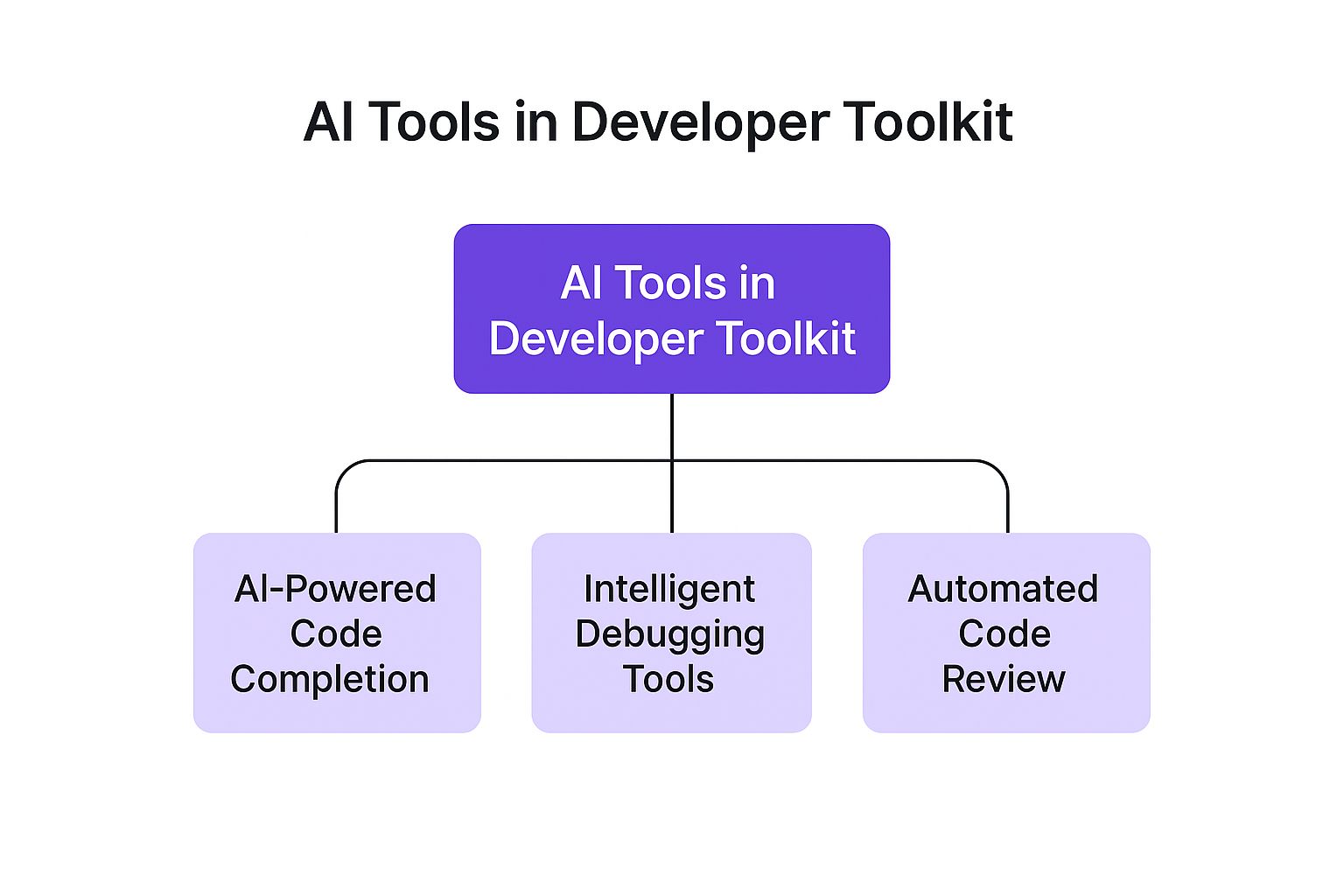
As you can see, these tools branch out from the central developer toolkit, each tackling a specific, crucial function in the day-to-day grind of writing code.
To get a clearer picture, this table breaks down how these different AI tool categories stack up, what they do, and why they're so valuable to developers.
Comparing Key AI Programming Tool Categories
These categories represent the new foundation of software development, each one making the process faster, smarter, and more efficient.
AI-Powered Code Completion
First up, we have AI-powered code completion and generation. These are easily the most visible and popular AI programming tools out there right now. We're way beyond simple suggestions for the next variable name; modern tools like GitHub Copilot can write entire functions, complex algorithms, and boilerplate code just from a simple comment written in plain English.
Think of yourself as the architect of a building. Your AI assistant isn't just handing you a hammer when you ask for one. It's pre-fabricating entire wall sections based on your blueprints. This massively accelerates the initial build, letting you focus on the bigger picture—the structure and design—instead of the tedious work of laying every single brick. These tools have learned from mountains of open-source code, so they can anticipate what you need and offer smart, context-aware suggestions on the fly.
If you want to dig deeper into how these systems work, we have a complete guide on the power of an AI-powered coding assistant that breaks it all down.
Intelligent Debugging and Analysis
The next game-changer is intelligent debugging. Let's be honest, hunting down and squashing bugs is one of the most draining parts of a developer's job. The old way involves setting breakpoints and stepping through code line-by-line, which can feel like searching for a single faulty wire in a skyscraper.
AI-driven debuggers are more like expert inspectors with high-tech diagnostic gear. They scan your code, pinpoint potential sources of errors, and often suggest the exact fix. Some can even predict bugs before they happen by spotting patterns known to cause common programming mistakes.
AI debuggers don't just find errors; they teach you why the error occurred. By explaining the root cause, these tools help developers write better, more resilient code in the future, turning every bug into a learning opportunity.
Automated Code Review and Optimization
Keeping code quality and consistency high across a team is a never-ending battle. This is where automated code review tools step in, acting as a tireless quality control supervisor that never gets bored. Fueled by AI, these tools go far beyond basic style checks.
They can analyze the logic and complexity of a pull request, flagging functions that are too convoluted or algorithms that could be more efficient. They make sure every piece of code meets project-specific best practices and security standards. This not only keeps the codebase healthy but also frees up senior developers from spending hours on manual reviews, letting them focus on mentoring and high-level architectural decisions.
Beyond just writing code, developers are also plugging into various AI workflow automation tools to handle repetitive tasks and make their teams more productive. These platforms tie the whole development process together—from coding to deployment—creating a much smoother and more efficient environment. Whether you're building a classic web app or using an AI app generator like Dreamspace, a vibe coding studio, these tools are becoming essential.
How AI Is Reshaping Daily Coding Habits
To really get what AI for programming means in practice, let’s forget the theory and just walk through a developer's day.
Picture this: your task is to build a new user authentication feature. The old way? It was a grind. You'd start with a blank screen, meticulously setting up the project structure—models, views, controllers, the whole nine yards.
Then came the boilerplate. Writing out database connections, user schemas, and API endpoints line by line. Every tiny detail, from password hashing to error handling, had to be typed out manually. It worked, but it was slow and full of small interruptions that could completely kill your flow.
Now, let's hit rewind and do it again, this time with an AI coding assistant. The entire game changes. The developer is no longer a bricklayer; they're an architect.
From Manual Labor to AI Orchestration
Instead of building from scratch, the dev kicks things off with a simple, high-level prompt. Something like: "Scaffold a new user auth system with Node.js, Express, and a PostgreSQL database."
In seconds, the AI generates the entire folder structure, config files, and starter code. A task that could easily have burned an hour is done before you can finish your coffee.
Next up is the core logic, but even that feels different. You don't sit there writing a complex registration function. Instead, you might just type a comment: // Create a function to validate user input, hash the password, and save the user. Your AI partner immediately turns that plain English into clean, working code.
The real change is a shift from writing code to describing intent. You focus on what you want to build, and the AI handles the how—translating your vision into syntax.
This back-and-forth continues for the whole project. Need to clean up a messy function? Ask the AI to refactor it. Need to make sure your new feature is solid? Tell the AI to generate a full suite of unit tests. It stops feeling like typing and starts feeling like a creative conversation.
The New Skillset for AI-Powered Developers
This new workflow doesn't make developers obsolete; it just changes the job description. The focus shifts from memorizing syntax to bigger-picture thinking.
- Prompt Engineering: Learning how to ask the right questions is the new superpower. A clear prompt gets you perfect code; a vague one gets you a mess.
- Strategic Code Review: The developer is still the one in charge. You have to be able to critically review what the AI produces, spot logical flaws, and make sure it fits the project's architecture.
- Architectural Vision: With the AI handling the grunt work, developers have more mental bandwidth to design systems that are truly scalable and efficient.
Honestly, for many, it's a more rewarding way to work. You can explore new technologies just by asking the AI for an example in a language you've never used before. It's an incredible accelerator for learning and trying new things.
You're no longer just a coder. You're a guide, an architect, and an innovator—all supercharged by your AI partner. It's this exact collaborative energy that platforms like Dreamspace are built on, offering a vibe coding studio where creators can use an AI app generator to build onchain apps focused completely on their vision.
The Global Impact of AI in Software Development
The move toward AI for programming isn’t happening in a vacuum. It’s a global shift, and what it looks like depends heavily on where you are in the world. As AI coding assistants become a standard part of the toolkit, we're starting to see clear patterns in how different economies are using them to get a leg up.
This isn’t just about making one developer’s life easier anymore. We're witnessing AI act as a great equalizer, fundamentally changing what’s possible for tech innovation on a global scale.
Innovation in Mature Economies
In higher-income nations, AI is playing the role of a creative partner, not just an automation bot. Developers in these regions are using AI to push the limits on complex projects, explore new tech frontiers, and weave intelligence into every corner of the business.
The real focus here is on augmentation. AI handles the grunt work—the boilerplate code, the repetitive tasks—so developers can spend their time on high-level architecture and creative problem-solving. This partnership is drastically speeding up R&D, letting teams build more sophisticated software, faster.
Bridging the Gap in Emerging Markets
On the flip side, emerging economies are using AI to quickly scale up their development muscle and bridge skill gaps. For developers in these markets, AI tools are an incredible accelerator, helping them churn out high-quality code that can compete on the world stage.
This levels the playing field. It allows small teams or even solo developers to take on projects that used to be the exclusive domain of huge, well-funded corporations. It’s all about a raw boost in productivity, opening the door for a new generation of builders to join the global tech economy.
By automating foundational coding tasks, AI empowers developers everywhere, regardless of their local economic conditions, to build, innovate, and compete.
A Look at Global Adoption Patterns
The economic and geographic trends tell a fascinating story. An analysis of AI tool usage across more than 150 countries in 2025 shows that higher-income regions have much higher adoption rates per capita. The U.S. leads in total global usage at 21.6%, while a tech-forward nation like Singapore shows usage 4.5 times higher than its population size would suggest. Meanwhile, in emerging markets like India, over 50% of AI use is for coding tasks, underscoring its role in boosting developer output. You can discover more about these global AI adoption trends and their economic implications.
Even within the United States, the leaders aren't who you might expect. California is obviously a huge player, but states like Washington D.C. and Utah are actually leading the charge in per capita AI usage.
The data paints a pretty clear picture:
- Mature Markets: Tend to use AI more collaboratively for tasks in education, science, and business strategy.
- Emerging Economies: Rely more heavily on AI to automate complete tasks, reflecting a different stage of digital growth.
These trends show an uneven but rapidly accelerating spread of AI. For developers and businesses, understanding these global patterns is crucial. It helps you see AI not just as a personal tool, but as a worldwide force that's changing how software gets made. This is the new reality that platforms like Dreamspace, an AI app generator, are built for—providing a vibe coding studio that makes powerful onchain development accessible to creators everywhere.
Beyond Assistants: The Rise of AI App Generators
AI coding assistants have been a game-changer for developers, but the next evolution is already here, and it's a massive leap forward. We're moving beyond AI that assists with code and into an era where AI can generate entire applications from the ground up. This is the next frontier in AI for programming.
This isn't just about making developers faster; it's about fundamentally changing who gets to be a creator. A new class of tools, called AI app generators, is emerging to empower entrepreneurs, designers, and business experts—people with incredible ideas who don't necessarily have a decade of coding experience. The barrier to building software is coming down. Fast.
From Code Syntax to Business Logic
The whole idea behind an AI app generator is to shift the conversation away from the nitty-gritty of code syntax and toward the high-level business logic of what an app should actually do. Instead of writing endless lines of code, you just give the AI clear instructions in plain English, describing the app's features and what you want users to experience.
It's like the difference between being a car mechanic and a driver. The mechanic needs to understand every single part of the engine. The driver just needs to know where they're going and how to use the steering wheel. AI app generators put you squarely in the driver's seat and handle all the complex engineering under the hood for you.
The paradigm is shifting from a conversation about how to write the code to a conversation about what the application should achieve. This focus on user intent is the key that unlocks a new generation of creators.
This is what democratizing software development really looks like. A marketing expert can now build a custom analytics dashboard. A financial analyst can spin up a portfolio tracker without having to become a full-time developer first. And this is exactly where tools like Dreamspace, a vibe coding studio and AI app generator, are leading the charge.
Dreamspace: A Vibe Coding Studio
We think of Dreamspace as a vibe coding studio. It’s a place where creators can bring their onchain app ideas to life with an intuitive AI app generator. The platform is built for this new kind of builder—someone who gets the "vibe" and purpose of their project and can direct the AI to make it a reality.
Building onchain apps this way comes with some serious advantages:
- Speed and Agility: Go from a simple idea to a fully deployed onchain app in a tiny fraction of the time it would take with old-school methods.
- Focus on Vision: You can pour your energy into perfecting the user experience and business model instead of getting stuck wrestling with smart contract syntax.
- Accessibility: It throws the doors wide open for a much bigger audience of creators who might have been put off by the steep technical learning curve of onchain development.
Platforms like Dreamspace aren't just making coding easier; they're forging a completely new path for innovation. By focusing on intent over implementation, they're empowering a whole new wave of builders to turn their visions into reality. To really get what’s happening behind the scenes, you need to understand how these systems work. You can learn more about AI code generation and see why it’s quickly becoming the new standard.
Navigating Your Future as an AI-Powered Developer
With AI for programming becoming so powerful, it’s natural to wonder: what does this mean for my career? It’s easy to see these tools and feel a twinge of anxiety about being replaced.
But that’s not what’s happening. The reality is far more interesting. AI isn't here to take your job; it's here to supercharge it.
This shift is happening fast. In 2025, 78% of companies were already using AI in some part of their business, a huge jump from just 55% the year before. The IT world alone has a 38% adoption rate, which shows just how deeply these tools are being woven into the fabric of development. You can dig into more of this data in Netguru's report on AI's business impact.
Mastering the Human-AI Partnership
Think of AI as the ultimate pair programmer—one that handles the grunt work. It takes on the tedious, repetitive tasks that used to eat up hours of your day, freeing you to focus on the things that actually require a human brain.
The skillset for the modern developer is evolving. Here’s what matters now:
- Mastering Prompt Engineering: Getting the AI to give you what you want is an art form. Your ability to communicate clear intent is the difference between generic, buggy code and a brilliant, tailored solution.
- Applying Critical Thinking: AI-generated code is a first draft, not a finished product. Your job is to be the editor—to review, validate, and refine its output to ensure it’s secure, efficient, and fits the bigger picture.
- Focusing on High-Level Architecture: When AI handles the line-by-line coding, you get to zoom out. You can dedicate your mental energy to designing robust, scalable, and truly elegant systems.
- Developing Collaborative Workflows: The new craft of software development is learning how to dance with AI. It’s knowing when to let it lead, when to step in, and how to integrate its work into a seamless whole.
The developer of the future is less of a manual coder and more of a strategic orchestrator, guiding intelligent systems to build better software, faster.
While AI agents are getting scary-good, it's critical to understand the irreplaceable role of developers in the age of AI. Your judgment, your architectural vision, and your creative problem-solving are more valuable than ever.
The future isn't about replacement; it's about augmentation. This is exactly what platforms like Dreamspace are built for. With a vibe coding studio and an AI app generator, we empower you to skip the tedious parts and focus on pure creativity and innovation. You get to redefine what's possible.
Your Questions About AI Programming, Answered
As AI for programming starts to feel less like science fiction and more like a daily tool, a lot of questions pop up. It’s a totally new way of working, and it’s smart to think about what it means for our jobs, our skills, and the quality of the code we ship.
Getting a handle on these things is key to using AI with confidence. Let's tackle some of the most common questions developers have about bringing AI into their day-to-day.
So, Will AI Take My Job?
Nope, but your job is definitely changing. Think of it less as a replacement and more as a promotion. Your role is evolving from someone who manually types out every line of code to a high-level strategist who directs the AI.
You’re still the one in charge. You’re the architect, the reviewer, and the one who signs off on the final product. The AI is an incredibly powerful tool, but you're the one wielding it. This shift means that big-picture skills—like system design, critical thinking, and knowing how to ask the AI for exactly what you need (hello, prompt engineering)—are becoming way more valuable. The AI takes care of the grunt work, freeing you up to solve the really hard problems.
Can I Trust AI-Generated Code? Is It Secure?
The code is only as reliable as the developer guiding it. It's a classic "garbage in, garbage out" situation, but with a twist. An AI model can spit out beautiful, efficient code, but it can just as easily introduce a subtle bug or a gaping security hole if you're not paying attention.
It helps to think of your AI assistant as a brilliant junior dev who's a bit too literal and has zero real-world experience. It needs your guidance and oversight. Always stick to the fundamentals:
- Review Everything: Treat every piece of AI-generated code like a pull request from a new hire. Go over it line by line. No exceptions.
- Test Relentlessly: Your testing suite is more important than ever. Use a mix of automated and manual tests to make sure the code works as expected and doesn’t break under pressure.
- Scan for Vulnerabilities: Run static and dynamic security analysis tools. It’s your job to catch security flaws before they ever see a production server.
At the end of the day, you are the final checkpoint for quality and security.
What Exactly Is an AI App Generator?
An AI app generator takes things a massive step further than just helping you write a function or two. It's a platform designed to build an entire, working application based on your high-level descriptions.
Instead of coding individual components, you describe the app you want to create—what it does, who it's for, what it looks like. The AI then gets to work, generating everything from the database schema and backend logic to the user interface.
Platforms like Dreamspace are at the forefront of this movement. We've built a vibe coding studio where you can use our AI app generator to build complex onchain applications from the ground up. This completely changes the game, making it possible for founders, creators, and builders without a deep technical background to bring their biggest ideas to life.
How Do I Actually Start Using AI for Programming?
Getting started is surprisingly simple. The easiest entry point is to add a code completion tool to your editor. Tools like GitHub Copilot or Tabnine integrate directly with editors like VS Code and start offering suggestions right away.
Once you’re comfortable with that, you can level up:
- Get Good at Prompting: Start writing detailed comments describing a function you need, and see how well the AI can generate it for you.
- Use it as a Tutor: Have a chat-based AI explain a chunk of legacy code you’re trying to understand.
- Automate Your Tests: After the AI writes a function, ask it to generate the unit tests to go with it.
The key is to start small. Build up your confidence and slowly let AI handle more and more of your workflow.
Ready to stop just assisting your code and start generating entire onchain apps? With Dreamspace, a vibe coding studio and AI app generator, you can bring your vision to life in a creative environment built for the next generation of creators.