
Create Apps with Our Free AI App Builder - Easy & Fast
Absolutely. Building a real, production-ready application with a free AI app builder isn't just possible anymore—it's happening every day. Tools like the Dreamspace vibe coding studio are giving anyone the power to create on-chain AI apps without needing to be a coding wizard or having a fat wallet.
The New Reality of No-Code App Creation
We've officially hit a point where a brilliant idea matters more than a computer science degree. The old way of building apps—months of complex coding, endless debugging, and sky-high costs—is being totally upended by intuitive, AI-powered platforms.
This is a huge deal. It’s tearing down the walls that kept so many entrepreneurs, artists, and even experienced developers from turning their visions into reality.
No More Technical Roadblocks
The real magic of a free AI app builder is how accessible it is. Forget writing hundreds of lines of code to deploy a smart contract or pull data from the blockchain. Now, you can just use plain English prompts.
Platforms like the Dreamspace ai app generator take your ideas and translate them into working code, doing all the heavy lifting for you. This opens the door for so much more innovation from a much bigger group of people. If you want to get into the nitty-gritty, we've covered the basics in our guide on what no-code development is.
And this isn't just some small trend. The global low-code market was already worth $28.75 billion in 2024 and is expected to explode to $264.40 billion by 2032. That kind of growth is driven by people and businesses who are tired of waiting and want to build things faster and smarter.
The real game-changer here is the focus on "on-chain AI apps." These aren't just basic websites. We're talking about sophisticated applications that can interact with decentralized networks, handle digital assets, and run complex logic—all built with a little help from AI.
To see just how much things have changed, here’s a quick look at the old way versus the new way.
Traditional Development vs AI App Building
The table really says it all. The speed and accessibility you get with an AI builder are worlds apart from the old, slow process.
The Rise of Citizen Developers
AI has made app creation a game anyone can play, even if you’ve never touched a line of code. For those looking to create powerful analytics apps without any coding, it’s worth checking out the best no-code BI platforms for non-technical users.
In this guide, we're going to walk you through building your very first on-chain AI application using Dreamspace as a vibe coding studio, taking you all the way from a simple idea to a fully deployed app.
Planning Your First On-Chain AI App
Before you even think about prompting an AI app builder, you need a crystal-clear vision. A great idea is one thing, but a solid plan is what actually gets you a production-ready application. This early stage isn't about code; it's all strategy.
You've got to ask the tough questions right at the start. What problem is this app actually solving? Who is it for, and why will they care? Thinking through these basics is non-negotiable, especially on the blockchain where every interaction is permanent.
Defining Your App's Core Purpose
First things first: nail down what your app does in a single sentence. Seriously. Are you building a decentralized prediction market? A tool to track NFT performance? Maybe an AI-powered game with on-chain assets?
For instance, a solid purpose sounds something like this: "An app that uses AI to recommend new DeFi protocols to users based on their on-chain transaction history."
Having that core mission makes every other decision a hundred times easier. It helps you separate the must-have features from the "nice-to-haves." I've found that tools like the Dreamspace ai app generator work best when you feed them specific, well-defined goals.
This simple flow chart really captures the essence of planning your app.
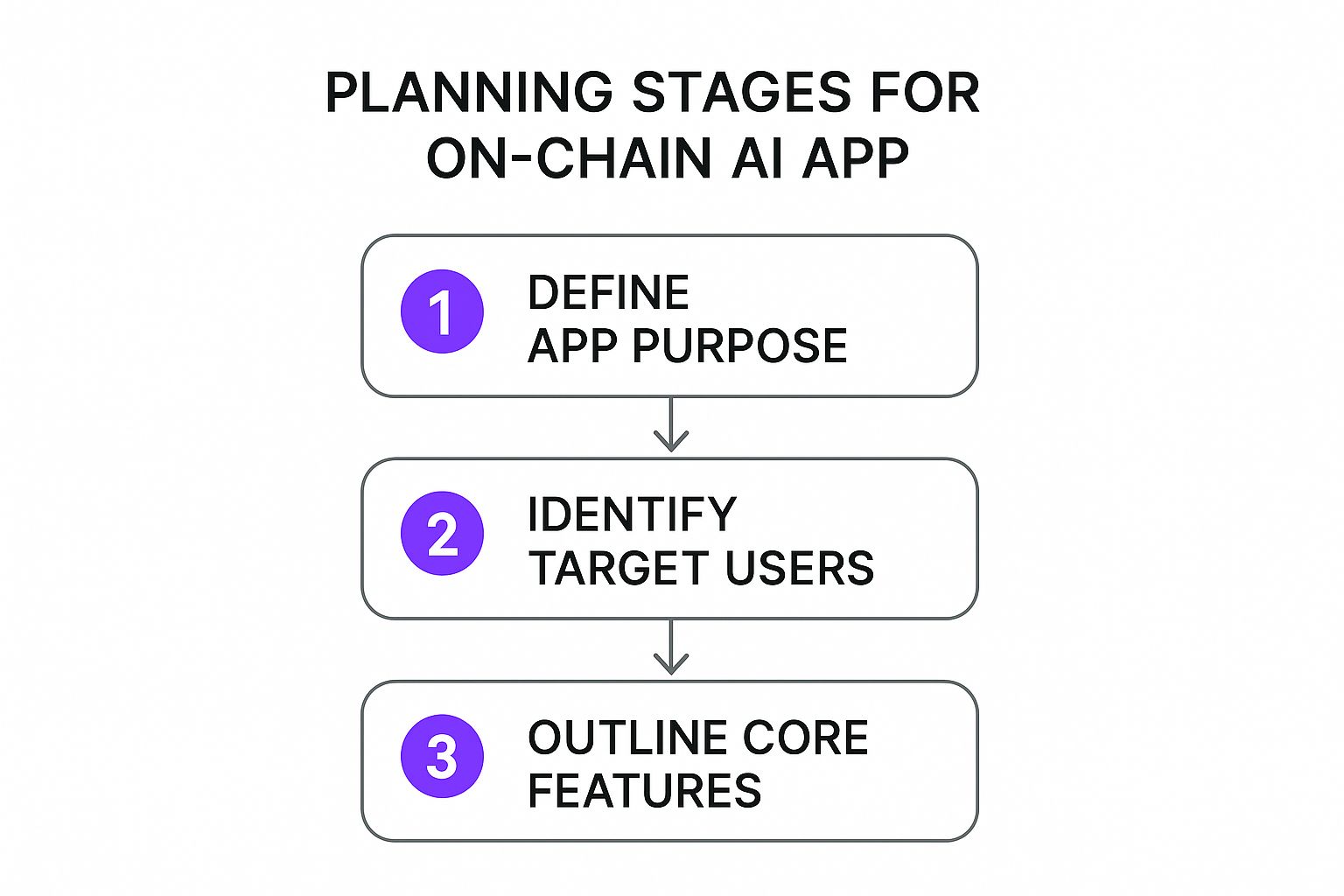
As you can see, a clear purpose flows directly into figuring out who your users are and what features they'll actually need.
Identifying Users and Core Features
With your purpose locked in, it's time to picture your ideal user. Are they a seasoned crypto degen, a digital artist, or a total Web3 newcomer? Knowing your audience shapes the entire experience. An app for experts can get away with dense data analytics, but an app for beginners needs to be incredibly simple and guided.
Now, think about the absolute must-have features. What are the core actions someone has to be able to do?
- User Onboarding: How do users connect their wallet and get going?
- Main Interaction: What's the primary AI-driven action? (e.g., getting a recommendation, generating an NFT, making a prediction).
- Data Display: How will you show on-chain data in a way that makes sense to your user?
One of the biggest mistakes I see is feature creep—trying to cram everything into the first version. Focus on a minimal, viable product (MVP) that does one thing perfectly. You can always add more later.
Getting a handle on smart contracts is also part of this planning phase, since they're the logic behind your app. If you're new to this world, reading up on decentralized app development will give you the context you need to build effectively. This foundational knowledge ensures you can write better prompts for the AI, which means getting better, more secure results from the get-go.
Generating Smart Contracts with Simple Prompts

Alright, this is where the rubber meets the road. All that planning you did is about to pay off as we translate your app idea into real, on-chain logic using nothing but plain English. This is precisely what the Dreamspace vibe coding studio was built for—turning simple descriptions into secure, efficient smart contracts.
You can forget about the headaches of learning Solidity from scratch. Instead of wrestling with code, you're essentially having a conversation with the AI. Just describe the rules and functions your app needs, and the platform will handle all the complex syntax and boilerplate behind the scenes. This approach just shaves off an incredible amount of development time.
Crafting Effective Prompts
The secret to getting great results from any ai app builder free of charge is learning how to ask for what you want with clarity. If you feed it vague prompts, you'll get generic code. But if you get specific and detailed, you'll get powerful, precise smart contracts that do exactly what you envision.
I like to think of it as giving instructions to a brilliant but very literal assistant. You need to spell out the who, what, and how for every single function.
Let's look at a couple of real-world examples to see how you'd structure these prompts:
- For an NFT Loyalty Program: "Create a smart contract for an NFT-based loyalty program. It needs an admin role that can mint new NFTs to user wallets. Also, include a function that rewards users with points if they hold the NFT for more than 30 days."
- For a Decentralized Voting System: "Generate a smart contract for a voting dApp. It should let someone create a new proposal, allow token holders to cast one vote per token they own, and have a function to tally the final votes after a 7-day voting period ends."
See the difference? Each prompt clearly defines roles (admin), actions (mint, cast vote), and conditions (30 days, 7-day period). This level of detail is what allows the Dreamspace ai app generator to produce code that’s a perfect fit. For a deeper dive, our guide on how to build smart contracts has even more tips.
From English to Executable Code
Once you hit 'enter' on your prompt, Dreamspace gets to work. It's not just guessing; it’s analyzing your request to identify the necessary functions, state variables, and security checks before generating the code. The platform is trained on massive datasets of audited, secure smart contracts, so it inherently follows industry best practices.
This AI-native approach is a game-changer. A 2025 survey of software execs found that AI-first companies hit their goals way faster. A striking 47% of these AI-native builders achieved product-market fit, while only 13% of companies just bolting on AI features could say the same. You can dig into more of these AI-driven market trends if you're curious.
The real magic here isn't just that it writes code for you; it's that it writes good code. It automatically builds in checks against common vulnerabilities, handles data storage efficiently, and structures the contract to optimize for gas usage on the blockchain.
From there, you can review the generated code, test its functions right inside the Dreamspace interface, and even tweak it with follow-up prompts. For instance, after getting your loyalty contract, you could just add: "Now, add a feature that gives bonus points to wallets holding more than five NFTs." The AI will intelligently update the existing contract with the new logic. This makes iterating and building out complex applications incredibly fast and painless.
Accessing Blockchain Data with AI-Powered SQL
Your smart contracts might be the engine of your on-chain app, but data is the fuel. To build anything truly useful, your app has to know what’s happening on the blockchain, and it needs that information in real-time.
This used to be a massive headache. You'd need to wrestle with complex data indexers and have a pretty solid grasp of SQL just to pull data from decentralized warehouses. It was a huge barrier for a lot of builders.
Thankfully, things have changed. A modern ai app builder free to use, like the Dreamspace vibe coding studio, now has tools that let you literally talk to the blockchain. You just describe what you need in plain English, and the AI handles the heavy lifting, translating your request into a perfect SQL query.
It’s a huge leap forward, meaning you no longer have to be a data engineer to build a data-rich dApp.
From Simple Questions to Powerful Queries
The real magic here is in the simplicity. Instead of spending hours figuring out how to join tables and filter results, you can just ask a question. This conversational approach lets you stay focused on your app's logic instead of getting bogged down in the technical weeds of data retrieval.
Think about some common scenarios where this is a game-changer:
- Tracking Token Analytics: You could just ask, "Show me the top 10 wallets that have traded the most volume of XYZ token in the last 24 hours."
- Monitoring NFT Activity: A simple prompt like, "Find all wallets that have purchased more than five NFTs from the 'CryptoPunks' collection," gets you the exact query you need.
- Analyzing User Behavior: Maybe you want to know, "List all addresses that have interacted with our DeFi protocol more than 10 times this month."
In every one of these cases, the Dreamspace ai app generator figures out what you mean, finds the right on-chain data tables, and builds the SQL query for you.
Why This Matters for Your App
This AI-driven data access is what makes your app feel responsive and intelligent. It’s the key to creating personalized experiences for your users and delivering insights that actually matter. Without it, your app is basically flying blind, unable to react to the constantly changing on-chain world.
With AI-generated SQL, you're not just building a static application; you're creating a dynamic system that can observe, analyze, and act on blockchain events as they happen. This is the difference between a simple smart contract and a full-fledged, intelligent dApp.
Imagine building a dApp that automatically airdrops a special NFT to users who hit a certain activity level. Or a dashboard that alerts traders to strange token movements. Features like these, which once required a dedicated backend and data team, can now be prototyped and built right inside your AI app builder.
This seamless integration of smart contract logic and on-chain data is what makes building powerful, production-ready apps more accessible than ever before.
Assembling and Deploying Your Live Application

Alright, this is where it all comes together. Your smart contracts are ready, the data queries are dialed in, and now it’s time for the most rewarding part: connecting the dots, running final checks, and shipping your on-chain AI app.
This stage can feel like the final boss battle for a lot of developers, but a good ai app builder free to use, like Dreamspace, is built to take the pain out of deployment. Forget wrestling with complex server configs or manual scripts. The whole point is to guide you through a clean process that stitches your frontend and backend together seamlessly.
The Pre-Launch Checklist
Before you push the big red button, a little extra diligence now will save you a world of headaches later. The name of the game is catching bugs before your users do. This is where testnets are your absolute best friend—they’re blockchain sandboxes where you can break things without any real-world consequences.
The Dreamspace vibe coding studio makes it easy to push your smart contracts to a testnet first. This lets you step into your users' shoes and make sure every button, query, and transaction works exactly as you planned.
I have a non-negotiable checklist I run through before any launch:
- Deploy to a Testnet: I usually pick a popular one like Sepolia for Ethereum. It’s a near-perfect simulation of the mainnet environment.
- Run Full End-to-End Tests: I mean everything. Can a user connect their wallet? Does the AI-powered query pull the right data? Does a transaction using your smart contract go through without a hitch?
- Check for Speed: How fast does the app load and respond? If a SQL query is lagging, I’ll jump back into the Dreamspace ai app generator and tweak my prompts to be more specific. Sometimes a small refinement makes a massive difference.
Think of the testnet as your final dress rehearsal. It’s the perfect opportunity to smooth out every wrinkle, ensuring a flawless user experience right out of the gate.
Hitting 'Deploy' with One Click
Once you're confident that your app is humming along perfectly on the testnet, the final launch is almost anticlimactic—in a good way. Dreamspace boils down the entire mainnet deployment into a single click.
You just pick your target blockchain—Ethereum, Polygon, or any other EVM-compatible chain—and the platform takes over. It securely deploys your contracts and hooks them up to the live frontend, officially putting your app on the map.
This radical simplicity is a huge reason we're seeing such a boom in AI-powered mobile apps. When creators have a great ai app builder free of charge, they can launch faster. This is fueling a market where consumer spending on AI apps already hit $1.4 billion in 2024 and is on track to smash $2 billion in 2025. You can dig into more of those numbers in this report on the rise of AI app adoption.
By knocking down the old barriers to deployment, platforms like Dreamspace let you pour your energy into what actually matters: building something awesome that people will love to use.
Got Questions About AI App Builders? Let's Clear Things Up.
Diving into a free ai app builder for the first time? You probably have a few questions. That's totally normal. This space is moving at lightning speed, and getting a handle on the details will make your build process so much smoother. Let's dig into some of the things people usually ask.
So, Are These AI App Builders Really Free?
Yep. Many of the best platforms, including Dreamspace, have seriously powerful free tiers. We're not talking about some crippled demo, either—these plans are more than enough to build and launch a real-world application.
You typically get full access to the core magic, like AI-driven smart contract generation and on-chain data queries. Of course, there are paid plans for when you need to handle massive scale or need specific enterprise features, but the free plan is designed to be completely functional. It’s perfect for getting your first on-chain app off the ground without spending a dime.
Do I Actually Need to Know How to Code?
Nope, and that's the whole point. Dreamspace is what we call a vibe coding studio. It works by understanding what you want from simple, natural language prompts.
You just describe what your app should do in plain English, and the ai app generator does the hard work of writing the actual code. A little background knowledge of how apps are put together can be useful, for sure, but you absolutely don't need a traditional software engineering degree to get started. It’s all about opening the doors for a new wave of creators.
The big idea here is to let you focus on your vision, not on wrestling with complicated syntax. If you can describe it, you can build it.
How Safe Is AI-Generated Smart Contract Code?
Security is baked into the DNA of any decent AI app builder. A platform like Dreamspace has been trained on a massive dataset of audited, battle-hardened smart contracts. It's built from the ground up to follow the latest security protocols and avoid common pitfalls like reentrancy attacks or integer overflows.
But let's be real—if your app is going to handle serious money, you still need to follow best practices. Always, always do extensive testing on a testnet. And for anything major, getting a professional third-party security audit before hitting the mainnet is a very smart move.
Can I Push My App to Big Blockchains like Ethereum?
Absolutely. The modern web3 world is multi-chain, and these builders are made for it. Dreamspace can deploy to a whole range of EVM-compatible blockchains, which covers the big ones like Ethereum, Polygon, Avalanche, and Base.
The platform makes it simple to pick and set up your target network. This gives you the freedom to launch your on-chain AI app on the ecosystem that makes the most sense for your audience, cost structure, and goals.
Ready to turn your on-chain app idea into reality without touching a line of code? Dreamspace is the vibe coding studio that lets you generate smart contracts, query blockchain data, and deploy your app with simple English. Start building for free today.